Drug Sales Trends for HARVONI
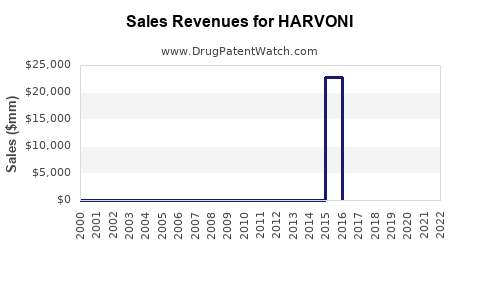
Annual Sales Revenues and Units Sold for HARVONI
| Drug Name | Revenues (USD) | Units | Year |
|---|---|---|---|
| HARVONI | ⤷ Start Trial | ⤷ Start Trial | 2022 |
| HARVONI | ⤷ Start Trial | ⤷ Start Trial | 2021 |
| HARVONI | ⤷ Start Trial | ⤷ Start Trial | 2020 |
| HARVONI | ⤷ Start Trial | ⤷ Start Trial | 2019 |
| HARVONI | ⤷ Start Trial | ⤷ Start Trial | 2018 |
| >Drug Name | >Revenues (USD) | >Units | >Year |
Harvoni Market Analysis, Sales Projections, Patent Exclusivity and Generic Competition
Harvoni's commercial peak has passed. The ledipasvir/sofosbuvir combination generated approximately $13.9 billion in 2015 sales, but annual revenue fell as the treated hepatitis C population declined, competing direct-acting antivirals gained share, and generic and licensed versions entered major markets. Harvoni remains commercially relevant in selected genotype 1 and pediatric segments, but its global revenue base is now a low-growth, erosion-sensitive specialty market.
Under a base-case forecast, Harvoni-related global sales decline from an estimated $200 million to $250 million in 2024 to approximately $70 million by 2030. Upside depends on residual demand in markets with limited access to pangenotypic therapies. Downside risk comes from generic ledipasvir/sofosbuvir, broader use of Epclusa and Mavyret, and the shrinking pool of untreated hepatitis C patients.
What is Harvoni and how large is its addressable market?
Harvoni is Gilead Sciences' fixed-dose combination of ledipasvir and sofosbuvir. It is an oral, once-daily direct-acting antiviral approved by the FDA on October 10, 2014, for chronic hepatitis C virus infection, initially focused on genotype 1 patients. The product was approved under New Drug Application 208341.[1]
Harvoni was commercially important because it delivered high sustained virologic response rates without interferon or ribavirin for many patients. Treatment duration generally ranged from eight to 24 weeks, depending on genotype, treatment history, cirrhosis status and viral burden.
The addressable market has contracted for four reasons:
- Many high-income-market patients have already been cured.
- Mavyret and Epclusa provide broader genotype coverage.
- Generic and government-negotiated pricing has reduced treatment cost.
- Remaining patients are increasingly concentrated in underserved regions, prisons, public-health programs and difficult-to-treat populations.
The World Health Organization estimates that more than 50 million people globally live with chronic hepatitis C, but diagnosed and treated populations remain far below the potential disease burden.[2] This creates residual volume opportunity, but not the premium pricing environment that existed immediately after Harvoni's launch.
How much did Harvoni generate in sales?
Gilead's reported Harvoni product sales peaked at approximately $13.9 billion in 2015. Sales then declined rapidly as the backlog of diagnosed patients was treated and competitors entered the market.
| Year | Harvoni sales | Approximate change |
|---|---|---|
| 2014 | $2.1 billion | Launch year |
| 2015 | $13.9 billion | Peak |
| 2016 | $9.1 billion | -35% |
| 2017 | $4.4 billion | -52% |
| 2018 | $2.1 billion | -51% |
| 2019 | $1.3 billion | -40% |
| 2020 | $0.8 billion | -40% |
| 2021 | Approximately $0.5 billion | Approximately -31% |
| 2022 | Approximately $0.4 billion | Approximately -20% |
| 2023 | Approximately $0.3 billion | Approximately -29% |
The figures are based on Gilead annual reports and company-reported product-sales disclosures. Minor differences can occur because of geographic presentation, foreign-exchange effects and rounding.[3-6]
Harvoni's decline was sharper than a normal patent-cliff pattern. The product lost volume before complete patent expiry because treatment demand was finite, competing curative therapies were available, and Gilead itself marketed multiple HCV products.
What are Harvoni's sales projections through 2030?
The following forecast is a market-based projection rather than Gilead guidance. It assumes continued volume erosion, stable access in selected countries, limited premium pricing, and gradual substitution by pangenotypic products.
| Year | Base-case sales | Low case | High case |
|---|---|---|---|
| 2024 | $220 million | $180 million | $280 million |
| 2025 | $180 million | $130 million | $240 million |
| 2026 | $150 million | $95 million | $210 million |
| 2027 | $120 million | $70 million | $180 million |
| 2028 | $95 million | $50 million | $150 million |
| 2029 | $80 million | $35 million | $130 million |
| 2030 | $70 million | $25 million | $115 million |
Base-case assumptions
The base case applies an annual decline of approximately 15% to 20% after 2024. It assumes:
- No major new Harvoni indication.
- Continued erosion from generic ledipasvir/sofosbuvir.
- Increasing substitution by Epclusa, Mavyret and generic pangenotypic regimens.
- Continued procurement in lower-income markets under voluntary licensing or public-health programs.
- Stable access for genotype 1 patients who remain eligible for Harvoni.
Upside case
The high case requires sustained demand from national elimination programs, price-sensitive procurement markets and patients for whom Harvoni remains a preferred genotype-specific regimen. The high case does not assume a return to billion-dollar annual revenue.
Downside case
The low case reflects accelerated generic uptake, rapid conversion to pangenotypic therapy and further reductions in the diagnosed patient pool. It also assumes that payers treat Harvoni as a legacy option with limited formulary preference.
When does Harvoni lose exclusivity?
Harvoni's commercial exclusivity has effectively been lost, although individual patent rights and settlement-based launch restrictions vary by jurisdiction.
| Protection category | Timing | Commercial effect |
|---|---|---|
| FDA approval | October 10, 2014 | Originator launch |
| New chemical entity exclusivity | Approximately October 2019 | Blocked abbreviated approval during the exclusivity period |
| Core sofosbuvir patent protection | Around 2029, subject to patent-term adjustments and extensions | Long-tail legal protection |
| Ledipasvir-related patent protection | Approximately 2030 for key U.S. rights | Does not prevent earlier licensed generic access |
| U.S. authorized and licensed generic entry | Beginning in 2019 | Major practical loss of brand exclusivity |
Patent expiration and market exclusivity are not the same. Gilead authorized selected generic and licensed launches before the latest nominal patent expirations through settlement and licensing arrangements. As a result, practical competition began well before the end of all listed patent terms.
What patents protect Harvoni?
Harvoni is protected by a layered patent estate covering the active ingredients, crystalline forms, combinations, treatment methods and manufacturing processes. The most commercially relevant rights have involved:
- Sofosbuvir composition and nucleoside analogue technology.
- Ledipasvir composition and related antiviral compounds.
- Fixed-dose combinations of ledipasvir and sofosbuvir.
- Treatment methods for HCV infection.
- Solid-state, formulation and manufacturing claims.
Representative U.S. patents associated with the underlying technology include U.S. Patent No. 7,964,580, which covers important sofosbuvir-related subject matter, and later ledipasvir and combination patents listed or historically associated with Gilead's HCV franchise. Patent-term calculations depend on terminal disclaimers, patent-term adjustment, patent-term extension and the specific claim set asserted.[7]
A patent-by-patent freedom-to-operate assessment must distinguish between:
- Patents listed in the FDA Orange Book.
- Unlisted process or intermediate patents.
- Patent claims covering sofosbuvir alone.
- Claims covering ledipasvir alone.
- Claims directed to the fixed-dose Harvoni product.
- Patents subject to generic settlement licenses.
What is the Orange Book status of Harvoni?
Harvoni remains an FDA-approved prescription product under NDA 208341. The Orange Book historically listed patents for the drug substance, drug product and methods of use. FDA approval does not guarantee continuing commercial exclusivity because generic applicants can challenge listed patents through Paragraph IV certifications or enter under a license before expiry.
Harvoni's five-year new chemical entity exclusivity expired in 2019. The product's current regulatory value is therefore based on residual physician familiarity, manufacturing reliability, payer access and geographic demand rather than FDA exclusivity.
Which companies are challenging or competing with Harvoni?
Harvoni faces both direct generic competition and branded therapeutic substitution.
| Competitor | Company or sponsor | Competitive position |
|---|---|---|
| Mavyret, glecaprevir/pibrentasvir | AbbVie | Pangenotypic regimen with strong duration and pricing advantages |
| Epclusa, sofosbuvir/velpatasvir | Gilead | Gilead's broader pangenotypic HCV product |
| Vosevi, sofosbuvir/velpatasvir/voxilaprevir | Gilead | Retreatment and resistance-management product |
| Generic ledipasvir/sofosbuvir | Multiple manufacturers | Direct Harvoni substitution |
| Generic sofosbuvir/velpatasvir | Multiple manufacturers | Pangenotypic substitution |
| Generic sofosbuvir combinations | Multiple manufacturers | Lower-cost alternatives, especially outside the U.S. |
Mavyret and Epclusa are the most important branded alternatives. Their pangenotypic coverage reduces the need for genotype-specific selection and makes them easier to use in simplified treatment protocols.[8]
What formulations are protected by Harvoni patents?
Harvoni is marketed as a fixed-dose oral tablet containing 90 mg of ledipasvir and 400 mg of sofosbuvir. The formulation estate can protect:
- The fixed-dose combination.
- Tablet composition and excipient selection.
- Manufacturing and coating processes.
- Solid-state properties.
- Stability and storage characteristics.
- Specific dosage regimens.
- Use in treatment-naive or treatment-experienced patients.
Formulation patents have reduced strategic importance where generic manufacturers can design around the claims or rely on separate active-ingredient patents and licensing rights. Process patents may still create manufacturing barriers, particularly in jurisdictions where regulatory dossiers depend on validated production routes.
What Paragraph IV challenges and litigation affect Harvoni?
Generic applicants may file Paragraph IV certifications asserting that Orange Book patents are invalid, unenforceable or not infringed. Harvoni-related disputes have been shaped by Gilead's broader litigation over sofosbuvir technology and by negotiated generic entry.
A major HCV patent dispute involved Gilead and Merck over patents covering nucleotide analog technology. The parties reached a settlement in 2017 under which Gilead paid Merck approximately $2.54 billion, including amounts connected with past damages and ongoing rights.[9] The dispute primarily concerned the broader Sovaldi and HCV technology estate, but it affected the legal economics of Harvoni because Harvoni contains sofosbuvir.
The most important commercial development was negotiated generic access. Gilead entered licensing arrangements that permitted selected companies to market generic versions in the United States and other markets before the latest patent dates. The arrangement reduced litigation uncertainty but accelerated the decline in branded Harvoni sales.
How do Harvoni licensing deals affect generic launch timing?
Gilead used voluntary licensing and settlement structures to expand access while retaining control over launch timing and geographic scope.
The principal mechanisms were:
- Nonexclusive licenses to selected generic manufacturers.
- Geographic restrictions covering defined low- and middle-income countries.
- Authorized-generic distribution arrangements.
- Settlement-linked launch dates.
- Licensing of manufacturing and regulatory know-how.
Gilead's agreements with generic manufacturers and public-health partners helped establish supply in countries where hepatitis C treatment demand was high but branded pricing was unaffordable. The Medicines Patent Pool and associated licensing structures also supported generic availability in eligible countries.[10]
These arrangements weakened the value of a simple patent-expiry forecast. The relevant commercial date is the earliest permitted generic launch in each market, not the last patent expiration globally.
What is Harvoni's biosimilar risk?
Harvoni has no conventional biosimilar risk because it is a chemically synthesized small-molecule drug, not a biologic. The relevant threat is generic substitution under abbreviated drug-approval pathways.
The competitive risks are:
- ANDA-approved generic ledipasvir/sofosbuvir.
- Generic component products used in alternative combinations.
- Pangenotypic generic regimens.
- Government procurement that favors lowest-cost treatment.
- Pharmacy substitution where permitted.
Generic risk is highest in the United States, Europe, India, Latin America and public-sector procurement markets. Regulatory and patent barriers remain more significant in countries that require local clinical data, restrict substitution or maintain stronger enforcement of process patents.
How strong is the Harvoni patent estate?
Harvoni's patent estate was strong at launch but has low remaining commercial leverage.
| Factor | Assessment |
|---|---|
| Composition-of-matter protection | Historically strong |
| FDA exclusivity | Expired |
| Direct generic competition | Established |
| Remaining patent term | Material for some claims, but reduced by licenses |
| Formulation protection | Moderate |
| Method-of-use protection | Narrower after broad HCV use became established |
| Manufacturing barriers | Moderate, particularly for high-purity intermediates |
| Litigation leverage | Reduced by settlements and authorized entry |
| Long-term brand pricing power | Low |
The estate remains relevant for supply-chain control, licensing revenue and market-by-market launch restrictions. It is no longer sufficient to support Harvoni's former premium pricing.
What is Harvoni's geographic market outlook?
United States
U.S. revenue continues to decline because of generic access, payer pressure and competition from Mavyret and Epclusa. Remaining demand is concentrated in Medicaid, prisons, safety-net systems, specialist practices and patients with established genotype 1 treatment plans.
Europe
European markets are highly exposed to tendering, reference pricing and national reimbursement negotiations. Harvoni has largely shifted from a premium branded product to a secondary or legacy option.
India and other licensed markets
India has a large hepatitis C burden and a mature generic manufacturing base. Generic sofosbuvir combinations have substantially reduced treatment cost and captured volume. Harvoni's brand has limited pricing power in this setting.
Middle East, Africa and Southeast Asia
These regions offer the largest residual patient opportunity but the lowest branded revenue per patient. Growth depends on diagnosis, government treatment programs, donor funding and generic supply. Volume can increase while Harvoni revenue remains flat or declines because of severe price compression.
What generic launch scenarios exist for Harvoni?
Base case
Generic and licensed products continue taking share, while Harvoni remains available for selected patients and contracts. Revenue declines 15% to 20% annually through 2030.
Accelerated erosion case
Payers remove Harvoni from preferred formularies, and generic pangenotypic products become the default. Revenue falls below $100 million globally before 2028.
Residual-market case
Harvoni retains a small but durable position in genotype 1, pediatric and institutional-treatment channels. Revenue remains above $100 million through 2030, but margins continue to compress.
How does Harvoni compare with Epclusa and Mavyret?
| Attribute | Harvoni | Epclusa | Mavyret |
|---|---|---|---|
| Active ingredients | Ledipasvir/sofosbuvir | Sofosbuvir/velpatasvir | Glecaprevir/pibrentasvir |
| Coverage | Primarily genotype-specific | Pangenotypic | Pangenotypic |
| Commercial position | Legacy Gilead product | Current Gilead HCV anchor | Major AbbVie competitor |
| Generic pressure | High | Increasing | Increasing |
| Use in simplified treatment | More limited | Strong | Strong |
| Pricing power | Low | Higher than Harvoni, but pressured | Pressured by competition |
| Growth outlook | Declining | Mature to declining | Mature to declining |
Epclusa is strategically more durable because of pangenotypic coverage. Mavyret competes through broad coverage, short treatment courses and aggressive payer positioning. Harvoni's principal advantage is established clinical familiarity rather than superior market access.
What is the FDA regulatory and commercial outlook for Harvoni?
Harvoni has no current regulatory catalyst comparable to its original approval. The FDA-approved product remains commercially viable, but future value depends on maintaining manufacturing, regulatory compliance and reimbursement access.
Key regulatory risks include:
- Label restrictions relative to pangenotypic competitors.
- Generic approvals that expand substitution.
- Manufacturing-site interruptions.
- Pricing controls in government programs.
- Reduced formulary placement.
- Lower physician use as simplified HCV protocols expand.
Gilead's strategic priority has shifted from Harvoni growth to broader HCV elimination, access programs and newer products within the infectious-disease portfolio.
What revenue exposure does Harvoni create for Gilead?
Harvoni represented one of Gilead's largest revenue concentrations during 2015 and 2016. Its decline contributed materially to the fall in Gilead's HCV franchise revenue. The company reduced concentration risk through HIV products, oncology assets and newer infectious-disease medicines.
By the mid-2020s, Harvoni is no longer a material driver of Gilead's consolidated revenue. Its remaining economic value comes from:
- Residual product sales.
- Licensed generic economics.
- Manufacturing and technology rights.
- Portfolio cross-selling.
- Strategic presence in HCV elimination programs.
Key Takeaways
- Harvoni sales peaked at approximately $13.9 billion in 2015.
- Revenue fell to roughly $300 million by 2023 and is projected to decline to about $70 million by 2030 in the base case.
- The product's FDA exclusivity expired in 2019.
- Generic and licensed entry began before the latest patent expirations.
- Harvoni has no biosimilar risk; its risk is generic substitution.
- Epclusa and Mavyret have stronger current positioning because both are pangenotypic.
- Remaining opportunity is concentrated in public-health programs, lower-income markets, genotype 1 patients and selected pediatric or institutional settings.
- Patent protection remains legally relevant but has limited ability to restore premium pricing.
- The principal investment issue is erosion management, not renewed growth.
FAQs About Harvoni Sales, Patents and Market Share
Will Harvoni sales return to their 2015 peak?
No. The diagnosed-patient backlog has been substantially treated, and lower-cost generic and pangenotypic alternatives have changed the market structure.
Is generic Harvoni available in the United States?
Yes. Licensed and authorized generic access began in the United States through arrangements that permitted entry before the expiration of all relevant patent rights.
Does Harvoni still have patent protection?
Some underlying sofosbuvir, ledipasvir, formulation, method and manufacturing patents have terms extending into the late 2020s or around 2030, depending on the specific patent and jurisdiction. Those rights do not prevent all licensed generic competition.
Is Harvoni still a first-line hepatitis C treatment?
Treatment selection depends on genotype, cirrhosis, prior therapy, renal status and current clinical guidelines. Pangenotypic regimens are generally more convenient for simplified treatment, reducing Harvoni's first-line role.
What is the biggest threat to Harvoni revenue?
The biggest threat is substitution by low-cost generic pangenotypic regimens, reinforced by payer formularies and public procurement programs. The shrinking pool of untreated diagnosed patients is the second major driver.
References
- U.S. Food and Drug Administration. (2014). FDA approves first combination pill to treat hepatitis C.
- World Health Organization. (2024). Global hepatitis report 2024.
- Gilead Sciences, Inc. (2016). Annual report 2015.
- Gilead Sciences, Inc. (2019). Annual report 2018.
- Gilead Sciences, Inc. (2021). Annual report 2020.
- Gilead Sciences, Inc. (2024). Annual report 2023.
- U.S. Patent and Trademark Office. (2024). Patent Center and patent-term information for U.S. Patent No. 7,964,580 and related HCV patents.
- American Association for the Study of Liver Diseases and Infectious Diseases Society of America. (2024). HCV guidance: Recommendations for testing, managing, and treating hepatitis C.
- Gilead Sciences, Inc. (2017). Gilead and Merck announce resolution of HCV litigation.
- Medicines Patent Pool. (2024). Hepatitis C licensing and access agreements.
More… ↓
