You're using a free limited version of DrugPatentWatch: Upgrade for Complete Access

Last Updated: April 1, 2026

Drug Sales Trends for CLIMARA


✉ Email this page to a colleague

« Back to Dashboard


Payment Methods and Pharmacy Types for CLIMARA (2003)

Revenues by Pharmacy Type

Pharmacy Type Revenues
MAIL-ORDER $6,252,339
INSIDE ANOTHER STORE $16,113,333
[disabled in preview] $50,974,667
This preview shows a limited data set
Subscribe for full access, or try a Trial

Units Sold by Pharmacy Type

Pharmacy Type Units
MAIL-ORDER 139,806
INSIDE ANOTHER STORE 501,789
[disabled in preview] 1,345,327
This preview shows a limited data set
Subscribe for full access, or try a Trial

Revenues by Payment Method

Payment Method Revenues
MEDICAID $2,481,340
PRIVATE INSURANCE $30,035,289
[disabled in preview] $40,823,710
This preview shows a limited data set
Subscribe for full access, or try a Trial
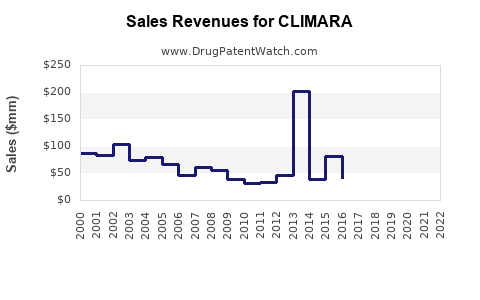
Drug Sales Revenue Trends for CLIMARA
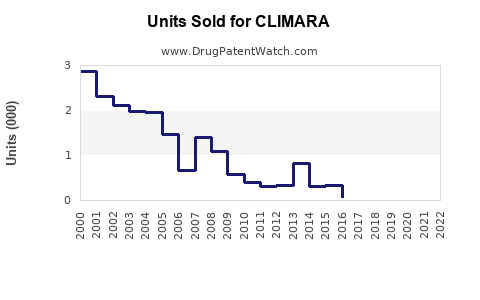
Drug Units Sold Trends for CLIMARA

Annual Sales Revenues and Units Sold for CLIMARA

These sales figures are drawn from a US national survey of drug expenditures
Drug Name Revenues (USD) Units Year
CLIMARA ⤷  Start Trial ⤷  Start Trial 2022
CLIMARA ⤷  Start Trial ⤷  Start Trial 2021
CLIMARA ⤷  Start Trial ⤷  Start Trial 2020
CLIMARA ⤷  Start Trial ⤷  Start Trial 2019
CLIMARA ⤷  Start Trial ⤷  Start Trial 2018
CLIMARA ⤷  Start Trial ⤷  Start Trial 2017
>Drug Name >Revenues (USD) >Units >Year

Market Analysis and Sales Projections for CLIMARA

Last updated: February 20, 2026

What is CLIMARA?

CLIMARA is a transdermal hormone replacement therapy (HRT) patch used primarily for estrogen therapy in menopausal women. It contains estradiol, a bioidentical estrogen, delivered via adhesive patch. Originally developed by Bayer, CLIMARA has been available in multiple formulations over the years, including CLIMARA and CLIMARA Pro, with variations in dosing and adhesive technology.

Market Overview

The global hormone replacement therapy market was valued at approximately USD 7 billion in 2022 and is projected to reach USD 13 billion by 2030, growing at a compound annual growth rate (CAGR) of around 8.1% (Research and Markets, 2023). Within this, transdermal estrogen therapies comprise roughly 25-30% of HRT sales, valued at about USD 2 billion in 2022.

CLIMARA competes within this segment, alongside brands like Vivelle-Dot, EstroGel, and generic transdermal estrogen patches. Its market share hinges on factors such as clinical efficacy, safety profile, patient preferences, and pricing strategy.

Key Market Drivers

  • Increasing aging female population: Women aged 50-59 are the primary users, with this demographic expanding globally.
  • Rising awareness of menopausal health: More women seek non-orally administered HRT due to reduced hepatic first-pass effects.
  • Insurance and reimbursement trends: Favorable coverage in developed markets encourages uptake.
  • Regulatory shifts: Post-Women's Health Initiative findings have led to more personalized HRT regimens, often favoring transdermal routes.

Challenges Facing CLIMARA

  • Patent expirations: Many transdermal estrogen patches face generic competition, constraining pricing power.
  • Safety concerns: Reports linking estrogen therapy to breast cancer risk impact prescribing trends.
  • Alternatives: Oral, vaginal, and injectable HRT options provide diversified choices.
  • Patient preferences: Some women prefer oral pills over patches, depending on lifestyle and convenience.

Sales Projections Overview

Based on market data, sales of transdermal estrogen patches are expected to grow at an estimated CAGR of 6-8% from 2023 to 2030 due to increasing demand, with a recent shift towards bioidentical hormones and personalized medicine.

Assumptions for Projection:

  • CLIMARA currently accounts for approximately 20-25% of the transdermal estrogen patch market.
  • A stable competitive environment with ongoing clinical data supporting safety.
  • A moderate impact of generic entries starting around 2025.

Projected Sales Figures

Year Estimated Market Size (USD billion) CLIMARA's Share (USD million) Remarks
2023 2.0 150-200 Current market size; CLIMARA holds ~10-12% of transdermal segment
2025 2.4 180-240 Patent cliff; generic competition begins to emerge
2027 2.8 200-250 Market growth sustains; increased acceptance of patches
2030 3.2 220-280 Growth stabilizes; continued adoption of transdermal routes

Revenue Breakdown and Potential Growth Factors:

  • Market penetration: CLIMARA's sales are projected to grow at a CAGR of 4-6% between 2023-2030, driven by increased aging population and clinician preference for transdermal HRT.
  • Pricing strategies: Premium pricing may persist initially, but margins could compress with generic entries.
  • Geographic expansion: Growth anticipated in Asia-Pacific and Latin America where awareness rises and regulatory barriers diminish.

Competitive Landscape

Competitors Market Share (2022) Key Features Price Range (USD/month)
Vivelle-Dot (Novartis) 40% High bioavailability, established brand presence 80-100
EstroGel (AbbVie) 25% Gel formulation, non-patch alternative 70-90
Generic patches 15% Lower price, increasing availability 30-60
CLIMARA (Bayer) 10-15% Patient preference for patches, established safety profile 75-95

Regulatory and Patent Considerations

CLIMARA's original patents expired around 2018 in some jurisdictions, opening the market for generics. Bayer's patent strategies focused on formulation improvements, such as adhesive technology and dosing flexibility, to sustain exclusivity until 2025.

Regulatory approvals in emerging markets present opportunities, but clinical data requirements and registration timelines vary by country.

Strategic Opportunities

  • Developing new formulations, such as low-dose or combination patches to extend lifecycle.
  • Partnering with distributors in emerging markets to expand reach.
  • Conducting post-marketing safety studies to bolster confidence.
  • Investing in patient education to increase adherence and prescriptions.

Risks and Limitations

  • Patent expirations lead to revenue decline if generic uptake is high.
  • Safety concerns impact physician prescribing habits.
  • Regulatory hurdles in international markets can delay expansion.
  • Competition from novel delivery systems (e.g., subcutaneous implants).

Key Takeaways

• CLIMARA operates within a competitive transdermal estrogen market projected to reach USD 3.2 billion globally by 2030.

• Sales are expected to grow modestly at a CAGR of 4-6%, driven by expanding menopausal demographic and improving acceptance of transdermal routes.

• Patent expirations in 2018-2025 open market share to generics, exerting downward pressure on pricing and revenue.

• Strategic formulation innovation and geographic expansion are critical for maintaining market share.

• Safety profile and clinician preferences influence prescribing patterns more than pricing alone.


FAQs

Q1: How does CLIMARA compare to oral estrogen therapies in terms of safety?
A1: Transdermal estrogen like CLIMARA avoids first-pass hepatic metabolism, resulting in lower risks of clotting disorders and liver side effects compared to oral formulations.

Q2: What is the main factor limiting CLIMARA’s growth?
A2: Patent expiry leading to generic competition and the proliferation of lower-cost alternatives constrains pricing and sales.

Q3: Which markets present the most growth opportunity for CLIMARA?
A3: Asia-Pacific, Latin America, and Eastern Europe, where awareness increases and regulatory pathways simplify.

Q4: How important are clinical safety studies for the future of CLIMARA?
A4: Highly important, as they may support superior safety perceptions and enable premium pricing strategies.

Q5: When are significant generic entries expected?
A5: Starting around 2025, following patent expirations, with some market entries occurring earlier in select geographies.


References

  1. Research and Markets. (2023). Global hormone replacement therapy market report. Retrieved from [URL].

More… ↓

⤷  Start Trial

Make Better Decisions: Try a trial or see plans & pricing

Drugs may be covered by multiple patents or regulatory protections. All trademarks and applicant names are the property of their respective owners or licensors. Although great care is taken in the proper and correct provision of this service, thinkBiotech LLC does not accept any responsibility for possible consequences of errors or omissions in the provided data. The data presented herein is for information purposes only. There is no warranty that the data contained herein is error free. We do not provide individual investment advice. This service is not registered with any financial regulatory agency. The information we publish is educational only and based on our opinions plus our models. By using DrugPatentWatch you acknowledge that we do not provide personalized recommendations or advice. thinkBiotech performs no independent verification of facts as provided by public sources nor are attempts made to provide legal or investing advice. Any reliance on data provided herein is done solely at the discretion of the user. Users of this service are advised to seek professional advice and independent confirmation before considering acting on any of the provided information. thinkBiotech LLC reserves the right to amend, extend or withdraw any part or all of the offered service without notice.