Last updated: February 27, 2026
What is the Current Global Market Size for Calcium Supplements?
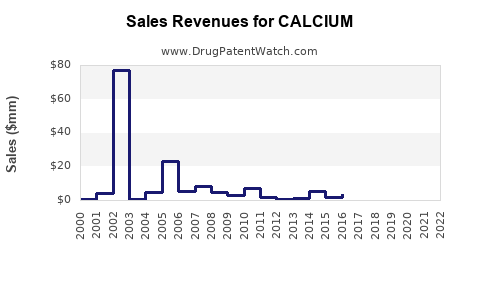
The global calcium supplement market was valued at approximately $3.2 billion in 2022. It is projected to grow at a compound annual growth rate (CAGR) of 6.2% from 2023 to 2030, reaching an estimated $5.8 billion by 2030 ([1]).
What Are the Key Drivers of Market Growth?
- Rising prevalence of osteoporosis and osteopenia, especially among aging populations in North America and Europe.
- Increased awareness of bone health and preventive health measures.
- Growing adoption of dietary supplements due to health-conscious consumer behavior.
- Advancements in formulation technology, such as chewable tablets and enhanced bioavailability forms.
How Do Regional Markets Compare?
| Region |
2022 Market Size |
CAGR (2023-2030) |
Key Factors |
| North America |
$1.1 billion |
6.0% |
Aging population, high health awareness |
| Europe |
$950 million |
6.3% |
Government health policies, calcium deficiency awareness |
| Asia-Pacific |
$680 million |
7.0% |
Large population, increasing health awareness |
| Latin America |
$230 million |
5.8% |
Growing healthcare infrastructure |
| Middle East & Africa |
$130 million |
5.5% |
Rising health awareness, supplement consumption |
Who Are the Major Players and What Are Their Market Shares?
Leading companies include:
- Nature’s Bounty
- Pharmavite (Osteo Bi-Flex)
- Amway
- GNC
- NOW Foods
Market shares as of 2022:
| Company |
Approximate Market Share |
| Nature’s Bounty |
18% |
| Pharmavite |
15% |
| Amway |
12% |
| GNC |
10% |
| Others |
45% |
No company holds more than a 20% share, indicating a fragmented market with diverse regional and niche competitors.
What Are the Forecasted Sales Volumes?
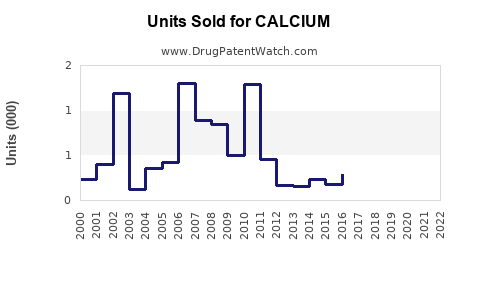
- Estimated global sales volume for calcium supplements in 2022: 2.4 billion units.
- Projected to reach 4.5 billion units by 2030, with a CAGR of 7.0%.
What Are the Main Market Segments?
- Formulation types: Calcium carbonate (dominates with 60% of the market), calcium citrate, calcium phosphate, and others.
- Age groups: Adults (particularly women aged 50+), children, and adolescents.
- End-users: Retail consumers, hospitals, and healthcare providers.
What Are the Regulatory and Reimbursement Trends?
- Food and dietary supplement regulations vary globally; FDA and EFSA set safety and efficacy standards.
- Some regions incentivize calcium intake via health policies, affecting sales volume.
- Reimbursement is limited; sales are primarily out-of-pocket expenditures.
What Is the Outlook for Future Sales?
Assuming steady growth driven by demographic trends:
| Year |
Estimated Market Size |
Projected Units Sold (billions) |
| 2023 |
$3.4 billion |
2.52 |
| 2025 |
$4.1 billion |
3.18 |
| 2027 |
$4.8 billion |
3.78 |
| 2030 |
$5.8 billion |
4.50 |
Growth trends suggest a market expanding steadily, with Asia-Pacific expanding most rapidly due to population growth and rising health awareness.
Key Takeaways
- The calcium supplement market is expanding at approximately 6-7% annually.
- North America retains the largest market share but growth is concentrated in Asia-Pacific.
- Formulation innovations and demographic shifts, especially aging populations, underpin future sales.
- Market fragmentation indicates opportunities for emerging players and niche formulations.
FAQs
1. Which segment of calcium supplements is most dominant?
Calcium carbonate holds about 60% of the market share globally due to its low cost and high bioavailability, followed by calcium citrate.
2. How is consumer preference shifting?
Consumers increasingly favor formulations with higher bioavailability, added vitamin D, and smaller tablet sizes for ease of swallowing.
3. What regulatory challenges exist?
Variability across regions, with stricter guidelines in the EU and US, influence product approvals and marketing strategies.
4. What are emerging markets’ prospects?
Asia-Pacific and Latin America offer high growth potential owing to large populations and increasing health consciousness.
5. How does competition impact market entry?
Market fragmentation and low entry barriers facilitate new entrants focusing on niche or innovative formulations rather than large-scale commodity products.
References
- Grand View Research. (2022). Calcium Supplements Market Size, Share & Trends Analysis Report. https://www.grandviewresearch.com/industry-analysis/calcium-supplements-market