Drug Sales Trends for BYDUREON
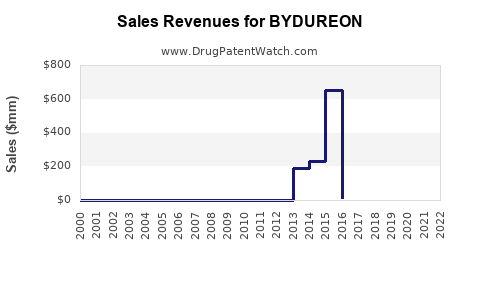
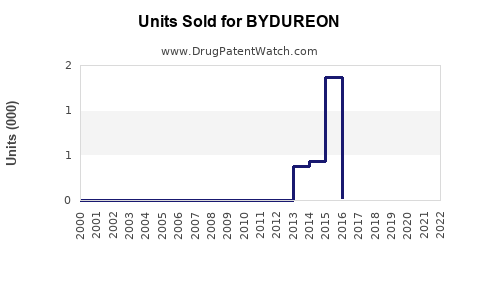
Annual Sales Revenues and Units Sold for BYDUREON
| Drug Name | Revenues (USD) | Units | Year |
|---|---|---|---|
| BYDUREON | ⤷ Start Trial | ⤷ Start Trial | 2022 |
| BYDUREON | ⤷ Start Trial | ⤷ Start Trial | 2021 |
| BYDUREON | ⤷ Start Trial | ⤷ Start Trial | 2020 |
| >Drug Name | >Revenues (USD) | >Units | >Year |
Bydureon Market Analysis, Patent Outlook, and Sales Projections
Bydureon, the once-weekly extended-release formulation of exenatide, has lost commercial relevance after AstraZeneca withdrew Bydureon BCise from the U.S. market. Its sales declined as semaglutide, dulaglutide, tirzepatide and other newer incretin therapies captured prescriptions. Bydureon remains commercially relevant mainly as a reference product for exenatide extended-release technology, but its projected global revenue is minimal relative to the broader GLP-1 market.
The base-case forecast is for Bydureon-related revenue to remain below $50 million annually by 2026 and approach immaterial levels by 2028, excluding licensing or one-time inventory transactions. The U.S. market is no longer a meaningful growth opportunity.
What is Bydureon and how does it work?
Bydureon is a once-weekly injectable formulation of exenatide, a glucagon-like peptide-1 receptor agonist used to improve glycemic control in adults with Type 2 diabetes. The product uses microsphere-based extended-release technology to maintain drug exposure over approximately one week.
The principal products were:
| Product | Active ingredient | Dosage form | Frequency | FDA status |
|---|---|---|---|---|
| Byetta | Exenatide | Immediate-release injection | Twice daily | Approved in 2005 |
| Bydureon | Exenatide extended release | Microsphere injection | Once weekly | Approved in 2012 |
| Bydureon BCise | Exenatide extended release | Autoinjector | Once weekly | Approved in 2017 |
Bydureon was initially developed by Amylin Pharmaceuticals and commercialized with Eli Lilly. Bristol Myers Squibb acquired Amylin in 2012. AstraZeneca later acquired Bristol Myers Squibb’s diabetes business, including Bydureon, in 2014.
What is the FDA regulatory status of Bydureon?
The FDA approved Bydureon in January 2012 as an adjunct to diet and exercise for adults with Type 2 diabetes. The original product required reconstitution before injection. The Bydureon BCise autoinjector was approved in October 2017 and simplified administration through a prefilled single-dose delivery system.
AstraZeneca announced the discontinuation of Bydureon BCise in the United States in 2021 as a commercial decision. The withdrawal was not announced as a result of a new safety finding. U.S. availability subsequently became limited or ceased through ordinary commercial channels.
The regulatory position is important because Bydureon is no longer a normal branded growth product in the United States. FDA approval does not guarantee continuing commercial supply, reimbursement access or active promotion.
How large is the Bydureon market?
The market for exenatide extended release has contracted sharply. Bydureon competed initially against Byetta and later against once-weekly GLP-1 products with stronger efficacy, simpler injection systems and broader commercial support.
The main competitive products are:
| Product | Company | Weekly dose | Primary competitive advantage |
|---|---|---|---|
| Ozempic | Novo Nordisk | Yes | Strong HbA1c and weight-loss profile |
| Trulicity | Eli Lilly | Yes | Established primary-care adoption and simple pen |
| Mounjaro | Eli Lilly | Yes | Dual GIP/GLP-1 mechanism and high efficacy |
| Wegovy | Novo Nordisk | Yes | Obesity indication and high weight-loss efficacy |
| Rybelsus | Novo Nordisk | Daily oral | Oral administration |
| Victoza | Novo Nordisk | Daily | Long commercial history |
| Bydureon | AstraZeneca | Yes | Long-acting exenatide formulation |
Semaglutide and tirzepatide have changed prescriber expectations for weight loss and glycemic control. Bydureon’s once-weekly schedule remains convenient, but convenience alone is insufficient to offset its lower clinical differentiation and weaker market access.
The broader global GLP-1 and incretin market has expanded rapidly. Novo Nordisk and Eli Lilly have captured most of the value from that expansion. Bydureon has not participated meaningfully in the current growth cycle because its U.S. product was discontinued and its clinical profile is less competitive.
What were Bydureon’s historical sales?
AstraZeneca’s diabetes portfolio generated substantial revenue from Farxiga and other products, while Bydureon sales declined over time. Bydureon’s historical revenue was generally reported as part of AstraZeneca’s diabetes or established-products portfolio rather than as a consistently separated global segment.
Public company reporting indicates a long-term decline from several hundred million dollars annually during the mid-to-late 2010s to materially lower revenue after the U.S. withdrawal. The decline reflected:
- Loss of prescriptions to Trulicity and Ozempic.
- Limited differentiation from other once-weekly GLP-1 therapies.
- Manufacturing and administration complexity associated with microsphere suspension.
- Reduced promotional investment.
- U.S. discontinuation of Bydureon BCise.
- Increasing payer preference for higher-efficacy incretin products.
Bydureon should therefore be analyzed as a declining mature product, not as a participant in the high-growth GLP-1 category.
What are the Bydureon sales projections through 2028?
The following base-case projection estimates product-related revenue rather than total market value. It assumes continued erosion, limited residual international sales and no meaningful relaunch.
| Year | Estimated Bydureon revenue | Year-over-year direction | Main assumption |
|---|---|---|---|
| 2023 | $75 million-$125 million | Declining | Residual international demand |
| 2024 | $40 million-$80 million | Declining | U.S. contribution effectively absent |
| 2025 | $20 million-$50 million | Declining | Continued substitution by newer GLP-1 drugs |
| 2026 | $10 million-$35 million | Declining | Small residual markets and inventory sales |
| 2027 | $5 million-$20 million | Declining | Limited commercial supply |
| 2028 | Below $10 million-$15 million | Near terminal | Product becomes commercially immaterial |
These projections exclude potential manufacturing transfers, out-licensing payments, settlement proceeds or sales of related exenatide products. They also exclude revenue from the broader GLP-1 market.
Upside scenario
An upside case could produce $50 million to $100 million in annual revenue if a regional company acquires rights, retains manufacturing capability and targets markets where injectable GLP-1 competition is less intense. That outcome would require continued regulatory approval, reliable supply and a commercial partner with established diabetes distribution.
Downside scenario
The downside case is a rapid move toward zero revenue if remaining international registrations lapse, manufacturing stops or local substitutes enter key markets. The U.S. business offers little basis for a recovery scenario.
What patents protect Bydureon?
Bydureon’s patent estate historically covered exenatide compositions, sustained-release microspheres, manufacturing processes and delivery systems. The key intellectual-property value was concentrated in the extended-release formulation rather than in the underlying exenatide molecule.
Relevant patent categories included:
| Patent category | Protected subject matter | Commercial relevance |
|---|---|---|
| Active ingredient | Exenatide peptide | Limited after basic molecule expiry |
| Microsphere formulation | Biodegradable polymer particles containing exenatide | Central Bydureon technology |
| Release profile | Once-weekly drug release | Supports dosing differentiation |
| Manufacturing | Encapsulation, drying and suspension processes | Can raise generic development costs |
| Device and administration | Reconstitution and injection systems | Protects delivery convenience and use |
The original exenatide composition patents are no longer the principal barrier to competition. Remaining value has historically depended on formulation and process patents, regulatory complexity and the difficulty of reproducing a controlled-release microsphere product.
When does Bydureon lose exclusivity?
Bydureon’s practical exclusivity has already expired or become commercially ineffective in the United States. The product’s market protection was affected by a combination of patent expiry, regulatory exclusivity expiration, discontinued U.S. commercialization and the superior performance of competing products.
The original Bydureon approval received statutory marketing exclusivity associated with the 2012 approval. That period expired years ago. Any remaining patent protection is jurisdiction-specific and depends on the individual formulation, manufacturing and delivery claims.
A formulation patent can remain legally enforceable after commercial exclusivity has weakened, but its economic value declines if:
- The brand is no longer actively marketed.
- The reference product has limited distribution.
- Prescribers have moved to competing therapies.
- Generic development is economically unattractive.
- Payers do not require substitution to the old product.
What is the Orange Book status of Bydureon?
Bydureon and Bydureon BCise have historically been listed in FDA Orange Book records with patents associated with the product and its formulation. Orange Book status should be assessed by product number and current listing status because patents may be delisted, expire or remain listed after commercial discontinuation.
The main regulatory distinction is between:
- Bydureon’s reference-product listing.
- Bydureon BCise’s device and formulation presentation.
- Byetta’s separate immediate-release exenatide listing.
- Any authorized generic or ANDA referencing exenatide products.
Orange Book listing does not establish that a product is commercially available. It also does not establish that a listed patent will prevent approval of every competing product.
Which companies are challenging Bydureon?
No major U.S. generic launch has displaced Bydureon BCise as a commercially active product. Exenatide immediate-release competition has been more feasible than competition against the extended-release microsphere product.
Potential challengers face several barriers:
- Complex formulation development.
- Demonstration of equivalent drug release.
- Device and reconstitution differences.
- Scale-up and batch reproducibility.
- Stability and particle-size control.
- Limited commercial return after U.S. discontinuation.
The greater competitive threat came from branded GLP-1 products rather than from a direct Bydureon generic. Ozempic, Trulicity and Mounjaro captured demand without needing to reproduce Bydureon’s formulation.
What generic entry risks exist for Bydureon?
Generic entry risk is technically moderate but commercially asymmetric.
From a technical perspective, a competing manufacturer would need to reproduce a sustained-release exenatide profile and demonstrate product quality through the applicable FDA pathway. The microsphere formulation creates more development complexity than an ordinary small-molecule tablet or immediate-release injection.
From a commercial perspective, the risk is lower because the U.S. market has already contracted. A generic entrant could face a small addressable market, limited reimbursement demand and intense competition from higher-value GLP-1 products.
The most credible entry pathways are:
- A direct generic or follow-on product in a market with residual Bydureon demand.
- A regional license transfer.
- A reformulated exenatide product with a new delivery system.
- Competition against Byetta rather than Bydureon BCise.
Does Bydureon face biosimilar risk?
Bydureon does not face conventional biosimilar risk in the same manner as insulin analogs or monoclonal antibodies. Exenatide is a peptide drug, not a monoclonal antibody or other large biologic. The relevant competitive pathway is generic, hybrid or follow-on drug regulation, depending on the jurisdiction and product presentation.
The main risk is therefore formulation substitution, not biosimilar interchangeability. A competitor would need to establish equivalence for the extended-release product and delivery system.
What licensing deals affect Bydureon?
The commercial history of Bydureon includes several corporate transactions:
| Year | Transaction | Impact |
|---|---|---|
| 2012 | Bristol Myers Squibb acquired Amylin | Added Byetta and Bydureon to BMS diabetes operations |
| 2014 | AstraZeneca acquired BMS diabetes assets | Transferred Bydureon control to AstraZeneca |
| 2021 | AstraZeneca discontinued Bydureon BCise in the U.S. | Removed the product from the principal commercial market |
The key licensing and transaction issue is not new business development. It is whether residual rights, manufacturing know-how or regional registrations can be monetized through a product transfer.
How strong is the Bydureon patent estate?
Bydureon’s patent estate is technically meaningful but commercially weak.
| Factor | Assessment |
|---|---|
| Active-ingredient protection | Weak or expired |
| Formulation protection | Historically meaningful |
| Manufacturing know-how | Moderate barrier |
| Device protection | Limited after discontinuation |
| Litigation leverage | Reduced |
| U.S. commercial value | Low |
| International residual value | Selective |
| Biosimilar exposure | Not the relevant framework |
The strongest assets are formulation know-how and manufacturing controls. Those assets can deter direct copying, but they do not create significant revenue without an active market.
What patent litigation affects Bydureon?
Bydureon’s commercial decline has not been driven primarily by a major continuing U.S. patent litigation campaign. The more important legal issue is whether any remaining formulation or manufacturing claims could delay a generic or follow-on product in a specific jurisdiction.
Patent litigation risk is limited by the product’s economics. A challenger has less incentive to litigate aggressively against a discontinued or low-revenue product when multiple branded alternatives dominate the category.
Any Paragraph IV challenge would need to be evaluated against the specific Orange Book-listed patent, dosage form and applicant. A challenge involving Byetta would not automatically apply to Bydureon because the products use different release profiles and formulations.
How does Bydureon compare with Ozempic, Trulicity and Mounjaro?
| Metric | Bydureon | Ozempic | Trulicity | Mounjaro |
|---|---|---|---|---|
| Molecule | Exenatide | Semaglutide | Dulaglutide | Tirzepatide |
| Mechanism | GLP-1 agonist | GLP-1 agonist | GLP-1 agonist | GIP/GLP-1 agonist |
| Dosing | Weekly | Weekly | Weekly | Weekly |
| U.S. commercial position | Discontinued or limited | Strong | Strong | Strong and expanding |
| Weight-loss profile | Lower | High | Moderate to high | Very high |
| Delivery | Microsphere injection | Prefilled pen | Prefilled pen | Prefilled pen |
| Growth outlook | Negative | Positive | Positive | Positive |
Bydureon’s once-weekly schedule is no longer distinctive. The market now rewards efficacy, weight reduction, cardiovascular outcomes, device simplicity and supply availability.
What generic launch scenarios exist for Bydureon?
Three scenarios are commercially plausible:
Scenario 1: No meaningful generic launch
This is the base case. Remaining demand continues to migrate to semaglutide, dulaglutide and tirzepatide. Bydureon revenue approaches zero.
Scenario 2: Regional follow-on launch
A manufacturer launches an exenatide extended-release product outside the United States, targeting markets where Bydureon remains registered and price sensitivity is high. This could preserve low tens of millions of dollars in annual category revenue.
Scenario 3: Technology or rights transaction
A company acquires formulation know-how, manufacturing assets or regional rights. The transaction could create a short-term licensing payment, but it would not restore Bydureon to its prior commercial scale without a differentiated product strategy.
What is the geographic outlook for Bydureon?
The United States is the weakest geographic opportunity because of product discontinuation and intense GLP-1 competition. Europe and selected emerging markets may retain residual demand, but local outcomes depend on registration status, tender pricing, supply continuity and physician familiarity.
A regional commercialization strategy would need to focus on markets where:
- Weekly injectable GLP-1 products remain underpenetrated.
- Reimbursement favors low-cost exenatide.
- Bydureon registrations remain active.
- Local manufacturing or import supply is reliable.
- Weight-loss indications do not dominate prescribing decisions.
Key Takeaways
- Bydureon is a mature, declining exenatide extended-release product.
- AstraZeneca’s U.S. discontinuation removed the principal commercial growth platform.
- The product is being displaced by Ozempic, Trulicity, Mounjaro and other incretin therapies.
- The underlying exenatide molecule provides little remaining exclusivity value.
- Formulation and manufacturing patents are more relevant than active-ingredient patents.
- Direct generic development is technically difficult but commercially unattractive.
- Bydureon revenue is projected to fall below $50 million annually by 2026 and toward immaterial levels by 2028.
- Residual value is concentrated in regional rights, manufacturing know-how and potential follow-on formulations.
- Bydureon does not face conventional biosimilar risk because it is a peptide drug rather than a monoclonal antibody biologic.
- The product’s main strategic risk is market obsolescence, not a single patent event.
FAQs About Bydureon Market Value and Exclusivity
Is Bydureon still available in the United States?
Bydureon BCise was discontinued in the United States as part of AstraZeneca’s commercial decision. Availability may persist through limited channels or residual inventory, but the product is no longer a meaningful U.S. growth product.
Can a generic company make Bydureon?
A generic or follow-on manufacturer may pursue an exenatide extended-release product if it satisfies applicable regulatory and patent requirements. The microsphere formulation and limited market size make development more difficult than for immediate-release exenatide.
Is Bydureon safer than Ozempic?
The products have different clinical profiles and safety data. Both are associated with class-related gastrointestinal adverse reactions. Comparative treatment selection depends on efficacy, tolerability, comorbidities, labeling and payer policy.
What replaced Bydureon in the GLP-1 market?
Semaglutide, dulaglutide and tirzepatide replaced much of Bydureon’s commercial role. These products offer stronger efficacy, broader market demand and, in some cases, significant weight-loss benefits.
Could Bydureon be relaunched?
A relaunch is commercially unlikely in the United States. A regional relaunch or rights transfer is more plausible, but it would require reliable manufacturing, active registrations and a price-based strategy against newer GLP-1 therapies.
References
-
AstraZeneca. (2021). Annual report and Form 20-F 2020. AstraZeneca PLC. https://www.astrazeneca.com/investor-relations/annual-reports.html
-
AstraZeneca. (2022). Annual report and Form 20-F 2021. AstraZeneca PLC. https://www.astrazeneca.com/investor-relations/annual-reports.html
-
U.S. Food and Drug Administration. (2012). BYDUREON- exenatide injection, suspension, extended release: Prescribing information. FDA. https://www.accessdata.fda.gov/drugsatfda_docs/label/
-
U.S. Food and Drug Administration. (2017). BYDUREON BCISE- exenatide injection, suspension, extended release: Prescribing information. FDA. https://www.accessdata.fda.gov/drugsatfda_docs/label/
-
U.S. Food and Drug Administration. (2024). Approved drug products with therapeutic equivalence evaluations, Orange Book. FDA. https://www.fda.gov/drugs/drug-approvals-and-databases/approved-drug-products-therapeutic-equivalence-evaluations-orange-book
-
AstraZeneca. (2021). AstraZeneca to discontinue Bydureon BCise in the U.S. AstraZeneca PLC. https://www.astrazeneca.com/media-centre/press-releases.html
-
U.S. Food and Drug Administration. (2005). FDA approves Byetta to treat Type 2 diabetes. FDA. https://www.fda.gov/news-events/press-announcements
More… ↓
