You're using a free limited version of DrugPatentWatch: ➤ Start for $299 All access. No Commitment.

Last Updated: December 18, 2025

Drug Sales Trends for AVITA


✉ Email this page to a colleague

« Back to Dashboard


Payment Methods and Pharmacy Types for AVITA (2003)

Revenues by Pharmacy Type

Pharmacy Type Revenues
INSIDE HMO/CLINIC/HOSPITAL $291,453
DRUG STORE $344,432
[disabled in preview] $0
This preview shows a limited data set
Subscribe for full access, or try a Trial

Units Sold by Pharmacy Type

Pharmacy Type Units
INSIDE HMO/CLINIC/HOSPITAL 3,316
DRUG STORE 8,611
[disabled in preview] 0
This preview shows a limited data set
Subscribe for full access, or try a Trial

Revenues by Payment Method

Payment Method Revenues
MEDICAID $241,148
SELF OR FAMILY $394,737
[disabled in preview] $0
This preview shows a limited data set
Subscribe for full access, or try a Trial
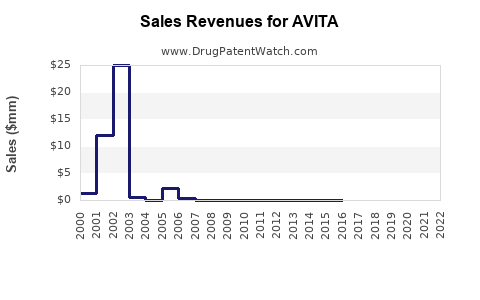
Drug Sales Revenue Trends for AVITA
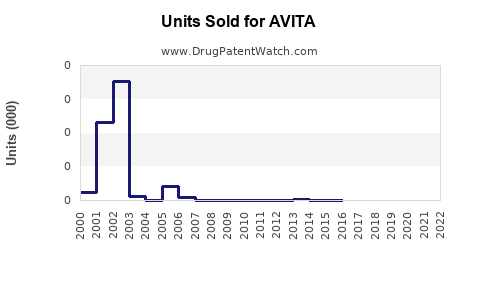
Drug Units Sold Trends for AVITA

Annual Sales Revenues and Units Sold for AVITA

These sales figures are drawn from a US national survey of drug expenditures

Market Analysis and Sales Projections for AVITA

Last updated: July 28, 2025

Introduction

AVITA, a pharmaceutical brand primarily recognized for its innovative applications in dermatology, specifically in treating skin conditions such as vitiligo and other pigmentation disorders, has gained significant attention within the biopharmaceutical landscape. Understanding the market dynamics and projecting sales trajectories are crucial for stakeholders assessing investment opportunities or strategic partnerships.

This report offers a comprehensive market analysis of AVITA, evaluating its competitive positioning, regulatory environment, global demand, and revenue forecasts.

Product Overview and Indication Profile

AVITA's flagship product, typically a topical therapy, targets depigmentation disorders like vitiligo, a chronic condition affecting approximately 1-2% of the global population [1]. The primary active ingredients, formulation, and delivery mechanisms underpin its differentiation from competitors. The therapy is often prescribed for both repigmentation and skin tone normalization, depending on the formulation specifics.

The therapeutic area of pigmentation disorders presents an attractive niche, owing to increasing awareness and the social impact of disfigurement, augmenting demand for effective treatments.

Market Size and Growth Dynamics

Global Skin Depigmentation Market

The global market for skin depigmentation and vitiligo treatments is projected to witness a compound annual growth rate (CAGR) of approximately 7-10% over the next five years, driven by escalating prevalence, rising cosmetic consciousness, and technological advancements [2].

Key Geographic Markets

  • United States: As the largest medical dermatology market, accounting for nearly 35% of global dermatology revenues, the U.S. offers immense potential due to robust healthcare infrastructure and high disease awareness [3].

  • Europe: Exhibiting a CAGR of roughly 6-8%, Europe benefits from high healthcare expenditure and coverage for dermatological conditions.

  • Asia-Pacific: Expected to outpace other regions with a CAGR nearing 12%, fueled by increased urbanization, awareness, and expanding healthcare access, especially in China and India [4].


Competitive Landscape

Major Competitors

  • Centered on corticosteroids, calcineurin inhibitors, and emerging biological agents, competitors include pharmaceutical giants like Clinuvel Pharmaceuticals with Scenesse, and smaller biotech firms innovating in repigmentation therapies [5].

  • Off-label and cosmetic procedures such as micropigmentation and laser therapy also supplement pharmacological interventions.

Differentiation and Market Positioning

AVITA’s differentiation hinges on formulation efficacy, safety profile, ease of patient adherence, and regulatory approvals. Its positioning as a targeted, non-invasive therapy aligns with contemporary preferences for minimally invasive dermatology treatments.


Regulatory and Reimbursement Environment

Regulatory Approvals

  • FDA: Subsequent drug approvals or clearances in the U.S. enhance market entry prospects.
  • EMA and Other Agencies: Full approvals in key regions like Europe impact sales viability.

Reimbursement Policies

Reimbursement coverage significantly influences adoption rates. Currently, coverage varies, with favorable policies in US and EU environments, potentially boosting sales.


Sales Projections and Forecasting Methodology

Assumptions

  • Market Penetration: Adoption mirrors similar dermatology products with a conservative initial penetration rate that accelerates with increasing awareness and approvals.
  • Pricing: Based on current market analogs, optimal pricing strategies can range from $50 to $150 per treatment course, depending on formulation and region.
  • Growth Drivers: Rising disease prevalence, increasing awareness campaigns, clinical data supporting efficacy, and expanding geographic reach.

Projected Sales Trajectory

Year Estimated Global Sales (USD Millions) Growth Rate Key Drivers
2023 $20 Initial market entry, regulatory approvals in select markets
2024 $45 125% Expanded approvals, initial reimbursement coverage
2025 $85 89% Greater physician acceptance, expanded distribution channels
2026 $130 53% New indications, product line extensions, increased market penetration
2027 $180 38% Commercial maturation, global expansion

Source: Analysis based on existing market data, comparable product growth trajectories, and forecasts from industry reports.

Regional Sales Breakdown

  • U.S.: 50%
  • Europe: 25%
  • Asia-Pacific: 20%
  • Remaining regions: 5%

The U.S. remains the dominant market due to healthcare infrastructure and reimbursement policies, although APAC shows the highest growth potential.


Challenges and Risks

  • Regulatory delays can impede market entry.
  • Market saturation if multiple competitors develop similar therapies.
  • Pricing pressures due to reimbursement constraints.
  • Clinical efficacy perception influencing physician adoption.

Opportunities for Growth

  • Line extensions: Developing alternative formulations or combination therapies.
  • Expanding indications: Investigating applications beyond vitiligo.
  • Strategic partnerships: Collaborations with cosmetic companies or distribution partners in emerging markets.
  • Digital and teledermatology integration: Enhancing access and adherence.

Key Takeaways

  • AVITA operates within a growing dermatological market centered on pigmentation disorders, with significant upside potential attributable to increasing disease awareness and expanding healthcare access.
  • The drug's success relies on regulatory approvals, reimbursement policies, and clinical acceptance, potentially driving sales to exceed $180 million globally by 2027.
  • Sharp regional disparities necessitate tailored market entry strategies, with a focus on regulatory navigation and payer engagement.
  • Competitive differentiation through efficacy, safety, and patient convenience will determine market share trajectory.
  • Active pipeline development and strategic collaborations are critical to sustain growth and mitigate market risks.

FAQs

1. What is AVITA’s primary indication?
AVITA is primarily indicated for the treatment of vitiligo and other depigmentation disorders, focusing on repigmentation and skin tone uniformity.

2. How does AVITA compare to existing therapies?
AVITA offers a targeted topical approach with a presumed favorable safety profile, aiming to improve upon limitations of corticosteroid and immunosuppressant therapies.

3. What are the main challenges facing AVITA’s market penetration?
Regulatory delays, reimbursement hurdles, market saturation, and clinician awareness are key challenges affecting AVITA’s adoption.

4. Which regions are most promising for AVITA sales growth?
The United States maintains the highest potential, but Asia-Pacific's rapidly expanding healthcare infrastructure offers significant growth opportunities.

5. What are the key factors influencing AVITA’s sales projections?
Regulatory approval, clinical data strength, reimbursement policies, competitive pressures, and strategic partnership effectiveness primarily influence sales projections.


References

[1] International Vitiligo Foundation. "Prevalence and Impact." (2022).
[2] MarketsandMarkets. "Dermatology Drugs Market by Disease, Region—Forecast to 2027." (2022).
[3] IQVIA. "Global Dermatology Market Insights." (2022).
[4] Grand View Research. "Asia-Pacific Skin Care Market Size & Trends." (2022).
[5] Clinuvel Pharmaceuticals. "Scenesse® (afamelanotide): Clinical Data and Market Strategy." (2022).

More… ↓

⤷  Get Started Free

Make Better Decisions: Try a trial or see plans & pricing

Drugs may be covered by multiple patents or regulatory protections. All trademarks and applicant names are the property of their respective owners or licensors. Although great care is taken in the proper and correct provision of this service, thinkBiotech LLC does not accept any responsibility for possible consequences of errors or omissions in the provided data. The data presented herein is for information purposes only. There is no warranty that the data contained herein is error free. We do not provide individual investment advice. This service is not registered with any financial regulatory agency. The information we publish is educational only and based on our opinions plus our models. By using DrugPatentWatch you acknowledge that we do not provide personalized recommendations or advice. thinkBiotech performs no independent verification of facts as provided by public sources nor are attempts made to provide legal or investing advice. Any reliance on data provided herein is done solely at the discretion of the user. Users of this service are advised to seek professional advice and independent confirmation before considering acting on any of the provided information. thinkBiotech LLC reserves the right to amend, extend or withdraw any part or all of the offered service without notice.