Share This Page
Drug Sales Trends for XULANE
✉ Email this page to a colleague
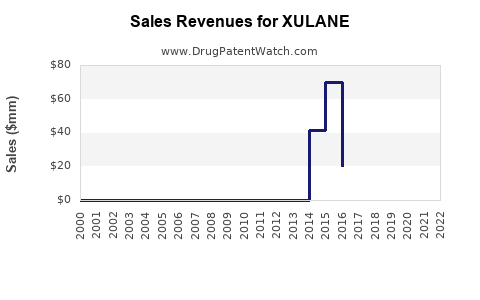
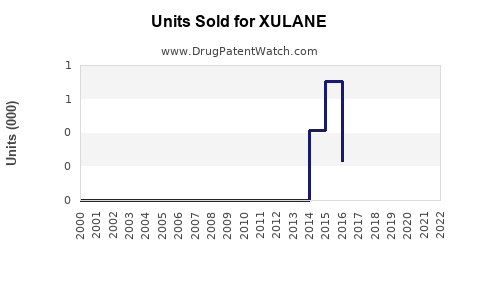
Annual Sales Revenues and Units Sold for XULANE
| Drug Name | Revenues (USD) | Units | Year |
|---|---|---|---|
| XULANE | ⤷ Start Trial | ⤷ Start Trial | 2022 |
| XULANE | ⤷ Start Trial | ⤷ Start Trial | 2021 |
| XULANE | ⤷ Start Trial | ⤷ Start Trial | 2020 |
| XULANE | ⤷ Start Trial | ⤷ Start Trial | 2019 |
| XULANE | ⤷ Start Trial | ⤷ Start Trial | 2018 |
| XULANE | ⤷ Start Trial | ⤷ Start Trial | 2017 |
| >Drug Name | >Revenues (USD) | >Units | >Year |
Xulane Market Analysis, Sales Projections, Patent Position, and Generic Competition
Xulane is a mature U.S. contraceptive patch marketed by Viatris through its legacy Mylan portfolio. The product has a defensible delivery-system position but limited remaining exclusivity, no meaningful biosimilar barrier, and substantial competition from oral contraceptives, long-acting reversible contraceptives, and newer hormonal patches. Viatris does not disclose standalone Xulane revenue, so the projections below are modeled estimates rather than company-reported sales.
The base-case forecast places U.S. Xulane net sales at approximately $210 million in 2025, declining to about $158 million by 2029. The primary risks are payer substitution, lower-cost generic and authorized-generic alternatives, reduced use of estrogen-containing contraception, and market share losses to long-acting methods.
What is Xulane and how does it work?
Xulane is a once-weekly transdermal contraceptive patch containing norelgestromin and ethinyl estradiol. Each patch delivers approximately 150 micrograms of norelgestromin and 35 micrograms of ethinyl estradiol per day over a seven-day dosing interval.[1]
The product is indicated for the prevention of pregnancy in females of reproductive potential. Patients apply one patch weekly for three consecutive weeks, followed by a patch-free week. Xulane is supplied in a three-patch cycle pack.
The patch offers a compliance advantage over daily oral contraceptives. Its principal clinical limitation is that it exposes users to estrogen and is associated with a higher systemic estrogen exposure than many oral contraceptive regimens. The FDA label includes contraindications and warnings related to venous thromboembolism, arterial thrombotic events, smoking, hypertension, migraine with aura, and obesity.[1]
Xulane is not approved as a treatment for heavy menstrual bleeding, endometriosis, or menopausal symptoms.
What is the FDA regulatory status of Xulane?
Xulane was approved by the FDA as a generic version of Ortho Evra, the contraceptive patch originally marketed by Janssen Pharmaceuticals. Mylan received FDA approval for Xulane in 2014.[2]
| Regulatory attribute | Xulane |
|---|---|
| Active ingredients | Norelgestromin and ethinyl estradiol |
| Dosage form | Transdermal patch |
| Dosing | One patch weekly for three weeks |
| FDA approval pathway | Abbreviated New Drug Application, or ANDA |
| Initial Xulane approval | 2014 |
| Reference product | Ortho Evra |
| Current commercial owner | Viatris, through the legacy Mylan portfolio |
| Main market | United States |
| Biosimilar eligibility | Not applicable |
| Primary indication | Prevention of pregnancy |
The FDA label states that Xulane is not recommended for women with a body mass index of 30 kg/m² or greater. The label also identifies reduced contraceptive effectiveness in women weighing 198 pounds or more.[1] These restrictions narrow the addressable patient population relative to oral contraceptives and non-estrogen methods.
How large is the Xulane market?
Xulane competes in the broader U.S. hormonal contraception market, which includes oral contraceptives, intrauterine systems, implants, injections, vaginal rings, and transdermal patches. The patch segment is materially smaller than the oral contraceptive segment and has fewer products.
Xulane’s commercial position is supported by:
- Weekly rather than daily administration.
- Established physician and pharmacy awareness.
- Broad contraceptive coverage under U.S. insurance plans.
- A lower manufacturing and development burden than a novel contraceptive.
- Limited direct patch competition.
The market is constrained by:
- High substitution from low-cost oral contraceptives.
- Increased use of long-acting reversible contraception.
- Estrogen-related safety restrictions.
- The BMI and weight limitations in the FDA label.
- Limited product differentiation against other combined hormonal contraceptives.
- Payer pressure on branded-generic pricing.
Viatris does not report Xulane as a separate revenue line in its public financial disclosures. The product is included within broader portfolio categories, making direct historical revenue verification difficult.[3]
Estimated 2024 commercial baseline
The following baseline is an analyst estimate based on Xulane’s mature branded-generic status, U.S.-centric distribution, prescription contraceptive pricing, and competitive position. It is not reported by Viatris.
| Metric | 2024 estimated range |
|---|---|
| U.S. net sales | $190 million-$240 million |
| Base-case midpoint | $220 million |
| International contribution | Limited relative to U.S. sales |
| Revenue trend | Mature to declining |
| Primary channel | Retail pharmacy and managed-care reimbursement |
| Sales sensitivity | Reimbursement, generic pricing, prescription volume |
The broad range reflects the absence of a public standalone revenue disclosure and the difference between gross prescription value, pharmacy revenue, and manufacturer net sales after rebates and discounts.
What are the Xulane sales projections through 2029?
The base case assumes declining net sales caused by price erosion, increased payer substitution, and gradual migration to long-acting and non-estrogen contraceptive methods. It assumes no product recall, major label expansion, or new high-volume competitor entering the patch category.
Xulane U.S. net sales forecast
| Year | Bear case | Base case | Bull case |
|---|---|---|---|
| 2024A / estimated base | $190M | $220M | $240M |
| 2025E | $170M | $210M | $235M |
| 2026E | $145M | $198M | $230M |
| 2027E | $123M | $185M | $225M |
| 2028E | $105M | $171M | $220M |
| 2029E | $90M | $158M | $215M |
Projection assumptions
The bear case applies annual revenue erosion of approximately 12% to 15%. It assumes accelerated substitution by lower-cost alternatives, tighter formulary positioning, and stronger uptake of Twirla and non-patch contraceptives.
The base case applies an approximate 6% to 8% annual decline. Xulane retains a stable prescriber base, but pricing and volume gradually deteriorate.
The bull case assumes relatively stable patch demand, limited direct substitution, and effective management of payer discounts. It does not assume a major expansion in the overall patch market.
Under the base case, cumulative U.S. Xulane net sales from 2025 through 2029 are approximately $922 million.
How does Xulane compare with Twirla and other contraceptive patches?
Xulane and Twirla are the principal branded U.S. contraceptive patches, but they use different progestins and have different label profiles.
| Product | Active ingredients | Dosing | Manufacturer | Commercial position |
|---|---|---|---|---|
| Xulane | Norelgestromin/ethinyl estradiol | Weekly | Viatris | Established branded generic |
| Twirla | Levonorgestrel/ethinyl estradiol | Weekly | Agile Therapeutics | Newer branded product |
| Ortho Evra | Norelgestromin/ethinyl estradiol | Weekly | Janssen legacy product | Reference product, largely displaced |
| Generic equivalents | Varies by product | Usually daily or other schedules | Multiple manufacturers | Price-led competition |
Twirla was approved by the FDA in 2020 and uses a lower-dose hormone delivery system than Xulane.[4] Its label includes a BMI limitation because efficacy was lower in clinical studies among users with BMI of 30 kg/m² or greater.[4] This creates an important commercial overlap with Xulane, which also carries an obesity-related limitation.
Twirla’s challenge is scale. Xulane has an established market position and pharmacy familiarity, while Twirla must fund continued commercial development in a small category. Xulane’s challenge is differentiation. Both products offer weekly dosing and remain exposed to the broader decline of estrogen-containing contraceptive use.
What patents protect Xulane?
Xulane’s principal commercial protection came from the original Ortho Evra transdermal delivery technology and associated formulation patents. Those protections have largely expired or no longer provide meaningful market exclusivity for the current product.
| IP category | Xulane position |
|---|---|
| Active pharmaceutical ingredient | Mature, widely known hormones |
| Transdermal delivery technology | Legacy protection largely expired |
| Product formulation | Limited practical exclusivity |
| Method-of-use patents | No clearly material remaining exclusivity identified from the public commercial record |
| Manufacturing know-how | Potential operational value, but not a substitute for patent exclusivity |
| Biosimilar protection | Not applicable |
| Orange Book value | No apparent material remaining listed-patent barrier to generic competition |
The FDA Orange Book is the controlling public reference for patents and regulatory exclusivity associated with approved drug products.[5] Xulane’s commercial status is consistent with a mature ANDA product rather than a product protected by an active, high-value patent estate.
Are Paragraph IV challenges relevant to Xulane?
Paragraph IV litigation risk is limited because Xulane itself is an ANDA product rather than a newly approved brand with a large Orange Book patent estate. The principal generic-entry event occurred when Mylan obtained approval for Xulane as an equivalent to Ortho Evra.
Future challenges would more likely involve:
- Additional ANDA products using the same active ingredients.
- Formulation or adhesive differences.
- Generic entry against any later-listed patents.
- Product-specific manufacturing or equivalence disputes.
A Paragraph IV filing against a mature product would likely create pricing pressure faster than it would create a prolonged exclusivity dispute. The economic value of litigation would depend on whether a challenger could obtain substitutable pharmacy placement and whether the reference product retained meaningful market share.
What is the Orange Book status of Xulane?
Xulane is an approved transdermal contraceptive product, but its commercial value is not dependent on a substantial remaining Orange Book patent term. The FDA Orange Book should be reviewed for current listing status before any transaction, litigation decision, or launch planning because patent listings and product records can change.[5]
The relevant legal distinction is between:
- Patents protecting the original Ortho Evra product.
- Patents listed for Xulane or a related approved product.
- Manufacturing know-how that is not listed in the Orange Book.
- Regulatory exclusivity, which is separate from patent protection.
No meaningful data exclusivity period remains for Xulane. The product’s competitive protection comes from market familiarity, pharmacy access, supply reliability, and commercial execution rather than regulatory exclusivity.
What formulation and manufacturing barriers affect Xulane?
Xulane’s manufacturing process requires reliable transdermal delivery, adhesive performance, dose uniformity, packaging stability, and control of hormone release over the intended seven-day period. These requirements create technical barriers, but they are not equivalent to a strong patent moat.
Key manufacturing risks include:
- Uniform distribution of hormones through the patch matrix.
- Adhesion during bathing, exercise, and extended wear.
- Stability under varied temperature and humidity conditions.
- Control of residual drug in the used patch.
- Consistent release rates between manufacturing lots.
- Bioequivalence and adhesion testing for competing products.
- Supply continuity for drug substances, adhesive components, and backing materials.
Transdermal systems can require more development work than conventional tablets because equivalence depends on both pharmacokinetic performance and physical patch characteristics. That can delay entry, but it does not necessarily prevent entry once a competitor completes FDA requirements.
Which companies are challenging Xulane commercially?
Xulane faces competition from several categories rather than one direct rival.
Direct patch competition
Agile Therapeutics’ Twirla is the most visible direct branded competitor. Twirla’s lower-dose formulation and separate clinical positioning give prescribers an alternative, although its obesity-related labeling limitation overlaps with Xulane’s restriction.[4]
Generic oral contraceptives
A large number of generic combined oral contraceptives compete for the same patient population. Their lower cost, broad pharmacy availability, and extensive payer coverage create the largest substitution risk.
Long-acting reversible contraception
Intrauterine devices and etonogestrel implants compete for patients who prioritize adherence and multi-year contraceptive efficacy. These products are not direct substitutes at the dosage-form level but are important alternatives in contraceptive decision-making.
Vaginal rings and injections
NuvaRing generics, Annovera, and depot medroxyprogesterone acetate provide non-daily options. Their dosing schedules and clinical profiles differ, but they compete for the same contraceptive budget and prescriber attention.
What litigation and settlement agreements affect Xulane?
No major current litigation or settlement agreement is identified here as a material driver of Xulane’s forecast. The historical legal significance lies in the transition from Ortho Evra to generic-equivalent products and the expiration of legacy transdermal contraceptive patents.
Any current transaction or investment analysis should distinguish among:
- Product-liability cases involving estrogen-containing contraceptives.
- Patent litigation over transdermal systems.
- ANDA litigation involving later entrants.
- Manufacturing or supply disputes.
- Commercial contracts and distribution arrangements.
These categories have different effects on revenue. Product-liability litigation can affect prescribing and insurance costs, while patent litigation may affect launch timing. A supply dispute can produce short-term sales disruption without changing the long-term competitive position.
What licensing deals support Xulane sales?
Xulane was developed and commercialized through the legacy Mylan business and is now associated with Viatris following the 2020 Mylan-Upjohn combination. Public Viatris filings do not identify a major current licensing arrangement as a standalone Xulane revenue driver.[3]
The most relevant commercial relationships are likely to involve:
- Wholesaler distribution.
- Pharmacy benefit manager contracting.
- Managed-care formulary access.
- Contract manufacturing and component supply.
- Regional commercialization arrangements.
Because Xulane is a mature U.S. product, licensing upside is limited unless Viatris transfers commercialization rights into a market where the patch has stronger reimbursement or lower direct competition.
How strong is the Xulane patent estate?
Xulane has a weak-to-moderate commercial IP position and a stronger operational position.
| Factor | Assessment |
|---|---|
| Composition-of-matter protection | Weak; active hormones are mature |
| Original delivery-system patents | Largely expired |
| Current regulatory exclusivity | None of commercial significance |
| Formulation protection | Limited practical exclusivity |
| Manufacturing know-how | Moderate operational value |
| Brand and pharmacy familiarity | Moderate commercial value |
| Generic-entry resistance | Low |
| Litigation leverage | Low to moderate |
| Long-term pricing power | Low |
The product can continue generating revenue without an active patent moat because contraceptive demand is recurring and the patch category has relatively limited direct competition. That revenue profile is vulnerable to price compression and formulary substitution.
What generic launch risks exist for Xulane?
The most likely generic-launch scenario is gradual erosion rather than an abrupt displacement event.
Scenario 1: No material new entrant
Xulane retains most of its current prescription base. Net sales decline primarily through rebates, payer pressure, and modest volume reduction.
Scenario 2: One substitutable generic entrant
A generic patch obtains meaningful pharmacy substitution. Xulane loses price-sensitive patients first, while brand-loyal and continuity-of-care patients remain. Revenue could decline by 15% to 30% over two to three years.
Scenario 3: Multiple generic entrants
Several suppliers compete on price and contract access. Xulane could face a 30% to 50% revenue reduction over three years, depending on substitution rules, supply reliability, and the degree of generic interchangeability.
The risk is higher if a competitor matches Xulane’s patch size, application schedule, adhesion performance, and reimbursement status. A nominally equivalent product with inferior adhesion or inconsistent supply may have limited commercial impact.
What is the geographic coverage of Xulane?
Xulane is primarily a U.S. commercial product. Its market value is concentrated in U.S. pharmacy reimbursement, FDA-approved labeling, and domestic payer contracts.
Geographic expansion is constrained by:
- Country-specific contraceptive approvals.
- Different regulatory requirements for transdermal systems.
- Local reimbursement policies.
- Contraceptive preferences that vary by market.
- Competition from established oral and long-acting products.
- The need to establish local distribution and pharmacovigilance infrastructure.
The U.S. concentration simplifies commercialization but increases exposure to domestic pricing policy and pharmacy-benefit-manager negotiations.
What FDA and market developments could change Xulane projections?
The most important upside event would be improved contraceptive access or a commercial partnership that expands patch use without changing the product’s label. A major downside event would be a new generic entrant with rapid pharmacy substitution.
Other potential forecast drivers include:
- New evidence concerning estrogen exposure and thrombotic risk.
- Label changes involving BMI or body weight.
- Changes in contraceptive coverage under U.S. health plans.
- Increased uptake of over-the-counter oral contraception.
- Manufacturing interruptions.
- Product recalls or FDA inspection findings.
- New weekly, monthly, or long-acting contraceptive technologies.
- Shifts in consumer preference toward progestin-only contraception.
The FDA approved Opill, the first over-the-counter daily oral contraceptive in the United States, in 2023.[6] Although Opill is progestin-only and not a direct substitute for Xulane, over-the-counter contraception can expand consumer choice and increase pressure on prescription contraceptive products.
Key Takeaways
- Xulane is a mature weekly contraceptive patch containing norelgestromin and ethinyl estradiol.
- Viatris does not publicly disclose standalone Xulane revenue.
- Estimated 2024 U.S. net sales are modeled at $190 million to $240 million.
- Base-case sales are projected to decline from approximately $210 million in 2025 to $158 million in 2029.
- Xulane has limited remaining patent or regulatory exclusivity.
- The principal competitive risks are generic patches, low-cost oral contraceptives, Twirla, long-acting contraceptives, and progestin-only options.
- No biosimilar risk applies because Xulane is a small-molecule transdermal product.
- Manufacturing know-how and pharmacy access provide more protection than the patent estate.
- The most probable generic-entry impact is gradual price and volume erosion rather than immediate market displacement.
- Xulane remains commercially viable as a mature branded generic, but its long-term value depends on supply reliability, payer access, and retention of a stable patch-using population.
FAQs About Xulane Market Sales and Competition
When does Xulane lose exclusivity?
Xulane has no remaining commercial exclusivity period comparable to a newly approved branded drug. Its commercial protection is primarily based on market presence, payer access, and manufacturing execution.
Is Xulane still patented?
Legacy patents associated with the original Ortho Evra transdermal system have largely expired. Any current patent position should be confirmed through the FDA Orange Book and relevant patent databases before a legal or transaction decision.
Can a generic Xulane patch enter the market?
Yes. Because Xulane is an ANDA-approved product with limited remaining exclusivity, additional equivalent products could enter if they satisfy FDA requirements and obtain pharmacy and payer access.
Is Twirla a substitute for Xulane?
Twirla is a direct weekly patch competitor, but it has different active ingredients, dose delivery, clinical data, and labeling. It competes for some of the same patients but is not the same product.
Will Xulane sales grow after 2025?
Sustained growth is unlikely under current market conditions. The base case assumes declining sales through 2029, with growth requiring a meaningful increase in patch use, stronger reimbursement, limited generic entry, or an effective commercial repositioning.
References
-
U.S. Food and Drug Administration. (2023). Xulane: Prescribing information. FDA.
-
U.S. Food and Drug Administration. (2014). FDA approves generic version of Ortho Evra contraceptive patch. FDA.
-
Viatris Inc. (2024). Annual report pursuant to Section 13 or 15(d) of the Securities Exchange Act of 1934. U.S. Securities and Exchange Commission.
-
U.S. Food and Drug Administration. (2020). Twirla: Prescribing information. FDA.
-
U.S. Food and Drug Administration. (2024). Approved drug products with therapeutic equivalence evaluations, Orange Book. FDA.
-
U.S. Food and Drug Administration. (2023). FDA approves first nonprescription daily oral contraceptive. FDA.
More… ↓
