Drug Sales Trends for TRIMETHOPRIM
Payment Methods and Pharmacy Types for TRIMETHOPRIM (2002)
Revenues by Pharmacy Type
Units Sold by Pharmacy Type
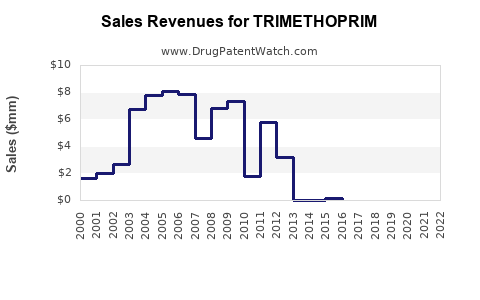
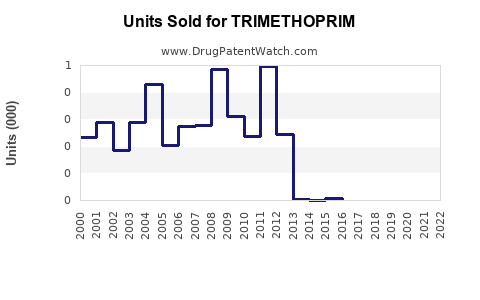
Annual Sales Revenues and Units Sold for TRIMETHOPRIM
| Drug Name | Revenues (USD) | Units | Year |
|---|---|---|---|
| TRIMETHOPRIM | ⤷ Start Trial | ⤷ Start Trial | 2022 |
| TRIMETHOPRIM | ⤷ Start Trial | ⤷ Start Trial | 2021 |
| TRIMETHOPRIM | ⤷ Start Trial | ⤷ Start Trial | 2020 |
| TRIMETHOPRIM | ⤷ Start Trial | ⤷ Start Trial | 2019 |
| TRIMETHOPRIM | ⤷ Start Trial | ⤷ Start Trial | 2018 |
| TRIMETHOPRIM | ⤷ Start Trial | ⤷ Start Trial | 2017 |
| TRIMETHOPRIM | ⤷ Start Trial | ⤷ Start Trial | 2016 |
| >Drug Name | >Revenues (USD) | >Units | >Year |
Trimethoprim Market Analysis and Sales Projections, 2025-2030
Trimethoprim is a mature, low-cost generic antibacterial with stable demand in urinary-tract infections and selected bacterial infections. The standalone drug has limited commercial growth potential because of generic competition, low reimbursement, narrow pricing power, and substitution by nitrofurantoin, fosfomycin, pivmecillinam, and trimethoprim-sulfamethoxazole.
The global standalone trimethoprim market is best modeled as a low-hundreds-of-millions-dollar market at manufacturer and wholesaler prices, rather than a large branded pharmaceutical opportunity. A base-case model indicates modest unit erosion and declining nominal sales through 2030. Trimethoprim-sulfamethoxazole should be analyzed separately because its commercial market, regulatory status, and competitive dynamics differ materially.
What is trimethoprim and how is it used?
Trimethoprim is a dihydrofolate reductase inhibitor used primarily for bacterial urinary-tract infections. It is available as a standalone oral product and in combination with sulfamethoxazole.
| Product category | Principal use | Commercial status |
|---|---|---|
| Trimethoprim tablets | Uncomplicated urinary-tract infections and selected bacterial infections | Generic |
| Trimethoprim oral suspension | Pediatric and other oral dosing applications | Generic or limited-market product |
| Trimethoprim-sulfamethoxazole tablets and suspension | Urinary, respiratory, skin, gastrointestinal, and opportunistic infections | Generic combination |
| Trimethoprim-sulfamethoxazole injection | Hospital and serious infections | Generic, institutional market |
In the United States, the FDA-approved trimethoprim tablet label identifies treatment of urinary-tract infections caused by susceptible organisms, including certain strains of Escherichia coli, Klebsiella pneumoniae, Enterobacter species, and coagulase-negative staphylococci.[1] Resistance and local treatment guidelines limit its use as an empiric first-line product.
Trimethoprim-sulfamethoxazole has a materially broader indication set, including Pneumocystis jirovecii pneumonia, selected methicillin-resistant Staphylococcus aureus infections, shigellosis, and other infections.[2] Sales attributed to the combination should not be counted as standalone trimethoprim revenue.
How large is the trimethoprim market?
No single public source reports audited global sales for standalone trimethoprim across all countries and dosage forms. Manufacturers generally report generic portfolios in aggregate, while public prescription databases vary by country and often combine products by ingredient or therapeutic class.
A practical market estimate requires separating:
- Standalone trimethoprim products.
- Trimethoprim-sulfamethoxazole products.
- Retail pharmacy sales.
- Hospital and institutional procurement.
- Manufacturer net sales versus pharmacy retail value.
Estimated global standalone trimethoprim market
The following scenario is a modeled estimate for standalone trimethoprim, excluding trimethoprim-sulfamethoxazole.
| Metric | 2025 estimate | 2030 base-case estimate | 2025-2030 trend |
|---|---|---|---|
| Global treatment courses | 8-12 million | 7-11 million | Slight decline |
| Manufacturer-level market value | $70 million-$150 million | $55 million-$125 million | Low-single-digit annual decline |
| Central estimate | $105 million | $85 million | Approximately -4% CAGR |
| Average net value per course | $7-$13 | $6-$12 | Price erosion |
| Generic share | More than 95% | More than 97% | Increasing |
These figures are analytical estimates rather than reported manufacturer sales. The central case assumes continuing demand in countries where trimethoprim remains an accepted oral UTI treatment, offset by generic price erosion and substitution toward nitrofurantoin and fosfomycin.
The broader trimethoprim-containing market, including trimethoprim-sulfamethoxazole, is substantially larger. It should not be used as a direct proxy for standalone trimethoprim because the combination has different clinical uses and hospital demand.
What are the main growth drivers for trimethoprim?
The market has defensive demand but limited structural growth.
Recurrent urinary-tract infection treatment
Trimethoprim remains useful in uncomplicated and recurrent urinary-tract infections when susceptibility testing supports its use. Generic affordability supports continued prescribing in lower-income and cost-sensitive markets.
Established regulatory status
The drug has a long clinical history, established dosing information, and broad physician familiarity. These factors reduce adoption barriers in markets where resistance remains manageable.
Oral outpatient distribution
Tablets and oral suspensions can be distributed through retail pharmacies without the infrastructure required for injectable anti-infectives. This supports continued use in primary care and outpatient settings.
Procurement in lower-cost markets
Trimethoprim can retain volume in public-health systems that prioritize low acquisition cost. The product is more exposed to tender pricing than to premium branded positioning.
Combination-product demand
The trimethoprim-sulfamethoxazole segment creates manufacturing, distribution, and contracting opportunities for companies already producing trimethoprim-containing products. It does not directly expand the standalone trimethoprim market, but it supports shared API sourcing and production infrastructure.
What factors are reducing trimethoprim sales?
Antimicrobial resistance
Resistance to trimethoprim is a central market constraint. The Infectious Diseases Society of America and other guideline bodies recommend considering local resistance levels when selecting oral agents for urinary-tract infections.[3] As resistance rises, clinicians shift toward nitrofurantoin, fosfomycin, pivmecillinam, or culture-directed treatment.
Therapeutic substitution
Nitrofurantoin has gained importance in uncomplicated cystitis because of favorable guideline positioning and lower systemic resistance concerns. Fosfomycin provides an alternative single-dose regimen in some markets. Pivmecillinam is important in several European markets.
Generic price erosion
Multiple approved suppliers limit pricing power. Retail reimbursement and pharmacy substitution compress net sales even when prescription volumes remain stable.
Narrow standalone indication profile
The standalone product does not have the broad clinical positioning of trimethoprim-sulfamethoxazole. It also lacks the hospital and opportunistic-infection demand associated with the combination.
Stewardship restrictions
Antimicrobial stewardship programs increasingly require culture data or restrict use of agents with higher resistance rates. These policies reduce empiric use in hospitals and integrated health systems.
What are the trimethoprim sales projections through 2030?
The base case assumes that global standalone treatment volume declines gradually, while unit prices fall faster in competitive markets.
| Scenario | 2025 sales | 2030 sales | CAGR | Main assumptions |
|---|---|---|---|---|
| Bull case | $125 million | $135 million | 1.5% | Stable susceptibility, limited substitution, stronger emerging-market volume |
| Base case | $105 million | $85 million | -4.1% | Moderate volume decline and continued generic price erosion |
| Bear case | $80 million | $50 million | -10.5% | Faster resistance growth, broad guideline substitution, aggressive tender pricing |
Base-case annual projection
| Year | Estimated global sales | Estimated treatment courses | Market interpretation |
|---|---|---|---|
| 2025 | $105 million | 10.0 million | Stable mature generic market |
| 2026 | $101 million | 9.8 million | Mild volume and price decline |
| 2027 | $97 million | 9.6 million | Continued substitution |
| 2028 | $93 million | 9.3 million | Tender and reimbursement pressure |
| 2029 | $89 million | 9.1 million | Lower empiric utilization |
| 2030 | $85 million | 8.8 million | Mature declining market |
The commercial outlook is more favorable for low-cost manufacturers with efficient API sourcing, automated solid-dose production, and established government or wholesaler contracts. It is unfavorable for companies seeking premium pricing or differentiated branded positioning.
Which regions have the strongest trimethoprim demand?
United Kingdom and selected European markets
The United Kingdom has historically used trimethoprim extensively for urinary-tract infections, although prescribing decisions are increasingly influenced by resistance surveillance and national guidance.[4] European demand varies by country according to treatment guidelines, availability of pivmecillinam, fosfomycin utilization, reimbursement, and antimicrobial stewardship.
United States
The U.S. standalone market is smaller than the U.S. trimethoprim-sulfamethoxazole market. Trimethoprim tablets are generic and concentrated in outpatient UTI treatment. Market value is constrained by low reimbursement and multiple generic suppliers.
Asia-Pacific
Asia-Pacific offers the largest volume opportunity because of population size, broad generic use, and lower-cost procurement. Revenue per course is lower than in North America and Western Europe. Regulatory fragmentation and local manufacturing reduce the attractiveness of direct export models.
Latin America, the Middle East, and Africa
These regions can support volume growth, particularly through public procurement and retail generic channels. Revenue visibility is weaker, and price competition is more intense. Quality compliance, registration requirements, and reliable distribution are material barriers.
| Region | Volume outlook | Price outlook | Commercial attractiveness |
|---|---|---|---|
| North America | Stable to declining | Low | Limited, but predictable |
| Western Europe | Declining to stable | Low to moderate | Selective |
| Eastern Europe | Stable | Low | Moderate |
| Asia-Pacific | Stable to growing | Very low | Volume-driven |
| Latin America | Stable | Low | Distributor-dependent |
| Middle East and Africa | Variable | Very low | Tender and registration-driven |
What is the FDA regulatory status of trimethoprim?
Trimethoprim is an established FDA-approved generic active ingredient. The FDA’s Approved Drug Products with Therapeutic Equivalence Evaluations, commonly called the Orange Book, lists approved trimethoprim products and their therapeutic-equivalence status.[5]
The regulatory profile is low risk compared with a new antibacterial:
- No novel drug approval is required for an ANDA applicant if the reference product and applicable requirements are satisfied.
- Products must meet chemistry, manufacturing, and controls requirements.
- Bioequivalence remains central for oral products.
- Labeling must conform to the approved reference product or applicable regulatory pathway.
- Facilities remain exposed to FDA inspection, warning letters, import controls, and manufacturing deficiencies.
Orange Book status is product-specific. A company evaluating an acquisition or launch must verify the current listing for each strength, dosage form, and reference product rather than relying on the active ingredient alone.
What patents protect trimethoprim?
The core composition-of-matter patent estate for trimethoprim is expired. Trimethoprim was discovered and commercialized decades ago, and the active ingredient is available from multiple generic manufacturers.
The current IP environment is therefore defined by product-level and process-level rights rather than meaningful molecule exclusivity.
Formulation patents
Potentially relevant rights can cover:
- Modified-release tablets.
- Taste-masked oral suspensions.
- Fixed-dose combinations.
- Specific excipient systems.
- Stability-enhancing formulations.
- Pediatric delivery systems.
- Manufacturing processes and impurity controls.
These rights generally do not block ordinary immediate-release generic trimethoprim tablets unless the generic product practices the claimed formulation.
Method-of-use patents
Method-of-use claims may target a particular dosing schedule, infection type, patient population, or combination regimen. Their commercial value is limited for a mature antibiotic because physicians can often prescribe the active ingredient under established indications, subject to labeling and applicable patent law.
Manufacturing and API rights
Manufacturing know-how can be more important than patent exclusivity. Competitive barriers may include:
- Low-cost API capacity.
- DMF support.
- Control of impurity profiles.
- Reliable supply of starting materials.
- Validated dissolution and stability performance.
- FDA-acceptable facilities.
- Regional registration dossiers.
When does trimethoprim lose exclusivity?
Standalone trimethoprim has already lost practical market exclusivity. The core molecule is generic, and multiple suppliers operate across major markets.
| Exclusivity category | Current position |
|---|---|
| Composition-of-matter exclusivity | Expired |
| Core branded exclusivity | Expired |
| Generic competition | Established |
| Pediatric exclusivity | Not a current market barrier |
| Orphan exclusivity | Not applicable to ordinary trimethoprim |
| Data exclusivity | Not a meaningful barrier for the mature active ingredient |
| Formulation exclusivity | Product-specific and potentially relevant |
| Method-of-use exclusivity | Product- and jurisdiction-specific |
The main remaining legal risk is not loss of molecule exclusivity. It is whether a particular product, formulation, manufacturing process, or method-of-use claim applies to a proposed product.
Are there Paragraph IV challenges involving trimethoprim?
Paragraph IV litigation risk is generally low for ordinary immediate-release trimethoprim tablets because the molecule and standard generic product are mature. A Paragraph IV certification may still arise when an applicant targets a listed formulation, combination, or other product with unexpired Orange Book patents.
Potential dispute areas include:
- Fixed-dose trimethoprim-sulfamethoxazole products.
- Extended-release or specialized oral formulations.
- Patents covering specific combinations or dosing regimens.
- Manufacturing patents asserted against an ANDA applicant.
Any litigation assessment must be conducted at the product and patent level. The active ingredient name alone does not identify a current Paragraph IV risk.
Which companies compete in trimethoprim?
Competition is fragmented and varies by country. Relevant supplier categories include:
- Large generic manufacturers with broad anti-infective portfolios.
- Regional pharmaceutical companies supplying public tenders.
- Contract manufacturers and API suppliers.
- Hospital-focused generic companies.
- Branded-generic companies in emerging markets.
The leading competitive advantages are operational rather than scientific:
- Lowest sustainable cost of goods.
- Reliable API supply.
- Regulatory-compliant manufacturing.
- Broad wholesaler or tender access.
- Ability to maintain supply during shortages.
- Registration coverage across multiple markets.
A branded launch would face weak differentiation unless supported by a new formulation, improved pediatric administration, combination product, or supply-reliability advantage.
What licensing deals and partnerships affect trimethoprim?
Trimethoprim has limited licensing appeal as a standalone asset because the core molecule is generic and low priced. Transactions are more likely to involve:
- Portfolio acquisitions containing several generic anti-infectives.
- Regional distribution agreements.
- API supply agreements.
- Contract manufacturing.
- Fixed-dose combination products.
- Hospital procurement contracts.
The most commercially relevant partnership structure is usually a supply or distribution agreement rather than an exclusive intellectual-property license. Buyers should evaluate minimum-volume commitments, price-adjustment clauses, quality obligations, pharmacovigilance responsibilities, and termination rights.
What patent litigation affects trimethoprim?
There is no broad, molecule-level litigation barrier comparable to disputes involving recently approved branded drugs. Litigation exposure is more likely to arise from:
- Product-specific formulation patents.
- Combination-product patents.
- Manufacturing process claims.
- ANDA litigation involving a particular reference-listed drug.
- Contract and quality disputes between generic manufacturers and distributors.
For investment purposes, litigation is a secondary risk factor. Supply interruption, regulatory compliance, API concentration, and pricing pressure are more important drivers of value.
What generic launch scenarios exist for trimethoprim?
Immediate-release tablet launch
This is the lowest-risk and lowest-return scenario. Entry requires regulatory approval, bioequivalence support, manufacturing capacity, and distribution. Expected pricing is highly competitive.
Oral suspension launch
A suspension can provide modest differentiation, particularly in pediatric or swallowing-impaired populations. Commercial returns remain limited unless the product solves a meaningful taste, stability, dosing, or supply problem.
Combination-product launch
Trimethoprim-sulfamethoxazole provides a larger addressable market but has more competitors and broader clinical substitution. Regulatory and commercial analysis must be conducted independently from standalone trimethoprim.
Emerging-market tender launch
This can generate volume but usually produces low margins. Success depends on local registration, government procurement eligibility, reliable supply, and payment discipline.
How strong is the trimethoprim patent estate?
The standalone patent estate is weak from an exclusivity perspective but can be operationally valuable.
| Estate component | Strength | Commercial implication |
|---|---|---|
| Core molecule | Very weak, expired | No meaningful exclusivity |
| Immediate-release tablet | Weak | Commodity competition |
| Oral suspension | Low to moderate | Possible niche differentiation |
| Combination products | Product-specific | Larger market, more regulatory complexity |
| Manufacturing know-how | Moderate operational value | Can support cost and quality advantage |
| Regulatory dossiers | Moderate | Reduces entry time but does not block competitors |
| Distribution contracts | Variable | Can protect regional access temporarily |
What is the investment outlook for trimethoprim?
Trimethoprim is a defensive generic asset, not a high-growth pharmaceutical opportunity. The strongest investment thesis is based on cash-flow stability, manufacturing efficiency, and portfolio synergies.
Attractive targets may have:
- Low-cost API access.
- FDA- or EU-compliant manufacturing.
- Strong public-tender participation.
- Multiple registered strengths and dosage forms.
- Reliable supply history.
- Exposure to markets where trimethoprim remains guideline-supported.
- Shared production with other anti-infective products.
Less attractive targets may have:
- Dependence on a single customer.
- Weak regulatory inspection history.
- High-cost API sourcing.
- Concentration in markets with rapidly rising resistance.
- No differentiated formulation.
- Revenue concentration in low-margin tenders.
What is the expected revenue exposure for manufacturers?
A manufacturer with a diversified generic portfolio should treat trimethoprim as a small contributor to total revenue. Standalone products may provide recurring volume but are unlikely to materially improve corporate growth.
Revenue exposure is more meaningful when trimethoprim is part of a broader anti-infective franchise that includes:
- Trimethoprim-sulfamethoxazole.
- Nitrofurantoin.
- Fosfomycin.
- Amoxicillin-clavulanate.
- Cephalosporins.
- Hospital injectable antibiotics.
The principal downside risks are price compression, loss of formulary preference, supply interruption, and resistance-driven prescribing declines. The principal upside is incremental share capture through reliable supply, low cost, and geographic expansion.
Key Takeaways
- Standalone trimethoprim is a mature generic market with limited growth potential.
- Estimated global standalone sales are approximately $70 million-$150 million in 2025, with a base-case decline to about $55 million-$125 million by 2030.
- The base-case central estimate falls from approximately $105 million in 2025 to $85 million in 2030.
- Trimethoprim-sulfamethoxazole is a separate and larger commercial segment.
- Resistance, nitrofurantoin substitution, fosfomycin use, and generic price erosion are the main market pressures.
- Core molecule exclusivity has expired, and ordinary immediate-release products face low patent risk.
- Formulation, combination, manufacturing, and method-of-use rights may remain relevant on a product-specific basis.
- The strongest commercial strategy is low-cost, reliable generic supply with broad geographic registration.
- Trimethoprim is better suited to a defensive generic portfolio than to a premium or innovation-led investment thesis.
FAQs
Is trimethoprim still profitable for generic manufacturers?
Yes, but margins depend on scale, API costs, manufacturing efficiency, and contract access. Standalone trimethoprim has limited pricing power.
Is trimethoprim the same as trimethoprim-sulfamethoxazole?
No. Trimethoprim-sulfamethoxazole contains two active ingredients and has a broader indication profile. Its sales should not be combined with standalone trimethoprim without adjustment.
Which antibiotic competes most directly with trimethoprim for UTI treatment?
Nitrofurantoin is a major competitor, followed by fosfomycin and pivmecillinam in markets where they are available. Local resistance patterns determine treatment selection.
Can a company obtain new exclusivity for a trimethoprim product?
Potentially, but only for a qualifying formulation, delivery system, combination, or use. Such rights would not restore exclusivity for the underlying molecule.
Does trimethoprim have biosimilar risk?
No. Trimethoprim is a small-molecule generic, not a biologic. Biosimilar regulation does not apply. Its competitive risk comes from generic manufacturers and therapeutic substitutes.
References
-
U.S. Food and Drug Administration. (n.d.). Trimethoprim tablet prescribing information. FDA/DailyMed.
-
U.S. Food and Drug Administration. (n.d.). Sulfamethoxazole and trimethoprim prescribing information. FDA/DailyMed.
-
Gupta, K., Hooton, T. M., Naber, K. G., Wullt, B., Colgan, R., Miller, L. G., Moran, G. J., Nicolle, L. E., Raz, R., Schaeffer, A. J., & Soper, D. E. (2011). International clinical practice guidelines for the treatment of acute uncomplicated cystitis and pyelonephritis in women. Clinical Infectious Diseases, 52(5), e103-e120.
-
National Institute for Health and Care Excellence. (2023). Urinary tract infection: Lower urinary tract infection in adults. NICE guideline NG109.
-
U.S. Food and Drug Administration. (n.d.). Approved drug products with therapeutic equivalence evaluations. FDA Orange Book.
More… ↓
