Drug Sales Trends for RANEXA
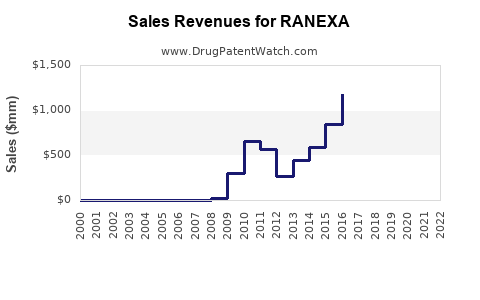
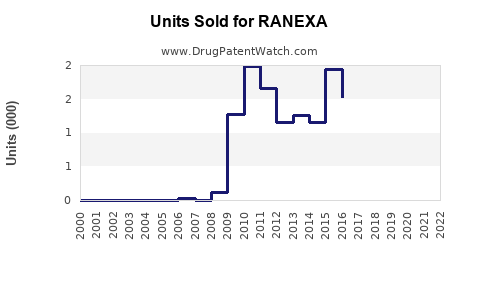
Annual Sales Revenues and Units Sold for RANEXA
| Drug Name | Revenues (USD) | Units | Year |
|---|---|---|---|
| RANEXA | ⤷ Start Trial | ⤷ Start Trial | 2022 |
| RANEXA | ⤷ Start Trial | ⤷ Start Trial | 2021 |
| RANEXA | ⤷ Start Trial | ⤷ Start Trial | 2020 |
| RANEXA | ⤷ Start Trial | ⤷ Start Trial | 2019 |
| RANEXA | ⤷ Start Trial | ⤷ Start Trial | 2018 |
| RANEXA | ⤷ Start Trial | ⤷ Start Trial | 2017 |
| RANEXA | ⤷ Start Trial | ⤷ Start Trial | 2016 |
| >Drug Name | >Revenues (USD) | >Units | >Year |
Ranexa (Ranolazine) Market Analysis, Patent Position and Sales Projections
Ranexa, the branded formulation of ranolazine, is a mature anti-anginal drug facing sustained generic erosion in the United States. Its commercial value is concentrated in low-cost generic ranolazine, while branded Ranexa has limited pricing power and declining strategic importance for its originator. A base-case forecast places the global ranolazine market at approximately $180 million to $230 million in 2025, rising to $220 million to $300 million by 2030, driven by prescription growth rather than price expansion.
The U.S. market is largely generic. Patent barriers that supported brand exclusivity have expired or have limited practical value against already-approved abbreviated new drug applications. The principal commercial risks are additional generic competition, formulary substitution, and low-cost international supply.
What is Ranexa and how large is the ranolazine market?
Ranexa is the extended-release formulation of ranolazine, approved by the U.S. Food and Drug Administration in 2006 for the treatment of chronic angina. It is generally used as add-on therapy when patients remain symptomatic despite treatment with beta blockers, calcium-channel blockers, or nitrates. Ranolazine does not materially reduce heart rate or blood pressure, which supports use in patients who cannot tolerate further hemodynamic effects.
| Market attribute | Assessment |
|---|---|
| Active ingredient | Ranolazine |
| Brand | Ranexa |
| Original developer | CV Therapeutics |
| Acquiring company | Gilead Sciences |
| U.S. approval | 2006 |
| Dosage form | Extended-release tablets |
| Primary indication | Chronic angina |
| Regulatory category | Small-molecule prescription drug |
| U.S. generic status | Multiple approved generic products |
| Current commercial phase | Mature, post-exclusivity market |
Gilead acquired CV Therapeutics in 2009. Ranexa generated several hundred million dollars in annual sales at its commercial peak, but revenue declined after generic ranolazine entered the U.S. market. Gilead’s later reporting has not consistently disclosed Ranexa as a separate material revenue line, limiting the reliability of current brand-sales estimates. [1]
When did Ranexa lose exclusivity?
Ranexa lost effective U.S. market exclusivity after the expiration of its principal small-molecule patents and the approval of generic ranolazine products.
The relevant patent estate included composition, formulation, and method-of-use claims. Public patent records and FDA Orange Book information indicate that the core patents expired between approximately 2019 and 2023, depending on the specific patent and applicable patent-term adjustments. The commercial consequence was earlier generic entry than the latest nominal patent date might suggest because not every listed patent created a durable barrier to an ANDA launch. [2,3]
| Exclusivity factor | Commercial effect |
|---|---|
| New chemical entity exclusivity | Expired |
| Core composition protection | Expired |
| Extended-release formulation patents | Expired or no longer commercially blocking |
| Method-of-use patents | Limited practical impact after generic approvals |
| Pediatric exclusivity | No material current protection |
| Current U.S. barrier | Low |
The key distinction is between patent expiration and effective market exclusivity. Ranexa retained listed patents after generic applications were filed, but generic companies could challenge those patents through Paragraph IV certifications or wait for the relevant expiration dates. The resulting litigation and regulatory process reduced the brand’s ability to preserve premium pricing.
What patents protect Ranexa and ranolazine?
Ranexa’s historic U.S. patent estate covered ranolazine itself, pharmaceutical compositions, extended-release delivery, and treatment of angina. The most relevant patent families reported in public FDA and USPTO records included the following:
| Patent area | Representative U.S. patent | General subject matter | Status |
|---|---|---|---|
| Ranolazine compound and pharmaceutical use | US 6,303,607 | Ranolazine-related composition and use claims | Expired |
| Ranolazine formulation and use | US 6,335,344 | Pharmaceutical composition and treatment claims | Expired |
| Extended-release formulation | US 7,265,119 | Modified-release ranolazine formulation | Expired or commercially non-blocking |
| Later treatment claims | US 8,211,896 | Method-of-use claims | Limited value against approved generic use |
Patent numbers and expiration dates should be assessed against the applicable Orange Book edition and USPTO patent-term calculation because patent-term adjustment, terminal disclaimers, and listed-use scope can affect the precise legal analysis. The estate is commercially weak today for four reasons:
- Core patents have expired.
- Generic products are already approved.
- Method-of-use claims do not prevent broad substitution when the generic label carries the relevant indication.
- Extended-release technology is no longer sufficient to support a meaningful brand premium.
What is the Orange Book status of Ranexa?
Ranexa is an FDA-approved reference-listed drug. Generic ranolazine extended-release tablets have been approved through the ANDA pathway. FDA Orange Book listings historically identified patents associated with the reference product, including formulation and method-of-use patents. [2]
The Orange Book is commercially important because it identifies patents submitted by the reference-product sponsor and the therapeutic-equivalence ratings of approved generic products. For Ranexa, the current value of the listing is primarily historical and legal. It does not create a meaningful barrier to generic substitution because approved generic products are available and the principal exclusivity period has passed.
Generic ranolazine tablets are generally available in the same extended-release strengths used for Ranexa, including 500 mg and 1,000 mg tablets. Therapeutic equivalence and state substitution rules support automatic or pharmacist-directed substitution in many U.S. settings.
Which companies are challenging Ranexa exclusivity?
The principal competitive challenge has come from generic manufacturers filing ANDAs for ranolazine extended-release tablets. Public FDA records have identified approvals or market activity involving manufacturers such as:
- Amneal Pharmaceuticals
- Dr. Reddy’s Laboratories
- Lupin
- Zydus Pharmaceuticals
- Torrent Pharmaceuticals
- Mylan and related Viatris entities
- Other regional and specialty generic manufacturers
The exact commercial participant set changes as suppliers enter, exit, acquire products, or lose preferred formulary placement. Competition is strongest in the United States, where multiple approved suppliers create significant pharmacy-benefit-manager leverage.
Paragraph IV litigation was relevant during the pre-generic period. Once FDA-approved generics entered the market, the practical effect of remaining patent disputes diminished sharply. The current issue is less whether a company can enter and more whether it can obtain sustainable volume and acceptable margins.
What Ranexa formulations are protected?
Ranexa uses an extended-release tablet designed to provide sustained ranolazine exposure. The formulation historically supported once- or twice-daily dosing depending on tablet strength and prescribing instructions. Formulation patents attempted to protect the release profile, excipient combination, and tablet composition rather than only the active ingredient.
Those formulation claims had greater value before generic approval. After approval of therapeutically equivalent extended-release products, formulation protection became commercially less effective. A generic manufacturer can avoid a patent claim through a different excipient system or manufacturing process, provided that the product meets FDA equivalence requirements.
The formulation remains technically relevant because ranolazine has a narrow commercial proposition: a reliable extended-release product with consistent exposure. It is not a major manufacturing barrier. The active ingredient is a small molecule, the dosage form is a conventional oral tablet, and no biologic manufacturing platform is involved.
What is the FDA regulatory status of Ranexa?
Ranexa is an approved FDA prescription product for chronic angina. Generic ranolazine extended-release tablets are also approved through the ANDA process. No biosimilar pathway applies because ranolazine is a small molecule rather than a biologic. [2]
The regulatory market is therefore defined by:
- ANDA competition rather than biosimilar competition
- Demonstrated pharmaceutical equivalence
- Therapeutic-equivalence ratings
- State substitution law
- Pharmacy-benefit-manager contracting
- Wholesale acquisition cost and rebate competition
A new entrant would face limited clinical-development requirements compared with a novel cardiovascular drug. The principal barriers are FDA compliance, bioequivalence, reliable extended-release manufacturing, controlled-substance-free supply logistics, and commercial access.
How much revenue does Ranexa generate?
Historical brand sales were materially higher before generic entry. Gilead’s public reporting showed a sharp decline in Ranexa revenue following generic competition, although subsequent filings have not provided a consistent standalone figure. [1]
A reasonable commercial reconstruction is:
| Period | Estimated branded Ranexa position | Market interpretation |
|---|---|---|
| 2017-2018 | Approximately $250 million-$350 million globally | Mature brand before full generic erosion |
| 2019-2020 | Approximately $100 million-$225 million | Rapid decline after generic entry |
| 2021-2024 | Below prior peak; likely tens of millions for the brand in the U.S. | Generic-dominated market |
| 2025 onward | Low and declining branded contribution | Residual brand demand and limited premium access |
These figures are estimates based on historical company disclosures, generic-entry timing, and the absence of recent standalone Ranexa reporting. They should not be treated as current audited product sales.
The economically relevant market is now the total ranolazine market, not the Ranexa brand alone. Generic products capture most prescription volume, while the brand may retain limited demand among patients, physicians, or payers with established product preference.
What are the Ranexa sales projections through 2030?
The following forecast models the total global ranolazine market, including branded Ranexa and generic ranolazine. It assumes low-single-digit prescription growth, continued price erosion in the United States, stable use in chronic angina, and modest expansion in international markets.
| Year | Bear case | Base case | Bull case |
|---|---|---|---|
| 2025 | $150 million | $205 million | $250 million |
| 2026 | $145 million | $215 million | $265 million |
| 2027 | $140 million | $225 million | $280 million |
| 2028 | $135 million | $235 million | $295 million |
| 2029 | $130 million | $245 million | $310 million |
| 2030 | $125 million | $255 million | $325 million |
| 2025-2030 CAGR | -3.6% | 4.5% | 5.4% |
Base-case assumptions
The base case assumes:
- U.S. generic price erosion continues but stabilizes as the supplier base consolidates.
- Ranolazine prescription volume grows by roughly 2% to 4% annually.
- Cardiovascular treatment remains the primary market.
- Generic manufacturers gain most incremental volume.
- Brand Ranexa remains a small share of U.S. revenue.
- International markets contribute a higher percentage of future growth than the United States.
- No major new indication receives broad regulatory approval.
Bear case assumptions
The bear case assumes further reimbursement compression, supplier exits that do not improve prices, greater substitution by alternative anti-anginal therapies, and weak international demand.
Bull case assumptions
The bull case requires sustained physician use in patients with low blood pressure or heart-rate limitations, stronger diagnosis and treatment of chronic angina, and improved generic pricing outside the United States. It does not assume a return to pre-generic brand revenue.
How does Ranexa compare with competing anti-anginal drugs?
Ranolazine competes with established low-cost therapies and newer cardiovascular treatment strategies.
| Therapy | Main advantage | Limitation versus ranolazine |
|---|---|---|
| Beta blockers | Low cost and strong physician familiarity | Can reduce heart rate and blood pressure |
| Calcium-channel blockers | Broad anti-anginal use | Hemodynamic and tolerability issues |
| Long-acting nitrates | Established symptom relief | Tolerance and dosing limitations |
| Ivabradine | Heart-rate reduction in selected markets | Regulatory availability varies |
| Trimetazidine | Used in some international markets | Limited U.S. availability |
| Ranolazine | Minimal effect on heart rate and blood pressure | Cost and drug-interaction concerns |
Ranolazine’s clinical niche is defensible but narrow. It is most valuable when standard agents are inadequate or poorly tolerated. It is less likely to displace inexpensive first-line drugs.
What generic entry risks exist for Ranexa?
The main generic-entry risk has already occurred. Future risks are commercial rather than patent-driven:
- Additional ANDA approvals can reduce supplier economics.
- Pharmacy-benefit managers can force substitution.
- Brand retention may require discounts or patient-support programs.
- Generic manufacturers can compete through lower acquisition cost.
- International markets may impose reference pricing.
- Formulation defects or supply interruptions can shift market share rapidly.
- Combination therapy and competing cardiovascular products can limit volume growth.
The possibility of a premium-priced reformulation is low unless a company develops a clinically differentiated delivery system, fixed-dose combination, or new indication supported by FDA approval.
What licensing deals and commercial partnerships affect Ranexa?
CV Therapeutics commercialized Ranexa before Gilead acquired the company. The 2009 acquisition transferred Ranexa-related assets, commercialization rights, and intellectual property to Gilead. [4]
No major current licensing transaction is required to explain the product’s market position. Any future transaction would likely involve regional generic rights, authorized-generic supply, or a portfolio sale rather than a high-value branded licensing agreement.
What is the litigation status and settlement risk?
Ranexa’s material patent-litigation risk was concentrated in the period before generic entry. Current litigation risk is low relative to the product’s historical exposure. The relevant settlement risk is also largely historical because generic manufacturers already have market access.
A new dispute could arise from:
- Manufacturing-process patents
- Labeling or induced-infringement claims
- Trademark or trade-dress disputes
- Product-quality allegations
- ANDA patent challenges for a new formulation
Such disputes would have limited ability to restore brand exclusivity for the existing product.
How strong is the Ranexa patent estate?
The current patent estate is weak for blocking purposes and moderate only as historical documentation of the product’s formulation and use. Its strongest period ended when the core patents expired and multiple generic products obtained FDA approval.
| Factor | Strength |
|---|---|
| Core molecule protection | None |
| Extended-release formulation protection | Low |
| Method-of-use protection | Low to moderate, depending on claim scope |
| Manufacturing barriers | Low |
| Regulatory exclusivity | None material |
| Generic substitution defense | Weak |
| International protection | Fragmented and largely expired |
| Relevance to new entrants | Limited |
What geographic markets offer the most opportunity?
The United States remains the largest and most competitive market. Future growth is more likely in countries where generic penetration is incomplete, ranolazine remains underused, or chronic angina treatment is expanding.
Potentially attractive regions include:
- China, subject to local procurement and pricing controls
- India, where cardiovascular disease prevalence is high but competition is intense
- Latin America, where branded and generic segments coexist
- Selected European markets, depending on reimbursement and national tendering
- Middle Eastern markets with private-pay cardiovascular demand
Geographic opportunity does not imply high margins. Ranolazine is vulnerable to reference pricing, tenders, compulsory substitution, and local generic manufacturing.
Key Takeaways
- Ranexa is a mature extended-release ranolazine product with no meaningful remaining U.S. exclusivity.
- Generic ranolazine dominates the U.S. market.
- The core patent estate is expired or commercially non-blocking.
- No biosimilar risk applies because ranolazine is a small molecule.
- Historical branded revenue reached several hundred million dollars annually before generic erosion.
- Current brand revenue is likely a small fraction of the total ranolazine market.
- The base-case global ranolazine market is projected at about $205 million in 2025 and $255 million in 2030.
- Growth depends on prescription expansion and international demand, not premium pricing.
- New formulation or indication patents would be required to create material commercial differentiation.
- The principal investment opportunity is in efficient generic manufacturing, regional distribution, and portfolio consolidation.
FAQs
Is Ranexa still protected by patents?
No material U.S. patent protection remains capable of preventing generic ranolazine competition. Historical formulation and method-of-use patents have expired or have limited practical blocking value.
Can a generic company launch ranolazine without clinical trials?
Yes. A manufacturer generally uses the FDA ANDA pathway and must demonstrate bioequivalence and pharmaceutical equivalence to the reference-listed drug.
Is Ranexa a biologic or biosimilar product?
No. Ranexa contains the small-molecule active ingredient ranolazine and competes through generic, not biosimilar, regulation.
Could a new Ranexa formulation regain market exclusivity?
Potentially, but only if the formulation is novel, patentable, clinically differentiated, and supported by an appropriate FDA regulatory pathway. A simple change in tablet strength or packaging would not normally create durable exclusivity.
What is the main commercial risk for ranolazine investors?
The main risk is continued price compression in a genericized market. Prescription growth may not translate into revenue growth if reimbursement reductions and supplier competition exceed volume gains.
References
- Gilead Sciences, Inc. (2019). Annual report pursuant to Section 13 or 15(d) of the Securities Exchange Act of 1934 for the fiscal year ended December 31, 2019.
- U.S. Food and Drug Administration. (2024). Approved drug products with therapeutic equivalence evaluations: Orange Book.
- U.S. Patent and Trademark Office. (2024). Patent Center and patent term adjustment records.
- Gilead Sciences, Inc. (2009). Gilead Sciences completes acquisition of CV Therapeutics. Press release.
More… ↓
