Last updated: February 20, 2026
This report provides a snapshot of the current market landscape for naltrexone, including key drivers, competitive dynamics, and sales forecasts through 2030.
Market Overview
Naltrexone is an opioid receptor antagonist used primarily in alcohol and opioid dependence management. It is marketed in oral form (Revia) and as an extended-release injectable (Vivitrol). The drug's versatility and established efficacy position it as a leading product in addiction treatment.
Market Drivers
- Growing prevalence of alcohol and opioid use disorders (OUD).
- Increased focus on medication-assisted treatment (MAT) programs.
- Expanding insurance coverage and government initiatives.
- Rising awareness of addiction treatment options.
Market Constraints
- Competition from newer therapeutics and combination therapies.
- Regulatory challenges, especially concerning abuse deterrent formulations.
- High cost of injectable formulations.
- Stigma associated with addiction treatment.
Regional Landscape
| Region |
Market Share (2022) |
Key Developments |
| North America |
50% |
Major market due to high OUD prevalence and coverage |
| Europe |
25% |
Growing adoption; regulatory approval for injectables |
| Asia-Pacific |
15% |
Rising treatment adoption; increased unregulated use |
| Rest of World |
10% |
Limited access; emerging markets’ growth potential |
Key Market Players
- Alkermes (Vivitrol)
- Reckitt Benckiser (discontinued after acquisition)
- Mylan (now part of Viatris)
- Sun Pharmaceutical Industries
- Camurus (FDA-approved for high-dose formulations)
Sales Trends
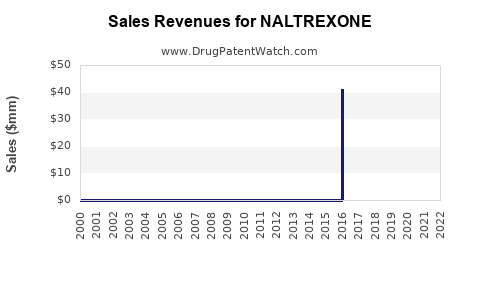
Global sales of naltrexone totaled approximately $400 million in 2022. North America accounts for half of this, with Europe at 25%. Sales are forecasted to grow at a compound annual growth rate (CAGR) of 6% from 2023 to 2030, reaching around $700 million.
Historical Revenue (2020–2022)
| Year |
Estimated Sales (USD million) |
Growth Rate |
| 2020 |
360 |
4% |
| 2021 |
380 |
5.5% |
| 2022 |
400 |
5.3% |
Future Projections (2023–2030)
| Year |
Projected Sales (USD million) |
CAGR |
| 2023 |
426 |
6.5% |
| 2024 |
454 |
6.6% |
| 2025 |
484 |
6.5% |
| 2026 |
516 |
6.4% |
| 2027 |
549 |
6.3% |
| 2028 |
584 |
6.2% |
| 2029 |
622 |
6.1% |
| 2030 |
662 |
6% |
Factors Influencing Sales Growth
- Expansion in OUD treatment programs, especially in the US through Medicare and Medicaid.
- Launch of extended-release formulations in emerging markets.
- Development of combination therapies that include naltrexone.
- Patent expirations lens: generic versions expected to lower prices, expanding access.
Competitive Dynamics
Sales dominance by Vivitrol (Alkermes) continues due to its injectable formulation and reimbursement coverages. Mylan and Sun Pharma challenge through patent challenges and cost competitiveness. Patent expiry for oral formulations may induce price reductions.
Regulatory Environment
- The US FDA has approved extended-release formulations for both alcohol and opioid dependence.
- Encouragement of heroin and opioid abuse treatment policies in the US and Europe aids market growth.
- Approvals in Asia-Pacific territories are increasing, driven by local demand.
Conclusions
Naltrexone's market remains robust within the addiction treatment space. Growth prospects hinge on expanding access, especially in underserved markets, and on innovations like combination regimens and new delivery systems.
Key Takeaways
- Naltrexone sales are driven by increased awareness of addiction treatment.
- The market is projected to grow at a CAGR of 6% through 2030.
- North America dominates sales, but emerging markets show significant potential.
- Generic entry and formulation innovations will influence pricing and adoption.
- Competition centers around delivery mechanisms and cost.
FAQs
1. What factors could hinder naltrexone sales growth?
Restrictions on reimbursement, competition from newer therapies, patent expirations, and stigma surrounding addiction treatment may slow growth.
2. Which region is expected to lead global sales in the next five years?
North America will likely maintain dominance due to high OUD prevalence and comprehensive treatment programs.
3. Are there any significant upcoming formulations or approvals?
Extended-release formulations with higher doses are under development; regulatory approvals in Asia and Latin America are anticipated.
4. How does patent expiry impact the market?
Patent expiry for branded formulations enables generics, lowering prices and expanding access but pressures brand sales.
5. What role do government policies play?
Policies supporting MAT, including funding and streamlined approvals, directly influence market expansion.
References
[1] U.S. Food and Drug Administration. (2022). Naltrexone drug approvals. FDA.gov.
[2] MarketScope. (2023). Global addiction treatment market report.
[3] IQVIA. (2022). Worldwide prescription drug sales data.
[4] World Health Organization. (2022). Substance use and health statistics.
[5] Reuters. (2022). Alkermes markets vivitrol in opioid addiction treatment.