Share This Page
Drug Sales Trends for LEVAQUIN
✉ Email this page to a colleague
Payment Methods and Pharmacy Types for LEVAQUIN (2002)
Revenues by Pharmacy Type
Units Sold by Pharmacy Type
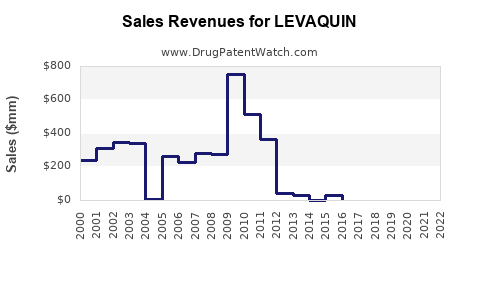
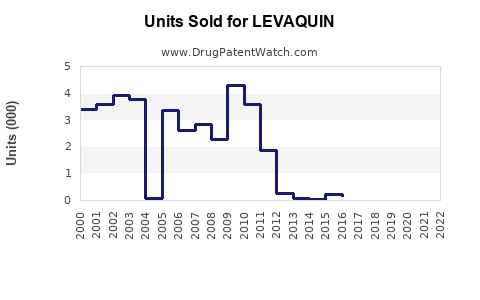
Annual Sales Revenues and Units Sold for LEVAQUIN
| Drug Name | Revenues (USD) | Units | Year |
|---|---|---|---|
| LEVAQUIN | ⤷ Start Trial | ⤷ Start Trial | 2022 |
| LEVAQUIN | ⤷ Start Trial | ⤷ Start Trial | 2021 |
| LEVAQUIN | ⤷ Start Trial | ⤷ Start Trial | 2020 |
| >Drug Name | >Revenues (USD) | >Units | >Year |
Levaquin Market Analysis and Sales Projections: Levofloxacin Patent, Generic Competition and Revenue Outlook
Levaquin is the branded formulation of levofloxacin, a fluoroquinolone antibiotic commercialized by Johnson & Johnson’s Janssen unit. Its U.S. patent exclusivity ended in 2011, and the market is now dominated by generic levofloxacin tablets, oral solution and injection. Brand Levaquin has minimal current commercial relevance in the United States; market value remains in generic hospital and outpatient use.
The levofloxacin market is mature, price-sensitive and likely to decline modestly in developed markets because of antimicrobial stewardship, fluoroquinolone safety restrictions and generic substitution. Emerging-market demand and injectable hospital use should limit the pace of decline.
What is the current market status of Levaquin?
Levaquin is no longer a protected branded growth product. It competes as an off-patent antibiotic across several dosage forms:
| Market characteristic | Current status |
|---|---|
| Active ingredient | Levofloxacin |
| Drug class | Fluoroquinolone antibiotic |
| Original U.S. sponsor | Ortho-McNeil-Janssen, now Janssen Pharmaceuticals |
| U.S. approval | 1996 |
| Primary indications | Pneumonia, sinusitis, urinary tract infections, pyelonephritis, skin infections and other susceptible bacterial infections |
| Main dosage forms | Tablets, oral solution and intravenous injection |
| U.S. patent position | Core exclusivity expired |
| Current competition | Multiple generic manufacturers |
| Biosimilar exposure | None; levofloxacin is a small-molecule drug |
| Commercial phase | Mature generic market |
FDA-approved labeling includes boxed warnings covering disabling and potentially irreversible adverse reactions involving tendons, muscles, joints, nerves and the central nervous system. FDA also requires warnings concerning exacerbation of myasthenia gravis and aortic aneurysm and dissection risk.[1][2]
These restrictions have reduced the role of systemic fluoroquinolones in uncomplicated infections. Levofloxacin remains commercially relevant in hospital care, serious respiratory infections and selected urinary tract infections where clinical considerations support use.
How much did Levaquin historically sell?
Levaquin reached peak commercial value before generic entry. Johnson & Johnson reported Levaquin sales of approximately $1.4 billion in 2010, according to company filings and contemporary market reporting.[3]
The product lost U.S. exclusivity in 2011 after patent expiry and pediatric exclusivity. Sales fell sharply as generic levofloxacin entered the market. The brand’s historical revenue profile was:
| Period | Commercial position | Revenue direction |
|---|---|---|
| 1996-2004 | Market expansion and broad clinical adoption | Rising |
| 2005-2009 | Mature branded product | High but relatively stable |
| 2010 | Pre-expiry peak | Approximately $1.4 billion globally |
| 2011-2013 | Generic erosion | Rapid decline |
| 2014 onward | Mature generic market | Brand revenue largely immaterial |
The post-expiry market should be analyzed as the levofloxacin molecule market rather than as branded Levaquin sales.
What are the sales projections for Levaquin and levofloxacin?
Brand Levaquin projection
Branded Levaquin has limited remaining revenue potential in the United States and other highly genericized markets. A reasonable base case is:
| Fiscal year | Estimated branded Levaquin revenue | Expected trend |
|---|---|---|
| 2024 | Less than $25 million globally | Stable to declining |
| 2025 | Less than $25 million | Declining |
| 2026 | Less than $20 million | Declining |
| 2027 | Less than $20 million | Flat to declining |
| 2028 | Less than $15 million | Declining |
These figures represent a commercial estimate for the original brand, not total sales of generic levofloxacin. Remaining brand revenue may persist in markets where physicians, hospitals or distributors retain brand preferences, but the brand has no credible path to a material growth trajectory.
Total levofloxacin molecule projection
A broader market estimate includes generic tablets, oral solution and injectable products. Because manufacturers generally report levofloxacin sales within broader generic portfolios, the market must be modeled from prescription volume, hospital demand and realized pricing.
| Year | Estimated global levofloxacin market | Base-case growth |
|---|---|---|
| 2024 | $1.3 billion-$1.7 billion | Baseline |
| 2025 | $1.3 billion-$1.7 billion | 0% to 2% |
| 2026 | $1.3 billion-$1.7 billion | -1% to 1% |
| 2027 | $1.2 billion-$1.7 billion | -1% to 1% |
| 2028 | $1.2 billion-$1.6 billion | -2% to 0% |
| 2029 | $1.1 billion-$1.6 billion | -2% to 0% |
The base case implies a low-single-digit annual decline in mature markets, offset partly by volume growth in emerging markets and continued use of intravenous formulations.
Scenario analysis
| Scenario | 2029 global market assumption | Main drivers |
|---|---|---|
| Downside | $0.9 billion-$1.2 billion | Faster stewardship restrictions, resistance, price compression and substitution by newer antibiotics |
| Base case | $1.1 billion-$1.6 billion | Stable hospital use, gradual outpatient decline and continued emerging-market demand |
| Upside | $1.6 billion-$2.0 billion | Higher infectious-disease burden, hospital volume growth and slower substitution |
The most probable outcome is market stability in nominal terms followed by gradual erosion. A return to branded Levaquin-era revenue is unlikely.
Which companies compete in the levofloxacin market?
Competition is fragmented and differs by country. Generic suppliers may include Teva Pharmaceutical Industries, Sandoz, Viatris, Sun Pharmaceutical Industries, Cipla, Dr. Reddy’s Laboratories, Aurobindo Pharma, Lupin and regional manufacturers.
The competitive structure differs by dosage form:
| Segment | Competitive intensity | Commercial characteristics |
|---|---|---|
| 250 mg and 500 mg tablets | Very high | Commodity pricing and broad generic availability |
| 750 mg tablets | High | Used for selected respiratory and complicated infections |
| Oral solution | Moderate | Lower volume and more limited supplier base |
| Intravenous injection | High | Hospital contracts, supply reliability and quality records influence awards |
| Institutional tenders | Very high | Price and manufacturing continuity are primary factors |
| Retail prescriptions | High | Generic substitution and formulary placement dominate |
Injectable levofloxacin generally has greater strategic value than tablets because hospitals prioritize dependable supply, sterile manufacturing capacity and regulatory compliance. However, hospital contracting can compress margins substantially.
What patents protect Levaquin?
The primary U.S. patent estate for Levaquin is expired. Levofloxacin is the S-enantiomer of ofloxacin, and its development relied on patents covering the compound and related quinolone chemistry.
A principal historical patent associated with levofloxacin was U.S. Patent No. 5,053,407, which covered levofloxacin-related quinolone compounds and expired before or around the original loss-of-exclusivity period. The commercial exclusivity period was extended by pediatric exclusivity, resulting in generic entry in 2011.
| Patent or exclusivity element | Relevance |
|---|---|
| U.S. Patent No. 5,053,407 | Core historical compound protection |
| Pediatric exclusivity | Extended effective market protection after patent expiry |
| Formulation patents | Did not create a durable barrier to standard generic tablets and injection |
| Method-of-use patents | Limited practical ability to preserve broad market exclusivity |
| Current blocking patents | None with broad commercial significance for standard levofloxacin products |
Patent protection in other jurisdictions expired on different schedules, but the major commercial markets have been generic for many years.
What was the Orange Book status of Levaquin?
Levaquin was approved under FDA NDA 020634. Its approved products included tablets, oral solution and injectable formulations. The brand has been discontinued or commercially inactive in the U.S. market, while generic abbreviated new drug applications remain the primary supply source.
Orange Book considerations are now limited:
- Expired patents do not prevent generic marketing.
- A discontinued brand does not eliminate generic approvals.
- Standard levofloxacin products do not face a current patent-based barrier to entry.
- Any remaining listed patent issue would need to be assessed by dosage form and NDA record rather than by the brand name alone.
FDA’s Orange Book remains the controlling source for current patent listings, therapeutic-equivalence evaluations and product discontinuation status.[4]
When did Levaquin lose exclusivity?
Levaquin lost effective U.S. market exclusivity in 2011.
The timing reflected three events:
- Original FDA approval in 1996.
- Expiration of core patent protection after the initial patent term.
- Additional pediatric exclusivity that delayed generic entry beyond the underlying patent expiry date.
Generic levofloxacin products entered after Abbreviated New Drug Application litigation and regulatory review. Once multiple products launched, rapid price and market-share erosion followed.
Which companies challenged Levaquin patents under Paragraph IV?
Generic manufacturers challenged the relevant Levaquin patents through Paragraph IV certifications during the pre-expiry period. The historical litigation involved generic companies seeking approval before the expiration of listed patents, including major U.S. generic manufacturers.
The legal outcomes produced settlements and delayed commercial entry until the agreed or legally available launch period. These disputes are now historical rather than active barriers to generic levofloxacin supply. The key commercial result was the opening of the market in 2011.
There is no current Paragraph IV risk comparable to the pre-2011 Levaquin litigation because the core market exclusivity has already expired.
What formulation patents protect levofloxacin products?
Standard levofloxacin tablets and injections have limited patent defensibility. Generic manufacturers can generally produce conventional dosage forms without infringing an active, commercially important Levaquin patent.
Potential formulation differentiation may involve:
- Modified-release delivery.
- Taste-masked oral liquids.
- Combination products.
- Ophthalmic or otic delivery systems.
- Specialized hospital packaging.
- Stability-enhanced injectable formulations.
- Novel administration devices.
These features can support a separate regulatory or commercial position, but they do not restore broad protection for conventional levofloxacin tablets or intravenous products.
The more relevant barriers are manufacturing validation, sterile-facility capacity, FDA inspection history, supply reliability and hospital contracting.
Does levofloxacin face biosimilar competition?
No. Levofloxacin is a chemically synthesized small molecule, not a biologic. The relevant competition is generic competition under the ANDA pathway, not biosimilar competition under the Public Health Service Act.
This distinction matters commercially:
| Issue | Levofloxacin |
|---|---|
| Regulatory pathway | ANDA generic pathway |
| Interchangeability | Therapeutic equivalence under FDA standards |
| Biosimilar designation | Not applicable |
| Reference biologic | None |
| Main price pressure | Generic substitution and tenders |
What regulatory factors affect future levofloxacin sales?
FDA safety actions are the most important regulatory factor affecting demand. FDA has advised that systemic fluoroquinolones should generally be reserved for patients without alternative treatment options for acute bacterial sinusitis, acute bacterial exacerbation of chronic bronchitis and uncomplicated urinary tract infections because the risks may outweigh the benefits in some cases.[1]
Demand is also affected by:
- Hospital antimicrobial stewardship programs.
- Increasing bacterial resistance.
- Prescriber preference for narrower-spectrum antibiotics.
- Safety warnings involving tendons, peripheral neuropathy and central nervous system effects.
- Concerns involving aortic aneurysm and dissection.
- Restrictions on use in uncomplicated outpatient infections.
- Changes in clinical guidelines.
These factors reduce prescription volume but do not eliminate use in serious infections where intravenous or high-bioavailability therapy remains clinically useful.
What generic entry risks exist for remaining Levaquin revenue?
The primary generic entry risk has already occurred. Remaining commercial risk involves further price erosion, supplier consolidation and substitution by competing antibiotics.
| Risk | Probability | Impact |
|---|---|---|
| New generic tablet entrant | Low strategic significance; market already generic | High price pressure |
| Additional injectable supplier | Moderate | Moderate price pressure |
| Hospital tender loss | High | High for individual suppliers |
| Manufacturing interruption | Moderate | Potential temporary price increase |
| Safety-driven volume decline | High over long term | Moderate to high |
| Resistance-driven displacement | Moderate | High in affected indications |
| Brand relaunch | Very low | Limited commercial upside |
For generic manufacturers, the opportunity is operational rather than patent-driven. A supplier with low-cost production, reliable sterile manufacturing and strong hospital distribution can capture share despite limited pricing power.
How does Levaquin compare with competing antibiotics?
Levofloxacin competes with moxifloxacin, ciprofloxacin, ceftriaxone, azithromycin, amoxicillin-clavulanate and newer branded antibiotics. Its advantages include oral bioavailability, intravenous availability and broad Gram-negative and respiratory coverage.
| Drug | Key advantage | Main competitive weakness |
|---|---|---|
| Levofloxacin | Oral/IV flexibility and broad coverage | Fluoroquinolone safety restrictions |
| Moxifloxacin | Strong respiratory coverage | Limited urinary utility and similar safety concerns |
| Ciprofloxacin | Strong Gram-negative activity | Weaker pneumococcal coverage and safety limitations |
| Ceftriaxone | Established hospital use | Injectable only |
| Azithromycin | Familiar outpatient use | Resistance and coverage limitations |
| Amoxicillin-clavulanate | Common first-line outpatient therapy | Tolerability and resistance limitations |
Levofloxacin’s strongest position is in settings requiring a high-bioavailability oral alternative to intravenous therapy or broad coverage when other options are unsuitable.
What is the revenue exposure for manufacturers?
Revenue exposure is concentrated in generic portfolios rather than in Janssen. A supplier’s levofloxacin exposure depends on product mix:
- Tablets generate volume but have the highest price competition.
- Injection generates hospital relevance but requires sterile capacity.
- Oral solution is a smaller niche.
- Government and hospital contracts create recurring demand but lower gross margins.
- Emerging-market retail markets can support volume growth but often at lower realized prices.
For investors, levofloxacin should generally be treated as a defensive mature product rather than a growth asset. A manufacturer with a broad hospital injectable portfolio may gain strategic value from levofloxacin supply, but the molecule alone is unlikely to materially change enterprise valuation.
What patent litigation or settlement agreements affect Levaquin today?
No active patent litigation is expected to create a broad U.S. barrier to conventional generic levofloxacin. Historical Paragraph IV litigation and settlement agreements determined the timing of generic entry, but those events no longer protect the brand.
Current legal exposure is more likely to involve:
- Product liability claims.
- Manufacturing and quality disputes.
- Contracting disputes.
- Antitrust claims concerning historical generic-delay settlements.
- Regulatory enforcement involving manufacturing or promotional conduct.
Patent litigation is no longer the primary market variable.
Key Takeaways
- Levaquin is the branded version of levofloxacin and has lost U.S. market exclusivity.
- Historical peak sales were approximately $1.4 billion in 2010.
- Brand Levaquin revenue is now immaterial relative to generic levofloxacin sales.
- The global levofloxacin market is estimated at approximately $1.3 billion to $1.7 billion in 2024.
- Base-case market value is expected to decline modestly through 2029.
- Standard tablets, oral solution and injection face no meaningful current patent barrier.
- Generic competition, hospital tenders and price compression define the market.
- FDA fluoroquinolone safety warnings and antimicrobial stewardship are the main demand constraints.
- Biosimilar risk does not apply because levofloxacin is a small-molecule drug.
- The best commercial opportunities are in reliable injectable supply, hospital contracting and selected emerging markets.
FAQs
Is Levaquin still sold in the United States?
Brand Levaquin has little current U.S. commercial significance. Generic levofloxacin tablets, oral solution and injection remain available through multiple FDA-approved suppliers.
Is levofloxacin a profitable generic drug?
Levofloxacin can be profitable when produced at low cost or supplied through hospital contracts, but conventional tablets face substantial price competition. Injectable products may offer greater strategic value but require qualified sterile manufacturing.
Can a company obtain new patents on levofloxacin?
A company may patent a genuinely novel formulation, delivery system or combination product, but new patents would not recreate broad exclusivity for conventional levofloxacin tablets or injection.
Is levofloxacin demand growing in emerging markets?
Demand may grow in selected emerging markets because of population growth, hospital expansion and broader antibiotic access. Revenue growth is constrained by low prices, generic competition and local antimicrobial-resistance policies.
What would cause levofloxacin sales to decline faster than projected?
Faster decline could result from expanded fluoroquinolone restrictions, higher resistance rates, safety-related regulatory action, stronger use of narrower-spectrum antibiotics or loss of hospital formulary access.
References
- U.S. Food and Drug Administration. (2016). FDA updates warnings for oral and injectable fluoroquinolone antibiotics due to disabling side effects. https://www.fda.gov
- U.S. Food and Drug Administration. (2018). FDA strengthens safety warnings for fluoroquinolone antibiotics regarding risks of aortic aneurysm and dissection. https://www.fda.gov
- Johnson & Johnson. (2011). Annual report 2010. https://www.jnj.com
- U.S. Food and Drug Administration. (2024). Approved drug products with therapeutic equivalence evaluations: Orange Book. https://www.fda.gov
- U.S. Food and Drug Administration. (2024). Levaquin prescribing information. https://www.accessdata.fda.gov
More… ↓
