Share This Page
Drug Sales Trends for LANSOPRAZOLE
✉ Email this page to a colleague
Payment Methods and Pharmacy Types for LANSOPRAZOLE (2002)
Revenues by Pharmacy Type
Units Sold by Pharmacy Type
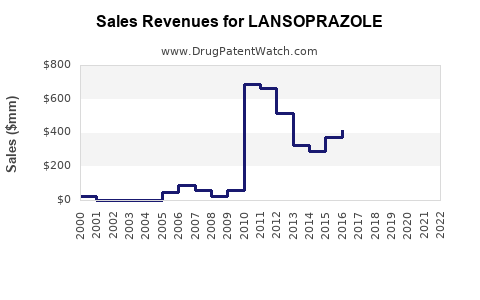
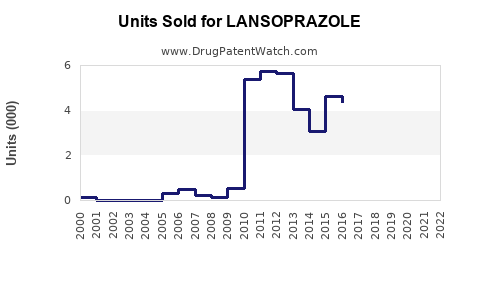
Annual Sales Revenues and Units Sold for LANSOPRAZOLE
| Drug Name | Revenues (USD) | Units | Year |
|---|---|---|---|
| LANSOPRAZOLE | ⤷ Start Trial | ⤷ Start Trial | 2022 |
| LANSOPRAZOLE | ⤷ Start Trial | ⤷ Start Trial | 2021 |
| LANSOPRAZOLE | ⤷ Start Trial | ⤷ Start Trial | 2020 |
| >Drug Name | >Revenues (USD) | >Units | >Year |
Lansoprazole Market Analysis, Sales Forecast, Patent Status, and Generic Competition
Lansoprazole is a mature proton pump inhibitor (PPI) with broad global availability, no meaningful U.S. market exclusivity, and extensive generic competition. Commercial value has shifted from the original Prevacid brand to low-cost prescription generics, over-the-counter products, private-label formulations, and markets where generic substitution remains incomplete. A reasonable base-case estimate places global finished-product lansoprazole sales at approximately $380 million in 2025, declining to about $330 million by 2029.
What is the current lansoprazole market size?
No public source reports a single audited global sales figure for lansoprazole across prescription, OTC, hospital, private-label, and generic channels. Public company filings generally aggregate lansoprazole with broader gastrointestinal or generic portfolios.
The market is best analyzed by product channel:
| Channel | Market position | Revenue outlook |
|---|---|---|
| U.S. prescription generics | Highly commoditized | Declining or stable |
| U.S. OTC lansoprazole | Established private-label and branded segment | Stable to modest decline |
| Europe | Generic and pharmacy-driven | Declining |
| Japan and selected Asian markets | Stronger branded and prescription presence | Stable |
| Emerging markets | Volume growth but low prices | Moderate unit growth |
| Hospital and institutional supply | Tender-driven | Low margins, volatile pricing |
The original Prevacid franchise generated multibillion-dollar revenue during its peak period, but that revenue is no longer representative of the current lansoprazole market. Takeda reported Prevacid as a major product before loss of exclusivity, while later filings reflected the erosion of the franchise following generic entry and the separation of Takeda’s former joint venture structure with Abbott. [1, 2]
2025 global sales scenario
The following estimate covers finished lansoprazole products and excludes API-only transactions. It is an analytical market model rather than reported company revenue.
| Scenario | 2025 sales | 2029 sales | 2025-2029 CAGR | Main assumptions |
|---|---|---|---|---|
| Low | $250 million | $190 million | -6.6% | Continued PPI substitution and price erosion |
| Base | $380 million | $330 million | -3.5% | Stable OTC demand and moderate emerging-market volume |
| High | $600 million | $610 million | 0.4% | Stronger Asian demand, slower substitution, stable OTC pricing |
The principal risks to the base case are low generic prices, physician substitution to omeprazole or pantoprazole, reduced long-term PPI use, and retailer pressure on OTC shelf pricing. The main upside factors are continued demand for acid suppression, low-cost access in emerging markets, and the availability of delayed-release formulations through multiple retail channels.
How are lansoprazole sales expected to change from 2025 to 2029?
The base-case forecast assumes declining revenue but relatively resilient unit demand.
| Year | Base-case global sales | Estimated unit trend | Revenue driver |
|---|---|---|---|
| 2025 | $380 million | Baseline | Generic and OTC demand |
| 2026 | $370 million | Flat to slightly higher | Price erosion offsets volume |
| 2027 | $355 million | Slightly higher | Substitution and tender pricing |
| 2028 | $340 million | Flat | Mature market conditions |
| 2029 | $330 million | Flat to slightly higher | Lower prices and stable access |
Lansoprazole is unlikely to regain the commercial profile of a branded innovative medicine. Revenue growth would require geographic expansion, a differentiated delivery system, pediatric positioning, or a new combination product. Standard 15 mg and 30 mg delayed-release capsules have little pricing power.
What products contain lansoprazole?
Lansoprazole is marketed in several oral formulations:
- Delayed-release capsules, commonly 15 mg and 30 mg
- Orally disintegrating or orally dissolving tablets
- OTC delayed-release capsules, commonly sold as 15 mg products
- Compounded or hospital-prepared liquid suspensions
- Fixed or co-packaged gastrointestinal treatment regimens in selected markets
The active pharmaceutical ingredient is lansoprazole, a substituted benzimidazole PPI. The molecule suppresses gastric acid secretion by irreversibly inhibiting the gastric H+/K+-ATPase after activation in the acidic canaliculi of parietal cells.
Formulation performance depends on protecting the acid-labile active ingredient until it reaches the intestine. Enteric coating, pellet technology, capsule construction, excipient selection, and moisture control are therefore more commercially relevant than the expired composition-of-matter estate.
What is the FDA regulatory status of lansoprazole?
Lansoprazole is an FDA-approved prescription and OTC active ingredient. FDA approved Prevacid for prescription use in the mid-1990s and later approved Prevacid 24HR for nonprescription use. FDA records identify lansoprazole products for gastroesophageal reflux disease, erosive esophagitis, duodenal ulcer, gastric ulcer, and hypersecretory conditions, with indications varying by product and strength. [3]
The U.S. regulatory pathway is now dominated by abbreviated new drug applications (ANDAs) and OTC products. New entrants generally do not need to repeat the original clinical development program if they demonstrate pharmaceutical equivalence, bioequivalence, manufacturing compliance, and labeling conformity.
What is the Orange Book status of lansoprazole?
Lansoprazole has no commercially meaningful unexpired U.S. Orange Book patent barrier for standard delayed-release products. Historical Prevacid listings covered the active ingredient, delayed-release formulations, and related product claims. Those patents have expired or no longer prevent routine generic competition. FDA’s Orange Book remains the controlling source for current listed patents, exclusivity, and reference-product status. [4]
The commercial implication is direct: an ANDA applicant generally competes on manufacturing cost, supply reliability, wholesaler access, formulary placement, and retail distribution rather than on an ability to design around a live core patent.
What patents protect lansoprazole?
The original lansoprazole patent estate included compound and formulation claims associated with Takeda and its development partners. Representative historical U.S. patents include:
| Patent | General subject | Current commercial status |
|---|---|---|
| U.S. Patent No. 4,628,098 | Lansoprazole compound and related benzimidazole chemistry | Expired |
| U.S. Patent No. 5,045,552 | Pharmaceutical formulation and oral dosage technology | Expired |
| Additional Prevacid patents | Delayed-release dosage forms and product-specific claims | Expired or commercially nonblocking |
Patent term calculations depend on filing date, issue date, patent-term adjustment, terminal disclaimers, pediatric extensions, and jurisdiction. The core compound protection is no longer relevant to U.S. generic entry. Secondary formulation patents also have reached the end of their practical commercial life.
What formulations are protected by lansoprazole patents?
Historical formulation protection focused on:
- Enteric protection of acid-sensitive lansoprazole
- Delayed-release pellets inside hard gelatin capsules
- Orally disintegrating dosage forms
- Stabilization against moisture and acid degradation
- Alternative excipient and coating systems
A current entrant may still obtain patents for a genuinely differentiated delivery system, manufacturing process, device, or combination regimen. Such patents would protect the new product, not restore exclusivity for ordinary lansoprazole capsules.
When did lansoprazole lose exclusivity?
Lansoprazole lost meaningful U.S. exclusivity in stages rather than on one universal date.
- Original prescription launch: 1995
- Pediatric and other regulatory exclusivities: historical and expired
- Core compound protection: expired
- Prevacid formulation protection: expired
- Generic competition: established by the late 2000s
- OTC competition: established after FDA’s approval of OTC lansoprazole products
The most commercially important loss occurred when generic manufacturers entered after the expiration of relevant formulation and product patents. By the early 2010s, lansoprazole was a mature generic product in the United States.
Which companies compete in the lansoprazole market?
The competitive field includes generic manufacturers, OTC marketers, regional pharmaceutical companies, and contract manufacturers. Participants vary by country and may change through product transfers or wholesaler contracts.
Representative competitive groups include:
- Viatris and legacy Mylan operations
- Teva Pharmaceutical Industries
- Dr. Reddy’s Laboratories
- Zydus Lifesciences
- Lupin
- Hikma Pharmaceuticals
- Perrigo in OTC and private-label channels
- Regional manufacturers in China, India, Japan, Europe, and Latin America
- Retailers selling private-label lansoprazole
The market is fragmented. No single manufacturer controls the global lansoprazole category. Supply concentration is more relevant at the API and finished-dose manufacturing level than at the brand level.
Which companies are challenging lansoprazole patents?
Paragraph IV litigation was relevant during the original generic-entry period, when ANDA applicants challenged Prevacid-related patents. Those disputes involved the standard U.S. Hatch-Waxman framework, including allegations of invalidity, unenforceability, or noninfringement.
Current Paragraph IV risk is limited because the main Prevacid patent estate has expired. New litigation would more likely involve:
- A newly patented formulation
- A specific orally disintegrating dosage form
- A combination product
- A manufacturing process
- Trade dress or trademark issues
- Product liability or regulatory compliance
There is no current biosimilar challenge because lansoprazole is a chemically synthesized small molecule, not a biologic.
What generic launch risks exist for lansoprazole?
A new generic launch faces commercial risks that are more significant than patent risk.
Pricing and channel risk
Multiple suppliers can rapidly reduce prices after approval. Wholesaler and pharmacy benefit manager contracts can determine whether a product achieves meaningful volume. OTC products face retailer margin demands, promotional fees, and shelf-space competition.
Manufacturing risk
Lansoprazole requires tight control of:
- API purity and polymorphic form
- Moisture exposure
- Enteric-coating performance
- Dissolution profile
- Capsule or tablet stability
- Bioequivalence across batches
Manufacturing deviations can trigger FDA warning letters, import alerts, supply interruptions, or product recalls. The active ingredient is inexpensive, so quality failures can erase the expected margin advantage.
Substitution risk
Lansoprazole competes with omeprazole, esomeprazole, pantoprazole, rabeprazole, and vonoprazan in selected markets. Omeprazole and pantoprazole often have stronger formulary presence and greater prescriber familiarity. Lansoprazole’s competitive position depends on price, tolerability, local prescribing practice, and availability.
How does lansoprazole compare with omeprazole and pantoprazole?
| Factor | Lansoprazole | Omeprazole | Pantoprazole |
|---|---|---|---|
| Patent status | Mature generic | Mature generic | Mature generic |
| U.S. OTC presence | Yes | Yes | Yes |
| Prescription competition | High | Very high | Very high |
| Formulation complexity | Delayed release and enteric protection | Delayed release and enteric protection | Delayed release and enteric protection |
| Commercial pricing power | Low | Low | Low to moderate by market |
| Biosimilar exposure | None | None | None |
| Main advantage | Established efficacy and broad access | Scale and prescriber familiarity | Strong institutional and prescription use |
Lansoprazole can maintain volume where it is embedded in local treatment guidelines or retail portfolios. It generally cannot command a premium against equivalent low-cost PPIs without a differentiated formulation.
What licensing deals affect lansoprazole?
Lansoprazole was historically developed and commercialized through Takeda’s relationship with TAP Pharmaceuticals, a joint venture associated with Abbott Laboratories. Prevacid was marketed through that structure in the United States before Takeda consolidated control of the relevant business interests. [1, 2]
Current commercial licensing is less important than manufacturing and distribution agreements. Generic lansoprazole products are commonly supplied through contract manufacturing, authorized-generic, private-label, and regional distribution arrangements. No current licensing transaction appears capable of materially restoring branded pricing power for standard lansoprazole.
What is the patent strength of the lansoprazole estate?
The current patent estate is weak for standard products.
| Patent category | Current strength | Commercial effect |
|---|---|---|
| Core molecule | None against ordinary generic entry | No barrier |
| Standard delayed-release capsule | Low | Generic competition established |
| OTC product | Low | Private-label competition |
| New delivery technology | Potentially moderate | Product-specific protection only |
| Manufacturing process | Potentially moderate | Depends on claim scope and enforceability |
| Trademark and trade dress | Limited | Does not block generic substitution |
The strongest remaining protection would arise from a newly developed formulation or manufacturing process, not from lansoprazole itself.
What is the outlook for lansoprazole revenue exposure?
Revenue exposure is concentrated among generic suppliers, OTC marketers, API manufacturers, and distributors. Branded pharmaceutical companies have limited direct exposure unless they own a large private-label or OTC portfolio.
The category is attractive for volume businesses with:
- Low-cost API access
- Reliable enteric-coating capacity
- Multiple approved manufacturing sites
- Strong retail or government tender access
- Efficient regulatory maintenance
It is less attractive for a company seeking high margins, durable exclusivity, or a premium specialty product.
Key Takeaways
- Lansoprazole is a mature, globally available PPI with no meaningful U.S. patent exclusivity.
- Estimated global finished-product sales are approximately $380 million in 2025 under a base-case model.
- Base-case sales decline to about $330 million by 2029 as pricing pressure offsets stable or slightly increasing unit demand.
- The market is divided among prescription generics, OTC products, private-label products, hospitals, and regional manufacturers.
- Standard delayed-release capsules have limited patent and pricing protection.
- Paragraph IV litigation is largely historical; current entry risk is primarily commercial and manufacturing-related.
- Lansoprazole has no biosimilar risk because it is a small-molecule drug.
- Omeprazole and pantoprazole remain the principal competitive substitutes.
- New commercial value would require a differentiated delivery system, combination product, geographic expansion, or manufacturing advantage.
FAQs
Is lansoprazole still a profitable drug?
It can be profitable at scale, but margins are generally low. Profitability depends on manufacturing cost, tender access, retailer contracts, and supply reliability rather than patent protection.
Does Prevacid still have market exclusivity?
No meaningful U.S. market exclusivity remains for standard Prevacid-equivalent lansoprazole products. Generic and OTC competition is established.
Can a company patent a new lansoprazole formulation?
Yes. A genuinely new formulation, delivery system, stability profile, or manufacturing process may qualify for patent protection if it satisfies novelty, nonobviousness, and other statutory requirements.
Is lansoprazole subject to FDA drug-shortage risk?
It can be affected by API shortages, manufacturing shutdowns, quality investigations, and limited supplier concentration. The risk is generally operational rather than patent-driven.
Which lansoprazole market has the highest growth potential?
Emerging markets and selected Asian markets have the strongest unit-growth potential. Revenue growth remains constrained by low generic prices and competition from other PPIs.
References
-
Takeda Pharmaceutical Company Limited. (2009). Annual report 2009. Takeda Pharmaceutical Company Limited.
-
Abbott Laboratories. (2007). Annual report 2007. Abbott Laboratories.
-
U.S. Food and Drug Administration. (n.d.). Drugs@FDA: FDA-approved drugs, Prevacid and lansoprazole products. https://www.accessdata.fda.gov/scripts/cder/daf/
-
U.S. Food and Drug Administration. (n.d.). Approved drug products with therapeutic equivalence evaluations: Orange Book. https://www.fda.gov/drugs/drug-approvals-and-databases/approved-drug-products-therapeutic-equivalence-evaluations-orange-book
-
U.S. Patent and Trademark Office. (n.d.). Patent Center and patent assignment records. https://patentcenter.uspto.gov/
More… ↓
