Share This Page
Drug Sales Trends for KEFLEX
✉ Email this page to a colleague
Payment Methods and Pharmacy Types for KEFLEX (2002)
Revenues by Pharmacy Type
Units Sold by Pharmacy Type
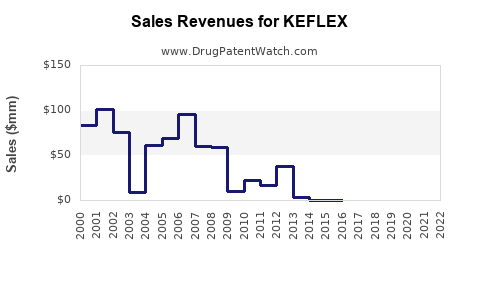
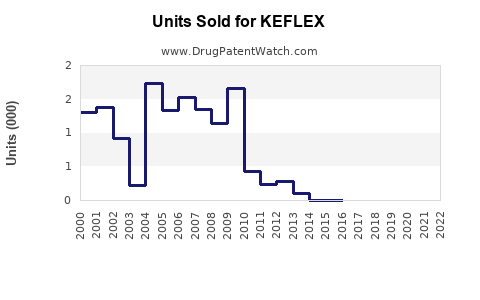
Annual Sales Revenues and Units Sold for KEFLEX
| Drug Name | Revenues (USD) | Units | Year |
|---|---|---|---|
| KEFLEX | ⤷ Start Trial | ⤷ Start Trial | 2022 |
| KEFLEX | ⤷ Start Trial | ⤷ Start Trial | 2021 |
| KEFLEX | ⤷ Start Trial | ⤷ Start Trial | 2020 |
| KEFLEX | ⤷ Start Trial | ⤷ Start Trial | 2019 |
| >Drug Name | >Revenues (USD) | >Units | >Year |
KEFLEX Market Analysis and Sales Projections: Cephalexin Revenue, Competition, Patents, and Generic Risk
KEFLEX is a mature cephalexin brand with limited standalone commercial scale in the United States. The market is dominated by generic cephalexin capsules, tablets, and oral suspensions. Revenue growth is constrained by low pricing, broad generic substitution, limited patent protection, and competition from other oral antibiotics. The most credible commercial opportunity is in generic cephalexin supply, institutional contracts, pediatric suspension, and selected international markets rather than in the KEFLEX brand itself.
An analyst-model estimate places global cephalexin product revenue, including generic and branded products, at approximately $1.0 billion to $1.4 billion in 2024. The market could reach $1.1 billion to $1.6 billion by 2030, implying a nominal compound annual growth rate of roughly 2% to 4%. U.S. KEFLEX-branded sales are estimated at less than $25 million annually, while the broader U.S. cephalexin market is several times larger.
What is KEFLEX and how large is the cephalexin market?
KEFLEX is the brand name for cephalexin, a first-generation cephalosporin antibiotic. The product is administered orally and is available in capsules, tablets, and oral suspension. FDA-approved indications include respiratory-tract infections, otitis media, skin and skin-structure infections, bone infections, genitourinary infections, and other infections caused by susceptible organisms.[1]
Cephalexin competes primarily on price, availability, prescriber familiarity, and pharmacy supply reliability. It is used extensively in outpatient medicine, urgent care, pediatrics, dermatology, primary care, veterinary medicine, and hospital discharge prescriptions.
| Market segment | 2024 estimated revenue | Commercial profile |
|---|---|---|
| Global cephalexin products | $1.0B-$1.4B | Primarily generic |
| U.S. cephalexin products | $250M-$400M | Generic-dominated |
| U.S. KEFLEX brand | Less than $25M | Niche branded demand |
| Global branded KEFLEX | $20M-$60M | Limited and geography-dependent |
The estimates include product revenue rather than total treatment spending. They exclude physician services, diagnostics, hospitalization, and adverse-event costs.
How are KEFLEX sales expected to develop through 2030?
The base-case forecast is for declining or flat KEFLEX brand revenue and modest growth in total cephalexin revenue. Brand sales are affected by generic substitution, while total market revenue benefits from population growth, outpatient prescribing, pediatric demand, and continued use in markets where cephalexin remains inexpensive and widely available.
KEFLEX brand sales projection
| Year | Bear case | Base case | Bull case |
|---|---|---|---|
| 2024 | $15M | $22M | $30M |
| 2025 | $13M | $21M | $31M |
| 2026 | $11M | $20M | $32M |
| 2027 | $9M | $19M | $32M |
| 2028 | $8M | $18M | $33M |
| 2029 | $7M | $18M | $34M |
| 2030 | $6M | $17M | $35M |
The base case assumes a 4% annual decline in U.S. branded demand, offset partly by stable international sales and continued institutional purchasing. The bull case requires improved brand distribution, higher private-pay use, or supply interruptions affecting generic competitors. The bear case reflects complete substitution by generic cephalexin and continued reduction in branded pharmacy dispensing.
Total cephalexin market projection
| Year | Estimated global revenue |
|---|---|
| 2024 | $1.0B-$1.4B |
| 2025 | $1.02B-$1.44B |
| 2026 | $1.04B-$1.48B |
| 2027 | $1.06B-$1.52B |
| 2028 | $1.08B-$1.55B |
| 2029 | $1.10B-$1.58B |
| 2030 | $1.12B-$1.62B |
The principal distinction is between market-unit growth and revenue growth. Prescription volume can increase while revenue remains flat because generic prices continue to fall.
What drives demand for KEFLEX and generic cephalexin?
Outpatient infections
Cephalexin remains a commonly selected oral antibiotic for uncomplicated skin infections, streptococcal infections, urinary-tract infections, and respiratory infections when the pathogen is susceptible. Its long market history gives prescribers substantial familiarity.
Pediatric use
The oral suspension market supports continued demand. Pediatric dosing flexibility, established safety experience, and availability in multiple concentrations make cephalexin relevant for children who cannot swallow capsules.
Low acquisition cost
Generic cephalexin is inexpensive compared with newer oral antibiotics. Its low cost supports use in Medicaid, cash-pay, rural, and international markets. The same low price limits commercial expansion for the KEFLEX brand.
Antimicrobial stewardship
Stewardship programs can reduce inappropriate antibiotic prescribing. At the same time, stewardship may favor narrow-spectrum agents such as cephalexin over broader-spectrum alternatives when microbiology and clinical presentation support their use.
Resistance and clinical substitution
Resistance among certain pathogens can reduce use. Prescribers may select trimethoprim-sulfamethoxazole, clindamycin, doxycycline, amoxicillin-clavulanate, fluoroquinolones, or newer agents depending on infection type, local resistance patterns, allergy history, and patient characteristics.
How does KEFLEX compare with competing oral antibiotics?
| Product | Active ingredient | Main commercial advantage | Main limitation |
|---|---|---|---|
| KEFLEX | Cephalexin | Long clinical history and broad generic supply | Brand price disadvantage |
| Generic cephalexin | Cephalexin | Lowest cost and broad availability | Supplier competition and low margins |
| Augmentin | Amoxicillin/clavulanate | Broader pathogen coverage | Gastrointestinal adverse effects and higher cost |
| Bactrim | Trimethoprim/sulfamethoxazole | Utility in selected skin and urinary infections | Resistance and contraindications |
| Clindamycin | Clindamycin | Useful in selected gram-positive infections | C. difficile risk |
| Doxycycline | Doxycycline | Broad outpatient utility | Pediatric and pregnancy restrictions |
| Cefdinir | Cefdinir | Convenient dosing and pediatric use | Higher cost and broader spectrum |
KEFLEX is strongest where narrow-spectrum therapy, low cost, and established prescribing behavior matter. It is weaker where resistant organisms, allergy concerns, adherence preferences, or broader coverage drive product selection.
Who manufactures KEFLEX and generic cephalexin?
The competitive field includes branded-product distributors, authorized generic suppliers, contract manufacturers, and large generic pharmaceutical companies. Generic cephalexin has been marketed by companies including Hikma Pharmaceuticals, Teva Pharmaceutical Industries, Sandoz, Lupin, Amneal Pharmaceuticals, Rising Pharmaceuticals, and other U.S. and international suppliers, subject to product availability and changes in approved labeling.
KEFLEX distribution has changed over time. The brand is not comparable to an actively promoted, high-revenue branded antibiotic such as a recently launched specialty product. Commercial performance depends more on channel access and product availability than on physician promotion.
The major competitive variables are:
- FDA-approved manufacturing capacity.
- Wholesale acquisition price and contract pricing.
- Reliable supply of capsules and suspension.
- FDA inspection and compliance history.
- Hospital and group-purchasing contracts.
- Ability to maintain multiple package sizes.
- International registration and distributor relationships.
What is the FDA regulatory status of KEFLEX?
KEFLEX is an FDA-approved immediate-release oral cephalexin product. The FDA-approved dosage forms include capsules and oral suspension products, with strength and concentration varying by product presentation.[1]
The product is regulated as a conventional small-molecule prescription drug. It is not a biologic and does not face biosimilar competition. Generic versions are approved through abbreviated new drug applications under section 505(j) of the Federal Food, Drug, and Cosmetic Act.[2]
FDA regulatory issues that can affect supply include:
- Manufacturing observations or warning letters.
- Product recalls.
- Failure to meet dissolution or sterility specifications.
- Suspension-manufacturing problems.
- Raw-material shortages.
- Changes in approved manufacturing sites.
- Labeling or stability failures.
Because the active ingredient and dosage forms are mature, regulatory differentiation is limited. Manufacturing execution and supply reliability are more important than clinical development.
What patents protect KEFLEX and when does it lose exclusivity?
KEFLEX does not have the patent profile of a recently approved branded drug. The original composition and early formulation patents expired decades ago. The product therefore has no meaningful remaining composition-of-matter exclusivity in the United States.
Orange Book status
The FDA Orange Book identifies patents and regulatory exclusivity associated with approved drug products. Mature cephalexin products generally have no commercially significant Orange Book patent barrier preventing generic entry.[3]
| Exclusivity category | KEFLEX position |
|---|---|
| Composition-of-matter patent | Expired |
| Core formulation patent | Expired or commercially immaterial |
| New chemical entity exclusivity | Expired |
| Pediatric exclusivity | Expired |
| Orphan-drug exclusivity | Not applicable |
| Biosimilar exclusivity | Not applicable |
| Current generic entry barrier | None of practical significance |
The absence of a current patent barrier means that Paragraph IV litigation is not a major commercial issue for KEFLEX. Generic manufacturers can rely on abbreviated approval pathways and compete through price and supply.
Are there Paragraph IV challenges or patent litigation involving KEFLEX?
No active, commercially material Paragraph IV dispute is central to the current KEFLEX market. Generic cephalexin entered the market long ago, and the core intellectual-property term has expired.
Patent litigation may still arise from:
- A new formulation or delivery system.
- A manufacturing process.
- A combination product.
- A polymorph or solid-state form.
- A newly approved method of use.
- Trade-secret or contract disputes involving suppliers.
Those categories do not create a meaningful barrier for ordinary generic cephalexin capsules or oral suspension unless a specific enforceable patent is listed or upheld. The primary market risk is operational competition, not patent enforcement.
What formulations are protected, and where are manufacturing barriers?
Standard capsules and oral suspensions are technically mature. The most defensible manufacturing advantages are operational rather than patent-based.
Formulation considerations
Cephalexin suspension products require control of:
- Particle size and dispersion.
- Reconstitution performance.
- Flavor and palatability.
- Stability after reconstitution.
- Microbial quality.
- Packaging and dosing-device accuracy.
Capsule products require consistent potency, dissolution, content uniformity, and packaging stability. These requirements are routine for established generic manufacturers, but failures can trigger shortages or recalls.
Manufacturing IP
Manufacturing know-how may cover process controls, granulation, impurity management, suspension stabilization, packaging, and quality systems. Such know-how can support cost and supply advantages even when no blocking patent exists. It is less likely to support premium pricing because multiple suppliers can manufacture standard cephalexin products.
What licensing deals affect KEFLEX?
Publicly disclosed licensing economics for KEFLEX are limited. The commercial structure is more likely to involve distribution, authorized-generic, contract-manufacturing, or regional commercialization arrangements than a high-value research license.
Potential transaction value is concentrated in:
- Regional brand rights.
- Hospital and government supply contracts.
- Authorized-generic arrangements.
- Pediatric suspension distribution.
- International registrations.
- Manufacturing-site transfers.
A KEFLEX transaction would generally be valued on net cash flow, supply reliability, and channel access rather than on patent life or clinical differentiation.
What generic launch scenarios exist for KEFLEX?
Generic entry is already established. The relevant scenarios concern additional suppliers, price erosion, and intermittent shortages.
Base scenario
Generic supply remains broad. Unit volume grows slowly, while average selling prices decline. KEFLEX brand sales contract gradually. Total market revenue grows 2% to 4% annually in nominal terms.
Downside scenario
Several suppliers compete aggressively on price, pharmacy substitution approaches full conversion, and brand distribution narrows. Branded sales decline 8% to 12% annually. Total market revenue is flat despite stable prescription volume.
Upside scenario
Manufacturing disruptions affect major generic suppliers. Hospitals and wholesalers shift purchases toward available inventory, allowing temporary price increases. The benefit is short-lived because additional generic capacity can enter once supply normalizes.
What is the revenue exposure for manufacturers and investors?
KEFLEX has low strategic value as a standalone branded asset but can have value as part of a generic portfolio.
| Asset type | Revenue exposure | Investment assessment |
|---|---|---|
| KEFLEX brand | Small and declining | Low growth, limited pricing power |
| Generic cephalexin portfolio | Moderate volume, low margin | Attractive only with efficient manufacturing |
| Pediatric suspension capacity | Higher supply sensitivity | Potential niche value |
| Hospital contract supply | Volume-driven | Dependent on reliability and pricing |
| International cephalexin rights | Market-specific | Can offer stable cash flow in selected regions |
The key financial risks are price compression, government reimbursement pressure, wholesaler concentration, product recalls, and manufacturing interruptions. The principal upside is not premium pricing. It is efficient production at scale combined with dependable supply.
How strong is the KEFLEX patent estate?
The KEFLEX patent estate is weak from a present-day commercial perspective. The original product has no meaningful remaining exclusivity, and generic substitution is established. Any value rests on trademarks, regulatory approvals, manufacturing capability, distribution, and supply contracts.
Patent strength should be rated as follows:
| Patent factor | Assessment |
|---|---|
| Core molecule protection | None remaining |
| Product exclusivity | Expired |
| Formulation protection | Limited or immaterial |
| Method-of-use protection | No material current barrier identified |
| Manufacturing protection | Possible know-how, not a market blockade |
| Litigation leverage | Low |
| Generic launch risk | Very high because entry is established |
Key Takeaways
- KEFLEX is a mature cephalexin brand with limited standalone sales potential.
- Global cephalexin revenue is estimated at $1.0 billion to $1.4 billion in 2024, with slow growth through 2030.
- U.S. branded KEFLEX sales are likely below $25 million annually.
- Generic cephalexin controls the market and will continue to pressure brand pricing.
- The original KEFLEX patent and exclusivity terms expired decades ago.
- No active Paragraph IV dispute is central to the current market.
- There is no biosimilar risk because cephalexin is a conventional small molecule.
- Pediatric suspension, hospital supply, and international distribution are the strongest commercial niches.
- Manufacturing reliability and contract access matter more than patent protection.
- A KEFLEX acquisition or license should be valued as a mature generic or distribution asset, not as a protected branded pharmaceutical.
Frequently Asked Questions
Is KEFLEX still a profitable drug?
KEFLEX can generate recurring revenue, but its profitability is constrained by generic substitution, low prices, and limited brand differentiation. Profitability is more likely in efficient generic manufacturing or distribution than in the branded product.
Is cephalexin a high-growth antibiotic market?
No. Cephalexin is a mature antibiotic. Growth is expected to be low single digit and driven mainly by population, outpatient volume, pediatric demand, and regional market expansion.
Can a company launch a generic version of KEFLEX?
Yes. Generic cephalexin products are already approved and widely marketed. A new entrant must compete on FDA compliance, manufacturing cost, supply reliability, and commercial distribution.
Does KEFLEX have exclusivity against generic cephalexin?
No commercially meaningful current exclusivity protects standard KEFLEX capsules or oral suspension in the United States.
Which KEFLEX product has the strongest commercial niche?
Oral suspension has the clearest niche because pediatric dosing, palatability, stability, and supply reliability create more operational differentiation than standard capsules.
References
- U.S. Food and Drug Administration. (2011). KEFLEX (cephalexin) capsule and oral suspension prescribing information. FDA/DailyMed.
- U.S. Food and Drug Administration. (2024). Abbreviated new drug application process. https://www.fda.gov/drugs/abbreviated-new-drug-application-anda
- U.S. Food and Drug Administration. (2024). Approved drug products with therapeutic equivalence evaluations, Orange Book. https://www.fda.gov/drugsatfda
- U.S. Centers for Disease Control and Prevention. (2024). Core elements of outpatient antibiotic stewardship. https://www.cdc.gov/antibiotic-use
- U.S. Food and Drug Administration. (2024). Drug shortages and current supply information. https://www.fda.gov/drugs/drug-safety-and-availability/drug-shortages-index
More… ↓
