Share This Page
Drug Sales Trends for FOSAMAX
✉ Email this page to a colleague
Payment Methods and Pharmacy Types for FOSAMAX (2002)
Revenues by Pharmacy Type
Units Sold by Pharmacy Type
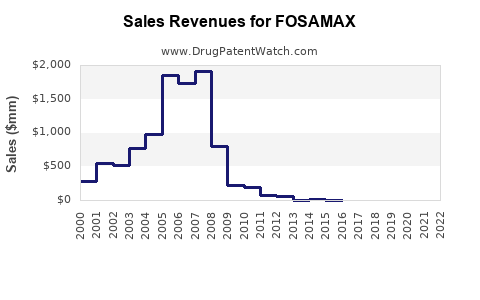
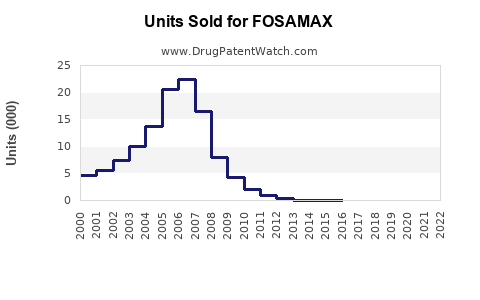
Annual Sales Revenues and Units Sold for FOSAMAX
| Drug Name | Revenues (USD) | Units | Year |
|---|---|---|---|
| FOSAMAX | ⤷ Start Trial | ⤷ Start Trial | 2022 |
| FOSAMAX | ⤷ Start Trial | ⤷ Start Trial | 2021 |
| FOSAMAX | ⤷ Start Trial | ⤷ Start Trial | 2020 |
| >Drug Name | >Revenues (USD) | >Units | >Year |
FOSAMAX Market Analysis and Sales Projections: Alendronate Revenue, Generic Competition, and Patent Exposure
FOSAMAX is a mature, genericized osteoporosis product with limited remaining commercial value for Merck. The active ingredient, alendronate sodium, has broad generic availability in the United States and other major markets. Originator revenue declined sharply after U.S. patent expiry and generic entry in 2008. Future sales are likely to come primarily from low-priced generic alendronate tablets and oral solution, not from branded FOSAMAX.
An indicative global market model places annual alendronate sales at approximately $250 million to $500 million through 2030, depending on volume, pricing, reimbursement, and continued use of oral bisphosphonates. Branded FOSAMAX sales are expected to remain immaterial relative to the historical franchise peak.
What is FOSAMAX and how large is its market?
FOSAMAX contains alendronate sodium, an oral bisphosphonate approved for osteoporosis treatment and prevention, glucocorticoid-induced osteoporosis, and Paget's disease of bone. The product is administered daily or once weekly, depending on strength and formulation. FOSAMAX Plus D combines alendronate with vitamin D3.
The market is divided into:
- Generic alendronate tablets, mainly 5 mg, 10 mg, 35 mg, and 70 mg strengths
- Generic alendronate oral solution
- FOSAMAX branded tablets
- FOSAMAX Plus D and equivalent products
- Competing osteoporosis therapies, including denosumab, teriparatide, abaloparatide, romosozumab, raloxifene, and other bisphosphonates
Generic alendronate is generally used as a low-cost first-line therapy for postmenopausal osteoporosis and male osteoporosis. It competes primarily on price, prescribing guidelines, tolerability, and dosing convenience.
FOSAMAX product and regulatory profile
| Attribute | Details |
|---|---|
| Active ingredient | Alendronate sodium |
| Drug class | Bisphosphonate |
| Original developer | Merck & Co. |
| U.S. approval | 1995 |
| Main dosage forms | Tablets and oral solution |
| Weekly regimen | 35 mg or 70 mg, depending on indication |
| Key indications | Osteoporosis, glucocorticoid-induced osteoporosis, Paget's disease |
| FDA pathway | New Drug Application for originator; Abbreviated New Drug Applications for generics |
| Biosimilar relevance | None; alendronate is a small molecule |
| Current market status | Mature generic market |
Merck's U.S. label identifies alendronate administration requirements that affect adherence and tolerability, including taking the product with plain water and remaining upright after dosing. These restrictions limit some of the product's commercial appeal relative to injectable or less frequent osteoporosis therapies. (U.S. Food and Drug Administration, 2023)
How much did FOSAMAX sell before generic entry?
FOSAMAX was one of Merck's largest products before loss of U.S. exclusivity. Sales declined during the mid-2000s as patients shifted from daily to weekly formulations, competitive products expanded, and patent litigation approached resolution.
Reported Merck sales included the following approximate figures:
| Year | FOSAMAX-related sales | Market context |
|---|---|---|
| 2006 | Approximately $2.5 billion | Large global branded franchise |
| 2007 | Approximately $2.2 billion | Pre-generic erosion |
| 2008 | Approximately $1.8 billion | U.S. generic competition began |
| 2009 onward | Rapid decline | Generic substitution and price compression |
The exact reported totals vary depending on whether FOSAMAX, FOSAMAX Plus D, and certain geographic sales are combined. Merck's annual reports show the commercial impact of U.S. generic competition after alendronate exclusivity ended. (Merck & Co., 2008, 2009)
FOSAMAX demonstrates the revenue sensitivity of a high-volume chronic medicine. Even with substantial prescription demand, the product lost most of its economic value once pharmacy substitution became available.
When did FOSAMAX lose exclusivity?
FOSAMAX lost its primary U.S. patent protection in the late 2000s. Generic alendronate products began entering the U.S. market in 2008 after the expiration of key patent rights and resolution of related challenges.
The commercial exclusivity timeline was:
| Milestone | Approximate date | Commercial impact |
|---|---|---|
| Initial FDA approval | 1995 | Branded market begins |
| Weekly dosing expansion | Late 1990s | Improved adherence and franchise growth |
| FOSAMAX Plus D approval | 2000s | Product-line extension |
| Primary alendronate patent expiry | December 2007 | Core U.S. protection ends |
| Generic entry | 2008 | Rapid pharmacy substitution |
| Branded revenue contraction | 2008-2010 | Major loss of sales |
| Current status | Mature generic market | Minimal originator pricing power |
Patent-term adjustments, pediatric exclusivity, formulation claims, and litigation settlements affected the exact timing of product launches. The practical commercial result was the same: generic alendronate became widely available in the United States during 2008.
What patents protect FOSAMAX?
FOSAMAX's original composition and use patents are no longer meaningful barriers to generic entry in the United States. The most important historical patent was U.S. Patent No. 4,621,077, associated with alendronate pharmaceutical compositions and methods. Its term ended in the late 2000s.
Historical protection also covered:
- Alendronate compositions
- Osteoporosis treatment methods
- Once-weekly dosing regimens
- FOSAMAX Plus D combinations
- Tablet formulations and manufacturing processes
The commercial value of later formulation or method-of-use claims was limited because generic applicants could rely on abbreviated regulatory pathways, use permitted labeling carve-outs, and enter after the core composition protection expired.
How strong is the current FOSAMAX patent estate?
The current FOSAMAX patent estate is weak from a commercial blocking perspective.
| Patent category | Current risk to generic entry |
|---|---|
| Core alendronate composition | Low; expired |
| Daily and weekly dosing claims | Low; expired or commercially ineffective |
| FOSAMAX Plus D combination claims | Low to moderate depending on jurisdiction and claim scope |
| Tablet formulation claims | Low |
| Manufacturing patents | Low for finished-dose market access |
| Method-of-use claims | Low where generic labels carve out protected uses |
| U.S. Orange Book protection | No material barrier to ordinary generic alendronate |
Patent protection may still exist in isolated jurisdictions or for narrow manufacturing processes. Those rights do not recreate the historical FOSAMAX franchise or prevent broad generic substitution.
What is the Orange Book status of FOSAMAX?
FOSAMAX is listed in FDA's Orange Book as an approved reference product, but the presence of a reference listing does not mean that the brand retains meaningful market exclusivity. FDA's Orange Book identifies approved drug products, therapeutic equivalence ratings, and relevant patent or exclusivity information. (U.S. Food and Drug Administration, 2024)
Generic alendronate products can obtain approval through ANDA procedures by demonstrating pharmaceutical equivalence and bioequivalence to the reference listed drug. Approved generic products generally receive an "AB" therapeutic equivalence rating when the regulatory requirements are satisfied.
For commercial purposes:
- The reference product remains important for regulatory comparison.
- Generic substitution is broadly available.
- Historical Paragraph IV disputes no longer create a significant launch barrier.
- Any remaining listed patent claim must be assessed individually.
- Orange Book listing does not preserve branded pricing power after core exclusivity loss.
Which companies compete with FOSAMAX?
Competition comes from generic manufacturers and from branded drugs with different administration profiles.
Generic alendronate manufacturers
The U.S. generic market has included major suppliers such as:
- Teva Pharmaceutical Industries
- Sandoz
- Mylan, now part of Viatris
- Apotex
- Zydus Pharmaceuticals
- Dr. Reddy's Laboratories
- Rising Pharmaceuticals
- Sun Pharmaceutical Industries
- Endo and affiliated generic businesses
- Various regional and contract manufacturers
Supplier participation changes over time because of low margins, manufacturing economics, product discontinuations, and shortages. A large number of approved ANDAs does not necessarily mean that all suppliers actively sell the product.
Competing osteoporosis drugs
| Product | Active ingredient | Commercial positioning |
|---|---|---|
| Fosamax | Alendronate | Low-cost oral bisphosphonate |
| Actonel | Risedronate | Oral bisphosphonate competitor |
| Boniva | Ibandronate | Monthly oral or periodic injectable option |
| Prolia | Denosumab | Six-month injectable biologic |
| Reclast | Zoledronic acid | Annual intravenous bisphosphonate |
| Forteo | Teriparatide | Anabolic osteoporosis treatment |
| Tymlos | Abaloparatide | Anabolic osteoporosis treatment |
| Evenity | Romosozumab | Monthly injectable anabolic therapy |
| Evista | Raloxifene | Selective estrogen receptor modulator |
Alendronate retains an important cost advantage. Its principal weaknesses are gastrointestinal tolerability, administration restrictions, adherence concerns, and competition from less frequent injectable products.
What sales projections exist for FOSAMAX and generic alendronate?
The relevant forecasting unit is generic alendronate, not branded FOSAMAX. Publicly available company filings generally do not disclose a standalone global revenue forecast for FOSAMAX after genericization. The following is an indicative scenario model rather than company guidance.
Base-case global revenue projection
| Year | Estimated global alendronate market | Branded FOSAMAX share | Generic share |
|---|---|---|---|
| 2024 | $350 million-$450 million | Less than 5% | More than 95% |
| 2025 | $335 million-$440 million | Less than 5% | More than 95% |
| 2026 | $325 million-$430 million | Less than 4% | More than 96% |
| 2027 | $315 million-$420 million | Less than 4% | More than 96% |
| 2028 | $305 million-$410 million | Less than 3% | More than 97% |
| 2029 | $295 million-$400 million | Less than 3% | More than 97% |
| 2030 | $285 million-$390 million | Less than 3% | More than 97% |
The model assumes:
- Stable or modestly declining prescription volume
- Continued generic price erosion
- Low single-digit annual volume growth in some emerging markets
- Declining use of oral bisphosphonates in markets with greater access to injectable therapies
- Continued use of alendronate as a low-cost first-line option
- No major safety signal or regulatory withdrawal
Under the base case, global market revenue declines by roughly 15% to 25% from 2024 to 2030. Volume may remain relatively stable while net pricing declines.
Scenario analysis
| Scenario | 2030 global revenue | Main assumptions |
|---|---|---|
| Downside | $175 million-$275 million | Faster migration to denosumab and annual IV therapy; aggressive generic pricing |
| Base case | $285 million-$390 million | Stable prescribing with gradual price erosion |
| Upside | $450 million-$600 million | Increased osteoporosis diagnosis, cost containment, and stronger generic uptake |
The upside case does not imply a branded FOSAMAX recovery. It reflects higher total alendronate volume and stronger generic demand.
What revenue exposure does Merck have to FOSAMAX?
Merck's direct revenue exposure is limited. The historical FOSAMAX franchise was material to Merck before generic entry, but post-expiry sales became a small contributor to the company's overall pharmaceutical revenue.
The main financial implications are:
- No realistic return to pre-2008 branded revenue levels
- Limited pricing leverage for the originator
- Low probability of a material FOSAMAX relaunch
- Potential residual sales in markets with weaker generic substitution
- Administrative and manufacturing costs that can reduce the value of low-volume branded sales
- Greater economic relevance for generic manufacturers than for Merck
For investors, FOSAMAX should be treated as a mature legacy product rather than a growth asset.
What generic entry risks remain?
Generic entry risk is effectively realized in the United States and other developed markets. Remaining risks concern market structure rather than legal launch timing.
Manufacturing and supply risks
Generic alendronate manufacturers face:
- Low unit prices
- Limited incentive to maintain multiple suppliers
- Dependence on active pharmaceutical ingredient producers
- Quality-system and inspection requirements
- Potential raw-material concentration
- Inventory and reimbursement pressure
These factors can cause temporary supply disruptions. A supply interruption could raise short-term prices, but it would not restore durable brand exclusivity.
Regulatory risks
FDA regulatory risks include:
- Product-quality findings
- Manufacturing deficiencies
- ANDA withdrawals
- Labeling changes
- Bioequivalence or dissolution issues
- Recalls involving specific suppliers
These risks affect individual generic manufacturers rather than the underlying molecule's regulatory status.
What Paragraph IV challenges and litigation affected FOSAMAX?
FOSAMAX was subject to historical generic challenges involving alendronate patents and dosing or formulation claims. Paragraph IV certifications allowed generic applicants to challenge listed patents before their expiration. Merck litigated patent claims related to alendronate products, including claims associated with once-weekly dosing and formulations.
The key commercial outcome was generic entry in 2008. Once the primary patent estate expired and multiple manufacturers entered, the litigation no longer supported meaningful brand protection.
Current litigation risk is low because:
- Core patents have expired.
- Generic products are established in the market.
- Any remaining claims are narrow relative to total alendronate demand.
- Generic applicants can use labeling strategies for certain method-of-use claims.
- The brand has no credible path to restore historical exclusivity.
What licensing deals affect FOSAMAX?
FOSAMAX's commercial history involved development and commercialization by Merck, but no current licensing transaction is known to create a material market constraint on generic alendronate. Historical collaborations or regional commercialization arrangements may affect individual markets, royalties, or product registrations. They do not materially change the global forecast.
The relevant commercial question is whether a license controls an active patent or supply channel. For ordinary alendronate tablets in the United States, no such license is likely to prevent generic competition.
How does FOSAMAX compare with Prolia and Reclast?
| Factor | FOSAMAX/generic alendronate | Prolia | Reclast |
|---|---|---|---|
| Administration | Oral daily or weekly | Injection every six months | Annual IV infusion |
| Product type | Small molecule | Biologic antibody | Small molecule |
| Price | Low | High | Higher than oral generic |
| Adherence burden | High | Lower dosing frequency | Low dosing frequency |
| Patent risk | Minimal | Greater biologic and formulation exposure | Patent protection largely mature |
| Biosimilar risk | None | Relevant | None |
| Commercial growth | Limited | More attractive branded market | Mature branded/generic market |
| Main advantage | Cost and guideline familiarity | Convenience and efficacy positioning | Annual administration |
FOSAMAX remains competitive where payers prioritize low cost and patients can follow administration instructions. It is less competitive where adherence, gastrointestinal tolerability, or injection convenience drives treatment selection.
Key Takeaways
- FOSAMAX is a mature, genericized alendronate product with minimal remaining branded growth potential.
- U.S. generic entry began in 2008 after expiration of key patent protection.
- Current Orange Book status supports reference-product identification and generic substitution, not meaningful brand exclusivity.
- Global alendronate revenue is likely to remain in the low hundreds of millions of dollars annually through 2030.
- Generic products should capture more than 95% of market revenue in the base case.
- Merck's historical revenue exposure was substantial, but current exposure is limited.
- Biosimilar risk does not apply because alendronate is a small molecule.
- The main threats are price erosion, declining oral bisphosphonate use, and migration to injectable therapies.
- The main market support is alendronate's low cost, clinical familiarity, and role as a first-line osteoporosis treatment.
FAQs
Is FOSAMAX still sold in the United States?
FOSAMAX remains an FDA-listed reference product, but generic alendronate is widely available and usually captures pharmacy demand.
Is alendronate a biosimilar or a generic drug?
Alendronate is a small-molecule generic drug. It is not a biologic and does not follow the biosimilar approval pathway.
Can Merck regain exclusivity for FOSAMAX?
A meaningful return of exclusivity is unlikely. New formulation or dosing patents would face substantial validity, infringement, regulatory, and commercial hurdles.
What is the biggest commercial threat to generic alendronate?
The largest long-term threat is substitution by injectable therapies, especially denosumab and annual zoledronic acid, rather than new generic entry.
Will FOSAMAX sales grow through 2030?
Branded FOSAMAX sales are unlikely to grow materially. Total alendronate volume may remain stable in cost-sensitive markets, but price erosion is expected to reduce total market revenue.
References
-
Merck & Co. (2008). Annual report 2008. https://www.annualreports.com/HostedData/AnnualReportArchive/m/NYSE_MRK_2008.pdf
-
Merck & Co. (2009). Annual report 2009. https://www.annualreports.com/HostedData/AnnualReportArchive/m/NYSE_MRK_2009.pdf
-
U.S. Food and Drug Administration. (2023). FOSAMAX prescribing information. https://www.accessdata.fda.gov/drugsatfda_docs/label/
-
U.S. Food and Drug Administration. (2024). Approved drug products with therapeutic equivalence evaluations: Orange Book. https://www.fda.gov/drugs/drug-approvals-and-databases/approved-drug-products-therapeutic-equivalence-evaluations-orange-book
-
U.S. Food and Drug Administration. (2024). Abbreviated new drug application approvals and generic drug information. https://www.fda.gov/drugs/generic-drugs-participation
-
U.S. Patent and Trademark Office. (2024). Patent term and patent expiration resources. https://www.uspto.gov/patents/laws/patent-term-extension-pte-granted
More… ↓
