Share This Page
Drug Sales Trends for FLUCONAZOLE
✉ Email this page to a colleague
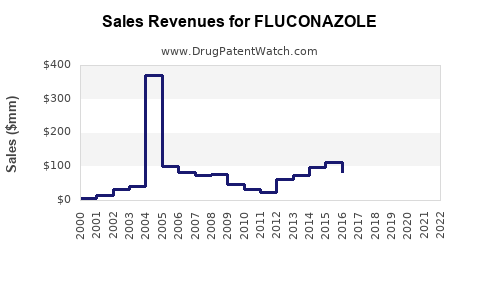

Annual Sales Revenues and Units Sold for FLUCONAZOLE
| Drug Name | Revenues (USD) | Units | Year |
|---|---|---|---|
| FLUCONAZOLE | ⤷ Start Trial | ⤷ Start Trial | 2022 |
| FLUCONAZOLE | ⤷ Start Trial | ⤷ Start Trial | 2021 |
| FLUCONAZOLE | ⤷ Start Trial | ⤷ Start Trial | 2020 |
| >Drug Name | >Revenues (USD) | >Units | >Year |
Fluconazole Market Analysis, Sales Projections, Patent Status, and Generic Competition
Fluconazole is a mature, off-patent triazole antifungal with broad global availability across oral capsules, tablets, oral suspension, and intravenous formulations. The commercial market is driven by high prescription volume, low unit prices, hospital demand, and continued use in candidiasis and cryptococcal infections. Global fluconazole sales are best modeled at approximately $1.3 billion to $1.5 billion in 2024 market value, with low-single-digit growth through 2029. Pfizer’s branded Diflucan franchise is no longer the principal market driver; generic manufacturers control most volume.
What is the current fluconazole market size?
The global fluconazole market is estimated at approximately $1.35 billion in 2024 on a manufacturer and institutional purchasing basis. Public market reports vary because some include only finished-dose products, while others include hospital procurement, active pharmaceutical ingredient sales, or broader systemic antifungal categories.
| Metric | 2024 estimate | 2029 base-case estimate | Expected growth |
|---|---|---|---|
| Global fluconazole market value | $1.35 billion | $1.56 billion | 2.9% CAGR |
| Oral formulations | $1.05 billion | $1.20 billion | 2.7% CAGR |
| Intravenous formulations | $250 million | $300 million | 3.7% CAGR |
| Hospital and institutional channel | $650 million | $760 million | 3.2% CAGR |
| Retail and outpatient channel | $700 million | $800 million | 2.7% CAGR |
These figures are analytical estimates rather than consolidated company-reported revenue. Fluconazole is sold by numerous generic manufacturers, and most companies do not separately disclose product-level sales.
The market has limited pricing power. Growth comes from infection prevalence, hospital utilization, expanded access in emerging markets, and procurement volume rather than premium pricing.
What are the main fluconazole indications and demand drivers?
Fluconazole is approved or used for several fungal infections, including:
- Vaginal candidiasis
- Oropharyngeal and esophageal candidiasis
- Systemic Candida infections
- Cryptococcal meningitis
- Urinary tract Candida infections
- Prophylaxis in selected immunocompromised patients
- Fungal infections in certain pediatric and neonatal settings
The FDA label identifies fluconazole as a systemic antifungal indicated for multiple Candida infections and cryptococcal meningitis in appropriate patient populations (U.S. Food and Drug Administration, 2024).
Clinical demand factors
The largest demand contributors are:
- High prevalence of vulvovaginal candidiasis.
- Continued hospital use for invasive candidiasis.
- HIV-associated cryptococcal disease in lower-income countries.
- Immunosuppression caused by cancer therapy, transplantation, and intensive-care treatment.
- Low-cost access to oral therapy.
- Broad generic supply in the United States, Europe, China, India, and Latin America.
Demand is constrained by increasing resistance among Candida species, especially non-albicans Candida and Candida auris. Fluconazole is not an appropriate treatment for every Candida infection, and resistance can shift prescribing toward echinocandins, amphotericin B, or newer agents.
How are fluconazole sales projected through 2029?
The following projections use a 2024 global market baseline of $1.35 billion and model different assumptions for volume growth, price erosion, and substitution by newer antifungals.
| Scenario | 2024 | 2025 | 2026 | 2027 | 2028 | 2029 | CAGR |
|---|---|---|---|---|---|---|---|
| Low case | $1.35B | $1.35B | $1.36B | $1.38B | $1.40B | $1.42B | 1.0% |
| Base case | $1.35B | $1.39B | $1.43B | $1.47B | $1.52B | $1.56B | 2.9% |
| High case | $1.35B | $1.41B | $1.47B | $1.54B | $1.61B | $1.68B | 4.5% |
Base-case assumptions
The base case assumes:
- Global unit demand growth of 3% to 4% annually.
- Continued price erosion of approximately 1% annually in mature markets.
- Stable use in vaginal candidiasis and outpatient infections.
- Moderate growth in hospital antifungal procurement.
- Partial substitution by newer agents in resistant infections.
- No major global manufacturing interruption.
- Continued inclusion in national essential-medicine and hospital formularies.
The principal downside risk is resistance-driven displacement. The principal upside risk is greater diagnosis and treatment access in emerging markets.
Which companies manufacture and sell fluconazole?
Fluconazole has a fragmented supplier base. Major manufacturers and marketers have included Pfizer, Viatris, Teva, Sandoz, Hikma, Cipla, Sun Pharmaceutical, Dr. Reddy’s Laboratories, Aurobindo Pharma, Zydus Lifesciences, Fresenius Kabi, and numerous regional manufacturers.
| Company | Commercial position | Typical products |
|---|---|---|
| Pfizer | Original developer and Diflucan marketer | Oral and injectable branded products |
| Viatris | Generic and legacy branded supply | Capsules, tablets, suspension |
| Teva | Large generic supplier | Oral dosage forms |
| Sandoz | European and international generic supply | Oral and injectable products |
| Hikma | Hospital and injectable focus | Intravenous products |
| Cipla | Emerging-market and international supply | Oral and injectable products |
| Sun Pharma | India and international generic supply | Oral dosage forms |
| Dr. Reddy’s | Generic supply | Tablets and capsules |
| Fresenius Kabi | Institutional injectable supply | Intravenous fluconazole |
Brand ownership and commercialization arrangements vary by country. Pfizer’s Diflucan brand remains commercially recognized, but generic fluconazole accounts for most prescriptions in markets with mature generic substitution.
What is the FDA regulatory status of fluconazole?
Fluconazole is an FDA-approved prescription antifungal. Pfizer’s Diflucan product was approved in the United States in 1990. Generic fluconazole products have been approved through the abbreviated new drug application pathway under section 505(j) of the Federal Food, Drug, and Cosmetic Act.
Available dosage forms include:
- 50 mg, 100 mg, 150 mg, and 200 mg oral capsules or tablets, depending on manufacturer.
- Oral suspension.
- Intravenous injection.
- Hospital-use premixed or pharmacy-compounded presentations in selected markets.
The 150 mg single-dose oral presentation is commercially important in uncomplicated vulvovaginal candidiasis. Higher and repeated doses are used for systemic candidiasis, cryptococcal disease, and other indications under physician supervision.
What is the Orange Book status of fluconazole?
Fluconazole has no remaining U.S. composition-of-matter patent barrier that prevents generic competition. The original Diflucan exclusivity period ended years ago, and multiple generic products are approved in the United States.
| Regulatory issue | Current commercial impact |
|---|---|
| Original brand | Pfizer Diflucan |
| Core composition patent | Expired |
| U.S. generic availability | Extensive |
| Hatch-Waxman exclusivity | Expired |
| Current generic entry barrier | None at the active-ingredient level |
| Orange Book relevance | Limited to any specific listed formulation or method claims |
| 180-day generic exclusivity | Not a current market-wide constraint |
The FDA Orange Book remains the controlling source for current listed patents and exclusivity entries. For fluconazole, the commercial question is generally product availability and procurement pricing rather than patent exclusion (FDA, 2024).
When did fluconazole lose exclusivity?
Fluconazole lost effective U.S. market exclusivity in the 1990s and early 2000s as generic products entered after expiration of the original Pfizer patent estate and regulatory exclusivities.
The principal commercial consequence was rapid erosion of Diflucan pricing and market share. Generic entry shifted the product from a branded pharmaceutical franchise to a high-volume, low-margin essential medicine.
The relevant U.S. patent history is associated with Pfizer’s original fluconazole compound and related development rights. Those rights are no longer an effective barrier to generic production. Current commercial protection, where present, would relate to a specific product presentation, manufacturing process, or jurisdiction rather than the fluconazole molecule itself.
Are there Paragraph IV challenges involving fluconazole?
Historical generic applicants could have used Paragraph IV certifications against any unexpired Orange Book-listed patents associated with Diflucan. Those challenges were relevant during the initial generic-entry period.
They do not create a current market-wide entry barrier. Fluconazole has been generic for decades, and the present U.S. market includes multiple approved suppliers. Any new Paragraph IV filing would likely concern a narrow formulation, delivery system, or newly listed use rather than the core active ingredient.
What formulation patents protect fluconazole products?
The principal commercial fluconazole formulations are conventional and technically mature:
- Immediate-release capsules and tablets
- Oral suspension
- Intravenous solution
- Premixed intravenous presentations
- Hospital pharmacy preparations
These products generally rely on established excipients and manufacturing methods. A formulation patent could protect a particular suspension, stability profile, excipient system, particle-size distribution, or intravenous presentation. Such claims would not prevent ordinary generic fluconazole capsules or tablets unless the generic product fell within the patent claims.
The practical IP barrier is low because fluconazole has high aqueous solubility relative to many antifungal agents, extensive manufacturing history, and established bioequivalence methods.
What method-of-use patents protect fluconazole?
Method-of-use protection for fluconazole has limited current commercial significance. The main uses, including candidiasis and cryptococcal meningitis, are long-established and have been described in the original regulatory and patent literature.
A later patent could theoretically claim:
- A dosing regimen.
- Use in a defined patient subgroup.
- Combination treatment.
- Prophylaxis in a narrowly defined population.
- Treatment of a resistant organism under specified conditions.
Such claims would be difficult to enforce against broad generic use because physicians may prescribe fluconazole for multiple established indications. Generic labeling and physician prescribing practices remain central to the commercial effect of any narrow method patent.
How strong is the fluconazole patent estate?
The patent estate is weak for conventional fluconazole products and strong only in the historical sense that the original compound and early development patents supported initial market exclusivity.
| Patent-estate factor | Assessment |
|---|---|
| Composition-of-matter protection | Expired |
| Core oral formulation protection | Expired or commercially ineffective |
| Injectable product protection | Low barrier |
| Method-of-use protection | Limited current value |
| Manufacturing process protection | Potentially relevant but nonblocking |
| Generic design-around ability | High |
| Litigation leverage | Low |
| Lifecycle-management opportunity | Limited |
The main competitive advantage is manufacturing scale, regulatory reliability, quality compliance, and distribution rather than proprietary IP.
What patent litigation affects fluconazole?
Fluconazole is not associated with a current high-value U.S. patent litigation campaign comparable to those involving branded oncology, immunology, or specialty drugs. Historical generic-entry disputes may have involved certification, infringement, and regulatory timing, but the market has since normalized around multiple generic suppliers.
Current litigation risk is more likely to involve:
- Manufacturing quality.
- Product recalls.
- Abbreviated new drug application deficiencies.
- Contract manufacturing disputes.
- Distribution agreements.
- Antitrust or procurement conduct.
- Foreign-market patent claims involving specialized formulations.
No litigation-related event is expected to materially delay ordinary generic fluconazole access in the United States.
Is there biosimilar risk for fluconazole?
Biosimilar risk does not apply. Fluconazole is a small-molecule drug, not a biologic. Competition occurs through generic abbreviated applications rather than biosimilar licensing under the Public Health Service Act.
The relevant risks are generic price competition, active pharmaceutical ingredient supply, hospital tenders, and therapeutic substitution by newer antifungal agents.
How does fluconazole compare with newer antifungals?
| Product class | Examples | Main advantage over fluconazole | Main disadvantage |
|---|---|---|---|
| Triazole | Fluconazole | Low cost, oral dosing, extensive experience | Resistance and drug interactions |
| Echinocandin | Micafungin, anidulafungin, caspofungin | Strong activity against many invasive Candida infections | Intravenous administration and higher cost |
| Polyene | Amphotericin B | Broad antifungal activity | Toxicity and administration burden |
| Newer triazole | Isavuconazole, posaconazole, voriconazole | Broader activity in selected infections | Higher price, monitoring, interactions |
| Tetrazole | Oteseconazole | Targeted use in recurrent vulvovaginal candidiasis | Narrower indication and higher price |
Fluconazole retains a cost advantage and remains valuable when the infecting organism is susceptible. Its position is weaker in invasive disease caused by resistant Candida species, particularly Candida auris, where clinical guidelines often favor echinocandins or other agents (Centers for Disease Control and Prevention, 2024; Pappas et al., 2016).
What generic launch scenarios exist for fluconazole?
A new generic entrant would face low legal barriers but difficult economics.
Scenario 1: Retail oral capsules
This is the easiest regulatory pathway but the most competitive commercial segment. A supplier would need low manufacturing cost, reliable FDA compliance, and access to pharmacy wholesalers. Price erosion would likely be immediate.
Scenario 2: Hospital intravenous supply
Intravenous fluconazole can offer better commercial positioning than retail capsules because hospitals value supply continuity. The main barriers are sterile manufacturing, quality systems, shortage management, and institutional contracting.
Scenario 3: Emerging-market expansion
The strongest volume opportunity is in India, Southeast Asia, Latin America, Africa, and parts of the Middle East. Pricing is lower, but demand growth can exceed mature-market growth. Local registration, public tenders, and API sourcing are decisive.
Scenario 4: Differentiated suspension or premixed product
A stable, convenient oral suspension or ready-to-use intravenous product could obtain modest pricing benefits. The opportunity remains limited because standard products are widely available.
What geographic markets offer the greatest growth?
| Region | 2024 share estimate | Growth outlook |
|---|---|---|
| North America | 20% to 25% | Low growth, high generic penetration |
| Europe | 20% to 25% | Stable volume, continued price pressure |
| Asia-Pacific | 35% to 40% | Highest volume and access growth |
| Latin America | 8% to 10% | Moderate growth, tender-driven |
| Middle East and Africa | 8% to 12% | Access growth, procurement volatility |
Asia-Pacific is the most attractive region for volume expansion. China and India have large generic manufacturing bases, while Southeast Asia and other emerging markets offer demand growth from improved diagnosis and broader treatment access.
North America and Western Europe remain important for regulatory-grade revenue but provide limited pricing upside.
What manufacturing and intellectual-property barriers exist?
The API is widely manufactured and does not present a meaningful proprietary supply barrier. Manufacturing risk is concentrated in:
- GMP compliance.
- API impurity control.
- Sterile injectable production.
- Supply-chain concentration.
- Regulatory inspection outcomes.
- Hospital tender performance.
- Product recalls and shortages.
For an oral product, manufacturing entry is relatively straightforward. For intravenous fluconazole, sterile processing and validated aseptic production raise the technical and capital requirements.
What is the revenue exposure for Pfizer and generic manufacturers?
Pfizer’s historical Diflucan revenue was material during the branded-exclusivity period, but fluconazole is no longer a major growth asset in Pfizer’s portfolio. Current Pfizer revenue exposure is limited relative to its oncology, vaccines, inflammation, and hospital product businesses.
Generic manufacturers face a different revenue profile:
- High unit volume.
- Low average selling prices.
- Thin margins in retail capsules.
- Better economics in institutional injectables.
- Strong dependence on procurement contracts.
- Limited ability to differentiate through patents.
A supplier with 5% of a modeled $1.35 billion global market would generate approximately $67.5 million in annual gross market sales before discounts, rebates, distributor deductions, and country-specific price adjustments.
Key Takeaways
- Fluconazole is a mature generic antifungal with an estimated 2024 global market of about $1.35 billion.
- Base-case market value reaches approximately $1.56 billion by 2029, implying 2.9% annual growth.
- Generic products control most U.S. and international volume.
- Pfizer’s Diflucan franchise no longer provides meaningful patent-based market protection.
- The original composition and core product exclusivities have expired.
- Current Paragraph IV activity is not a material barrier to ordinary fluconazole entry.
- Oral products offer easy regulatory entry but intense price competition.
- Intravenous products offer better institutional positioning but require sterile manufacturing capability.
- Asia-Pacific provides the strongest volume-growth opportunity.
- Resistance, especially among non-albicans Candida and Candida auris, is the main long-term demand risk.
- Fluconazole has no biosimilar exposure because it is a small-molecule drug.
- Competitive advantage depends on cost, supply reliability, regulatory compliance, and hospital distribution rather than patents.
FAQs About Fluconazole Market and Patent Outlook
Is fluconazole still profitable for generic manufacturers?
Yes, but profitability depends on scale, manufacturing efficiency, and channel access. Retail capsules are highly commoditized. Injectable products and institutional contracts can provide better margins.
What is the most commercially important fluconazole dosage form?
Oral capsules and tablets account for most global volume because they are inexpensive, easy to distribute, and widely used in outpatient treatment. Intravenous products contribute disproportionate institutional value.
Can a company obtain new patents on fluconazole?
A company could pursue patents on a novel formulation, manufacturing process, delivery system, or narrow dosing method. It cannot obtain a new composition patent on the established fluconazole molecule.
Will Candida auris increase fluconazole sales?
Not necessarily. Candida auris often has reduced fluconazole susceptibility, so its expansion can increase antifungal demand while shifting treatment toward echinocandins and other agents.
What is the biggest risk to a new fluconazole entrant?
The biggest risk is commercial commoditization. Regulatory approval may be achievable, but securing profitable volume requires reliable supply, competitive pricing, quality performance, and access to wholesalers or hospital tenders.
References
-
Centers for Disease Control and Prevention. (2024). Candida auris clinical overview and treatment guidance. U.S. Department of Health and Human Services.
-
Pfizer Inc. (1990). Diflucan (fluconazole) prescribing information. U.S. Food and Drug Administration.
-
Pappas, P. G., Kauffman, C. A., Andes, D. R., Clancy, C. J., Marr, K. A., Ostrosky-Zeichner, L., Reboli, A. C., Schuster, M. G., Vazquez, J. A., Walsh, T. J., Zaoutis, T. E., & Sobel, J. D. (2016). Clinical practice guideline for the management of candidiasis: 2016 update by the Infectious Diseases Society of America. Clinical Infectious Diseases, 62(4), e1-e50.
-
U.S. Food and Drug Administration. (2024). Approved drug products with therapeutic equivalence evaluations: Orange Book. U.S. Department of Health and Human Services.
-
U.S. Food and Drug Administration. (2024). Fluconazole prescribing information and approved generic drug products. U.S. Department of Health and Human Services.
More… ↓
