Share This Page
Drug Sales Trends for DULOXETINE
✉ Email this page to a colleague
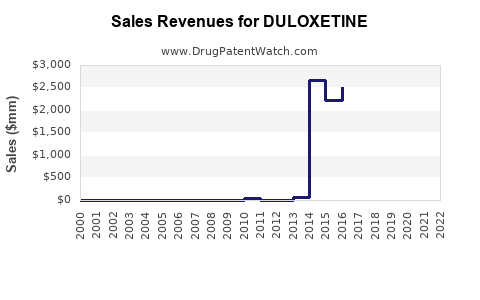
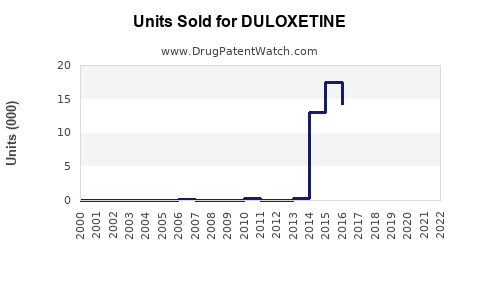
Annual Sales Revenues and Units Sold for DULOXETINE
| Drug Name | Revenues (USD) | Units | Year |
|---|---|---|---|
| DULOXETINE | ⤷ Start Trial | ⤷ Start Trial | 2022 |
| DULOXETINE | ⤷ Start Trial | ⤷ Start Trial | 2021 |
| DULOXETINE | ⤷ Start Trial | ⤷ Start Trial | 2020 |
| DULOXETINE | ⤷ Start Trial | ⤷ Start Trial | 2019 |
| DULOXETINE | ⤷ Start Trial | ⤷ Start Trial | 2018 |
| DULOXETINE | ⤷ Start Trial | ⤷ Start Trial | 2017 |
| DULOXETINE | ⤷ Start Trial | ⤷ Start Trial | 2016 |
| >Drug Name | >Revenues (USD) | >Units | >Year |
Duloxetine Market Analysis, Sales Projections, Patent Expiration, and Generic Competition
Duloxetine is a mature, largely genericized serotonin-norepinephrine reuptake inhibitor marketed originally as Cymbalta by Eli Lilly. The product generated nearly $5 billion in annual global sales before generic entry, but lost most branded revenue after U.S. generic launches in late 2013. The current market is driven by high-volume generic prescriptions for depression, anxiety, neuropathic pain, fibromyalgia, and chronic musculoskeletal pain.
The commercial outlook is stable rather than high-growth. Volume should remain resilient because duloxetine has multiple indications and low generic prices, but revenue growth is constrained by price erosion, therapeutic substitution, and limited protection for a new branded formulation.
What is duloxetine used for and how large is the market?
Duloxetine is approved in the United States for major depressive disorder, generalized anxiety disorder, diabetic peripheral neuropathic pain, fibromyalgia, and chronic musculoskeletal pain. It is available mainly as delayed-release capsules in 20 mg, 30 mg, and 60 mg strengths. The delayed-release design protects duloxetine from degradation in the stomach and controls release in the gastrointestinal tract. [1]
The principal commercial demand drivers are:
| Market segment | Commercial role |
|---|---|
| Major depressive disorder | Large patient base, but intense competition from generic SSRIs and SNRIs |
| Generalized anxiety disorder | Supports chronic use and repeat prescriptions |
| Diabetic peripheral neuropathic pain | Differentiates duloxetine from many antidepressants |
| Fibromyalgia | Established use, with competition from pregabalin and milnacipran |
| Chronic musculoskeletal pain | Expands prescribing beyond psychiatry |
| Off-label pain and anxiety use | Adds demand but is not separately protected by FDA exclusivity |
Duloxetine competes with venlafaxine, desvenlafaxine, milnacipran, pregabalin, gabapentin, amitriptyline, escitalopram, sertraline, and other generic therapies. Its strongest commercial advantage is the combination of psychiatric and pain indications.
What were Cymbalta’s peak sales and how much revenue remains?
Cymbalta reached peak annual sales of approximately $5 billion worldwide before generic competition. Eli Lilly reported Cymbalta revenue of about $5.1 billion in 2012, followed by a sharp decline after loss of exclusivity. [2]
The branded product’s revenue trajectory was approximately:
| Year | Cymbalta worldwide revenue trend | Primary market event |
|---|---|---|
| 2012 | About $5.1 billion | Pre-generic peak |
| 2013 | Declining | U.S. generic entry in December |
| 2014 | Steep decline | Full-year generic substitution |
| 2015 onward | Low residual revenue | Generic market established |
Cymbalta is no longer a material growth product for Eli Lilly. The economic value has shifted from brand sales to generic manufacturers, wholesalers, pharmacies, and healthcare systems that benefit from lower treatment costs.
Current U.S. duloxetine revenue is difficult to isolate because the market consists of multiple generic suppliers and pharmacy-channel pricing. A reasonable strategic estimate is that annual U.S. manufacturer sales are in the low hundreds of millions of dollars, while retail prescription spending is higher because of wholesaler and pharmacy margins.
What are the duloxetine sales projections through 2029?
The base case assumes stable prescription volume, continued low generic pricing, modest growth in pain-related use, and no major branded product relaunch. The forecast below is an analytical estimate for global manufacturer revenue from duloxetine products, not a reported market figure.
| Year | Downside case | Base case | Upside case |
|---|---|---|---|
| 2024 | $250 million | $325 million | $400 million |
| 2025 | $245 million | $330 million | $415 million |
| 2026 | $240 million | $335 million | $430 million |
| 2027 | $235 million | $340 million | $445 million |
| 2028 | $230 million | $345 million | $460 million |
| 2029 | $225 million | $350 million | $475 million |
The base case implies a compound annual growth rate of roughly 1.5% from 2024 through 2029. The upside case requires prescription growth in pain indications, stable supplier concentration, and limited additional price compression. The downside case reflects further generic price reductions, supply normalization, and substitution by venlafaxine, pregabalin, gabapentin, or newer branded pain products.
A separate retail-spending estimate would be materially higher than manufacturer revenue. Retail sales include dispensing fees, distribution margins, and payer-specific rebates. Market reports that combine retail spending with manufacturer revenue should not be compared directly with company-reported product sales.
When did duloxetine lose exclusivity?
Duloxetine lost effective U.S. market exclusivity in December 2013, when multiple generic manufacturers began commercializing delayed-release capsules after patent litigation and settlement activity. Generic duloxetine subsequently became widely available in the United States.
Key milestones include:
| Date | Event |
|---|---|
| August 2004 | FDA approved Cymbalta for major depressive disorder and diabetic peripheral neuropathic pain |
| 2007 | FDA expanded approval to generalized anxiety disorder |
| 2008 | FDA approved fibromyalgia indication |
| 2010 | FDA approved chronic musculoskeletal pain indication |
| 2013 | U.S. generic launch and rapid brand erosion |
| 2014 onward | Generic duloxetine became the dominant U.S. product |
The original compound and formulation protections no longer provide a meaningful barrier to ordinary generic duloxetine capsules. Commercial exclusivity has therefore expired even where historical patents remain relevant to the litigation record.
What patents protected Cymbalta and when did they expire?
The principal Cymbalta patent estate covered the duloxetine compound, pharmaceutical compositions, delayed-release formulations, and selected methods of use. Key historical U.S. patents included the following:
| Patent | General subject matter | Historical relevance |
|---|---|---|
| U.S. Patent No. 5,023,269 | Duloxetine compound and related chemical subject matter | Core compound protection; expired before or around generic launch after applicable patent-term adjustments |
| U.S. Patent No. 6,541,493 | Delayed-release duloxetine formulation | Important formulation protection; later expiration than the compound patent |
| Other formulation and method patents | Dosage forms, administration, and therapeutic uses | Relevant to Paragraph IV litigation and settlement terms |
Patent dates must be distinguished from regulatory exclusivity. The FDA’s Orange Book identifies patents submitted by the NDA holder, but an Orange Book listing does not guarantee that a patent is valid or infringed. Some listed patents may also be challenged through Paragraph IV certifications.
The commercial importance of the estate ended when generic applicants obtained approval and launched under litigation settlements or after relevant protections expired. Current generic manufacturers generally rely on the absence of enforceable blocking patents rather than on licenses from Eli Lilly.
What is the Orange Book status of duloxetine?
Cymbalta was listed in the FDA Orange Book under NDA 021427. Historical Orange Book entries covered delayed-release capsules and included patents associated with the compound and formulation.
The relevant regulatory structure is:
- Generic applicants file ANDAs for duloxetine delayed-release capsules.
- Applicants may certify that listed patents have expired or are not infringed.
- A Paragraph IV certification can trigger patent litigation.
- A valid Paragraph IV filing can create a 30-month stay of FDA approval under the Hatch-Waxman Act, unless the litigation is resolved earlier.
- Generic approval does not require the generic applicant to reproduce unprotected brand labeling claims beyond the permitted labeling framework.
The Orange Book should be reviewed by strength and dosage form because listed patents, therapeutic equivalence codes, and approved products can differ. Historical patent listings should not be treated as evidence of current enforceability.
Which companies challenged Cymbalta patents?
Multiple generic companies pursued duloxetine delayed-release capsules, including Teva Pharmaceuticals, Watson Pharmaceuticals, Wockhardt, Torrent Pharmaceuticals, Sun Pharmaceutical Industries, Apotex, and other ANDA applicants. Eli Lilly filed patent litigation against several applicants after Paragraph IV certifications.
The litigation strategy centered on formulation patents and the timing of generic entry. Generic applicants argued that the relevant claims were invalid, not infringed, or otherwise did not block approval. Eli Lilly sought to delay generic entry until patent expiry or negotiated launch dates.
The market ultimately developed into a multi-supplier generic field. That outcome reduced the probability that any one manufacturer could sustain premium pricing after launch.
What patent litigation and settlement agreements affected duloxetine?
The major litigation issue was whether generic delayed-release capsules infringed valid Cymbalta formulation patents. Settlements typically established an agreed launch date, although the precise commercial terms were often confidential.
The practical effects of the settlements were:
- Generic entry occurred before the latest possible patent expiry in some circumstances.
- Multiple manufacturers entered within a limited period.
- Brand revenue fell faster than it would have under a single-authorized-generic strategy.
- Generic manufacturers gained time to prepare manufacturing, distribution, and pharmacy contracts.
Eli Lilly’s public filings described Cymbalta as one of the company’s largest products exposed to loss of exclusivity. The company warned that generic competition would materially reduce revenue after 2013. [2,3]
No active litigation is needed to explain current market conditions. The core commercial dispute has been superseded by broad generic availability.
What formulations are protected by duloxetine patents?
The main protected formulation was the delayed-release capsule. Duloxetine is acid-sensitive, so the dosage form uses enteric protection or an equivalent release-control approach. The formulation patents addressed issues such as:
- Delayed release in the intestinal tract
- Protection from gastric conditions
- Capsule composition
- Stability of the active pharmaceutical ingredient
- Dosage-form performance
- Manufacturing and coating processes
Generic manufacturers must meet dissolution, stability, bioequivalence, and quality requirements. These technical requirements are meaningful manufacturing barriers, but they are not strong commercial exclusivity barriers because several suppliers have demonstrated the ability to produce approved products.
The most defensible technical positions today are likely to involve manufacturing controls, impurity profiles, coating processes, and supply reliability rather than broad product claims covering ordinary duloxetine delayed-release capsules.
How strong is the current duloxetine patent estate?
The current patent estate is weak for a conventional generic product and stronger only for genuinely differentiated delivery systems or new combinations.
| Patent category | Current strength |
|---|---|
| Original duloxetine compound | Expired or commercially exhausted |
| Standard delayed-release capsule | Low blocking value |
| New dosage strengths | Low, absent a novel formulation or approved indication |
| Method-of-use claims | Limited value because major indications are established and generic labeling is broad |
| Manufacturing process claims | Moderate technical value, usually difficult to enforce across suppliers |
| Novel combination products | Potentially stronger if supported by new clinical and patent claims |
| Abuse-deterrent or modified-release products | Potentially strong, but requires regulatory differentiation |
A new branded duloxetine product would need a meaningful clinical, adherence, safety, or delivery advantage. A simple reformulation would face both patentability and reimbursement challenges.
Does duloxetine face biosimilar risk?
No. Duloxetine is a small-molecule drug, not a biologic. It is regulated through the ANDA generic pathway, not the biosimilar pathway under the Public Health Service Act.
The relevant competitive risks are:
- Additional generic suppliers
- Authorized generic or private-label products
- Formulation improvements by competing antidepressant manufacturers
- Substitution with venlafaxine or desvenlafaxine
- Substitution with pregabalin or gabapentin in pain markets
- Greater use of low-cost SSRIs in depression and anxiety
- Payer formulary changes
Biosimilar penetration does not affect duloxetine directly.
How does duloxetine compare with competing drugs?
| Drug | Primary strengths | Commercial position |
|---|---|---|
| Duloxetine | Depression plus multiple chronic pain indications | Broad generic demand |
| Venlafaxine | Depression, anxiety, established SNRI use | Major generic competitor |
| Desvenlafaxine | Depression, simple branded and generic positioning | Smaller indication base |
| Pregabalin | Neuropathic pain, fibromyalgia | Strong pain competitor; generic pressure |
| Gabapentin | Broad neuropathic pain use, low cost | High-volume substitute |
| Milnacipran | Fibromyalgia | Narrower market |
| SSRIs | Depression and anxiety, strong physician familiarity | Low-cost substitutes |
Duloxetine has a favorable indication mix, but its net price is low. Its strongest defense is clinical familiarity and cross-specialty prescribing, not patent protection.
What generic launch scenarios exist for duloxetine?
The U.S. market is already in the mature generic phase. Future scenarios are therefore based on supplier behavior rather than first generic entry.
Base scenario
Several manufacturers maintain supply, prescription volume remains stable, and prices decline gradually. Manufacturer revenue grows slowly through volume but is offset by lower unit pricing.
Downside scenario
A new low-cost supplier enters, wholesaler inventory rises, and payer contracts shift toward the lowest-cost product. Revenue declines despite stable prescription volume.
Upside scenario
Demand increases in chronic pain and anxiety, supply remains concentrated among disciplined manufacturers, and pricing stabilizes. Revenue growth remains limited because the market lacks meaningful exclusivity.
What are the manufacturing and geographic IP barriers?
Duloxetine manufacturing barriers are moderate. Producers must manage:
- Chiral chemistry and stereochemical purity
- Impurity control
- Delayed-release coating uniformity
- Dissolution specifications
- Stability under humidity and temperature stress
- Bioequivalence across capsule strengths
- Reliable supply of active pharmaceutical ingredient
Geographic patent risk is largely historical in the United States and Europe. Commercial protection may differ in emerging markets because of local filing dates, patent-term rules, supplementary protection certificates, compulsory licensing rules, and national litigation outcomes.
Generic products are available across the United States, Europe, India, Canada, and other regulated markets. Pricing is generally lowest in markets with multiple approved suppliers and centralized reimbursement.
What FDA regulatory status applies to duloxetine?
Duloxetine is FDA approved and marketed in the United States as delayed-release capsules. Cymbalta is the reference listed drug, while generic products are approved through ANDAs demonstrating pharmaceutical equivalence and bioequivalence.
The FDA approval history provides regulatory support for five major use areas:
- Major depressive disorder
- Generalized anxiety disorder
- Diabetic peripheral neuropathic pain
- Fibromyalgia
- Chronic musculoskeletal pain
Generic manufacturers do not receive new-chemical-entity exclusivity for duloxetine. Any commercial advantage must come from manufacturing scale, supply reliability, distribution, formulation differentiation, or a new approved product.
What are the key investment and licensing implications?
Duloxetine is a cash-generative mature generic market, not a conventional patent-investment opportunity. Attractive opportunities are more likely to involve:
- Low-cost API production
- Reliable delayed-release manufacturing
- Private-label supply agreements
- Hospital and government tenders
- Fixed-dose combinations
- New delivery systems
- International markets with fragmented supply
- Contract manufacturing for regulated-market products
Licensing a standard duloxetine capsule has limited strategic value because equivalent products are widely available. A license could have value if it includes a differentiated formulation, a novel combination, proprietary manufacturing technology, or access to a protected geographic market.
Key Takeaways
- Duloxetine is a mature generic SNRI with established demand in psychiatric and pain indications.
- Cymbalta generated approximately $5 billion in annual global sales before generic entry.
- U.S. generic commercialization began in late 2013 and eliminated most branded revenue.
- The relevant patent estate covered the compound and delayed-release formulation, but no longer blocks ordinary generic competition.
- Duloxetine has no biosimilar risk because it is a small-molecule drug.
- Base-case global manufacturer revenue is estimated at approximately $325 million in 2024 and $350 million by 2029.
- The strongest remaining commercial opportunities involve manufacturing scale, supply reliability, and differentiated delivery systems.
- Standard delayed-release duloxetine capsules have low patent strength and limited licensing value.
FAQs
Is duloxetine still a profitable drug for manufacturers?
Yes, but profitability depends on manufacturing cost, supplier scale, tender access, and supply reliability. The market no longer supports branded-style margins.
Can a new company launch a generic duloxetine product?
Yes. A manufacturer can pursue an ANDA for a therapeutically equivalent delayed-release capsule, subject to FDA requirements for chemistry, manufacturing, controls, dissolution, stability, and bioequivalence.
Does Cymbalta still have market exclusivity?
No meaningful U.S. market exclusivity remains for standard duloxetine delayed-release capsules. Cymbalta continues to exist as a brand, but generic substitution dominates the market.
Is duloxetine protected by a new formulation patent?
Historical formulation patents protected the delayed-release capsule, but ordinary delayed-release generic products are already established. A new formulation would need distinct claims and regulatory differentiation.
Which drug is the closest competitor to duloxetine?
Venlafaxine is the closest pharmacologic competitor because both are SNRIs used in depression and anxiety. Gabapentin and pregabalin are important commercial substitutes in neuropathic pain and fibromyalgia.
References
-
U.S. Food and Drug Administration. (2024). Cymbalta (duloxetine hydrochloride) prescribing information. FDA.
-
Eli Lilly and Company. (2013). 2012 annual report. Eli Lilly and Company.
-
Eli Lilly and Company. (2014). 2013 annual report. Eli Lilly and Company.
-
U.S. Food and Drug Administration. (2024). Orange Book: Approved drug products with therapeutic equivalence evaluations. FDA.
-
U.S. Food and Drug Administration. (2024). Drugs@FDA: Cymbalta application and approval history. FDA.
-
U.S. Patent and Trademark Office. (2024). Patent Center and patent term information for U.S. Patent Nos. 5,023,269 and 6,541,493. USPTO.
More… ↓
