Share This Page
Drug Sales Trends for CYTOMEL
✉ Email this page to a colleague
Payment Methods and Pharmacy Types for CYTOMEL (2002)
Revenues by Pharmacy Type
Units Sold by Pharmacy Type
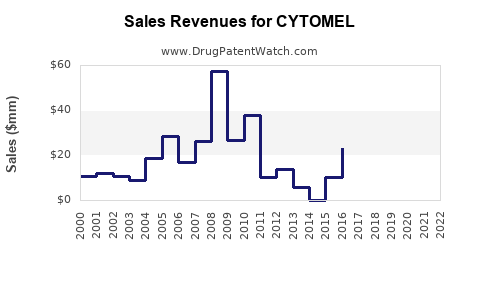
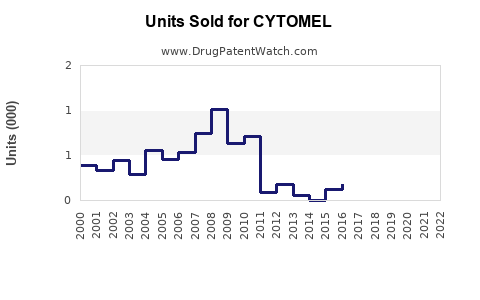
Annual Sales Revenues and Units Sold for CYTOMEL
| Drug Name | Revenues (USD) | Units | Year |
|---|---|---|---|
| CYTOMEL | ⤷ Start Trial | ⤷ Start Trial | 2022 |
| CYTOMEL | ⤷ Start Trial | ⤷ Start Trial | 2021 |
| CYTOMEL | ⤷ Start Trial | ⤷ Start Trial | 2020 |
| CYTOMEL | ⤷ Start Trial | ⤷ Start Trial | 2019 |
| CYTOMEL | ⤷ Start Trial | ⤷ Start Trial | 2018 |
| CYTOMEL | ⤷ Start Trial | ⤷ Start Trial | 2017 |
| >Drug Name | >Revenues (USD) | >Units | >Year |
Cytomel Market Analysis, Sales Forecast, Patent Status, and Generic Competition
Cytomel, the branded liothyronine sodium product, operates in a mature and heavily genericized thyroid-hormone market. Its commercial opportunity is limited by low-cost generic liothyronine, dominant levothyroxine prescribing, long-expired exclusivity, and clinical caution around routine T3 use. A reasonable base-case estimate places U.S. Cytomel-branded net sales below $100 million annually, with low-single-digit revenue erosion expected through 2029 unless the manufacturer expands specialty distribution, secures favorable formulary positioning, or develops a differentiated formulation.
The broader liothyronine market should grow modestly in volume but remain exposed to price compression. The principal commercial value lies in the generic market, not the Cytomel brand.
What is Cytomel and how is it used?
Cytomel is an oral formulation of liothyronine sodium, the synthetic form of triiodothyronine, or T3. It is approved for thyroid hormone replacement in hypothyroidism and for selected other thyroid-related indications described in the FDA labeling. The product is available in multiple tablet strengths, including 5, 25, and 50 micrograms in the U.S. label historically associated with Cytomel.
Liothyronine has a faster onset and shorter half-life than levothyroxine, or T4. That pharmacology creates a clinical role for patients who cannot achieve satisfactory symptom control with levothyroxine alone, but it also increases the risk of transient high T3 exposure, cardiovascular effects, and bone loss when dosing is excessive.
The American Thyroid Association identifies levothyroxine monotherapy as the standard treatment for most patients with primary hypothyroidism. Liothyronine is generally considered for selected patients rather than as routine first-line therapy (Jonklaas et al., 2014).
How large is the Cytomel and liothyronine market?
The market has three distinct segments:
| Segment | Commercial position | Primary competitive pressure |
|---|---|---|
| Levothyroxine products | Dominant thyroid-replacement segment | Generic price competition |
| Generic liothyronine tablets | Main T3 market by prescription volume | Multiple manufacturers and low barriers |
| Branded Cytomel | Niche premium segment | Generic substitution and payer controls |
Public-company filings generally do not disclose Cytomel revenue separately. Cytomel is typically grouped within broader established-products or legacy-branded portfolios. As a result, standalone revenue must be modeled rather than directly observed.
A practical U.S. market estimate is:
| Metric | Estimated range |
|---|---|
| Annual U.S. liothyronine prescription market value | $150 million-$350 million |
| Estimated branded Cytomel share of value | 15%-35% |
| Estimated Cytomel U.S. net sales | $25 million-$100 million |
| Estimated generic share of liothyronine prescriptions | More than 60% |
| Expected 2025-2029 branded Cytomel revenue CAGR | -5% to -1% |
| Expected 2025-2029 total liothyronine market value CAGR | 0% to 3% |
These ranges reflect the absence of a separately reported manufacturer revenue figure and the large spread between list prices, payer rebates, specialty-pharmacy prices, and pharmacy acquisition costs.
What are the main Cytomel sales drivers?
Prescriber demand for T3-containing therapy
Cytomel demand is supported by patients who report persistent symptoms on levothyroxine, patients with unusual conversion or absorption concerns, and clinicians who use combination T4/T3 therapy in selected cases. This demand is clinically persistent but limited by treatment guidelines.
A sustained increase in liothyronine prescribing would require broader acceptance of combination therapy or better evidence supporting specific patient subgroups. Current guidelines do not support broad substitution of liothyronine for levothyroxine.
Chronic treatment duration
Hypothyroidism is usually a chronic condition. Once prescribed, thyroid replacement may continue for years. This supports refill stability and reduces dependence on new patient acquisition.
Generic availability
Generic competition limits Cytomel’s ability to convert prescription persistence into premium revenue. Pharmacists and health plans can substitute generic liothyronine unless the prescriber specifies that the brand is medically necessary.
Product familiarity
Cytomel has longstanding physician and patient recognition. That history supports residual brand demand, particularly among patients who report differences between manufacturers or who have remained stable on the branded product.
Limited therapeutic alternatives within T3
There are relatively few widely used oral T3 products. That supports Cytomel’s residual position despite generic availability. The limitation is commercial rather than clinical: the brand remains differentiated mainly by familiarity and perceived consistency, not by strong patent protection.
What is the Cytomel sales forecast through 2029?
The following forecast is an analytical scenario model, not reported company guidance. It assumes U.S. net sales, a mature generic market, no new Cytomel formulation, and no major change in thyroid-treatment guidelines.
| Year | Bear case | Base case | Upside case |
|---|---|---|---|
| 2024 estimated baseline | $30 million | $60 million | $95 million |
| 2025 | $27 million | $58 million | $94 million |
| 2026 | $24 million | $56 million | $94 million |
| 2027 | $21 million | $54 million | $93 million |
| 2028 | $18 million | $52 million | $92 million |
| 2029 | $16 million | $50 million | $91 million |
Bear case
The bear case assumes continued generic substitution, lower reimbursement for branded liothyronine, reduced prescriber use of T3-containing therapy, and no meaningful brand differentiation. Under this scenario, Cytomel sales decline at approximately 10% annually.
Base case
The base case assumes stable clinical demand, gradual loss of branded share, and modest price increases offset by rebates. Revenue declines at approximately 3% to 4% annually.
Upside case
The upside case assumes stable brand retention among chronic users, limited generic supply disruptions, favorable payer coverage for selected patients, and modest list-price increases. It does not assume broad guideline adoption of liothyronine.
The forecast range is wide because the manufacturer does not publicly report a standalone Cytomel revenue line.
How does Cytomel compare with levothyroxine?
Levothyroxine is commercially stronger because it is the guideline-preferred treatment for most hypothyroid patients, is available from numerous generic manufacturers, and has a much larger patient base.
| Factor | Cytomel | Levothyroxine |
|---|---|---|
| Active ingredient | Liothyronine, T3 | Levothyroxine, T4 |
| Typical role | Selected patients and combination therapy | Standard replacement therapy |
| Market size | Niche | Mass market |
| Brand pricing power | Limited | Limited, with some branded exceptions |
| Generic competition | High | Very high |
| Clinical half-life | Shorter | Longer |
| Formulation opportunity | Meaningful for sustained-release T3 | More limited |
| Guideline position | Selective use | Standard first-line therapy |
Cytomel’s commercial ceiling is constrained by the much larger levothyroxine market. A patient who remains adequately controlled on levothyroxine generally does not create a commercial opportunity for Cytomel.
What is the FDA regulatory status of Cytomel?
Cytomel is an FDA-approved prescription drug. Its regulatory status is that of an established immediate-release oral liothyronine product rather than a recently approved innovative therapy. FDA labeling identifies the product as liothyronine sodium tablets and describes dosing, contraindications, warnings, and adverse reactions associated with excessive thyroid hormone exposure (U.S. Food and Drug Administration, n.d.-a).
Important regulatory characteristics include:
- Prescription-only status.
- Chronic-use indication for thyroid hormone replacement.
- Multiple tablet strengths.
- No biologic pathway or biosimilar framework.
- No meaningful regulatory exclusivity remaining from the original approval.
- Generic abbreviated new drug application competition.
Cytomel is not exposed to biosimilar substitution because it is a small-molecule tablet, not a biologic. Its principal regulatory threat is generic substitution through the ANDA pathway.
What is the Orange Book status of Cytomel?
Cytomel’s original active-ingredient and basic tablet protection expired decades ago. Any current commercial protection would have to arise from a later formulation, manufacturing process, or other separately listed patent. Publicly available product information does not indicate a modern composition-of-matter patent estate capable of supporting long-term exclusivity for conventional immediate-release Cytomel tablets.
The relevant Orange Book issues are:
| Orange Book issue | Cytomel position |
|---|---|
| Listed active ingredient | Liothyronine sodium |
| Dosage form | Immediate-release tablet |
| Generic competition | Established |
| Paragraph IV relevance | Primarily applies to later-listed patents, if any |
| Remaining original exclusivity | None |
| Biosimilar competition | Not applicable |
| Core patent barrier | Expired or commercially ineffective for standard tablets |
An Orange Book listing should be checked by product number and current reference-listed drug entry before relying on a patent conclusion for litigation or transaction purposes. Historical listing data can change when patents expire, delist, or are transferred.
What patents protect Cytomel?
The commercially relevant Cytomel product does not depend on an active composition-of-matter patent. Liothyronine sodium is an old active pharmaceutical ingredient, and standard immediate-release tablet technology is widely available.
Potential IP categories include:
- Tablet composition claims covering excipients or manufacturing parameters.
- Process claims covering blending, compression, or impurity control.
- Packaging claims related to stability.
- Method-of-use claims covering selected thyroid treatment regimens.
- Future formulation claims covering sustained-release or chronotherapy-based T3 delivery.
These categories have materially weaker blocking power than a new-molecule patent. Generic manufacturers can often design around narrow formulation or process claims, particularly when the reference product is a conventional tablet.
How strong is the Cytomel patent estate?
The Cytomel patent estate is weak as a barrier to generic entry and moderate only as a potential defense against narrowly defined follow-on formulations.
| Patent-strength factor | Assessment |
|---|---|
| Composition-of-matter protection | Very weak or expired |
| Standard tablet protection | Weak |
| Method-of-use protection | Limited practical enforceability |
| Manufacturing IP | Potentially narrow |
| Formulation innovation | Possible source of new protection |
| Generic design-around risk | High |
| Litigation leverage | Low for legacy tablets |
Method-of-use patents would face practical challenges because physicians can prescribe liothyronine for overlapping thyroid indications and generic labels may not always reproduce the full scope of a branded treatment method. A litigation strategy based solely on a narrow use patent would have limited ability to preserve broad brand revenue.
When did Cytomel lose exclusivity?
Cytomel lost meaningful market exclusivity long before the current generic market developed. The product’s active ingredient and conventional tablet dosage form are not protected by a modern patent term that could delay generic entry.
The commercial exclusivity timeline is therefore best described as:
| Period | Event |
|---|---|
| Initial approval era | Cytomel introduced as an oral liothyronine product |
| Later lifecycle | Additional strengths and labeling maintained the product |
| Generic era | ANDA competition entered the market |
| Current period | Brand competes through recognition, continuity, and prescriber preference |
| 2025-2029 | Continued erosion expected without product differentiation |
The key commercial date is not a future patent expiration date. It is the historical transition from protected brand product to mature generic market.
Which companies are challenging Cytomel?
Generic liothyronine competition has historically come from major generic manufacturers and specialty suppliers rather than from a single high-profile Paragraph IV campaign. The competitive set can include manufacturers such as Hikma, Teva, Amneal, Sandoz, and other FDA-approved suppliers, depending on current product availability and approved label status.
The market should be evaluated through:
- FDA Orange Book active-ingredient records.
- FDA Drug Shortages data.
- National Drug Code listings.
- Wholesale acquisition cost changes.
- Pharmacy benefit manager formulary placement.
- Manufacturer discontinuation notices.
Because liothyronine is a small market, supply interruptions or manufacturer exits can temporarily improve brand retention and pricing. Such events usually create short-term opportunities rather than durable structural advantages.
What generic launch risks exist for Cytomel?
Generic launch risk is already realized rather than prospective. The principal risks are ongoing share migration and price competition.
The main risks are:
- Automatic or pharmacist-level substitution.
- Formulary exclusion of the brand.
- Low generic acquisition cost.
- New ANDA approvals from additional manufacturers.
- Improved generic supply reliability.
- Payer pressure against brand-only prescriptions.
- Clinical movement toward levothyroxine monotherapy.
- Patient switching caused by pharmacy benefit redesign.
A new generic entrant could reduce brand sales through both volume substitution and lower market reference pricing. The effect would be largest in commercial insurance and managed-care channels.
What formulation patents could improve Cytomel sales?
A sustained-release liothyronine product would offer the clearest lifecycle-management opportunity. The commercial rationale is to reduce peak-related adverse effects and approximate a more physiologic T3 exposure profile.
Potentially protectable features include:
- Extended-release matrix systems.
- Multi-pulse release tablets.
- Delayed-release capsules.
- Chronotherapy formulations.
- Combination T4/T3 products.
- Improved stability and dose uniformity.
- Abuse-deterrent or controlled-dispersion delivery systems.
A differentiated formulation could command a premium if clinical studies demonstrate better tolerability, adherence, or symptom control. It would also face development risks, including bioequivalence complexity, narrow therapeutic margins, and the need to show meaningful clinical benefit over inexpensive generic tablets.
What licensing deals affect Cytomel?
No major publicly disclosed licensing transaction is required to explain Cytomel’s current market position. The brand’s economics depend primarily on ownership of the established product, manufacturing rights, distribution arrangements, and generic competition.
Potential transaction value would be constrained by:
- Low standalone revenue visibility.
- Mature generic exposure.
- Limited patent life.
- Dependence on chronic but narrow demand.
- Payer pressure.
- Potential manufacturing concentration.
A buyer would likely value Cytomel as a cash-generating legacy asset rather than as a protected growth product. The strongest strategic rationale would be portfolio fit, low-cost manufacturing, or combination with a broader endocrinology franchise.
What litigation and settlement risks affect Cytomel?
Cytomel does not have the profile of a current high-value Paragraph IV litigation asset. There is no evident basis for assuming a major active patent settlement that would preserve branded exclusivity for conventional immediate-release tablets.
Future litigation risk would arise if a sponsor launched:
- A sustained-release liothyronine product.
- A combination T4/T3 product.
- A new tablet with clinically meaningful pharmacokinetic differentiation.
- A method-of-use program directed at a defined hypothyroid subgroup.
For the legacy product, litigation is more likely to involve supply, labeling, manufacturing, trademark, or product-quality matters than core patent exclusion.
What is the geographic coverage and international opportunity?
Cytomel’s strongest commercial relevance is in the United States, where the brand has longstanding recognition and an established prescription channel. International markets are fragmented by national reimbursement systems, local generic suppliers, product naming, and differences in clinical preference.
International growth is constrained by:
- Generic liothyronine availability.
- National price controls.
- Limited use of T3 monotherapy.
- Country-specific registration requirements.
- Local distributor dependence.
- Small patient populations in some markets.
The most attractive geographic opportunities would be markets with reliable reimbursement, limited local generic supply, and established endocrinology demand. These opportunities are unlikely to change the global growth profile materially without a differentiated formulation.
What revenue exposure does Cytomel create for its owner?
Cytomel is likely to represent a small portion of a diversified pharmaceutical company’s total revenue. Its strategic value is higher than its absolute sales value when it provides:
- Stable chronic prescription demand.
- Manufacturing utilization.
- Cross-selling into endocrinology.
- Portfolio diversification.
- Cash flow from a mature product with limited development expense.
The main downside is gradual decline rather than sudden loss of exclusivity. Revenue volatility would increase if a major generic manufacturer entered, if a supply disruption ended, or if a payer removed brand coverage.
Key Takeaways
- Cytomel is a mature branded liothyronine product with no meaningful modern composition-of-matter exclusivity.
- Generic liothyronine is the primary competitive threat.
- Estimated U.S. Cytomel net sales are approximately $25 million-$100 million annually, because standalone company revenue is not publicly reported.
- Base-case sales are projected to decline from approximately $60 million in 2024 to $50 million in 2029.
- Levothyroxine remains the dominant thyroid-replacement therapy and limits Cytomel’s addressable market.
- Biosimilar risk is not applicable; ANDA-based generic substitution is the relevant regulatory threat.
- A sustained-release or combination T4/T3 formulation would provide the strongest lifecycle-management opportunity.
- The legacy Cytomel product has low patent strength and limited litigation leverage.
- Cytomel is better valued as a stable legacy asset than as a growth or exclusivity platform.
FAQs
Is Cytomel still commercially profitable?
Likely yes, if manufacturing and distribution costs remain controlled. Chronic demand and brand recognition can support positive cash flow despite generic competition, but profitability cannot be determined from publicly disclosed standalone financial statements.
Does Cytomel have a patent expiration date?
The original protection for liothyronine and conventional Cytomel tablets expired long ago. Current commercial risk is driven by generic substitution rather than a pending single patent cliff.
Can a generic manufacturer launch liothyronine without a Paragraph IV lawsuit?
Yes. Generic liothyronine products can enter through the ANDA pathway when applicable patent and exclusivity barriers do not block approval. A Paragraph IV certification is relevant only if a listed patent remains legally relevant.
Is Cytomel more valuable than generic liothyronine?
The brand can command a higher price, but the generic market has greater prescription volume. Cytomel’s value depends on brand retention, payer coverage, and manufacturing economics rather than patent protection.
Could a sustained-release Cytomel replace levothyroxine?
A sustained-release T3 product could expand use among selected patients, but it is unlikely to replace levothyroxine as the standard treatment for most hypothyroid patients without strong clinical evidence and guideline changes.
References
-
American Thyroid Association. (2014). Guidelines for the treatment of hypothyroidism. Thyroid, 24(12), 1670-1751.
-
U.S. Food and Drug Administration. (n.d.-a). Cytomel (liothyronine sodium) tablets: Prescribing information. FDA.
-
U.S. Food and Drug Administration. (n.d.-b). Approved drug products with therapeutic equivalence evaluations. FDA Orange Book.
-
U.S. Food and Drug Administration. (n.d.-c). Drugs@FDA: FDA-approved drugs database. FDA.
-
Jonklaas, J., Bianco, A. C., Bauer, A. J., Burman, K. D., Cappola, A. R., Celi, F. S., Cooper, D. S., Kim, B. W., Peeters, R. P., Rosenthal, M. S., & Sawka, A. M. (2014). Guidelines for the treatment of hypothyroidism. Thyroid, 24(12), 1670-1751.
More… ↓
