Share This Page
Drug Sales Trends for BUSPIRONE
✉ Email this page to a colleague
Payment Methods and Pharmacy Types for BUSPIRONE (2002)
Revenues by Pharmacy Type
Units Sold by Pharmacy Type
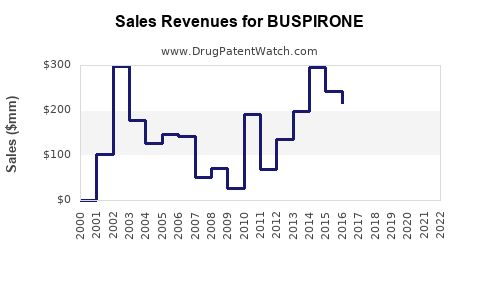
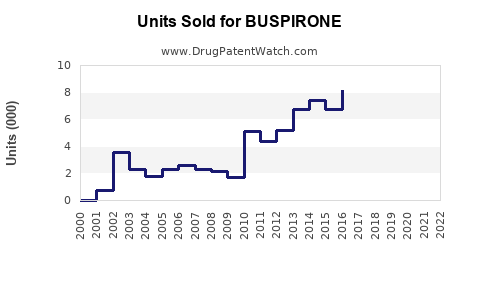
Annual Sales Revenues and Units Sold for BUSPIRONE
| Drug Name | Revenues (USD) | Units | Year |
|---|---|---|---|
| BUSPIRONE | ⤷ Start Trial | ⤷ Start Trial | 2022 |
| BUSPIRONE | ⤷ Start Trial | ⤷ Start Trial | 2021 |
| BUSPIRONE | ⤷ Start Trial | ⤷ Start Trial | 2020 |
| BUSPIRONE | ⤷ Start Trial | ⤷ Start Trial | 2019 |
| >Drug Name | >Revenues (USD) | >Units | >Year |
Buspirone Market Analysis, Sales Forecast, Patent Status, and Generic Competition
Buspirone is a mature, low-cost generic anxiolytic with broad U.S. availability and no meaningful remaining brand exclusivity. The commercial market is driven by prescription volume, pharmacy reimbursement, generic pricing, and continued use in generalized anxiety disorder. A reasonable base-case estimate places global buspirone product revenue at approximately $150 million to $250 million annually, with low-single-digit growth through 2030. The U.S. is the largest market, but price compression limits revenue expansion.
What is the current market status of buspirone?
Buspirone hydrochloride is an oral azaspirodecanedione anxiolytic approved by the FDA for the management of anxiety disorders or short-term relief of anxiety symptoms. It is marketed primarily as a generic tablet under the former reference brand name BuSpar.[1]
The product has several commercial characteristics:
- Small-molecule generic drug
- Immediate-release oral tablets
- Primarily used for generalized anxiety symptoms
- No biosimilar pathway
- No meaningful brand premium
- Multiple approved generic manufacturers
- Low manufacturing complexity relative to controlled substances
- Limited exposure to specialty-pharmacy economics
Buspirone competes mainly with generic selective serotonin reuptake inhibitors, serotonin-norepinephrine reuptake inhibitors, hydroxyzine, benzodiazepines, and pregabalin in certain markets. Its clinical positioning is strongest where prescribers want an anxiolytic without the dependence and controlled-substance restrictions associated with benzodiazepines.
What dosage forms and strengths are marketed?
The principal U.S. dosage form is the immediate-release tablet. FDA-approved labeling identifies 5 mg, 10 mg, 15 mg, and 30 mg tablets, with some products supplied as scored tablets that support intermediate dosing.[1][2]
| Product characteristic | Buspirone position |
|---|---|
| Active ingredient | Buspirone hydrochloride |
| Route | Oral |
| Primary dosage form | Immediate-release tablet |
| Common strengths | 5 mg, 10 mg, 15 mg, 30 mg |
| Primary indication | Anxiety disorders and anxiety symptoms |
| Controlled substance status | Not scheduled under the U.S. Controlled Substances Act |
| Reference brand | BuSpar |
| Generic competition | Extensive |
| Specialty distribution | Limited |
How large is the buspirone market?
Public companies generally do not report buspirone revenue separately because the product is sold as one generic molecule within broader portfolios. Market sizing therefore requires a prescription-volume and realized-price model rather than direct company disclosures.
A practical estimate for annual global buspirone revenue is $150 million to $250 million. The range reflects differences in country coverage, whether hospital and tender sales are included, and whether estimates use pharmacy acquisition revenue, manufacturer net sales, or retail spending.
The U.S. likely accounts for the majority of global value because buspirone is widely prescribed and has broad insurance coverage. The market is economically concentrated in prescription volume rather than price.
Estimated 2024 market structure
| Metric | Estimated range |
|---|---|
| Global annual revenue | $150 million-$250 million |
| U.S. share of global revenue | 55%-75% |
| U.S. annual prescriptions | Several million |
| Average generic prescription value | Approximately $8-$20 |
| Manufacturer net revenue per prescription | Approximately $3-$12 |
| Branded share | Effectively negligible |
| Specialty pharmacy share | Less than 5% |
| Hospital and institutional share | Approximately 10%-20% globally |
These figures are market-model estimates, not reported sales from a buspirone manufacturer. The large gap between retail spending and manufacturer revenue reflects rebates, pharmacy margins, wholesaler discounts, payer contracts, and generic purchasing arrangements.
What are the buspirone sales projections through 2030?
The base case assumes stable anxiety-treatment demand, modest prescription growth, continued generic price erosion, and no major product shortage. Under those conditions, volume grows faster than revenue.
Global buspirone revenue forecast
| Year | Downside case | Base case | Upside case |
|---|---|---|---|
| 2024 | $150 million | $200 million | $250 million |
| 2025 | $147 million | $202 million | $258 million |
| 2026 | $144 million | $204 million | $266 million |
| 2027 | $141 million | $208 million | $274 million |
| 2028 | $138 million | $212 million | $282 million |
| 2029 | $135 million | $216 million | $291 million |
| 2030 | $132 million | $220 million | $300 million |
The base case implies approximately 1.9% compound annual growth from 2024 to 2030. The downside case reflects further reimbursement compression and substitution by SSRIs, SNRIs, and low-cost hydroxyzine. The upside case assumes increased prescribing for non-controlled anxiety treatment and periodic supply constraints that improve pricing for reliable manufacturers.
U.S. forecast
| Year | U.S. market estimate |
|---|---|
| 2024 | $110 million-$150 million |
| 2025 | $111 million-$153 million |
| 2026 | $112 million-$156 million |
| 2027 | $114 million-$159 million |
| 2028 | $116 million-$162 million |
| 2029 | $118 million-$165 million |
| 2030 | $120 million-$168 million |
U.S. revenue growth is likely to remain below prescription growth. Generic competition caps price increases, while payer formularies favor low-cost suppliers. The main commercial opportunity is therefore manufacturing scale, dependable supply, and portfolio efficiency rather than premium pricing.
What factors will drive buspirone sales growth?
Anxiety prevalence and treatment persistence
Anxiety disorders generate a large potential patient pool, but buspirone competes against several established pharmacologic classes. Long-term use depends on tolerability, perceived efficacy, adherence, and prescriber familiarity.
Buspirone may gain share when clinicians seek an option that:
- Is not a controlled substance
- Has lower dependence concerns than benzodiazepines
- Can be used chronically
- Has a low acquisition cost
- Fits primary-care prescribing workflows
The drug does not provide the rapid symptom relief associated with benzodiazepines. That limits its use in acute panic or immediate crisis settings.
Controlled-substance avoidance
Prescribers and health systems continue to manage dependence, diversion, and monitoring risks associated with benzodiazepines. Buspirone can benefit from substitution in selected patients, although SSRIs and SNRIs remain more common long-term pharmacologic choices for many anxiety disorders.
Generic supply reliability
Buspirone is a low-margin product. Manufacturers that maintain reliable API sourcing, quality systems, and inventory can gain share during supply disruptions. FDA drug shortage conditions, however, are episodic and should not be treated as a durable pricing thesis.
Retail and mail-order access
The drug is dispensed through retail pharmacies, mail-order channels, and institutional pharmacies. Expanded use of 90-day prescriptions and mail-order fulfillment can increase adherence and prescription persistence but generally reduces per-unit margins.
What is the FDA regulatory status of buspirone?
Buspirone was approved in the United States through an NDA for BuSpar and is now supplied mainly through abbreviated new drug applications. The FDA-approved product is an immediate-release oral tablet.[1]
The regulatory profile is mature:
- No new molecular entity exclusivity remains.
- No meaningful pediatric exclusivity remains.
- No current brand-driven regulatory barrier prevents generic substitution.
- Generic applicants must demonstrate pharmaceutical equivalence and bioequivalence.
- Manufacturing sites remain subject to FDA current good manufacturing practice requirements.
The product is not a biologic and does not create biosimilar interchangeability issues. Regulatory risk is concentrated in manufacturing compliance, analytical controls, dissolution performance, and supply continuity.
What is the Orange Book status of buspirone?
The Orange Book identifies FDA-approved buspirone products and their therapeutic-equivalence status. The original BuSpar exclusivity and patent period expired decades ago. Current market access is based on approved generic products rather than an active brand patent position.[3]
| Orange Book issue | Buspirone assessment |
|---|---|
| Reference listed drug | Historical BuSpar NDA |
| Active brand exclusivity | None expected |
| Unexpired core composition patent | None of commercial significance |
| Generic substitution | Broadly available |
| Paragraph IV exposure | Limited practical relevance |
| Pediatric exclusivity | Expired |
| Regulatory market barrier | Low |
Orange Book status can change as products are approved, withdrawn, or updated. The commercial conclusion remains unchanged: buspirone is an established generic market without a meaningful remaining exclusivity moat.
What patents protect buspirone?
The original buspirone patent estate is expired. Historical patent protection covered the active compound and related pharmaceutical compositions, but those rights do not provide a current barrier to generic entry.
What formulation patents protect buspirone?
No widely recognized, commercially material formulation patent appears to protect the standard U.S. immediate-release buspirone tablet market. Generic products compete through conventional tablet manufacturing, strength selection, bioequivalence, and supply execution.
A manufacturer could pursue a new extended-release formulation, combination product, liquid formulation, or alternate delivery system. Such a product would need clinical, regulatory, and commercial differentiation. A new patent filing would not automatically block the existing immediate-release generic market.
What method-of-use patents protect buspirone?
The principal approved use is anxiety treatment. Method-of-use protection associated with the original branded product has expired or has no meaningful effect on current generic competition. Off-label use does not create a reliable exclusivity position.
When does buspirone lose exclusivity?
Buspirone lost practical market exclusivity in the 1990s after expiration of the original brand patent and the launch of generic products. There is no commercially relevant future loss-of-exclusivity event comparable to a branded drug approaching patent expiry.
Buspirone exclusivity timeline
| Event | Timing |
|---|---|
| Original BuSpar development and approval | 1980s |
| FDA approval of reference product | 1986 |
| Original patent protection | Expired decades ago |
| Generic entry | Established by the 1990s |
| Current market status | Mature, multisource generic |
| Expected future LOE event | None material |
Which companies are competing in the buspirone market?
Competition is fragmented among generic manufacturers and distributors. The U.S. market has historically included companies such as Teva Pharmaceuticals, Viatris or Mylan, Sandoz, Solco Healthcare, Zydus, Dr. Reddy’s Laboratories, and other FDA-approved suppliers. Product availability varies by strength, distributor contract, manufacturing status, and pharmacy inventory.[2][4]
No single company is likely to control the full global buspirone market. Competitive advantages include:
- FDA-compliant manufacturing
- Low-cost API procurement
- Multiple tablet strengths
- Reliable wholesaler supply
- Ability to absorb reimbursement pressure
- Diversified generic portfolio economics
What generic entry risks exist for buspirone?
Generic entry risk is already realized rather than prospective. The key business risks are price erosion, product discontinuation, and supply instability.
| Risk | Commercial effect |
|---|---|
| Additional generic suppliers | Lower average selling price |
| Payer reimbursement cuts | Lower manufacturer margin |
| API disruption | Temporary shortage or higher costs |
| Manufacturing warning letter | Loss of market supply |
| Low prescription growth | Limited revenue expansion |
| Substitution by SSRIs or SNRIs | Reduced volume |
| Pharmacy consolidation | Greater buyer negotiating power |
The most likely launch scenario for any new entrant is rapid substitution into an existing multisource market, followed by reimbursement compression. A new entrant would need manufacturing-cost advantages or a contracted distribution position to achieve attractive returns.
What patent litigation or Paragraph IV challenges affect buspirone?
No major active patent litigation is expected to affect the standard U.S. buspirone tablet market. Because the foundational patents expired long ago, a new Paragraph IV challenge would have limited strategic significance unless directed at a newly developed formulation, combination product, or proprietary delivery system.
The relevant litigation risk is more likely to involve:
- Manufacturing quality
- Product liability
- Antitrust claims involving generic supply
- Distribution contracts
- Shortage-related commercial disputes
- ANDA regulatory disputes unrelated to core composition patents
There is no known biosimilar litigation pathway because buspirone is a small molecule.
How strong is the buspirone patent estate?
The patent estate is weak from an exclusivity perspective and largely irrelevant to standard generic tablets.
| Patent factor | Assessment |
|---|---|
| Core compound protection | Expired |
| Formulation protection | Limited or immaterial for standard tablets |
| Method-of-use protection | Expired or commercially ineffective |
| Manufacturing patents | Potentially narrow and non-blocking |
| Orange Book leverage | Minimal |
| Generic launch barrier | Low |
| Lifecycle-management opportunity | Possible only through differentiated formulation |
Buspirone is therefore a manufacturing and distribution opportunity, not a patent-protected specialty pharmaceutical asset.
How does buspirone compare with competing anxiety drugs?
| Drug class | Generic status | Main advantage | Main limitation |
|---|---|---|---|
| Buspirone | Mature generic | Non-controlled, low cost | Delayed onset; limited acute relief |
| SSRIs | Mature generic | Broad evidence for anxiety disorders | Adverse effects and delayed onset |
| SNRIs | Mature generic | Anxiety and depression coverage | Tolerability and discontinuation issues |
| Benzodiazepines | Mature generic | Rapid symptom relief | Dependence, misuse, and controlled-substance risk |
| Hydroxyzine | Mature generic | Low cost and non-controlled | Sedation and anticholinergic effects |
| Pregabalin | Generic in many markets | Efficacy in selected anxiety settings | Controlled status in some jurisdictions |
Buspirone's strongest competitive position is as a low-cost, non-controlled chronic anxiolytic. Its weakest position is in acute anxiety, severe panic symptoms, and markets where SSRIs or SNRIs dominate treatment algorithms.
What is the investment and commercial outlook for buspirone?
Buspirone is unlikely to produce branded-drug economics. Its value lies in stable demand, low development risk, and portfolio fit.
The commercial profile is most attractive for:
- Established generic manufacturers
- Contract manufacturers with excess oral-solid capacity
- Distributors serving institutional and retail channels
- Companies with low-cost API access
- Portfolio buyers seeking predictable mature-product revenue
The profile is less attractive for a company seeking high-margin assets, patent-protected growth, or a differentiated specialty product. Revenue is durable but modest, and margin expansion depends more on procurement and operational execution than on clinical innovation.
Key Takeaways
- Buspirone is a mature generic anxiolytic with no meaningful remaining brand exclusivity.
- Estimated global revenue is approximately $150 million to $250 million annually.
- A base-case forecast reaches about $220 million globally by 2030.
- The U.S. remains the largest market, but generic price competition limits revenue growth.
- The core patent estate is expired and does not block generic entry.
- No biosimilar risk exists because buspirone is a small molecule.
- Formulation or delivery-system innovation could create new intellectual property, but standard immediate-release tablets have little patent protection.
- The main commercial risks are price erosion, supply disruption, and substitution by SSRIs, SNRIs, hydroxyzine, or benzodiazepines.
- Buspirone is more valuable as a reliable generic portfolio product than as an independent high-growth pharmaceutical asset.
FAQs
Is buspirone still profitable for generic manufacturers?
It can be profitable at scale, but margins are usually modest. Profitability depends on API cost, manufacturing utilization, supply reliability, and payer contracts.
Does buspirone have a brand-name product today?
BuSpar was the original brand product. Current U.S. dispensing is overwhelmingly generic, and the brand does not provide a meaningful commercial premium.
Can a company obtain new patents on buspirone?
A company may patent a genuinely novel formulation, delivery system, combination, manufacturing process, or therapeutic use. Such patents would not automatically protect the conventional immediate-release tablet market.
Is buspirone subject to controlled-substance restrictions?
Buspirone is not federally scheduled as a controlled substance in the United States. That status is a commercial advantage over benzodiazepines, although local regulatory treatment can differ by country.
What would increase buspirone sales most?
The strongest potential drivers are sustained anxiety-treatment demand, greater avoidance of benzodiazepines, reliable generic supply during shortages, and new formulations that improve onset, adherence, or tolerability.
References
-
U.S. Food and Drug Administration. (n.d.). Buspirone hydrochloride: Prescribing information and Drugs@FDA records. https://www.accessdata.fda.gov/scripts/cder/daf/
-
National Library of Medicine. (n.d.). DailyMed: Buspirone hydrochloride tablet. https://dailymed.nlm.nih.gov/dailymed/
-
U.S. Food and Drug Administration. (2025). Approved drug products with therapeutic equivalence evaluations, commonly known as the Orange Book. https://www.fda.gov/drugs/drug-approvals-and-databases/approved-drug-products-therapeutic-equivalence-evaluations-orange-book
-
U.S. Food and Drug Administration. (n.d.). FDA-approved generic drugs and abbreviated new drug applications. https://www.fda.gov/drugs/abbreviated-new-drug-application-anda/generic-drug-facts
More… ↓
