Share This Page
Drug Sales Trends for ACIPHEX
✉ Email this page to a colleague
Payment Methods and Pharmacy Types for ACIPHEX (2002)
Revenues by Pharmacy Type
Units Sold by Pharmacy Type
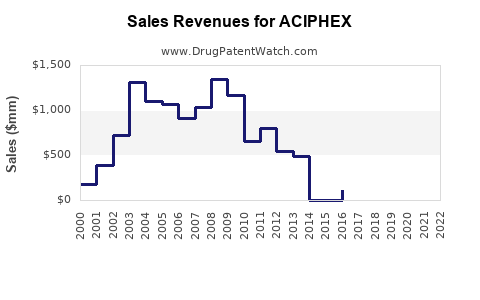
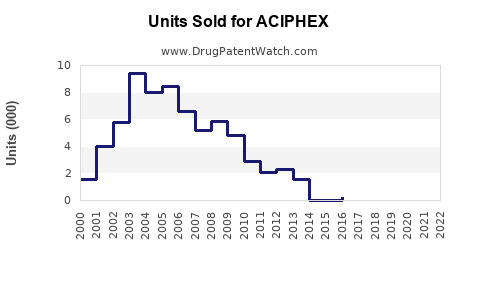
Annual Sales Revenues and Units Sold for ACIPHEX
| Drug Name | Revenues (USD) | Units | Year |
|---|---|---|---|
| ACIPHEX | ⤷ Start Trial | ⤷ Start Trial | 2022 |
| ACIPHEX | ⤷ Start Trial | ⤷ Start Trial | 2021 |
| ACIPHEX | ⤷ Start Trial | ⤷ Start Trial | 2020 |
| ACIPHEX | ⤷ Start Trial | ⤷ Start Trial | 2019 |
| ACIPHEX | ⤷ Start Trial | ⤷ Start Trial | 2018 |
| ACIPHEX | ⤷ Start Trial | ⤷ Start Trial | 2017 |
| >Drug Name | >Revenues (USD) | >Units | >Year |
ACIPHEX Market Analysis, Sales Projections, Patent Status, and Generic Competition
ACIPHEX, the U.S. brand for rabeprazole sodium, is a mature proton-pump inhibitor with limited remaining branded commercial value. Its U.S. market exclusivity ended after generic rabeprazole delayed-release tablets entered the market in 2013. Current revenue is concentrated in low-cost generic rabeprazole and in selected international markets where the product is sold as PARIET or under local brands. The molecule has durable clinical demand but weak pricing power, limited patent protection, and high substitution risk from omeprazole, esomeprazole, lansoprazole, and pantoprazole.
A base-case model indicates that the global rabeprazole market is likely to grow at approximately 1% to 3% annually through 2029, driven mainly by prescription volume and inflation rather than price expansion. Branded ACIPHEX sales are likely to remain below $50 million annually in the United States, while global rabeprazole sales across branded and generic products could remain in the approximate range of $700 million to $1.1 billion, depending on geographic scope and whether hospital, retail, and private-label sales are included.
What is ACIPHEX and how does it compete in the proton-pump inhibitor market?
ACIPHEX contains rabeprazole sodium, a substituted benzimidazole proton-pump inhibitor. The delayed-release tablet was approved by the U.S. Food and Drug Administration in 1997 for acid-related gastrointestinal conditions, including gastroesophageal reflux disease, duodenal ulcer, gastric ulcer, and Helicobacter pylori eradication when used with antibiotics.[1]
Rabeprazole irreversibly inhibits the gastric H+/K+-ATPase enzyme. Its principal commercial indications are:
- Gastroesophageal reflux disease
- Erosive or ulcerative GERD
- Duodenal ulcer
- Gastric ulcer
- H. pylori eradication therapy
- Maintenance treatment for healed erosive GERD
- Hypersecretory conditions such as Zollinger-Ellison syndrome
The global PPI category is highly competitive. Generic omeprazole and pantoprazole typically have greater volume, while esomeprazole benefits from brand recognition and broader premium positioning. Rabeprazole’s commercial advantages include rapid acid suppression, established physician familiarity, and availability in multiple international markets. Its disadvantages are limited differentiation, generic substitution, and the absence of meaningful U.S. patent exclusivity.
ACIPHEX competitive position
| Product | Active ingredient | Commercial position | Generic pressure |
|---|---|---|---|
| ACIPHEX / PARIET | Rabeprazole | Mature branded and generic PPI | Very high |
| Prilosec / Losec | Omeprazole | Large legacy PPI franchise | Very high |
| Nexium | Esomeprazole | Strong historical brand and OTC presence | High |
| Prevacid | Lansoprazole | Mature prescription and OTC product | Very high |
| Protonix | Pantoprazole | Strong hospital and institutional presence | Very high |
| Dexilant | Dexlansoprazole | Differentiated dual delayed-release formulation | Moderate to high |
Rabeprazole is commercially viable as a low-cost generic but does not have a strong basis for premium pricing in the United States.
What were ACIPHEX’s historical sales and peak-market conditions?
ACIPHEX was commercialized in the United States through Eisai and Janssen Pharmaceuticals. Outside the United States, Eisai marketed rabeprazole principally as PARIET. The product generated substantial revenue before the U.S. loss of exclusivity and before physicians shifted toward generic PPIs.
Eisai reported PARIET-related sales as a major mature-product contribution in its fiscal-year reporting before generic erosion accelerated. The company’s branded pharmaceutical portfolio also included Aricept, Fycompa, and other products, making standalone global ACIPHEX revenue difficult to isolate from consolidated disclosures.[2]
The key commercial inflection points were:
| Period | Event | Market effect |
|---|---|---|
| 1997 | FDA approved ACIPHEX delayed-release tablets | U.S. commercial launch |
| 2000s | Expansion of PPI prescribing | Strong category growth |
| 2010-2012 | Increasing generic PPI adoption | Pressure on branded pricing |
| 2013 | Generic rabeprazole approvals and market entry | Rapid U.S. branded erosion |
| 2014 onward | Mature generic market | Volume retained, price compressed |
| 2020s | Continued PPI use with stricter stewardship | Stable to low-growth demand |
ACIPHEX’s historical peak value was supported by branded reimbursement and physician prescribing before generic rabeprazole became broadly available. After generic entry, the product’s economic value shifted from a branded pharmaceutical franchise to a low-price molecule with multiple suppliers.
When did ACIPHEX lose exclusivity and when do its patents expire?
U.S. market exclusivity for ACIPHEX effectively ended with generic rabeprazole delayed-release tablet approvals in 2013. The principal composition and formulation patents associated with the original product had reached the end of their effective U.S. life by that period, subject to patent-term adjustments, pediatric extensions, and product-specific listing details in the FDA Orange Book.[3]
The practical exclusivity position is:
| Exclusivity category | ACIPHEX status |
|---|---|
| New chemical entity exclusivity | Expired |
| U.S. branded market exclusivity | Expired |
| Core composition patent protection | Expired |
| Orange Book lifecycle protection | No meaningful commercial barrier |
| Pediatric exclusivity | Expired, if applicable |
| Generic approval barrier | None of material commercial significance |
The relevant patent estate included patents covering substituted benzimidazole compounds, rabeprazole sodium, pharmaceutical compositions, and delayed-release dosage forms. Those rights supported the original launch but no longer prevent generic manufacture or sale in the United States.
A current competitive assessment should focus less on expired ACIPHEX patents and more on whether a particular generic manufacturer has a separate patent dispute involving a formulation, polymorph, manufacturing process, or combination product. Such rights would generally be narrower than the original ACIPHEX franchise and would not restore broad product exclusivity.
What is the FDA regulatory and Orange Book status of ACIPHEX?
ACIPHEX is an FDA-approved small-molecule prescription drug. Its original U.S. product is rabeprazole sodium delayed-release tablets. Generic versions are approved through the abbreviated new drug application pathway under the Hatch-Waxman Act.[1,4]
The current regulatory structure has four relevant elements:
- The reference product has a historical New Drug Application.
- Generic rabeprazole products rely on abbreviated applications.
- Therapeutic equivalence allows pharmacy-level substitution where state law and payer policy permit.
- The product has no biosimilar pathway because rabeprazole is a chemically synthesized small molecule.
The FDA Orange Book remains the principal source for reference-listed drug status, patent listings, and therapeutic-equivalence codes.[4] ACIPHEX’s commercial risk is therefore driven by generic approvals and substitution, not by biosimilar competition or a pending U.S. biologic patent cliff.
Are there Paragraph IV challenges to ACIPHEX?
Paragraph IV litigation was commercially relevant during the generic entry period. Generic applicants could certify that listed patents were invalid, unenforceable, or not infringed. Once the relevant ACIPHEX patents expired or lost practical force, Paragraph IV litigation no longer represented a material barrier to market entry.
The post-exclusivity landscape is different from an active branded product facing a new Paragraph IV challenge. ACIPHEX now has:
- No meaningful remaining core-patent barrier
- Multiple generic suppliers
- Low probability of a commercially significant injunction
- Limited value in defending legacy patent claims
- High probability of continued price competition
How large is the current rabeprazole market?
The market should be separated into three layers:
- Branded ACIPHEX sales in the United States
- Branded PARIET and local-brand sales outside the United States
- Generic rabeprazole sales across retail, hospital, and government channels
Public company reporting rarely provides a complete global rabeprazole market total. A practical market model based on prescription volume, generic prices, international brand retention, and channel mix produces the following range:
| Market segment | 2024 estimated annual sales | 2029 base-case estimate |
|---|---|---|
| U.S. branded ACIPHEX | Less than $50 million | Less than $40 million |
| U.S. generic rabeprazole | $100 million-$200 million | $105 million-$220 million |
| Japan and selected Asian branded markets | $250 million-$450 million | $260 million-$500 million |
| Other international rabeprazole markets | $300 million-$450 million | $330 million-$530 million |
| Global rabeprazole total | $700 million-$1.1 billion | $750 million-$1.25 billion |
These are analytical market estimates rather than reported ACIPHEX product sales. The range reflects differences in country coverage, net pricing, parallel trade, and whether combination therapies are attributed to rabeprazole.
What is the ACIPHEX sales forecast through 2029?
The most likely outcome is stable or declining branded revenue and modest growth in total rabeprazole volume.
| Scenario | 2024 global rabeprazole sales | 2029 sales | Implied CAGR | Main assumptions |
|---|---|---|---|---|
| Downside | $700 million | $650 million | -1.5% | Continued price erosion and therapeutic substitution |
| Base case | $900 million | $1.0 billion | 2.1% | Stable PPI demand and moderate Asian growth |
| Upside | $1.1 billion | $1.25 billion | 2.6% | Higher diagnosis rates and sustained branded pricing outside the U.S. |
For ACIPHEX as a branded U.S. product, the base case is different:
| Year | Estimated U.S. branded ACIPHEX sales |
|---|---|
| 2024 | $20 million-$50 million |
| 2025 | $18 million-$45 million |
| 2026 | $17 million-$43 million |
| 2027 | $16 million-$42 million |
| 2028 | $15 million-$41 million |
| 2029 | $14 million-$40 million |
The principal drivers are declining branded prescriptions, formulary preference for generic rabeprazole, and substitution by other PPIs. Any short-term increase would likely result from supply disruption among competing generics rather than improved product differentiation.
What companies manufacture or compete with ACIPHEX?
The generic rabeprazole market includes large multinational manufacturers, U.S. generic companies, and regional pharmaceutical producers. Market participants have included Teva, Mylan/Viatris, Dr. Reddy’s Laboratories, Lupin, Zydus, Sandoz, and other suppliers, depending on jurisdiction and product availability.[5]
Competition occurs on:
- Wholesale acquisition cost
- Guaranteed supply
- FDA manufacturing compliance
- Formulation equivalence
- Payer contracts
- Pharmacy substitution
- International registration coverage
No single generic manufacturer is likely to control the global market. Supply fragmentation creates occasional price and availability volatility, but it does not materially strengthen ACIPHEX’s branded position.
What formulation and method-of-use patents protect rabeprazole?
The original ACIPHEX estate focused on the active compound and delayed-release oral dosage form. Formulation protection is important because rabeprazole is acid-labile and requires enteric protection. Tablets use delayed-release technology to prevent degradation in the stomach and release the active ingredient in the intestine.
Potentially relevant technical areas include:
- Enteric coatings
- Tablet core composition
- Stabilization of rabeprazole sodium
- Release profiles
- Polymorphic or crystalline forms
- Packaging and moisture protection
- Combination therapy with antibiotics for H. pylori
Most broad protections covering these functions have either expired or have limited commercial scope. A later formulation patent could affect a specific dosage form or manufacturing process, but it would not ordinarily block standard generic delayed-release tablets unless the approved generic practices the protected claims.
Method-of-use patents have limited remaining market impact. GERD, ulcer, and H. pylori treatment uses are established indications, and generic products can generally enter based on approved labeling and applicable patent certifications.
What generic launch risks exist for ACIPHEX?
Generic launch risk is already realized in the United States. The remaining commercial risks are operational and pricing-related:
| Risk | Severity | Effect |
|---|---|---|
| Additional generic entrants | High | Further price compression |
| Pharmacy substitution | High | Loss of branded volume |
| Payer exclusion | High | Lower reimbursement and access |
| Manufacturing disruption | Moderate | Temporary supply imbalance |
| New formulation competition | Moderate | Niche displacement |
| Biosimilar entry | None | Not applicable to small molecule |
| Patent injunction | Low | Core patents are expired |
| OTC PPI substitution | Moderate | Pressure on prescription demand |
The main downside to generic manufacturers is not legal entry but margin deterioration. The main downside to the branded holder is persistent erosion of volume and net price.
How does ACIPHEX compare with competing PPI patent estates?
ACIPHEX has a weaker current patent position than newer or formulation-differentiated acid-suppression products. Its core estate is expired, while some competitors have relied on later delivery systems, combination products, or reformulated presentations.
| Product | Patent position | Differentiation | Current commercial risk |
|---|---|---|---|
| ACIPHEX | Core patents expired | Conventional delayed-release rabeprazole | Very high generic risk |
| Nexium | Core patents expired; OTC and brand extensions | Esomeprazole brand recognition | High |
| Protonix | Core patents expired | Institutional familiarity | High |
| Dexilant | Later formulation protection historically more relevant | Dual delayed-release delivery | Moderate |
| Voquezna | Newer product and combination positioning | Potassium-competitive acid blocker | Lower near-term generic risk |
Vonoprazan-based products such as VOQUEZNA provide the most important newer mechanism competition in acid suppression. They may take share in selected GERD and H. pylori treatment segments, particularly where rapid or sustained acid control is prioritized.[6]
What licensing deals and litigation affect ACIPHEX?
The original ACIPHEX commercial structure involved collaboration between Eisai and Janssen in the United States. That arrangement was relevant during the product’s growth period, but it does not create a current barrier to generic competition.
No active, broad-based patent litigation is likely to change the U.S. market outcome for standard ACIPHEX delayed-release tablets. Historical patent disputes and settlement arrangements, where applicable, should be evaluated against the 2013 generic-entry date rather than treated as current launch threats.
The most important legal conclusion is that ACIPHEX is a post-exclusivity product. Current value depends on manufacturing economics, geographic rights, brand retention, and supply contracts rather than enforceable platform patents.
What is the commercial outlook for ACIPHEX?
ACIPHEX has a durable but low-value commercial profile.
The positive factors are:
- Large installed PPI patient population
- Established safety and efficacy record
- Continued use in GERD and ulcer treatment
- International brand recognition as PARIET
- Low manufacturing complexity relative to biologics
The negative factors are:
- Expired U.S. exclusivity
- Broad generic substitution
- Low price per prescription
- Limited product differentiation
- Competition from other PPIs and vonoprazan
- Increasing clinical scrutiny of long-term PPI use
For investors and potential licensees, the asset is more attractive as a low-cost generic or international portfolio product than as a U.S. branded growth franchise. Value may remain in selected Asian markets, government tenders, hospital supply, and fixed-dose H. pylori combinations. A premium valuation based on historical ACIPHEX peak sales would not reflect the current patent or reimbursement environment.
Key Takeaways
- ACIPHEX is rabeprazole sodium, a mature proton-pump inhibitor approved by the FDA in 1997.
- U.S. exclusivity ended with generic rabeprazole entry in 2013.
- Core composition and delayed-release formulation patents no longer provide a material U.S. market barrier.
- U.S. branded ACIPHEX sales are likely below $50 million annually and should decline gradually.
- Global rabeprazole sales across branded and generic products are estimated at $700 million to $1.1 billion in 2024.
- Base-case global rabeprazole sales are projected to reach approximately $1.0 billion by 2029.
- Biosimilar risk is irrelevant because rabeprazole is a small-molecule drug.
- Generic pricing, pharmacy substitution, and international brand retention determine commercial value.
- PARIET and other international rabeprazole brands are more commercially relevant than U.S. ACIPHEX.
- The strongest competitive threat comes from generic PPIs and newer acid-suppression products such as vonoprazan.
FAQs About ACIPHEX Market Size and Exclusivity
Is ACIPHEX still sold in the United States?
Yes. ACIPHEX may remain available through branded channels, but most U.S. prescriptions are filled with generic rabeprazole rather than branded ACIPHEX.
Is rabeprazole more valuable than omeprazole?
Rabeprazole generally has lower market volume than omeprazole. Its value depends on local prescribing preferences, reimbursement, and brand retention rather than a broad global pricing premium.
Can a company launch a generic ACIPHEX product without a license from Eisai?
In the United States, a manufacturer can generally market an approved generic after applicable patents and exclusivities expire. A license may still be required for country-specific rights, trademarks, or privately held formulation technology.
Does ACIPHEX have orphan-drug exclusivity?
ACIPHEX is not primarily an orphan drug. Its approved uses are common acid-related gastrointestinal conditions, not rare diseases with orphan exclusivity.
What is the strongest remaining commercial opportunity for rabeprazole?
The strongest opportunities are low-cost generic supply, selected Asian markets, hospital tenders, and combination regimens for H. pylori eradication. The U.S. branded market offers limited growth potential.
References
-
U.S. Food and Drug Administration. (2022). Aciphex (rabeprazole sodium) delayed-release tablets prescribing information. FDA.
-
Eisai Co., Ltd. (2013). Annual report and financial results for the fiscal year ended March 31, 2013. Eisai.
-
U.S. Patent and Trademark Office. (n.d.). Patent term adjustment and patent term extension resources. USPTO.
-
U.S. Food and Drug Administration. (n.d.). Approved drug products with therapeutic equivalence evaluations: Orange Book. FDA.
-
U.S. Food and Drug Administration. (n.d.). Drugs@FDA: FDA-approved drugs and abbreviated new drug applications for rabeprazole sodium delayed-release tablets. FDA.
-
U.S. Food and Drug Administration. (2022). Voquezna (vonoprazan fumarate) prescribing information. FDA.
More… ↓
