Share This Page
Drug Sales Trends for ABILIFY
✉ Email this page to a colleague
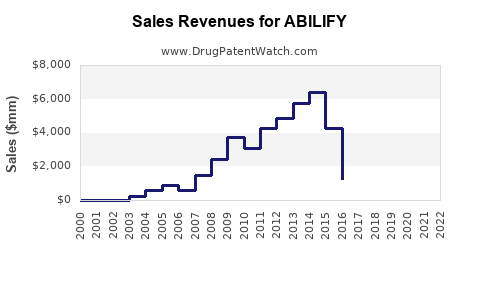
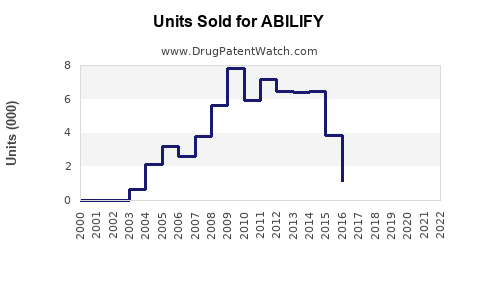
Annual Sales Revenues and Units Sold for ABILIFY
| Drug Name | Revenues (USD) | Units | Year |
|---|---|---|---|
| ABILIFY | ⤷ Start Trial | ⤷ Start Trial | 2022 |
| ABILIFY | ⤷ Start Trial | ⤷ Start Trial | 2021 |
| ABILIFY | ⤷ Start Trial | ⤷ Start Trial | 2020 |
| ABILIFY | ⤷ Start Trial | ⤷ Start Trial | 2019 |
| ABILIFY | ⤷ Start Trial | ⤷ Start Trial | 2018 |
| ABILIFY | ⤷ Start Trial | ⤷ Start Trial | 2017 |
| >Drug Name | >Revenues (USD) | >Units | >Year |
ABILIFY Market Analysis, Sales Projections, Patent Exclusivity, and Generic Risk
ABILIFY (aripiprazole) is a mature atypical antipsychotic with a sharp split between declining oral sales and expanding long-acting injectable demand. The original oral brand lost U.S. exclusivity in 2015, pushing commercial value toward generic aripiprazole and long-acting products such as ABILIFY MAINTENA. Oral ABILIFY should be treated as a low-revenue legacy brand, while the aripiprazole long-acting injectable market remains the principal growth opportunity.
What is the current market position of ABILIFY?
ABILIFY is an atypical antipsychotic marketed originally by Otsuka Pharmaceutical and Bristol-Myers Squibb. Its active ingredient, aripiprazole, is a dopamine D2 and D3 partial agonist with activity at serotonin 5-HT1A and 5-HT2A receptors.
The product’s approved U.S. uses include:
- Schizophrenia
- Acute manic and mixed episodes associated with bipolar I disorder
- Maintenance treatment of bipolar I disorder
- Adjunctive treatment of major depressive disorder
- Irritability associated with autistic disorder
- Tourette’s disorder in specified pediatric patients
The commercial product family now has three distinct segments:
| Segment | Product | Market status | Commercial outlook |
|---|---|---|---|
| Oral immediate-release | ABILIFY tablets and oral solution | Brand largely displaced by generics | Declining or minimal |
| Oral generic | Aripiprazole tablets, ODT and solution | Broad generic availability | High volume, low price |
| Long-acting injectable | ABILIFY MAINTENA | Branded specialty product | Growth opportunity |
| Longer-interval injectable | ARISTADA, from Alkermes | Competing aripiprazole LAI | Competitive growth |
ABILIFY MAINTENA contains aripiprazole monohydrate and is administered monthly or at specified intervals under its prescribing information. ARISTADA contains aripiprazole lauroxil, a prodrug with a different delivery platform and dosing schedule. These products compete clinically but are not interchangeable formulations.
How much did ABILIFY generate before generic competition?
ABILIFY was one of the largest-selling psychiatric drugs before U.S. generic entry. Bristol-Myers Squibb reported approximately $7.5 billion in global ABILIFY sales in 2014, the last full year before widespread U.S. generic erosion. The product represented a significant portion of Bristol-Myers Squibb’s revenue and faced a rapid decline after generic aripiprazole approvals (Bristol-Myers Squibb, 2015).
| Year | Commercial event | Revenue implication |
|---|---|---|
| 2002 | U.S. approval for schizophrenia | Initial launch |
| 2007 | Adjunctive major-depressive-disorder indication | Expanded prescribing base |
| 2009 | Autism-related irritability indication | Pediatric and behavioral-health expansion |
| 2013-2014 | Peak commercial period | Global sales reached multibillion-dollar scale |
| 2015 | U.S. generic launch | Rapid oral-brand erosion |
| 2015 onward | Growth of ABILIFY MAINTENA | Revenue shifted toward injectable treatment |
The sales decline was driven by the loss of oral-brand pricing power rather than by a major loss of therapeutic relevance. Aripiprazole remained widely prescribed after generic entry because the active ingredient retained established clinical use across several psychiatric indications.
When did ABILIFY lose exclusivity?
The original oral ABILIFY product lost effective U.S. market exclusivity in 2015. The key U.S. compound patent, U.S. Patent No. 5,006,528, expired in 2009 after accounting for the applicable patent term and regulatory extensions reflected in the product’s lifecycle. Pediatric exclusivity and litigation over generic timing delayed broad commercial competition.
The practical exclusivity date was determined by patent litigation and settlement arrangements rather than by the basic compound patent alone. Generic aripiprazole products entered the U.S. market in April 2015, ending the oral brand’s high-margin monopoly.
ABILIFY exclusivity timeline
| Milestone | Date or period | Effect |
|---|---|---|
| U.S. patent grant for aripiprazole compound | 1990 | Established core composition protection |
| FDA approval of oral ABILIFY | 2002 | Began U.S. regulatory exclusivity |
| Major supplemental indications | 2004-2009 | Extended commercial use |
| Generic patent litigation | 2010-2015 | Delayed or structured generic entry |
| First major U.S. generic entry | April 2015 | Began rapid oral-brand substitution |
| Current oral market | 2024 onward | Primarily generic |
The original oral formulation no longer has a commercially meaningful patent barrier in the United States. Any remaining patent value is more likely to relate to particular formulations, delivery systems, manufacturing processes, or long-acting dosage forms than to standard oral aripiprazole.
What patents protect ABILIFY and ABILIFY MAINTENA?
The core oral ABILIFY patent estate is substantially expired. The commercial protection profile differs by product.
Oral aripiprazole
U.S. Patent No. 5,006,528 covered the aripiprazole compound. The patent is expired and does not prevent generic tablets, orally disintegrating tablets, or oral solution products from competing in the U.S. market.
The oral product may historically have been supported by:
- Composition-of-matter protection
- Pediatric exclusivity
- Approved-use patents
- Formulation and dosage-form claims
- Regulatory exclusivity associated with supplemental indications
Those protections no longer support the original oral brand’s pricing structure.
ABILIFY MAINTENA
ABILIFY MAINTENA has a different patent profile because it uses an injectable aripiprazole monohydrate formulation. Relevant protection can include:
- Long-acting injectable composition claims
- Particle-size and suspension claims
- Depot formulation claims
- Dosing-regimen claims
- Manufacturing and stabilization processes
- Device, packaging, and administration claims
The commercial barrier for a follow-on injectable is therefore higher than for a standard oral tablet. A competitor must address formulation reproducibility, particle characteristics, release kinetics, injection-site tolerability, manufacturing controls, and FDA approval requirements.
The FDA Orange Book is the controlling source for listed patents and exclusivity associated with approved drug products. Orange Book entries should be reviewed by product and dosage form because patents listed for ABILIFY MAINTENA do not automatically apply to oral aripiprazole or ARISTADA (U.S. Food and Drug Administration, 2024a).
What is the Orange Book status of ABILIFY?
The original oral ABILIFY product has no effective Orange Book barrier comparable to its pre-2015 position. Generic aripiprazole tablets and other oral dosage forms are approved through abbreviated new drug applications.
ABILIFY MAINTENA must be evaluated separately. Injectable products can retain market protection through formulation and administration patents even after the active ingredient is old. Orange Book-listed patents may create a Paragraph IV litigation pathway for generic or follow-on applicants.
A generic applicant challenging a listed patent can:
- File an ANDA with a Paragraph IV certification.
- Assert that the patent is invalid, unenforceable, or not infringed.
- Trigger potential patent litigation after notice to the patent holder.
- Face a 30-month stay of approval if the holder files suit within the statutory period.
- Receive 180-day exclusivity in certain first-filer circumstances.
The commercial effect depends on whether the challenge targets the active ingredient, formulation, dosing regimen, or a nonblocking patent.
Which companies compete with ABILIFY?
The competitive landscape differs between oral aripiprazole and long-acting injectable therapy.
Oral competitors
Generic aripiprazole is supplied by multiple manufacturers, including large generic companies and specialty suppliers. The market is price-driven and subject to pharmacy-benefit-manager contracting, wholesaler purchasing, manufacturing concentration, and periodic supply disruptions.
Competitors may include products marketed by:
- Teva Pharmaceutical Industries
- Aurobindo Pharma
- Dr. Reddy’s Laboratories
- Zydus Pharmaceuticals
- Solco Healthcare
- Torrent Pharmaceuticals
- Hikma Pharmaceuticals
- Other ANDA holders and authorized distributors
The number of approved suppliers does not equal the number of active commercial suppliers. Generic markets often have fewer reliable suppliers than the FDA approval count suggests.
Long-acting injectable competitors
The principal branded competitor is ARISTADA, marketed by Alkermes. Other long-acting antipsychotics include:
- INVEGA SUSTENNA and INVEGA TRINZA, paliperidone
- RISPERDAL CONSTA, risperidone
- Perseris, risperidone
- Uzedy, risperidone
- FLUPHENAZINE and haloperidol depot products
ABILIFY MAINTENA competes on aripiprazole’s partial-agonist pharmacology, established oral formulation, clinical familiarity, and injection frequency. ARISTADA competes through longer dosing intervals and its lauroxil prodrug technology.
What are ABILIFY sales projections for 2025 through 2029?
The forecast depends on whether "ABILIFY" means the original oral brand or the broader aripiprazole franchise.
Oral ABILIFY brand projection
The oral brand is unlikely to recover meaningful premium sales in the United States. A reasonable base-case projection for global branded oral ABILIFY revenue is:
| Year | Base-case branded oral sales | Market interpretation |
|---|---|---|
| 2025 | $50 million-$150 million | Residual markets and brand-loyal prescribing |
| 2026 | $40 million-$125 million | Continued substitution |
| 2027 | $30 million-$100 million | Mature legacy-brand decline |
| 2028 | $20 million-$85 million | Limited branded presence |
| 2029 | $15 million-$70 million | Primarily residual international demand |
These are commercial scenario estimates, not reported company guidance. They assume no major relaunch, supply disruption, or withdrawal of competing generic products.
ABILIFY MAINTENA projection
A separate forecast is appropriate for ABILIFY MAINTENA:
| Scenario | 2025 revenue | 2029 revenue | Compound trend |
|---|---|---|---|
| Downside | $700 million | $650 million | Flat to declining |
| Base case | $900 million | $1.25 billion | Mid-single-digit growth |
| Upside | $1.1 billion | $1.75 billion | High-single-digit growth |
The base case assumes continued expansion of long-acting injectable use, stable reimbursement, moderate price increases, and no immediate generic injectable launch. The upside case requires higher conversion from oral therapy and stronger adoption of less frequent dosing. The downside case reflects reimbursement pressure, competing injectable products, and faster erosion from follow-on formulations.
These projections exclude ARISTADA revenue and should not be added to oral ABILIFY sales without defining the commercial perimeter.
What drives ABILIFY MAINTENA revenue growth?
The principal growth drivers are clinical persistence, adherence management, reduced dosing frequency, and expansion of long-acting injectable use in outpatient psychiatry.
Key commercial variables include:
- Physician willingness to initiate long-acting treatment
- Patient acceptance of intramuscular administration
- Coverage under Medicaid, Medicare, and commercial plans
- Buy-and-bill economics
- Specialty-pharmacy distribution
- Injection-site tolerability
- Availability of trained administration sites
- Hospital discharge protocols
- Use in patients with recurrent adherence problems
The injectable market has a larger revenue pool per treated patient than generic oral aripiprazole. It also has higher operational friction. Reimbursement and administration logistics can limit uptake even where the clinical profile is attractive.
What generic entry risks affect ABILIFY MAINTENA?
Generic risk for oral aripiprazole is already realized. The remaining risk is concentrated in long-acting injectable products.
High-probability risks
- Continued price erosion in oral aripiprazole
- Contracting pressure from health plans
- Switching from branded oral products to generic equivalents
- Substitution by other atypical antipsychotics
- Lower adherence to injection schedules
- Increased competition from longer-interval products
Medium-term injectable risks
A follow-on ABILIFY MAINTENA product would face technical and regulatory barriers but could materially change the market if approved. A competitive injectable would likely require:
- Demonstration of pharmaceutical equivalence or comparable clinical performance
- Control of particle size and suspension characteristics
- Data supporting injection-site safety
- Validated manufacturing processes
- Device or administration compatibility
- Resolution of Orange Book patent disputes
The first approved follow-on product could obtain substantial contracting leverage even without fully replacing the originator.
What FDA regulatory status does ABILIFY have?
The FDA has approved aripiprazole in multiple oral and injectable dosage forms. Oral generic products are approved under the ANDA pathway, while branded long-acting injectable products were approved through full new drug applications.
The regulatory distinction is commercially important:
| Product type | FDA pathway | Main barrier |
|---|---|---|
| Generic oral aripiprazole | ANDA | Bioequivalence and quality |
| ABILIFY MAINTENA | NDA | Clinical, formulation and manufacturing package |
| ARISTADA | NDA | Prodrug and long-acting delivery technology |
| Follow-on injectable | Potentially ANDA or other pathway, depending on product | Equivalence, formulation and patent requirements |
The FDA label identifies warnings and precautions including akathisia, tardive dyskinesia, metabolic changes, impulse-control problems, orthostatic hypotension, and increased mortality risk in elderly patients with dementia-related psychosis. These safety considerations affect prescribing, monitoring, payer management, and liability exposure (U.S. Food and Drug Administration, 2024b).
How strong is the ABILIFY patent estate?
Oral product: weak
The oral ABILIFY estate is commercially weak because the core compound protection is expired and generic competition is established. Remaining patents or regulatory protections do not support meaningful U.S. monopoly pricing.
Long-acting injectable: moderate
ABILIFY MAINTENA has a stronger technical estate because formulation and delivery patents can create barriers beyond the active ingredient. The estate is still exposed to:
- Patent-validity challenges
- Noninfringement positions based on alternative formulations
- Design-around products
- Patent-term expiration
- FDA approval of competing depot technologies
- Payer-driven switching without literal substitution
The estate’s strength depends on claim scope, patent expiration, Orange Book listings, manufacturing know-how, and the ability to enforce claims against a follow-on injectable.
What litigation and settlement issues affect ABILIFY?
The major commercial litigation event was the patent litigation that delayed generic aripiprazole before the 2015 launch. Generic applicants used Paragraph IV certifications to challenge relevant patents, producing settlements and launch arrangements that controlled the timing of entry.
For current diligence, the relevant questions are different:
- Are any Orange Book-listed patents still enforceable?
- Has a generic or follow-on applicant filed a Paragraph IV challenge?
- Does a settlement permit an earlier launch?
- Are formulation patents being asserted separately from composition patents?
- Does a product claim infringement based on dosing interval or administration method?
- Are state substitution laws likely to permit automatic switching?
A settlement can materially change the forecast. An authorized generic or licensed launch may reduce litigation cost while accelerating price erosion.
Does ABILIFY have biosimilar risk?
ABILIFY has no biosimilar risk because aripiprazole is a chemically synthesized small molecule, not a biologic. The relevant competitive threats are generic tablets, authorized generics, follow-on injectables, and competing long-acting antipsychotics.
The absence of biosimilar exposure does not eliminate lifecycle risk. For ABILIFY MAINTENA, a technically complex generic or follow-on injectable can produce some of the same pricing effects associated with biosimilar competition, even though the legal pathway is different.
How does ABILIFY compare with ARISTADA?
| Attribute | ABILIFY MAINTENA | ARISTADA |
|---|---|---|
| Active moiety | Aripiprazole | Aripiprazole lauroxil |
| Sponsor | Otsuka Pharmaceutical | Alkermes |
| Delivery | Aripiprazole monohydrate depot | Prodrug depot |
| Dosing | Monthly and specified extended schedules | Multiple dosing intervals |
| Commercial advantage | Familiarity and established aripiprazole use | Longer-interval flexibility |
| Main risk | Follow-on injectable competition | Reimbursement and adoption |
| Patent value | Formulation, depot and dosing claims | Prodrug, formulation and delivery claims |
ABILIFY MAINTENA has a larger installed base and strong brand recognition. ARISTADA has differentiation through its prodrug technology and dosing flexibility. Neither product has the composition-of-matter protection that once supported oral ABILIFY economics.
What geographic markets remain attractive for ABILIFY?
The United States is mature for oral ABILIFY but remains strategically important for long-acting injectable products. Growth opportunities are more likely in markets where:
- Generic substitution is incomplete
- Long-acting injectable reimbursement is improving
- Psychiatric specialty care is expanding
- Hospital discharge programs emphasize adherence
- Public health systems seek to reduce relapse and rehospitalization
Europe, Japan, and other developed markets generally have stronger generic substitution and pricing controls. Emerging markets may offer volume growth but usually produce lower net prices and greater tender exposure.
Manufacturing capacity is a more material barrier for injectable products than for tablets. Sterile filling, suspension uniformity, supply reliability, and quality-control requirements can constrain entry and protect incumbent share.
Key Takeaways
- Oral ABILIFY lost U.S. exclusivity in 2015 and is now a mature generic market.
- The core aripiprazole patent, U.S. Patent No. 5,006,528, is expired.
- Historical ABILIFY sales reached roughly $7.5 billion globally in 2014 before generic erosion.
- Branded oral ABILIFY sales should remain minimal through 2029.
- ABILIFY MAINTENA is the principal remaining branded growth asset associated with aripiprazole.
- Base-case ABILIFY MAINTENA revenue could rise from approximately $900 million in 2025 to $1.25 billion in 2029, subject to payer and competitive conditions.
- ARISTADA is the leading direct branded competitor in long-acting aripiprazole.
- Biosimilar risk does not apply; generic and follow-on injectable risk does.
- Injectable formulation, manufacturing, dosing, and administration patents are more commercially important than expired oral composition patents.
- The principal investment question is whether long-acting injectable growth can offset the permanent loss of oral-brand economics.
FAQs
Is ABILIFY still under patent protection?
The original oral ABILIFY compound protection has expired. Long-acting injectable products may retain formulation, dosing, manufacturing, or delivery patents that require separate Orange Book analysis.
Are there generic versions of ABILIFY?
Yes. Generic aripiprazole is widely available in tablets, orally disintegrating tablets, and oral solution. Generic competition began in the United States in 2015.
Is ABILIFY MAINTENA the same as generic aripiprazole?
No. Both contain or deliver aripiprazole, but ABILIFY MAINTENA is a long-acting injectable formulation with different pharmacokinetics, administration requirements, and regulatory considerations.
What is the largest commercial threat to ABILIFY MAINTENA?
The largest threats are competing long-acting antipsychotics, payer pressure, improved dosing flexibility from ARISTADA, and a potential follow-on injectable that avoids or invalidates key formulation patents.
Does Otsuka still benefit from oral ABILIFY sales?
Otsuka may retain residual international or branded sales, but the principal economic opportunity is in long-acting products and other lifecycle extensions rather than the original oral brand.
References
-
Bristol-Myers Squibb Company. (2015). 2014 annual report. Bristol-Myers Squibb.
-
U.S. Food and Drug Administration. (2024a). Approved drug products with therapeutic equivalence evaluations: Orange Book. https://www.accessdata.fda.gov/scripts/cder/ob/
-
U.S. Food and Drug Administration. (2024b). Abilify prescribing information. Otsuka America Pharmaceutical, Inc. https://www.accessdata.fda.gov/drugsatfda_docs/label/
-
U.S. Food and Drug Administration. (2024c). Abilify Maintena prescribing information. Otsuka America Pharmaceutical, Inc. https://www.accessdata.fda.gov/drugsatfda_docs/label/
-
U.S. Patent No. 5,006,528. (1991). Quinolinone derivatives. United States Patent and Trademark Office.
-
Alkermes plc. (2024). Annual report. Alkermes plc.
More… ↓
