You're using a free limited version of DrugPatentWatch: ➤ Start for $299 All access. No Commitment.

Last Updated: March 26, 2026

Drug Sales Trends for vancomycin


✉ Email this page to a colleague

« Back to Dashboard


Payment Methods and Pharmacy Types for vancomycin (2001)

Revenues by Pharmacy Type

Pharmacy Type Revenues
MAIL-ORDER $997,292
INSIDE ANOTHER STORE $5,171,955
[disabled in preview] $70,159,030
This preview shows a limited data set
Subscribe for full access, or try a Trial

Units Sold by Pharmacy Type

Pharmacy Type Units
MAIL-ORDER 7,991
INSIDE ANOTHER STORE 53,601
[disabled in preview] 547,174
This preview shows a limited data set
Subscribe for full access, or try a Trial

Revenues by Payment Method

Payment Method Revenues
MEDICAID $5,171,955
MEDICARE $60,080,494
[disabled in preview] $11,075,827
This preview shows a limited data set
Subscribe for full access, or try a Trial
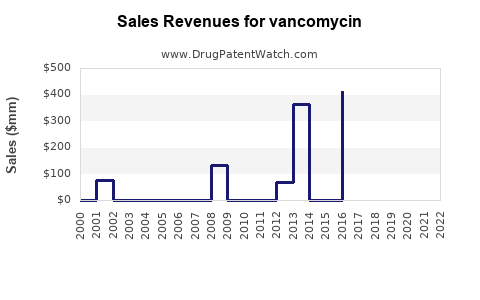
Drug Sales Revenue Trends for vancomycin
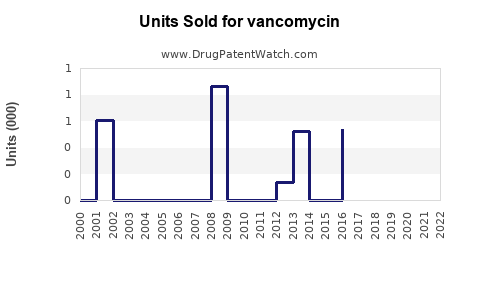
Drug Units Sold Trends for vancomycin

Annual Sales Revenues and Units Sold for vancomycin

These sales figures are drawn from a US national survey of drug expenditures
Drug Name Revenues (USD) Units Year
VANCOMYCIN ⤷  Start Trial ⤷  Start Trial 2022
VANCOMYCIN ⤷  Start Trial ⤷  Start Trial 2021
VANCOMYCIN ⤷  Start Trial ⤷  Start Trial 2020
VANCOMYCIN ⤷  Start Trial ⤷  Start Trial 2019
VANCOMYCIN ⤷  Start Trial ⤷  Start Trial 2018
VANCOMYCIN ⤷  Start Trial ⤷  Start Trial 2017
>Drug Name >Revenues (USD) >Units >Year

Vancomycin Market Analysis and Financial Projection

Last updated: February 13, 2026

What Is the Current Market Size and Demand for Vancomycin?

Vancomycin remains a frontline antibiotic primarily used to treat severe Gram-positive bacterial infections. Its global market was valued at approximately $1.2 billion in 2022. The demand stems from its effectiveness against MRSA (methicillin-resistant Staphylococcus aureus), Clostridioides difficile-associated diarrhea, and other resistant infections (1).

The increasing prevalence of antimicrobial resistance (AMR) sustains steady demand growth. The World Health Organization classifies AMR as a critical global health threat, with resistant infections causing over 1.27 million deaths annually (2). Rising cases of MRSA in hospital settings support ongoing need for vancomycin.

What Are the Key Regional Markets for Vancomycin?

North America leads market share, accounting for approximately 45% of sales in 2022. The United States dominates due to high healthcare expenditure, advanced healthcare infrastructure, and strict adherence to infection control protocols.

Europe follows, with about 25% of the global market share, driven by regulatory approvals and increasing antibiotic resistance cases.

Asia-Pacific exhibits the fastest growth rate, estimated at 7% CAGR from 2023 to 2028. Factors include expanding healthcare access, rising prevalence of resistant infections, and increasing pharmaceutical manufacturing capacities in China, India, and Japan.

How Is the Market Evolving in Terms of Supply and Competition?

The market is characterized by a few dominant manufacturers: Fresenius Kabi, Hikma Pharmaceuticals, and Sandoz. These companies supply generic formulations across hospitals and infusion centers.

Recently, some manufacturers have begun developing liposomal formulations designed to improve delivery, reduce toxicity (particularly nephrotoxicity), and extend shelf life. These innovations aim to elevate competitive advantage.

Patent expirations have allowed generics to flood the market, intensifying price competition and reducing margins. Current average price for a standard 1g vial hovers at $10–$15, depending on region.

What Are Sales Projections for the Next Five Years?

Market analysts project a compound annual growth rate (CAGR) of 3.5% from 2023 to 2028, driven by:

  • Increasing antimicrobial resistance and infection rates.
  • Expanded use in hospital settings, including intensive care units.
  • Rising prevalence of complicated infections requiring IV administration.

Projected revenues for 2028 reach approximately $1.6 billion.

Year Estimated Market Size (USD billion)
2023 1.3
2024 1.36
2025 1.42
2026 1.49
2027 1.55
2028 1.61

This steady growth assumes no disruption to supply chains or significant regulatory shifts.

How Will Regulatory and Prescribing Trends Influence Sales?

Regulatory bodies require assessments of toxicity, particularly nephrotoxicity and ototoxicity, affecting formulation development. The FDA endorses stewardship programs aimed at reducing inappropriate use, which can constrain growth but also promote innovation in optimized formulations.

Prescribing practices tend to favor vancomycin for resistant infections. Stewardship initiatives may limit broad use, maintaining steady but not exponential growth.

What Are Key Risks to Market and Sales Growth?

  • Antibiotic stewardship efforts reduce unnecessary use.
  • Emergence of novel agents (e.g., teicoplanin alternatives, new lipoglycopeptides) could replace vancomycin.
  • Supply chain disruptions, such as raw material shortages, could impact production.
  • Regulatory changes that restrict certain formulations or indications.

Final Summary

Vancomycin's market size is approximately $1.2 billion as of 2022, with a forecast to reach $1.6 billion by 2028 at a CAGR of 3.5%. Steady demand persists because of resistant bacterial infections, primarily in hospital settings worldwide. Competition primarily involves generic manufacturers, with innovation focused on improved delivery systems. Future growth hinges on antimicrobial resistance trends, healthcare practices, regulatory environment, and development of new formulations.


Key Takeaways

  • Vancomycin's global market was valued at $1.2 billion in 2022; projected to reach $1.6 billion in 2028.
  • North America accounts for nearly half the sales; Asia-Pacific shows the fastest growth.
  • The market is mature with broad generic competition; innovation centers on formulation improvements.
  • Growth is moderated by antimicrobial stewardship programs and potential competition from new drugs.
  • Supply chain stability and regulatory policies are critical to sustaining market performance.

FAQs

1. How does vancomycin compare with new antibiotics targeting resistant Gram-positive bacteria?

New agents like telavancin, dalbavancin, and oritavancin offer longer dosing intervals and reduced nephrotoxicity but have higher costs and limited over-the-counter availability. Vancomycin remains dominant due to cost-effectiveness and established protocols.

2. What factors could accelerate vancomycin sales beyond current projections?

Emergence of new resistant strains that require vancomycin, increased hospital admissions for resistant infections, and expansion of intravenous therapy protocols could boost demand.

3. How has the COVID-19 pandemic affected vancomycin sales?

Initial disruptions reduced elective procedures, impacting hospital-infection-related prescribing. However, the pandemic's focus on infection control led to sustained or increased use in ICU settings.

4. What are the implications of generic drug price trends for manufacturers?

Price reductions pressure profit margins but also stimulate volume sales. Manufacturers investing in formulation improvements or new delivery methods may retain premium pricing.

5. Are there any regulatory initiatives influencing vancomycin sales?

Regulatory authorities promote antibiotic stewardship programs that limit unnecessary use, but also approve new formulations aimed at reducing toxicity and improving patient adherence.


References

  1. Markets and Markets, "Antibiotics Market," 2022.
  2. World Health Organization, "Global Antimicrobial Resistance Surveillance System," 2021.

More… ↓

⤷  Start Trial

Make Better Decisions: Try a trial or see plans & pricing

Drugs may be covered by multiple patents or regulatory protections. All trademarks and applicant names are the property of their respective owners or licensors. Although great care is taken in the proper and correct provision of this service, thinkBiotech LLC does not accept any responsibility for possible consequences of errors or omissions in the provided data. The data presented herein is for information purposes only. There is no warranty that the data contained herein is error free. We do not provide individual investment advice. This service is not registered with any financial regulatory agency. The information we publish is educational only and based on our opinions plus our models. By using DrugPatentWatch you acknowledge that we do not provide personalized recommendations or advice. thinkBiotech performs no independent verification of facts as provided by public sources nor are attempts made to provide legal or investing advice. Any reliance on data provided herein is done solely at the discretion of the user. Users of this service are advised to seek professional advice and independent confirmation before considering acting on any of the provided information. thinkBiotech LLC reserves the right to amend, extend or withdraw any part or all of the offered service without notice.