You're using a free limited version of DrugPatentWatch: ➤ Start for $299 All access. No Commitment.

Last Updated: April 3, 2026

Drug Sales Trends for imiquimod


✉ Email this page to a colleague
« Back to Dashboard


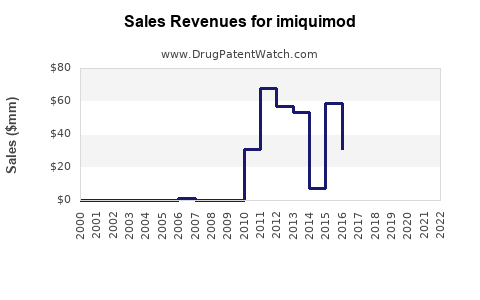
Drug Sales Revenue Trends for imiquimod
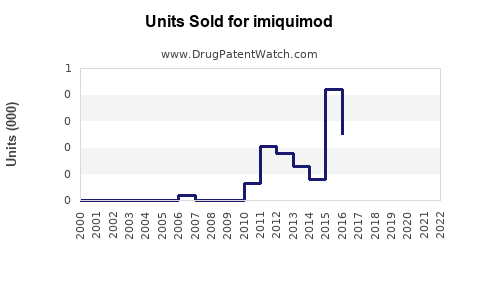
Drug Units Sold Trends for imiquimod

Annual Sales Revenues and Units Sold for imiquimod

These sales figures are drawn from a US national survey of drug expenditures
Drug Name Revenues (USD) Units Year
IMIQUIMOD ⤷  Start Trial ⤷  Start Trial 2022
IMIQUIMOD ⤷  Start Trial ⤷  Start Trial 2021
IMIQUIMOD ⤷  Start Trial ⤷  Start Trial 2020
IMIQUIMOD ⤷  Start Trial ⤷  Start Trial 2019
IMIQUIMOD ⤷  Start Trial ⤷  Start Trial 2018
IMIQUIMOD ⤷  Start Trial ⤷  Start Trial 2017
IMIQUIMOD ⤷  Start Trial ⤷  Start Trial 2016
>Drug Name >Revenues (USD) >Units >Year

Imiquimod Market Analysis and Financial Projection

Last updated: February 13, 2026

What is Imiquimod and Its Market Position?

Imiquimod is an immune response modifier approved primarily for treating actinic keratosis, superficial basal cell carcinoma, external genital warts, and some other dermatologic conditions. Marketed under brands such as Aldara and Zyclara, it functions by activating toll-like receptor 7, prompting cytokine production that enhances immune response against abnormal cells.

Key Market Data and Approvals

  • FDA Approval: 1997 for external genital warts.
  • Other Regulatory Clearances: Approved in over 50 countries for various indications.
  • Indications Expansion: Off-label uses include treatment of certain HPV-related lesions and possibly melanoma in situ.

Market Size and Revenue

The global market for Imiquimod was valued at approximately $400 million in 2022. The primary revenue drivers include dermatology and HPV treatment sectors. The United States accounts for roughly 60% of sales, with Europe representing 20% and the remaining 20% spread across other regions.

Sales Distribution by Region (2022)

Region Percentage of Total Sales Estimated Revenue (USD millions)
United States 60% 240
Europe 20% 80
Asia-Pacific 10% 40
Other Regions 10% 40

Market Trends

  • Growing prevalence of HPV-related diseases sustains demand.
  • Increased off-label use in dermatology.
  • Competition from alternative treatments like cryotherapy, surgeries, and newer pharmaceuticals.

Sales Projections and Future Outlook

Short-Term (Next 3 Years, 2023-2025)

  • Compound Annual Growth Rate (CAGR): Estimated at 4-6%, driven by increased awareness and expanding off-label applications.
  • Market Expansion Factors: Launches in emerging markets, especially in Asia and Latin America; novel dermatology indications.

Long-Term (2026-2030)

  • Projected Market Size: Could reach approximately $500-$550 million by 2030, assuming ongoing expansion.
  • Potential Growth Catalysts:
    • New indications and combination therapies.
    • Patent expirations of key formulations (e.g., Aldara in 2022 in some regions) could influence pricing and market share.
    • Rising HPV infection rates and skin cancer incidences globally.

Competitive Landscape

Major competitors include:

  • Podophyllotoxin: Topical treatment for genital warts.
  • 5-Fluorouracil: Used in actinic keratosis.
  • Phototherapies and Cryotherapy: For skin lesions.

Novel agents and biosimilars could further impact sales trends.

Regulatory and Market Dynamics Impacting Sales

  • Patent Expiries: Several formulations near patent expiry, risking entry of generics.
  • Pricing Pressures: Especially in Europe due to healthcare cost containment.
  • Patient Compliance: Preference for less invasive, convenient options influences market share.
  • Research Advances: Promising developments in immunotherapy for skin cancers might redefine the role of Imiquimod.

Sensitivity Analysis

Estimations depend on factors such as:

  • Disease prevalence.
  • Regulatory environment.
  • Competition intensity.
  • Off-label use expansion.

For example, a 10% decrease in HPV prevalence or improved generic penetration could reduce market size projections.

Key Takeaways

  • Imiquimod remains a significant dermatologic immunotherapy with a stable base in HPV and skin cancer treatments.
  • The market is experiencing moderate growth, with potential for expansion through new indications and geographic penetration.
  • Patent expiries and competition from newer therapies present risks to sustained revenues.
  • Strategic positioning in emerging markets could drive future sales growth.

FAQs

Q1: What are the primary indications for Imiquimod?
It treats actinic keratosis, superficial basal cell carcinoma, external genital warts, and off-label dermatologic conditions.

Q2: What is the current market size for Imiquimod?
Approximately $400 million globally in 2022.

Q3: What factors influence future sales growth?
Market expansion in emerging regions, new indications, off-label use, and competition from generics and novel treatments.

Q4: How do patent expiries affect Imiquimod’s sales?
Patent expiries typically lead to generic entry, reducing prices and market dominance for branded formulations.

Q5: What are the main competitive therapies?
Podophyllotoxin, 5-fluorouracil, cryotherapy, laser therapy, and emerging immunotherapies.


References

[1] Market data sourced from Global Market Insights, 2022.
[2] FDA approval records, 1997.
[3] Pharmaceutical patent expiry databases, 2022.
[4] Industry reports on dermatologic treatment trends, 2022.

More… ↓

⤷  Start Trial

Make Better Decisions: Try a trial or see plans & pricing

Drugs may be covered by multiple patents or regulatory protections. All trademarks and applicant names are the property of their respective owners or licensors. Although great care is taken in the proper and correct provision of this service, thinkBiotech LLC does not accept any responsibility for possible consequences of errors or omissions in the provided data. The data presented herein is for information purposes only. There is no warranty that the data contained herein is error free. We do not provide individual investment advice. This service is not registered with any financial regulatory agency. The information we publish is educational only and based on our opinions plus our models. By using DrugPatentWatch you acknowledge that we do not provide personalized recommendations or advice. thinkBiotech performs no independent verification of facts as provided by public sources nor are attempts made to provide legal or investing advice. Any reliance on data provided herein is done solely at the discretion of the user. Users of this service are advised to seek professional advice and independent confirmation before considering acting on any of the provided information. thinkBiotech LLC reserves the right to amend, extend or withdraw any part or all of the offered service without notice.