Share This Page
Drug Sales Trends for VIORELE
✉ Email this page to a colleague
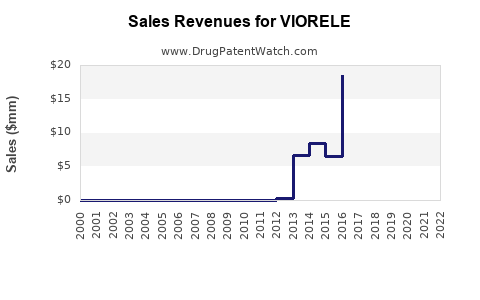
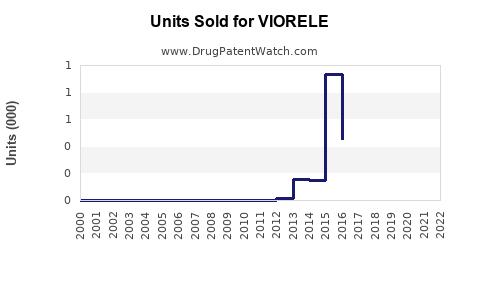
Annual Sales Revenues and Units Sold for VIORELE
| Drug Name | Revenues (USD) | Units | Year |
|---|---|---|---|
| VIORELE | ⤷ Start Trial | ⤷ Start Trial | 2022 |
| VIORELE | ⤷ Start Trial | ⤷ Start Trial | 2021 |
| VIORELE | ⤷ Start Trial | ⤷ Start Trial | 2020 |
| VIORELE | ⤷ Start Trial | ⤷ Start Trial | 2019 |
| >Drug Name | >Revenues (USD) | >Units | >Year |
VIORELE Market Analysis, Patent Status, and Sales Projections
VIORELE is a mature U.S. oral contraceptive containing desogestrel and ethinyl estradiol. Its commercial opportunity is limited by generic competition, minimal differentiation, and the absence of meaningful remaining exclusivity. Public product-level revenue is not disclosed. The base-case outlook is a stable-to-declining low-single-digit generic product, with revenue driven by payer contracts, pharmacy distribution, and price management rather than market expansion.
What is VIORELE and how is it positioned?
VIORELE is a prescription combined oral contraceptive containing:
- Desogestrel: 0.15 mg
- Ethinyl estradiol: 0.02 mg in active tablets
- Ethinyl estradiol: 0.01 mg in the final active tablets, depending on the marketed pack configuration
- 28-tablet regimen with active and inactive tablets
The product is therapeutically aligned with the desogestrel and ethinyl estradiol contraceptive class, which includes generic Kariva and related products. The formulation uses a low-dose estrogen regimen and a third-generation progestin.
VIORELE competes primarily on availability, formulary placement, pharmacy supply, and price. It does not have a material device, delivery-system, biologic, or administration advantage over competing oral contraceptives.
The FDA-approved labeling identifies the product as a prescription oral contraceptive. DailyMed records the product labeling and active ingredient information (National Library of Medicine, 2024).
What is the market size for VIORELE and comparable oral contraceptives?
The addressable market is the U.S. combined oral contraceptive market, with VIORELE representing a narrow generic segment. The market includes:
- Desogestrel and ethinyl estradiol products
- Levonorgestrel and ethinyl estradiol products
- Norgestimate and ethinyl estradiol products
- Drospirenone and ethinyl estradiol products
- Extended-cycle oral contraceptives
- Progestin-only pills
- Transdermal, vaginal, injectable, implantable, and intrauterine contraceptives
VIORELE's direct competitors are generic desogestrel and ethinyl estradiol products. Its broader competitors include lower-cost levonorgestrel and norgestimate formulations, branded oral contraceptives, and long-acting reversible contraceptives.
The U.S. contraceptive market has a large patient base but modest prescription growth. Demand is influenced by reproductive health policy, insurance coverage, contraception access, patient preference, and switching between delivery systems. The FDA's approval of Opill, the first nonprescription daily oral contraceptive in the United States, expanded consumer access to a progestin-only option but does not directly replace VIORELE's estrogen-containing regimen (FDA, 2023).
How strong is the VIORELE patent estate?
VIORELE has limited patent-based commercial protection. The active ingredients are long-established, and the product competes in a mature generic market.
| Patent or exclusivity category | VIORELE assessment |
|---|---|
| New chemical entity exclusivity | Expired or not applicable |
| Orphan-drug exclusivity | Not applicable |
| Biologic exclusivity | Not applicable |
| Pediatric exclusivity | No material current protection identified |
| Formulation patent | No material active protection identified |
| Method-of-use patent | No material active protection identified |
| Device patent | Not applicable |
| Orange Book blocking patent | No meaningful current barrier identified |
| Generic substitution risk | High |
The Orange Book is the relevant FDA source for approved drug products and listed patents or exclusivity. VIORELE's commercial position is therefore based on generic-market execution rather than patent enforcement (FDA, 2025).
What formulations are protected by VIORELE patents?
No commercially significant active formulation protection is apparent for the conventional VIORELE tablet. The product's low-dose estrogen regimen and desogestrel component are established technologies. Any historical formulation or method patents would not be expected to prevent broad generic competition today.
The principal barriers are manufacturing qualification, regulatory compliance, supply continuity, and pharmacy-channel access. These are operational barriers rather than durable intellectual-property barriers.
When does VIORELE lose exclusivity?
VIORELE has no meaningful remaining market exclusivity in the United States. The product competes as a mature prescription oral contraceptive, and generic versions are available or can be introduced without waiting for a significant branded exclusivity period.
The commercial timeline is therefore:
| Period | Commercial status |
|---|---|
| Original approval and launch period | Prescription combined oral contraceptive |
| Generic-market development | Multiple equivalent or therapeutically substitutable products |
| Current period | Mature, low-differentiation generic market |
| 2025-2026 | Continued price and formulary competition |
| 2027-2030 | Stable-to-declining demand unless distribution or access improves |
What is the Orange Book status of VIORELE?
The Orange Book does not provide a durable patent barrier for VIORELE's current commercial business. The product is not comparable to a newly approved branded drug with listed composition, formulation, or method-of-use patents.
This has several consequences:
- A competitor does not need to wait for a late-expiring patent to enter a comparable market segment.
- A Paragraph IV challenge is unlikely to be commercially important unless a specific, currently listed patent is identified.
- The principal risk is ordinary generic competition, not patent litigation.
- Any future product enhancement would need separate intellectual-property protection to support premium pricing.
Are there Paragraph IV challenges or VIORELE patent lawsuits?
No material active Paragraph IV dispute or patent litigation is identifiable as a central commercial issue for VIORELE. The product's risk profile is different from that of a branded small molecule with a dense Orange Book estate.
The absence of a major patent dispute does not eliminate commercial risk. Generic manufacturers can compete through abbreviated regulatory pathways, contract pharmacy arrangements, wholesaler relationships, and lower pricing. A market entrant may erode VIORELE sales without initiating high-profile litigation.
What is the FDA regulatory status of VIORELE?
VIORELE is an FDA-regulated prescription oral contraceptive. It is not a biologic and does not face biosimilar substitution risk.
Relevant regulatory factors include:
- FDA approval of the drug product and labeling
- Compliance with current good manufacturing practices
- Active pharmaceutical ingredient supply
- Stability and packaging controls
- Pharmacovigilance for estrogen-related and thromboembolic risks
- State and federal prescription-dispensing requirements
- Potential substitution under state pharmacy laws
The product's regulatory risk is primarily manufacturing and supply-chain risk. A quality recall, shortage, or manufacturing transfer could affect sales more quickly than a patent event.
What companies compete with VIORELE?
Competition comes from manufacturers of generic desogestrel and ethinyl estradiol products, as well as suppliers of other combined oral contraceptives.
| Competitor group | Examples | Competitive effect |
|---|---|---|
| Direct generic competitors | Desogestrel/ethinyl estradiol tablets | Direct price and formulary pressure |
| Low-cost combined pills | Levonorgestrel/ethinyl estradiol; norgestimate/ethinyl estradiol | Substitution and lower net pricing |
| Drospirenone products | Generic Yaz-type products | Compete for patients seeking different hormonal profiles |
| Progestin-only pills | Opill and prescription norethindrone products | Expand non-estrogen alternatives |
| Long-acting contraceptives | IUDs and implants | Reduce repeat oral prescription demand |
| Branded products | NuvaRing, Xulane and other branded contraceptives | Compete on convenience and delivery method |
VIORELE's strongest competitive vulnerability is substitution by lower-cost combined pills. Its strongest commercial support is physician familiarity with the desogestrel formulation and continued demand for oral contraception.
How much revenue exposure does VIORELE represent?
Product-level revenue is not publicly reported in a sufficiently detailed form to establish an audited VIORELE sales base. Manufacturers commonly report broader pharmaceutical revenue without separating individual mature generic products.
The economic value of the product depends on:
- Annual prescription or 28-day pack volume
- Net price after rebates and wholesaler discounts
- Payer mix
- Retail versus mail-order distribution
- Product availability
- Number of competing suppliers
- Contract renewals
- Manufacturing cost and gross margin
A practical revenue formula is:
Net revenue = annual packs sold × net revenue per pack
For every 100,000 annual packs, the revenue sensitivity is:
| Net revenue per pack | Annual revenue per 100,000 packs |
|---|---|
| $6 | $0.6 million |
| $10 | $1.0 million |
| $15 | $1.5 million |
| $20 | $2.0 million |
These figures represent net sales, not gross retail sales.
What are the VIORELE sales projections for 2025 to 2030?
Because audited baseline sales are unavailable, the most defensible projection uses a 2025 revenue index. The table below assumes a mature product with no new indication, no material price premium, and no major supply disruption.
| Scenario | 2025 baseline | 2026 | 2027 | 2028 | 2029 | 2030 |
|---|---|---|---|---|---|---|
| Downside: price erosion and share loss | 100 | 92 | 84 | 77 | 71 | 65 |
| Base case: stable volume, modest price pressure | 100 | 98 | 96 | 94 | 92 | 90 |
| Upside: improved access and supply execution | 100 | 103 | 106 | 109 | 112 | 115 |
The base case implies approximately 10% cumulative revenue erosion from 2025 through 2030. This reflects the expected behavior of a mature generic product: stable underlying contraceptive demand offset by lower realized pricing and competitive substitution.
For illustration only, if 2025 net revenue were $5 million:
| Scenario | 2026 | 2028 | 2030 |
|---|---|---|---|
| Downside | $4.6 million | $3.85 million | $3.25 million |
| Base case | $4.9 million | $4.7 million | $4.5 million |
| Upside | $5.15 million | $5.45 million | $5.75 million |
The upside case requires better distribution, reliable inventory, and successful payer or pharmacy contracting. It does not assume a new patent estate or a new FDA indication.
What generic launch scenarios exist for VIORELE?
Three launch scenarios are commercially relevant.
Continued mature-market competition
This is the most likely outcome. Existing suppliers maintain distribution, prices decline gradually, and demand remains tied to the overall oral contraceptive market.
Aggressive low-price entry
A new or expanding generic supplier enters with a discount strategy. This could produce rapid share loss for incumbent suppliers, particularly in cash-pay, Medicaid, and price-sensitive pharmacy channels.
Supply disruption and temporary share capture
A competitor experiences a shortage, manufacturing issue, or regulatory interruption. VIORELE could gain temporary volume if it maintains inventory and has active wholesaler contracts. This benefit would likely reverse when supply normalizes.
What manufacturing and intellectual-property barriers affect VIORELE?
The key manufacturing requirements are routine but commercially important:
- Qualified supplier for desogestrel and ethinyl estradiol
- Consistent tablet compression and content uniformity
- Stability across the labeled shelf life
- Packaging that protects the tablets from environmental degradation
- FDA-compliant batch release
- Reliable contract manufacturing capacity
- Pharmacovigilance and complaint handling
No specialized delivery technology creates a strong manufacturing moat. The principal barrier is execution at acceptable cost.
How does VIORELE compare with other oral contraceptives?
| Factor | VIORELE | Levonorgestrel/ethinyl estradiol generics | Drospirenone/ethinyl estradiol generics | Progestin-only pills |
|---|---|---|---|---|
| Patent strength | Low | Low | Generally low to moderate by product | Low |
| Estrogen-containing | Yes | Yes | Yes | No |
| Generic competition | High | Very high | High | Increasing |
| Price premium potential | Limited | Very limited | Some patient-driven differentiation | Limited |
| FDA biosimilar risk | None | None | None | None |
| Main commercial driver | Access and supply | Lowest cost | Product preference and formulary | Estrogen avoidance |
VIORELE may retain a niche among patients and prescribers who prefer desogestrel-containing regimens, but the product lacks a durable basis for premium pricing.
Key Takeaways
- VIORELE is a mature combined oral contraceptive with limited differentiation.
- Its active ingredients and dosage form do not provide meaningful current exclusivity.
- The Orange Book and patent profile do not indicate a material litigation barrier.
- Paragraph IV and biosimilar risks are low relative to ordinary generic substitution risk.
- Public product-level VIORELE revenue is not disclosed.
- The base-case forecast is stable-to-declining revenue through 2030.
- Distribution, formulary access, pricing, and supply continuity matter more than patent strategy.
- A new low-price generic entrant could materially reduce incumbent sales.
- Revenue upside would most likely come from channel execution, not innovation.
FAQs
Is VIORELE still commercially available?
VIORELE has been marketed as a prescription oral contraceptive, but availability can vary by manufacturer, pharmacy, wholesaler inventory, and product listing status. Generic desogestrel and ethinyl estradiol alternatives remain the relevant competitive set.
Is VIORELE a generic version of Kariva?
VIORELE contains the same active ingredients and a comparable low-dose oral contraceptive regimen associated with Kariva-type products. Product equivalence depends on the specific FDA-approved application and labeling.
Does VIORELE have any remaining market exclusivity?
No material current exclusivity is expected to protect VIORELE from generic competition. Its commercial position depends on supply and distribution.
Can VIORELE sales grow despite generic competition?
Yes, but growth would likely come from temporary supply shortages affecting competitors, new pharmacy contracts, improved formulary access, or increased product availability. Structural long-term growth is unlikely without a new formulation or commercial repositioning.
Is VIORELE exposed to biosimilar competition?
No. VIORELE is a small-molecule oral contraceptive, not a biologic. It is exposed to generic and therapeutic substitution rather than biosimilar competition.
References
-
Food and Drug Administration. (2023). FDA approves first nonprescription daily oral contraceptive. U.S. Department of Health and Human Services.
-
Food and Drug Administration. (2025). Approved drug products with therapeutic equivalence evaluations: Orange Book. U.S. Department of Health and Human Services.
-
National Library of Medicine. (2024). Viorele: Desogestrel and ethinyl estradiol tablets prescribing information. DailyMed.
-
Centers for Disease Control and Prevention. (2024). Contraception and birth control methods. U.S. Department of Health and Human Services.
-
Food and Drug Administration. (2024). Generic drugs: Questions and answers. U.S. Department of Health and Human Services.
More… ↓
