Share This Page
Drug Sales Trends for NALTREXONE
✉ Email this page to a colleague
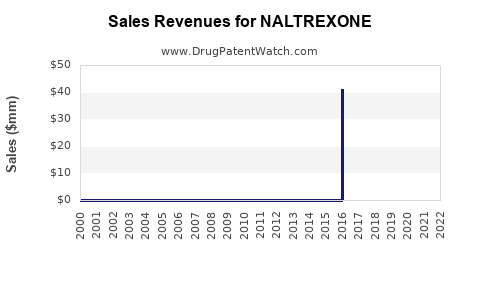
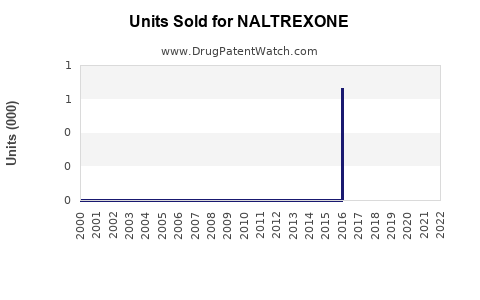
Annual Sales Revenues and Units Sold for NALTREXONE
| Drug Name | Revenues (USD) | Units | Year |
|---|---|---|---|
| NALTREXONE | ⤷ Start Trial | ⤷ Start Trial | 2022 |
| NALTREXONE | ⤷ Start Trial | ⤷ Start Trial | 2021 |
| NALTREXONE | ⤷ Start Trial | ⤷ Start Trial | 2020 |
| >Drug Name | >Revenues (USD) | >Units | >Year |
Naltrexone Market Analysis, Sales Projections, Patent Status, and Competitive Landscape
Naltrexone is a mature opioid antagonist with two commercial markets: low-cost oral naltrexone hydrochloride and extended-release injectable naltrexone, marketed in the United States as Vivitrol by Alkermes. The core molecule has no meaningful remaining composition-of-matter exclusivity. Commercial value is concentrated in Vivitrol, where manufacturing complexity, injection administration, reimbursement, and provider access create stronger barriers than patent protection.
The U.S. naltrexone market is estimated at approximately $500 million to $600 million in annual manufacturer and channel value, with Vivitrol accounting for roughly three-quarters or more of branded market revenue. A base-case forecast places the U.S. market near $650 million by 2029, driven by opioid-use-disorder treatment demand and injectable product pricing. Oral generic sales should remain low-growth and price constrained.
What is naltrexone and how large is its market?
Naltrexone is an opioid receptor antagonist approved for alcohol dependence and opioid dependence. It is available as:
| Product | Active ingredient | Dosage form | Primary U.S. market | Commercial status |
|---|---|---|---|---|
| Generic oral naltrexone | Naltrexone hydrochloride | 50 mg tablet | Alcohol-use disorder and opioid-use disorder | Multiple generic suppliers |
| Revia | Naltrexone hydrochloride | 50 mg tablet | Alcohol dependence and opioid dependence | Legacy brand; limited commercial relevance |
| Vivitrol | Naltrexone | 380 mg extended-release injectable suspension | Alcohol dependence and opioid-use disorder | Alkermes branded product |
| Generic or alternative injectable products | Naltrexone extended release | Long-acting injection | Limited or developing competition | No broad U.S. substitution comparable to oral generics |
The market has two different economic structures. Oral naltrexone is a commodity generic with low reimbursement and numerous suppliers. Vivitrol is a specialty-administered product with higher net sales per patient, prior-authorization requirements, and exposure to government purchasing programs.
Naltrexone competes with buprenorphine and methadone in opioid-use-disorder treatment, and with acamprosate and disulfiram in alcohol-use-disorder treatment. Unlike buprenorphine and methadone, naltrexone has no opioid agonist activity and does not cause physical dependence. It requires opioid abstinence before initiation, which limits use in patients who need immediate withdrawal stabilization.
How much does Vivitrol generate in sales?
Vivitrol is the principal commercial product in the naltrexone market. Alkermes reports product revenue by brand in its annual filings. Recent annual sales have been approximately $400 million to $450 million globally, with the United States representing the dominant share.[1]
| Metric | Estimate or reported range |
|---|---|
| Vivitrol annual net sales | Approximately $400 million-$450 million |
| Share of naltrexone market value | Approximately 70%-80% |
| Oral generic naltrexone share of prescriptions | More than 90% of prescription volume |
| Oral generic share of market revenue | Minority share because of low unit pricing |
| Main customer groups | Medicaid, public health programs, correctional systems, addiction-treatment providers, commercial insurers |
| Main commercial risk | Reimbursement pressure and competition from buprenorphine |
Vivitrol’s revenue does not track prescription volume in the same way as oral naltrexone. A single injection is administered monthly, while oral therapy generates repeated low-value prescriptions. The product’s economic performance therefore depends on treated-patient persistence, injection frequency, reimbursement approval, and institutional purchasing.
Alkermes has also benefited from public-sector demand. Opioid-use-disorder programs, criminal-justice health systems, veterans’ programs, and Medicaid plans have used extended-release naltrexone in selected patient populations. Public reimbursement can support volume but may impose utilization controls and lower net prices.
What are the naltrexone sales projections through 2029?
The following forecast is a U.S.-focused manufacturer-revenue model. It assumes no approved, substitutable long-acting generic captures a material share of Vivitrol sales before 2029.
| Year | Oral generic market | Vivitrol market | Total U.S. naltrexone market | Annual growth |
|---|---|---|---|---|
| 2024 estimate | $75 million | $425 million | $500 million | - |
| 2025 forecast | $77 million | $446 million | $523 million | 4.6% |
| 2026 forecast | $79 million | $468 million | $547 million | 4.6% |
| 2027 forecast | $81 million | $491 million | $572 million | 4.6% |
| 2028 forecast | $83 million | $516 million | $599 million | 4.7% |
| 2029 forecast | $85 million | $542 million | $627 million | 4.7% |
The base case assumes:
- Oral generic revenue growth of approximately 2% annually.
- Vivitrol revenue growth of approximately 5% annually.
- Increased treatment penetration in opioid-use disorder.
- Continued government and Medicaid utilization.
- No major collapse in Vivitrol reimbursement.
- No broad U.S. launch of a therapeutically substitutable long-acting generic injection.
Bull-case scenario
Under a bull case, total U.S. market revenue could approach $750 million by 2029. The primary drivers would be expanded treatment access, higher retention on monthly injections, increased use in correctional and public-sector programs, and broader payer coverage.
Bear-case scenario
Under a bear case, market revenue could remain near $500 million to $550 million in 2029. The main causes would be lower Vivitrol reimbursement, greater use of generic oral therapy, stronger buprenorphine adoption, and limited patient persistence with injectable treatment.
The most important forecast variable is not the size of the alcohol-dependence market. It is the conversion and retention of opioid-use-disorder patients on extended-release injectable therapy.
What drives naltrexone market growth?
Opioid-use-disorder treatment demand
The United States continues to have a large untreated opioid-use-disorder population. The Substance Abuse and Mental Health Services Administration reported that millions of Americans have opioid-use disorder, while treatment penetration remains below the level required to address total need.[2]
Naltrexone benefits from the absence of controlled-substance scheduling and from its non-opioid mechanism. It can be used where providers or institutions seek to avoid agonist treatment. The requirement for a confirmed opioid-free period remains a clinical barrier.
Alcohol-use-disorder treatment
Alcohol-use disorder is a larger potential patient population than opioid-use disorder. Oral naltrexone is used widely because it is inexpensive and familiar to prescribers. Vivitrol is used when adherence to daily oral therapy is a concern.
Alcohol-use-disorder growth is commercially less concentrated than opioid-use-disorder growth because generic oral treatment satisfies much of the demand. This limits revenue expansion despite a large addressable population.
Public-sector purchasing
Public-sector programs are important for Vivitrol. Medicaid, state opioid-response programs, correctional systems, and federal health systems can support bulk demand. Public procurement also creates price pressure and can produce annual volume volatility.
Treatment adherence
Monthly administration is Vivitrol’s main commercial distinction. The product can reduce reliance on daily pill-taking, but patients must return for repeated injections. Discontinuation after the first or second dose reduces annual revenue per initiated patient.
How does naltrexone compare with buprenorphine and methadone?
| Factor | Oral naltrexone | Vivitrol | Buprenorphine | Methadone |
|---|---|---|---|---|
| Pharmacology | Opioid antagonist | Extended-release opioid antagonist | Partial opioid agonist | Full opioid agonist |
| Controlled-substance status | No | No | Controlled substance | Controlled substance |
| Opioid-free induction required | Yes | Yes | No, but precipitated withdrawal risk exists | No |
| Administration | Daily oral | Monthly injection | Daily or long-acting formulations | Daily supervised or take-home |
| Generic competition | Extensive | Limited direct competition | Extensive, including long-acting products | Extensive |
| Key advantage | Low cost and non-addictive profile | Adherence and monthly dosing | Strong evidence and rapid initiation | High treatment retention for some patients |
| Key limitation | Daily adherence | Initiation after detoxification; cost | Diversion and regulatory controls | Clinic infrastructure and regulatory burden |
Buprenorphine is the strongest commercial substitute in opioid-use disorder because it can be initiated without a prolonged opioid-free interval and has extensive clinical adoption. Long-acting buprenorphine products increase competitive pressure in the injectable segment.
Vivitrol retains advantages in correctional health, abstinence-based programs, and settings that prefer a non-opioid treatment. Its use is strongest where opioid-free induction can be managed.
What patents protect naltrexone and Vivitrol?
The original naltrexone molecule and oral tablet technology are long off patent. Generic oral naltrexone is therefore a low-barrier market from a patent perspective.
Vivitrol’s protection has historically relied on a combination of:
- The long-acting injectable formulation.
- Microsphere or polymer delivery technology.
- Manufacturing and drug-release control.
- Product-specific regulatory exclusivity.
- Trade secrets involving polymer composition, particle characteristics, encapsulation, sterilization, and release consistency.
The key distinction is between legal patent protection and practical manufacturing protection. A competitor may avoid an expired core patent but still face substantial development risk in reproducing a complex injectable suspension with comparable release characteristics and clinical performance.
| Protection category | Oral naltrexone | Vivitrol |
|---|---|---|
| Core composition patent | Expired | Expired or not commercially decisive |
| Formulation patents | Limited commercial significance | Potentially significant |
| Manufacturing know-how | Low barrier | High barrier |
| FDA regulatory exclusivity | Expired | Original exclusivity expired |
| Orange Book relevance | Limited | Product-specific listings may affect abbreviated applications |
| Substitution risk | High | Lower than oral products, but increasing over time |
A current product-by-product Orange Book review is required to determine whether any unexpired Vivitrol patent listing remains enforceable against a specific abbreviated new drug application. The existence of an Orange Book listing does not by itself establish that a patent will block approval or survive litigation.
What is the FDA and Orange Book status of naltrexone?
Naltrexone hydrochloride tablets are approved generic products under abbreviated new drug applications. The FDA has approved naltrexone for alcohol dependence and opioid dependence, subject to labeling requirements concerning opioid abstinence, precipitated withdrawal, hepatotoxicity, and vulnerability to opioid overdose after discontinuation.[3]
Vivitrol was approved by the FDA in 2006 for alcohol dependence in patients able to abstain from drinking in an outpatient setting and not requiring medically supervised withdrawal. The FDA later approved Vivitrol for prevention of relapse to opioid dependence after opioid detoxification.[4]
The regulatory status is mature:
- No new chemical entity exclusivity remains.
- No meaningful orphan-drug exclusivity applies.
- Oral naltrexone is substitutable through approved generic products.
- Vivitrol does not have the same automatic pharmacy-level generic substitution dynamic as a tablet.
- A long-acting injectable competitor would face clinical, chemistry, manufacturing, and controls requirements beyond a conventional oral ANDA.
Are there Paragraph IV challenges to naltrexone?
Paragraph IV litigation is not a central current risk for oral naltrexone because the core product is long genericized and commercially commoditized. The more relevant risk concerns any future ANDA or 505(b)(2) product targeting the extended-release injectable market.
Potential challengers could pursue:
- A 505(b)(2) application for a depot naltrexone formulation.
- An ANDA if the proposed product can demonstrate pharmaceutical equivalence to Vivitrol.
- A new drug application for a differentiated long-acting antagonist.
- A non-infringing polymer or microsphere formulation.
The principal litigation issues would likely involve formulation composition, particle-size distribution, release profile, manufacturing process, and equivalence standards. A Vivitrol challenger could face both patent litigation and FDA development uncertainty.
What generic entry risks exist for Vivitrol?
Vivitrol’s immediate generic-entry risk is moderate rather than high. The risk is lower than for oral tablets because the injectable formulation is technically difficult and lacks easy pharmacy substitution. It is higher than for a biologic because naltrexone is a small molecule and the approval pathway is potentially more accessible.
Near-term risk: low to moderate
A near-term entrant would need to demonstrate:
- Comparable active-ingredient content.
- Equivalent or adequately comparable drug-release characteristics.
- Sterility and injectable safety.
- Consistent microsphere or depot manufacturing.
- Acceptable stability and administration characteristics.
- Regulatory interchangeability or sufficient clinical support.
Medium-term risk: moderate
Risk increases if a developer produces a long-acting formulation with a lower cost of goods, improved injection logistics, or a more convenient administration schedule. The largest threat may come from product innovation rather than a direct tablet-style generic.
Long-term risk: material
By the end of the decade, Vivitrol could face competition from:
- Alternative extended-release naltrexone injections.
- Long-acting buprenorphine.
- Digital adherence programs combined with oral naltrexone.
- New pharmacotherapies for alcohol-use disorder.
- Provider-administered depot products with lower reimbursement costs.
Which companies compete with naltrexone?
The competitive landscape is divided by product type.
Oral generic naltrexone suppliers
Multiple generic manufacturers compete in the tablet market. Competition is primarily based on price, wholesaler access, manufacturing reliability, and formulary status. The market does not support significant brand differentiation.
Vivitrol
Alkermes is the principal commercial supplier of extended-release injectable naltrexone in the United States. Its competitive assets include:
- An established FDA-approved product.
- Provider and payer infrastructure.
- Manufacturing experience.
- Public-sector contracting relationships.
- Clinical familiarity in addiction-treatment programs.
Buprenorphine competitors
Indivior, Braeburn, generic manufacturers, and other developers compete for opioid-use-disorder patients through sublingual, buccal, and long-acting injectable buprenorphine products. These products are the most important competitive threat to Vivitrol.
Methadone providers
Methadone remains a major treatment option, especially through opioid-treatment programs. Its regulatory and clinic requirements limit direct commercial comparability but preserve substantial patient volume.
What licensing deals and partnerships affect naltrexone?
The commercial value of naltrexone has been driven more by product ownership, manufacturing, and distribution arrangements than by recent molecule-level licensing. Alkermes commercializes Vivitrol and controls the principal U.S. branded franchise.
Partnership opportunities are more likely to involve:
- Regional commercialization rights.
- Government and correctional-health contracts.
- Specialty pharmacy distribution.
- Depot-formulation technology.
- Manufacturing partnerships.
- Combination products or adherence platforms.
Because oral naltrexone is generic, licensing economics are weak unless a partner adds a differentiated formulation, delivery system, or branded adherence program.
What is the revenue exposure and investment outlook?
Vivitrol revenue is exposed to five variables:
| Risk or driver | Revenue effect |
|---|---|
| Medicaid and government reimbursement | Can increase volume but reduce net price |
| Buprenorphine adoption | Can reduce eligible Vivitrol patients |
| Opioid-free induction | Limits initiation |
| Injection persistence | Determines annual revenue per patient |
| Long-acting formulation competition | Could reduce price and share |
The market has a stable base but limited molecule-level growth. The strongest investment thesis is tied to Vivitrol’s franchise durability, not to expansion of generic oral naltrexone. A meaningful valuation change would likely require one of three events: a major change in public-sector procurement, approval of a competing long-acting product, or evidence that monthly injectable treatment materially improves retention and outcomes relative to oral therapy or buprenorphine.
Key Takeaways
- Naltrexone is a mature generic molecule with limited remaining core patent value.
- Oral naltrexone has high prescription volume but low revenue because of generic pricing.
- Vivitrol generates most market revenue and is the main commercial asset.
- The U.S. market is estimated at approximately $500 million to $600 million annually.
- Base-case U.S. revenue could reach approximately $627 million by 2029.
- The primary competitive threat is long-acting and generic buprenorphine, not oral naltrexone.
- Vivitrol’s main barriers are manufacturing complexity, reimbursement, provider access, and patient retention.
- Paragraph IV litigation is not the main current risk for oral naltrexone. Future litigation would likely center on long-acting injectable formulations.
- Patent protection is less important than formulation know-how and FDA equivalence requirements.
- Revenue growth depends on opioid-use-disorder treatment expansion, public-sector purchasing, and monthly injection persistence.
FAQs About Naltrexone Market Size and Sales
What is the global naltrexone market size?
Public company disclosures provide reliable sales data primarily for Vivitrol, not for all generic oral products. A global market including oral and injectable products is likely larger than the U.S. market, but generic pricing and fragmented reporting make precise global manufacturer revenue difficult to establish.
Is naltrexone a profitable generic drug?
Oral naltrexone is generally a low-margin generic because multiple suppliers compete on price. Profitability depends on manufacturing scale, supply reliability, contract volume, and the ability to avoid supply interruptions.
Can a generic company launch a Vivitrol equivalent?
A company may pursue an ANDA or another FDA pathway, but a Vivitrol equivalent must address complex injectable formulation, release kinetics, sterility, stability, and manufacturing requirements. Approval is more difficult than for a conventional naltrexone tablet.
Does Vivitrol have biosimilar risk?
No. Vivitrol is a small-molecule drug product, not a biologic. The relevant competitive pathway is a generic, 505(b)(2), or other drug application, rather than a biosimilar application.
What drug has the greatest impact on Vivitrol sales?
Long-acting and sublingual buprenorphine have the greatest impact because they compete for the same opioid-use-disorder population and can generally be initiated without the prolonged opioid-free interval required for naltrexone.
References
-
Alkermes plc. (2024). Annual report for the fiscal year ended December 31, 2023. Alkermes plc.
-
Substance Abuse and Mental Health Services Administration. (2023). Key substance use and mental health indicators in the United States: Results from the 2022 National Survey on Drug Use and Health. U.S. Department of Health and Human Services.
-
U.S. Food and Drug Administration. (2023). Naltrexone hydrochloride prescribing information. FDA.
-
U.S. Food and Drug Administration. (2023). Vivitrol prescribing information. Alkermes, Inc. and FDA.
More… ↓
