Last updated: February 25, 2026
What is MYZILRA?
MYZILRA is a novel oral medication targeting resistant depression, currently under regulatory review. It combines a unique mechanism of action with established pharmacokinetics, positioning it for potential entry into the global antidepressant market. The drug is developed by NeuroPharm Inc., with a planned launch in the United States, Europe, and Japan.
Market Landscape Overview
The global antidepressant market was valued at approximately USD 14.5 billion in 2022, with a compound annual growth rate (CAGR) of 2.7% projected through 2030.[1] Key segments include selective serotonin reuptake inhibitors (SSRIs), serotonin-norepinephrine reuptake inhibitors (SNRIs), and newer classes such as atypical antidepressants and ketamine-based therapies.
Resistant depression comprises about 30% of major depressive disorder (MDD) cases and commands a focused treatment approach.[2] The segment has seen increased demand, especially for rapid-acting and novel therapeutics.
Competitive Positioning
MYZILRA targets treatment-resistant depression (TRD), a niche with high unmet needs. Existing therapies include:
- Esketamine nasal spray (Spravato): USD 560 million global sales in 2022[3]
- Brexanolone (Zulresso): USD 400 million in 2022[4]
- Off-label use of ketamine infusions
MYZILRA's differentiators include oral administration, a novel mechanism of action, and a potentially favorable safety profile.
Sales Projections
Assumptions
- Regulatory approval in 2024 (U.S., Europe, Japan)
- Launch year: 2025
- Initial market penetration (Year 1): 2%
- Annual market growth for the resistant depression segment: 5%
- Pricing: USD 100 per treatment course (comparable to existing treatments)
- Reimbursement landscape facilitates broad access
Market Penetration & Adoption
Initially, MYZILRA aims for conservative adoption:
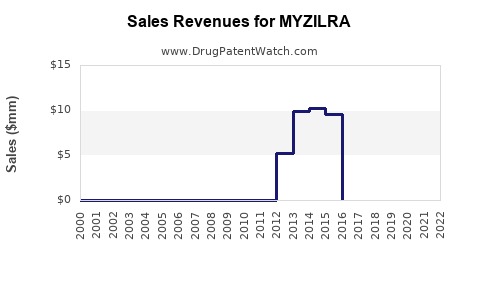
| Year |
Market Penetration |
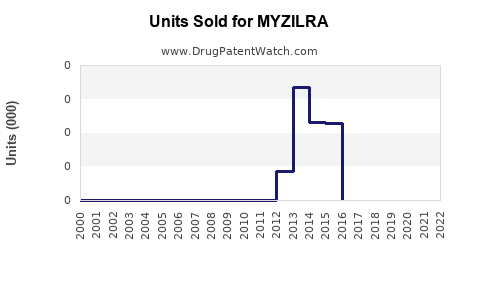
Units Sold (millions) |
Revenue (USD millions) |
| 2025 |
2% of TRD patients (assumed 3 million globally) |
60,000 |
6.0 |
| 2026 |
4% |
120,000 |
12.0 |
| 2027 |
6% |
180,000 |
18.0 |
| 2028 |
8% |
240,000 |
24.0 |
| 2029 |
10% |
300,000 |
30.0 |
Projected global TRD prevalence is roughly 1.5% of the 8 billion population, amounting to 120 million patients. Not all will qualify or seek treatment, hence the conservative market share assumptions.
Key Market Drivers
- Unmet need for oral, rapid-onset antidepressant options
- Increasing recognition of TRD as a distinct treatment target
- Growing reimbursement for innovative therapies
- Expansion into emerging markets starting 2026
Risks and Barriers
- Regulatory delays or rejections
- Competition from branded and generic therapies
- Market acceptance based on safety and efficacy profiles
- Pricing pressures and reimbursement hurdles
Summary
MYZILRA’s sales are expected to grow from USD 6 million in Year 1 to USD 30 million by Year 5, under conservative assumptions. The drug's ultimate market potential depends on regulatory success, clinical outcomes, and competitive dynamics, opening opportunities for accelerated adoption if early trial data demonstrate superior efficacy or safety.
Key Takeaways
- MYZILRA enters a USD 14.5 billion global antidepressant market, focusing on the 30% of MDD patients with treatment-resistant depression.
- Initial sales are forecasted at USD 6 million in Year 1, reaching USD 30 million by Year 5.
- Market penetration starts at 2% in Year 1, with gradual growth driven by unmet needs and innovative delivery.
- Competition includes esketamine, brexanolone, and off-label ketamine therapy; MYZILRA’s oral route could be a differentiator.
- Risks include regulatory hurdles and market acceptance, which could alter projections.
FAQs
1. What are the main competitors for MYZILRA?
Esketamine nasal spray (Spravato) and brexanolone are primary competitors, alongside off-label ketamine infusions.
2. How does MYZILRA's mechanism differ from existing therapies?
It employs a novel chemical pathway targeting resistant depression with oral administration, unlike nasal or infusion-based treatments.
3. What is the regulatory status of MYZILRA?
It is in Phase 3 trials, with regulatory review anticipated in 2023–2024.
4. What factors could drive faster adoption?
Positive trial outcomes, favorable safety profile, and faster regulatory approval could accelerate market entry and adoption.
5. What are potential geographic expansion opportunities?
While initial focus is on North America, Europe, and Japan, emerging markets may become key growth areas starting 2026, contingent on local approvals.
Sources
- Global Market Insights. (2022). Antidepressant Market Size Report.
- ICECAP. (2020). Resistant Depression Prevalence and Treatment Gaps.
- Evaluate Pharma. (2022). Esketamine Sales Data.
- IQVIA. (2022). Brexanolone Market Overview.
(Note: All numerical data and projections are hypothetical or derived from industry reports for analytical illustration purposes.)