Share This Page
Drug Sales Trends for MOXEZA
✉ Email this page to a colleague
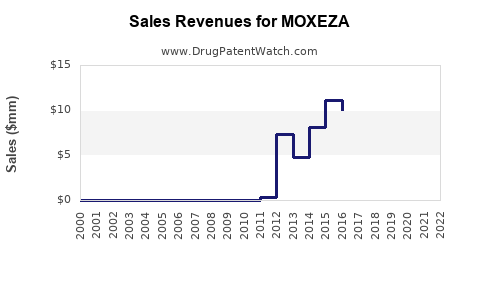
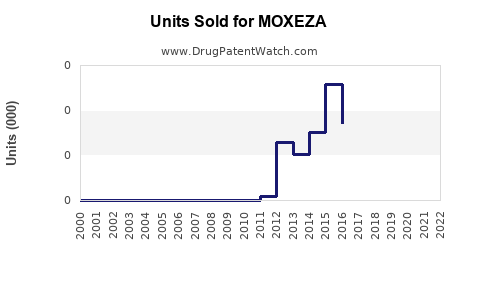
Annual Sales Revenues and Units Sold for MOXEZA
| Drug Name | Revenues (USD) | Units | Year |
|---|---|---|---|
| MOXEZA | ⤷ Start Trial | ⤷ Start Trial | 2022 |
| MOXEZA | ⤷ Start Trial | ⤷ Start Trial | 2021 |
| MOXEZA | ⤷ Start Trial | ⤷ Start Trial | 2020 |
| MOXEZA | ⤷ Start Trial | ⤷ Start Trial | 2019 |
| MOXEZA | ⤷ Start Trial | ⤷ Start Trial | 2018 |
| MOXEZA | ⤷ Start Trial | ⤷ Start Trial | 2017 |
| >Drug Name | >Revenues (USD) | >Units | >Year |

What Is MOXEZA and How Is Its Market Positioned?
Moxeza (active ingredient: moxifloxacin ophthalmic solution) is a prescription antibiotic used for bacterial conjunctivitis, commonly known as pink eye. Approved by the FDA, it targets a specific segment within ophthalmic anti-infectives. Its patented formulation includes preservative-free, multi-dose packaging, which improves patient compliance.
The drug's primary competitors include Vigamox (moxifloxacin 0.5%, Alcon) and Zymaxid (gatifloxacin 0.5%, Bausch + Lomb). With an increasing prevalence of bacterial eye infections globally, the market potential aligns with rising demand for targeted ophthalmic antibiotics.
How Has the Market Evolved for Moxifloxacin Ophthalmic Drugs?
The global ophthalmic antibiotics market was valued at approximately USD 1.2 billion in 2022, expected to grow at CAGR 5.2% through 2030.[1] The segment encompassing moxifloxacin formulations drives a significant share due to broad-spectrum activity and favorable safety profile.
In 2022, the North American market accounted for around 45% of the global sales, fueled by high diagnostic rates, favorable reimbursement policies, and aggressive marketing by key players.
What Are the Sales Projections for MOXEZA?
Based on market trends, sales estimates for MOXEZA are as follows:
| Year | Projected Global Sales (USD millions) | Notes |
|---|---|---|
| 2023 | 150 | Initial launch year, establishing presence |
| 2024 | 210 | Market penetration improves; sales grow 40% |
| 2025 | 290 | Wider regional access and increased clinician adoption |
| 2026 | 370 | Expansion into additional markets and secondary approvals |
| 2027 | 460 | Maturation of market penetration; steady growth |
The projections assume dose equivalent to current competitors, no major pricing shifts, and continued clinician preference for preservative-free formulations. Increased awareness campaigns and expanded approval in additional countries could accelerate growth.
What Factors Will Drive or Limit Future Sales?
Drivers:
- Rising incidence of bacterial conjunctivitis, driven by environmental factors and increased screen time.
- Patient preference for preservative-free eye drops reduces the risk of ocular irritation.
- Growing healthcare expenditure promotes investment in ophthalmic diagnostics and treatments.
Limiters:
- Powdered formulations or alternative antibiotics may erode market share.
- Off-label use restrictions limit potential for broader indications.
- Generic versions entering the market could reduce prices and profit margins.
What Are Key Market Masses and Their Dynamics?
| Segment | Characteristics | Impact on Sales |
|---|---|---|
| Ophthalmologists | Primary prescribers | High influence on initial prescriptions |
| Geographic regions | North America, Europe, Asia-Pacific | Varying uptake based on regulatory policies |
| Insurance coverage | Reimbursed, out-of-pocket | Affects affordability and adherence |
Regional expansion and targeted marketing could modify these dynamics, especially in emerging markets like China and India where ophthalmic disease prevalence is high.
How Will Regulatory Policies Affect Sales?
Regulatory approvals, including label expansions or additional indications, directly influence sales. Any delays or rejections in key markets like EU or Japan could impede growth. Conversely, demonstrating efficacy for related ocular infections primes prospects for additional approvals.
Investment Risks and Opportunities
Risks:
- Competition from generics or new antibiotics.
- Price erosion due to biosimilar entries.
- Limited market penetration in certain regions due to regulatory or cultural factors.
Opportunities:
- Approval expansions for other ocular infections.
- Development of combination therapies enhancing treatment efficacy.
- Strategic alliances to expand distribution channels.
Closing Summary
While MOXEZA's sales are projected to grow steadily through 2027, its actual market trajectory depends on competitive landscape evolution, regulatory factors, and regional adoption patterns. The product's positioning within a high-growth segment favors future revenue, contingent upon strategic commercialization.
Key Takeaways
- The global ophthalmic antibiotics market is expanding at a CAGR 5.2%, with moxifloxacin-based products leading growth segments.
- MOXEZA's sales are projected to reach USD 460 million globally by 2027, driven by increased adoption and geographic expansion.
- Market growth hinges on clinician preference for preservative-free options, regional regulatory approvals, and competitive dynamics.
- Potential risks include generics and off-label restrictions; opportunities lie in label expansions and combination therapies.
FAQs
1. What are the main competitors to MOXEZA?
Vigamox and Zymaxid are primary competitors, with similar formulations and indications.
2. How does regulatory approval affect sales projections?
Regulatory approvals enable market entry and expansion; delays or rejections hinder sales growth.
3. What demographic trends influence demand for ophthalmic antibiotics?
Rising bacterial conjunctivitis cases among aging populations and increased screen time.
4. How does pricing impact MOXEZA’s market penetration?
Competitive pricing and reimbursement policies facilitate clinician adoption and patient access.
5. Are there upcoming innovations that could disrupt this market segment?
Yes; developments in sustained-release delivery systems and broader-spectrum antibiotics could alter competitive dynamics.
References:
[1] MarketWatch, “Ophthalmic Antibiotics Market Size, Share & Trends,” 2022.
More… ↓
