Share This Page
Drug Sales Trends for MESALAMINE
✉ Email this page to a colleague
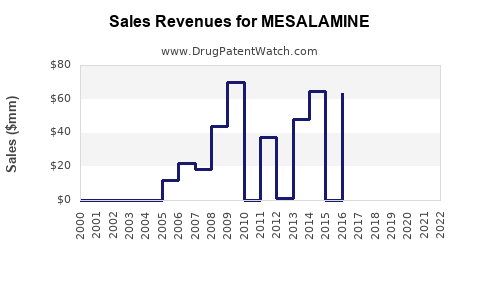
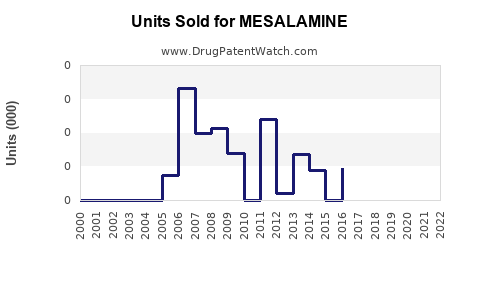
Annual Sales Revenues and Units Sold for MESALAMINE
| Drug Name | Revenues (USD) | Units | Year |
|---|---|---|---|
| MESALAMINE | ⤷ Start Trial | ⤷ Start Trial | 2022 |
| MESALAMINE | ⤷ Start Trial | ⤷ Start Trial | 2021 |
| MESALAMINE | ⤷ Start Trial | ⤷ Start Trial | 2020 |
| MESALAMINE | ⤷ Start Trial | ⤷ Start Trial | 2019 |
| MESALAMINE | ⤷ Start Trial | ⤷ Start Trial | 2018 |
| >Drug Name | >Revenues (USD) | >Units | >Year |
Mesalamine Market Analysis, Sales Forecast, Patent Risk, and Competitive Landscape
Mesalamine is a mature, genericized small-molecule treatment for mild-to-moderate ulcerative colitis. The market remains commercially relevant because treatment is chronic, prescription volume is high, and patients often require long-term maintenance therapy. Revenue is shifting from branded products such as Lialda, Apriso, Delzicol, Pentasa, and Rowasa to lower-priced generic delayed-release, extended-release, and rectal formulations.
A reasonable base-case estimate places the global mesalamine market at approximately $1.1 billion to $1.4 billion in 2024 sales, with the United States representing roughly 65% to 75% of branded and generic prescription value. Under continued price erosion and stable ulcerative-colitis prevalence, global sales are likely to decline at approximately 2% to 5% annually through 2029. Volume should remain stable or increase modestly while revenue falls because of generic substitution.
What is the current mesalamine market size?
Mesalamine, also known as mesalazine, is sold in oral and rectal dosage forms. It is used primarily for induction and maintenance of remission in ulcerative colitis. Product revenue is divided across:
- Delayed-release tablets and capsules
- Extended-release tablets and capsules
- Controlled-release capsules
- Rectal suppositories
- Rectal enemas
- Rectal foam
- Generic equivalents of branded products
Public company filings generally report mesalamine within broader gastrointestinal or specialty-pharmaceutical segments rather than as a standalone product. As a result, market estimates require triangulation from prescription volume, reported brand revenue, generic pricing, and ulcerative-colitis treatment patterns.
| Market measure | 2024 estimate | 2029 base-case estimate | Trend |
|---|---|---|---|
| Global mesalamine sales | $1.1B-$1.4B | $0.9B-$1.2B | Declining value |
| U.S. share of global value | 65%-75% | 60%-70% | Declining as generic prices fall |
| Branded-product share of U.S. value | 35%-45% | 20%-30% | Declining |
| Generic share of U.S. prescriptions | 55%-70% | 70%-80% | Increasing |
| Global annual volume growth | 1%-3% | 1%-3% | Stable to modestly positive |
| Global revenue CAGR | -2% to -5% | -2% to -5% | Negative |
The market is more resilient by volume than by value. Ulcerative colitis is chronic, and mesalamine remains a first-line option for many patients with mild-to-moderate disease. American Gastroenterological Association guidance supports oral and rectal 5-aminosalicylate therapy in appropriate disease settings, although biologics and targeted small molecules are increasingly used in moderate-to-severe disease (American Gastroenterological Association, 2020).
How much revenue does mesalamine generate?
The largest commercial exposure is concentrated in branded oral products, particularly Lialda and Apriso in the United States. Bausch Health reports Salix Pharmaceuticals revenue at the segment level, but does not consistently provide standalone global revenue for each mesalamine brand. Ferring similarly reports broader pharmaceutical results rather than a product-level Pentasa revenue figure.
The following estimates are modeled ranges rather than company-reported product sales.
| Product or segment | Principal company | Estimated 2024 revenue range | Commercial position |
|---|---|---|---|
| Lialda and authorized generic equivalents | Bausch Health / Salix | $250M-$400M | Largest U.S. oral brand franchise |
| Apriso and generic equivalents | Bausch Health / Salix | $75M-$150M | Extended-release maintenance product |
| Delzicol and generic equivalents | Bausch Health / Salix | $40M-$90M | Delayed-release capsule product |
| Pentasa | Ferring Pharmaceuticals | $100M-$200M globally | Established controlled-release franchise |
| Rowasa and rectal mesalamine products | Multiple companies | $100M-$200M | Important niche with lower generic substitution |
| Other oral and rectal generics | Teva, Perrigo, Amneal, Dr. Reddy's, Zydus and others | $400M-$650M | Main source of prescription volume |
These ranges reflect the combined value of branded products, authorized generics, and conventional generics. They should not be interpreted as reported net sales for individual companies.
Which mesalamine products have the strongest commercial position?
Lialda has historically held the strongest U.S. branded position because its once-daily dosing and high-dose delayed-release tablet support adherence and physician familiarity. Apriso competes in maintenance treatment with an extended-release profile. Delzicol replaced or supplemented earlier Asacol products in parts of the market. Pentasa remains differentiated by its controlled-release formulation and broader international presence.
Rectal products have lower total revenue but greater formulation defensibility. Enemas, suppositories, and foam products are more difficult to substitute on a milligram-for-milligram basis because delivery location, administration device, excipient system, and patient usability affect prescribing.
What are the sales projections for mesalamine through 2029?
Base-case forecast
The base case assumes stable ulcerative-colitis incidence, modest growth in diagnosed prevalence, continued generic substitution, and no major new mesalamine indication.
| Year | Global sales estimate | Annual growth | Main driver |
|---|---|---|---|
| 2024 | $1.25B | — | Established market baseline |
| 2025 | $1.21B | -3.2% | Generic price pressure |
| 2026 | $1.17B | -3.3% | Branded erosion |
| 2027 | $1.13B | -3.4% | Additional formulary substitution |
| 2028 | $1.09B | -3.5% | Mature generic market |
| 2029 | $1.05B | -3.7% | Lower average selling prices |
Scenario analysis
| Scenario | 2029 global sales | Implied CAGR, 2024-2029 | Assumptions |
|---|---|---|---|
| Upside | $1.30B-$1.45B | 1%-3% | Higher diagnosis, persistent branded use, stronger rectal demand |
| Base case | $1.0B-$1.1B | -3% to -4% | Stable volume and sustained price erosion |
| Downside | $0.75B-$0.9B | -7% to -9% | Rapid generic substitution and aggressive payer contracting |
The most likely outcome is declining revenue with relatively stable patient volume. The key financial variable is net price, not market expansion.
When does mesalamine lose exclusivity?
Mesalamine has already lost primary composition-of-matter exclusivity. Current commercial protection depends mainly on formulation, dosage form, manufacturing process, and method-of-use patents.
| Protection category | Current status |
|---|---|
| Active ingredient patent | Expired |
| Basic oral formulation protection | Largely expired or commercially bypassed |
| Delayed-release formulation patents | Mature; generic competition established |
| Extended-release formulation patents | Mature; product-specific challenges possible |
| Rectal delivery patents | Mixed; some formulation and device barriers remain |
| Method-of-use patents | Limited value where treatment claims are broad or obviousness-sensitive |
| Regulatory exclusivity | Generally expired for major products |
| Biosimilar exclusivity | Not applicable |
FDA approval of generic mesalamine products demonstrates that the principal oral dosage forms can be replicated through the abbreviated new drug application pathway. The remaining commercial protection is product-specific rather than molecule-wide.
What patents protect mesalamine products?
The commercially relevant patent estate historically focused on:
- Delayed-release coatings that prevent drug release in the stomach.
- Multiunit or matrix systems that release mesalamine in the terminal ileum and colon.
- Extended-release granules or capsules.
- Rectal suspensions, foams, suppositories, and applicator systems.
- Dosing regimens for maintaining remission.
- Manufacturing processes that control particle size, coating thickness, dissolution, or release profile.
Patent risk is highest when a generic applicant seeks approval for a formulation that closely reproduces the branded product's release profile. Patent holders can assert listed patents under the Hatch-Waxman framework after receiving a Paragraph IV certification.
How strong is the mesalamine patent estate?
The overall estate is weak for the active ingredient and mature oral products but stronger for certain dosage forms and delivery systems.
| Estate component | Relative strength | Reason |
|---|---|---|
| Active ingredient | Very low | Long expired |
| Conventional delayed-release tablet | Low to moderate | Multiple generic precedents |
| Once-daily high-dose tablet | Moderate | Release profile and dosing claims can delay entry |
| Extended-release capsule | Moderate | Formulation-specific barriers |
| Rectal foam | Moderate to strong | Device, formulation, and administration complexity |
| Enema and suppository | Low to moderate | Established generic technologies |
| Manufacturing process | Variable | Can be bypassed unless process is essential to product performance |
| Broad method-of-use claims | Low | Vulnerable to obviousness and written-description challenges |
The practical value of a mesalamine patent depends on whether the patent blocks the approved product, can be designed around, and is listed in the FDA Orange Book. A patent that does not cover the commercial formulation or is not listed may have limited ability to delay generic approval.
What is the Orange Book status of mesalamine?
The FDA Orange Book identifies patents and exclusivity information associated with approved drug products. Mesalamine listings must be evaluated by product and dosage form, not by active ingredient alone. Lialda, Apriso, Delzicol, Pentasa, Rowasa, and other products have separate approval histories and may have different listed patents.
The relevant Orange Book questions are:
- Whether a patent remains listed for the specific reference-listed drug.
- Whether the listed patent covers the formulation, method of use, or both.
- Whether an ANDA applicant submitted a Paragraph IV certification.
- Whether litigation triggered a 30-month stay.
- Whether the patent expires before the generic is commercially ready.
- Whether an authorized generic changes the economics of entry.
Because mesalamine has several reference products, an ANDA applicant can sometimes avoid a high-value patent estate by targeting a different dosage form or reference product.
Which companies are challenging mesalamine patents?
Generic competition has come from major and specialty generic manufacturers, including Teva, Perrigo, Amneal, Dr. Reddy's, Zydus, Sun Pharmaceutical, and other abbreviated-application sponsors. The competitive pattern is fragmented because mesalamine products differ by release profile and dosage form.
Paragraph IV litigation risk is highest for:
- Once-daily delayed-release tablets
- Extended-release capsules
- High-dose oral products
- Rectal foam products
- Products with limited approved generic alternatives
The absence of a major patent dispute does not mean the product is protected. Generic applicants may file Paragraph III certifications, wait for patent expiry, or pursue products with non-infringing release technologies.
Is there biosimilar risk for mesalamine?
No. Mesalamine is a chemically synthesized small molecule, not a biologic. It faces generic drug competition under the Hatch-Waxman framework rather than biosimilar competition under the Biologics Price Competition and Innovation Act.
The main regulatory barriers are bioequivalence, dissolution testing, pharmacokinetic comparability where applicable, and demonstration of equivalent release characteristics. For rectal products, formulation and local delivery performance can create greater development complexity than for conventional oral tablets.
What generic launch scenarios exist for mesalamine?
Scenario 1: Immediate multisource launch
Several generic manufacturers enter after approval, leading to rapid price compression. This is the standard outcome for mature oral products with no enforceable blocking patent.
Scenario 2: Limited-source launch
One or two approved manufacturers enter initially. Prices decline more slowly, and the branded product retains a niche among patients who are stable on a particular formulation.
Scenario 3: Delayed entry after Paragraph IV litigation
The reference sponsor sues within the statutory period, potentially creating a 30-month stay. Entry may occur after settlement, patent invalidation, or expiration.
Scenario 4: Formulation-specific protection
Generic oral products enter while a branded rectal foam or other differentiated dosage form maintains pricing power. This creates a split market in which commodity oral products decline faster than specialized delivery systems.
What patent litigation affects mesalamine?
Mesalamine litigation has generally centered on formulation and release technology rather than the active ingredient. The most material disputes involve:
- Whether a delayed-release coating falls within the asserted claims.
- Whether a generic product has an equivalent dissolution profile.
- Whether method-of-use claims are valid and enforceable.
- Whether the patent is obvious in view of earlier 5-aminosalicylic-acid formulations.
- Whether the listed patent properly covers the approved product.
For investors and licensing teams, litigation value should be measured against the remaining commercial life of the reference product. A patent with only a short remaining term may have little economic value if multiple generics can enter through alternative dosage forms.
Are licensing deals important in mesalamine?
Mesalamine licensing activity is less strategically important than in specialty or biologic markets. The molecule is mature, and most value comes from product rights, manufacturing scale, and distribution contracts rather than discovery licenses.
Commercial transactions can still affect competition through:
- U.S. rights transfers
- Authorized-generic agreements
- Contract manufacturing
- Regional commercialization licenses
- Product portfolios acquired with gastrointestinal assets
Bausch Health's Salix portfolio and Ferring's gastrointestinal product infrastructure are more relevant to mesalamine distribution than new-molecule licensing. A licensing transaction involving mesalamine is likely to be portfolio-driven rather than based on novel patent exclusivity.
How does mesalamine compare with competing ulcerative-colitis drugs?
| Drug class | Examples | Market effect on mesalamine |
|---|---|---|
| 5-ASA products | Mesalamine, sulfasalazine, balsalazide | Direct competition |
| Corticosteroids | Budesonide, prednisone | Used for induction, not long-term maintenance |
| Immunomodulators | Azathioprine, 6-mercaptopurine | Used in selected patients |
| Anti-TNF biologics | Infliximab, adalimumab | Compete in moderate-to-severe disease |
| Integrin inhibitors | Vedolizumab | Compete in advanced treatment |
| JAK inhibitors | Tofacitinib, upadacitinib | Compete in moderate-to-severe disease |
| IL-12/23 and IL-23 therapies | Ustekinumab, guselkumab, mirikizumab | Expand advanced-therapy competition |
Mesalamine retains an advantage in low acquisition cost, oral administration, long clinical experience, and use in mild-to-moderate disease. It is vulnerable when patients escalate to biologics or targeted therapies, but those products generally do not eliminate mesalamine demand across the full ulcerative-colitis population.
What is the investment outlook for mesalamine?
Mesalamine is a cash-flow and manufacturing-efficiency market, not an innovation-led growth market. Attractive opportunities are concentrated in:
- Low-cost manufacturing
- Reliable supply of active pharmaceutical ingredient
- Complex oral release technologies
- Rectal foam and other specialized delivery systems
- Authorized-generic strategies
- International markets with lower generic penetration
- Product portfolios that combine mesalamine with other gastrointestinal therapies
The main risks are rapid price erosion, FDA manufacturing observations, supply interruptions, payer substitution, and litigation costs that exceed the remaining branded revenue opportunity.
Key Takeaways
- Global mesalamine sales are estimated at approximately $1.1 billion to $1.4 billion in 2024.
- Base-case revenue is projected to decline to about $1.0 billion to $1.1 billion by 2029.
- Prescription volume should remain stable or rise modestly while average selling prices fall.
- Lialda, Apriso, Delzicol, Pentasa, and Rowasa remain the principal branded franchises.
- Generic competition is already established for major oral dosage forms.
- The active ingredient has no meaningful remaining patent protection.
- Formulation, release profile, rectal delivery, and manufacturing patents provide the main residual barriers.
- Mesalamine has generic risk, not biosimilar risk.
- Rectal foam and other complex delivery systems have stronger commercial defensibility than conventional oral tablets.
- The market favors low-cost manufacturers, reliable suppliers, and companies with differentiated delivery technology.
FAQs About Mesalamine Market Competition and Patents
What is the largest mesalamine brand?
Lialda has historically been the leading U.S. branded mesalamine product by commercial importance, although generic substitution has reduced its market share and pricing power.
Is mesalamine still profitable after generic entry?
Yes. Profitability remains possible for manufacturers with scale, efficient production, stable supply, or differentiated rectal and extended-release products. Conventional oral products have lower margins than before generic entry.
Can a generic company launch mesalamine before all patents expire?
It may launch through a Paragraph IV challenge, after a settlement, after successful patent litigation, or by designing around the relevant claims. Entry timing depends on the reference product and listed patents.
Which mesalamine formulation has the greatest patent risk?
Complex extended-release oral products and rectal foams generally have greater formulation and delivery-system risk than standard delayed-release tablets.
Will biologics eliminate demand for mesalamine?
No. Biologics and targeted small molecules mainly compete in moderate-to-severe ulcerative colitis. Mesalamine remains widely used in mild-to-moderate disease and as maintenance therapy for selected patients.
References
-
American Gastroenterological Association. (2020). American Gastroenterological Association clinical practice guidelines on the management of mild-to-moderate ulcerative colitis. Gastroenterology, 158(5), 1450-1461.
-
Bausch Health Companies Inc. (2024). Annual report for the fiscal year ended December 31, 2023. https://ir.bauschhealth.com
-
U.S. Food and Drug Administration. (2024). Drugs@FDA: FDA-approved drugs. https://www.accessdata.fda.gov/scripts/cder/daf/
-
U.S. Food and Drug Administration. (2024). Approved drug products with therapeutic equivalence evaluations, commonly known as the Orange Book. https://www.fda.gov/drugs/drug-approvals-and-databases/orange-book
-
U.S. Food and Drug Administration. (2024). Mesalamine prescribing information and product labeling. https://www.accessdata.fda.gov/scripts/cder/daf/
More… ↓
