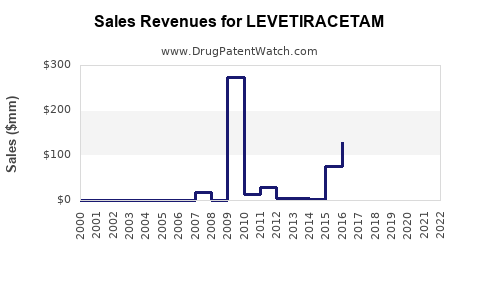
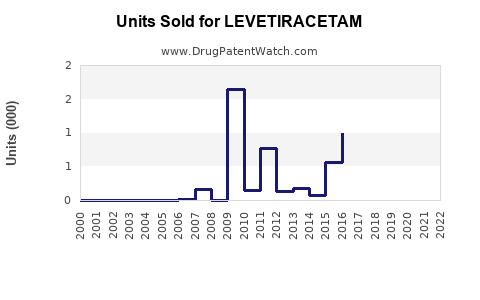
Last updated: February 13, 2026
Market Overview of Levetiracetam
Levetiracetam (brand name: Keppra, among others) is an antiepileptic drug (AED) approved for adjunctive therapy in partial-onset seizures, myoclonic seizures, and primary generalized tonic-clonic seizures, with additional off-label use for neurological conditions like neuropathic pain and mood disorders.
The drug's global market has grown steadily since its initial approval in 2008, driven by increasing epilepsy prevalence, expanding indications, and its favorable safety profile compared to older AEDs.
Market Size and Growth Trends
Global Market Value
In 2022, the global levetiracetam market was valued at approximately USD 2.3 billion. It is projected to reach USD 3.9 billion by 2030, reflecting a compound annual growth rate (CAGR) of about 6.2% from 2023–2030.
Regional Breakdown
| Region |
2022 Market Share |
2023–2030 CAGR |
Key Drivers |
| North America |
45% |
5.8% |
High epilepsy prevalence, early adoption of new formulations |
| Europe |
30% |
6.5% |
Growing awareness, healthcare infrastructure investment |
| Asia-Pacific |
15% |
7.2% |
Increasing medication access, rising epilepsy cases |
| Rest of World |
10% |
6.0% |
Emerging markets, improving healthcare access |
Drivers of Growth
- Epidemiological Factors: Approx. 50 million epilepsy cases worldwide as of 2021 (per WHO), with a global prevalence of 7.6 per 1,000 people.
- Regulatory Approvals: Expansion of indications, including pediatric forms and broader off-label uses.
- Formulation Advancements: Development of extended-release and injectable forms to improve compliance.
- Market Penetration: Increased acceptance over older AEDs due to better side-effect profiles.
Competitive Landscape
Major manufacturers include UCB Pharma (original innovator), Teva Pharmaceuticals, Sandoz, and Mylan (now part of Viatris). UCB maintains a dominant position with an estimated 55-60% market share.
Key Patent and Formulation Developments
- UCB received patent extensions in multiple regions up to 2030.
- Generic competition has eroded off-patent pricing since 2015, impacting revenue but expanding access.
Sales Projections (2023–2030)
| Year |
Estimated Global Sales |
Notes |
| 2023 |
USD 2.5 billion |
Mature market, steady growth, generic competition persists |
| 2025 |
USD 3.2 billion |
Increased use in pediatric populations, expanded indications |
| 2030 |
USD 3.9 billion |
Market maturity, innovation in formulations, broader access |
Key Assumptions
- Launch of new extended-release formulations in North America and Europe.
- Continued expansion into off-label uses, increasing prescription volume.
- Price erosion from generics, but offset by volume increases.
Risks and Challenges
- Competitive landscape intensifies with generics reducing revenue per unit.
- Regulatory delays or restrictions could slow market growth.
- Emerging therapies, such as novel epilepsy drugs and gene therapies, may reduce levetiracetam's long-term market share.
Conclusion
Levetiracetam's market maintains steady growth driven by its established efficacy, safety, and expanding indications. Revenue growth is moderated by generic competition but supported through formulation innovations and broader clinical adoption.
Key Takeaways
- Expected global sales to reach USD 3.9 billion by 2030 at a CAGR of approx. 6.2%.
- North America remains the largest market, with rapid growth in Asia-Pacific.
- Generic competition has both decreased pricing and expanded market access.
- Innovative formulations and off-label uses will sustain sales trajectories.
- Market risks include emerging therapies and regulatory challenges.
FAQs
Q1: What are the primary indications for levetiracetam?
Partial-onset seizures, myoclonic seizures, and primary generalized tonic-clonic seizures.
Q2: How does the patent landscape affect sales?
Patent expiry has introduced generic competition, reducing prices but increasing prescription volume, balancing out revenues.
Q3: What are the recent formulation innovations?
Extended-release and injectable forms aimed at improving adherence and expanding use cases.
Q4: Which markets present the highest growth potential?
Asia-Pacific and Latin America, due to increasing disease prevalence and improving healthcare infrastructure.
Q5: What competitive threats exist?
Emerging epilepsy drugs, gene therapies, and potential new mechanisms of action that could replace levetiracetam.
References
- World Health Organization (WHO). "Epilepsy." 2021.
- Grand View Research. "Levetiracetam Market Size, Share & Trends Analysis Report," 2023–2030.
- UCB Pharma filings and patent updates, 2022–2023.