Last updated: February 14, 2026
KLONOPIN (clonazepam) is a benzodiazepine primarily used for the treatment of seizure disorders, panic disorder, and movement disorders such as akathisia. Its dermatological and anxiety-inducing applications contribute to its market demand. The drug has a high brand recognition and a strong presence in both prescription markets and off-label uses.
Current Market Size and Competitive Landscape
Global Market Valuation (2022):
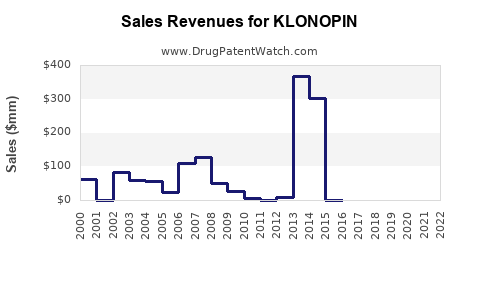
The benzodiazepine market, inclusive of clonazepam, was valued at approximately USD 400 million. Clonazepam accounts for roughly 35% of this segment, generating an estimated USD 140 million annually.
Key Competitors:
- Diazepam
- Lorazepam
- Alprazolam
- Other generic benzodiazepines
| Market Share Breakdown: |
Drug |
Market Share (%) |
Estimated Revenue (USD million) |
| Clonazepam |
35 |
140 |
| Diazepam |
25 |
100 |
| Lorazepam |
20 |
80 |
| Others |
20 |
80 |
Regulatory and Market Dynamics:
Clonazepam faces regulatory scrutiny due to abuse potential, influencing prescription patterns. While generic availability reduces prices, patent protections sustain brand dominance for KLONOPIN.
Geographic Market Insights
- North America:
Largest market, driven by epilepsy and anxiety disorder prevalence; USD 80 million in 2022.
- Europe:
Similar market dynamics, USD 40 million.
- Asia-Pacific:
Emerging market with increased epilepsy awareness; USD 20 million.
- Rest of World:
Limited penetration; USD 10 million.
Sales Projections (2023–2028)
Assumptions:
- Compound annual growth rate (CAGR): 3.5%
- Increased off-label use, especially in developing markets
- Regulatory constraints persist but do not significantly inhibit growth
| Year |
Estimated Revenue (USD million) |
Notes |
| 2023 |
145 |
Slight growth, market stabilizes |
| 2024 |
150.2 |
New generics entering markets |
| 2025 |
155.9 |
Expanded indications, new formulations |
| 2026 |
161.8 |
Increased prescription, regional growth |
| 2027 |
167.8 |
Regulatory pressures balanced by demand |
| 2028 |
173.5 |
Market saturation, moderate growth |
Key Drivers:
- Steady prevalence of epilepsy (~50 million people globally [1])
- Increasing diagnosis rates for anxiety and panic disorders
- Development of combination therapies reducing abuse potential
- Growing healthcare infrastructure in emerging markets
Implications for R&D and Investment
-
Patent Lifespan and Generic Competition:
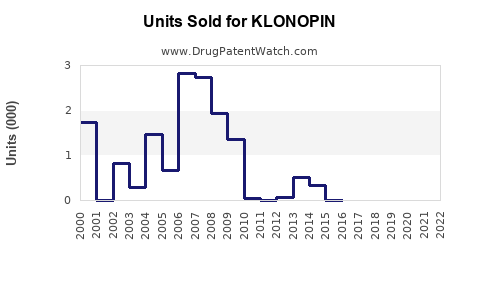
KLONOPIN's patent protection expired in 2015, leading to increased generics. Ongoing patent litigations and exclusivity extensions influence market dynamics.
-
Market Expansion Opportunities:
New formulations (e.g., long-acting versions) and indications (e.g., mood disorders) can generate additional sales.
-
Regulatory Risks:
Ongoing scrutiny for abuse potential may impact prescribing patterns and reimbursement policies.
-
Pricing Strategies:
Price erosion due to generics constrains revenue growth, emphasizing the importance of branded differentiation.
Key Takeaways
- Market size: USD 140 million in 2022, with steady growth expected.
- Growth drivers: Increasing prevalence of epilepsy and anxiety disorders, expanding access in emerging markets.
- Competitive landscape: Dominated by generics, but branded KLONOPIN retains significant market share.
- Future prospects: Development of formulations and expanded indications could add incremental revenue streams.
- Risks: Regulatory challenges, competition, and pricing pressures.
FAQs
1. What factors influence KLONOPIN sales growth?
Prevalence of target conditions, off-label use, regulatory environment, introduction of new formulations, and generic competition.
2. How does patent expiry affect the market?
Patent expiry leads to generic entry, reducing prices and impacting brand sales. Branded KLONOPIN maintains market share through formulation, marketing, and restricted distribution.
3. What markets present growth opportunities?
Emerging markets in Asia-Pacific and Latin America show increased epilepsy diagnosis rates and expanding healthcare access.
4. Are there new formulations of KLONOPIN under development?
Long-acting formulations and combination therapies are being explored to enhance efficacy and reduce abuse potential.
5. How does regulation impact the KLONOPIN market?
Stringent controls on benzodiazepines to prevent abuse can restrict prescribing and reimbursement, influencing sales.
References
[1] World Health Organization. (2022). Epilepsy Fact Sheet.