Drug Sales Trends for JALYN
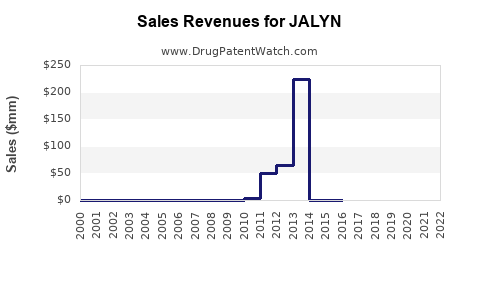
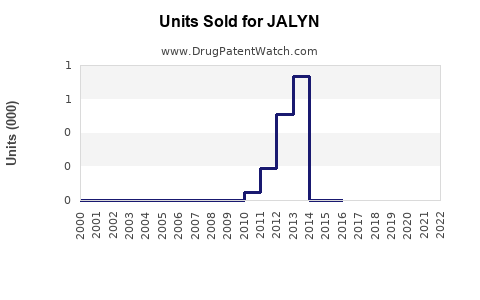
Annual Sales Revenues and Units Sold for JALYN
| Drug Name | Revenues (USD) | Units | Year |
|---|---|---|---|
| JALYN | ⤷ Start Trial | ⤷ Start Trial | 2022 |
| JALYN | ⤷ Start Trial | ⤷ Start Trial | 2021 |
| JALYN | ⤷ Start Trial | ⤷ Start Trial | 2020 |
| JALYN | ⤷ Start Trial | ⤷ Start Trial | 2019 |
| JALYN | ⤷ Start Trial | ⤷ Start Trial | 2018 |
| JALYN | ⤷ Start Trial | ⤷ Start Trial | 2017 |
| JALYN | ⤷ Start Trial | ⤷ Start Trial | 2016 |
| >Drug Name | >Revenues (USD) | >Units | >Year |
JALYN Market Analysis and Sales Projections: Dutasteride/Tamsulosin Outlook
JALYN is a fixed-dose combination of dutasteride 0.5 mg and tamsulosin hydrochloride 0.4 mg for symptomatic benign prostatic hyperplasia (BPH) in men with an enlarged prostate. Its commercial outlook is limited by generic availability, mature BPH pharmacotherapy, and the absence of a durable branded exclusivity position. The product retains clinical relevance where physicians prefer a single capsule for men needing both a 5-alpha-reductase inhibitor and an alpha blocker, but most future volume will be generic.
A reasonable base-case forecast for global JALYN-related sales, including branded and generic equivalents, is approximately $90 million to $140 million in 2025, declining to $65 million to $105 million by 2030. Branded JALYN revenue is likely a small fraction of that market.
What is JALYN and how does it compete in BPH treatment?
JALYN combines two established BPH medicines:
| Component | Drug class | Clinical role |
|---|---|---|
| Dutasteride 0.5 mg | 5-alpha-reductase inhibitor | Reduces dihydrotestosterone and prostate volume |
| Tamsulosin 0.4 mg | Alpha-1 adrenergic blocker | Improves urinary flow and lower urinary tract symptoms |
The combination is intended for men with moderate-to-severe BPH symptoms and an enlarged prostate. The FDA approved JALYN in 2010 under NDA 022460.[1]
The principal branded alternatives are:
- Avodart, dutasteride, historically marketed by GlaxoSmithKline
- Flomax, tamsulosin, historically marketed by Boehringer Ingelheim
- Duodart, the same dutasteride/tamsulosin combination marketed outside the United States
- Jalyn, the U.S. fixed-dose combination
- Separate generic dutasteride and generic tamsulosin capsules
JALYN’s clinical value is convenience. Its commercial weakness is that both active ingredients are mature generic products. Physicians can prescribe the components separately, often at lower cost and with greater dose flexibility.
How large is the JALYN addressable market?
The addressable market is the treated BPH population requiring both an alpha blocker and a 5-alpha-reductase inhibitor. It is smaller than the total BPH drug market.
BPH prevalence increases sharply with age. Approximately half of men aged 51 to 60 and up to 90% of men older than 80 have histologic evidence of BPH, although not all require medication.[2] Combination treatment is generally used in men with a larger prostate, more severe symptoms, or a higher risk of disease progression.
Estimated market structure
| Market layer | 2025 estimated value | 2030 estimated value | Main driver |
|---|---|---|---|
| Global prescription BPH drugs | $4.0 billion-$5.5 billion | $4.8 billion-$6.5 billion | Aging male population |
| Dutasteride-containing therapy | $250 million-$400 million | $230 million-$360 million | Generic pricing pressure |
| Dutasteride/tamsulosin fixed-dose combinations | $150 million-$250 million | $130 million-$210 million | Convenience and adherence |
| Branded JALYN | $10 million-$30 million | $3 million-$12 million | Residual brand demand |
| Generic JALYN equivalents | $80 million-$125 million | $60 million-$95 million | Pharmacy substitution |
These figures are market-model estimates rather than company-reported product sales. GSK has not reported JALYN as a separately material revenue line in its principal public financial disclosures. The company reports at broader portfolio and therapeutic-area levels.[3]
What are JALYN’s current sales and revenue exposure?
JALYN’s standalone revenue is not separately disclosed in a way that permits a verified annual sales series. Its commercial exposure should therefore be assessed through prescription volume, reimbursement, and generic substitution rather than through GSK segment revenue.
Revenue characteristics
JALYN has several features that limit revenue potential:
- Both active ingredients are available separately as low-cost generics.
- The product is used primarily in an older population with high generic substitution.
- Payers can reject the combination capsule in favor of two individual prescriptions.
- BPH therapy is chronic, but treatment switching and discontinuation reduce persistence.
- There is no biologic exclusivity or specialty-distribution model supporting premium pricing.
A branded JALYN prescription can still generate a higher gross price than separate generic products, but net pricing is constrained by formularies, rebates, and pharmacy substitution.
Estimated JALYN-related revenue scenarios
| Scenario | 2025 global revenue | 2030 global revenue | 2025-2030 CAGR |
|---|---|---|---|
| Bull case | $140 million | $115 million | -3.9% |
| Base case | $105 million | $82 million | -4.8% |
| Bear case | $70 million | $48 million | -7.2% |
The base case assumes continued growth in the treated BPH population, annual prescription-volume growth of 1% to 3%, and net price erosion of 5% to 8% per year across the fixed-dose combination market.
When did JALYN lose exclusivity?
JALYN’s market exclusivity has effectively ended. The product does not have a meaningful remaining U.S. exclusivity barrier capable of supporting branded pricing.
FDA product information identifies JALYN as a conventional small-molecule combination product rather than a biologic.[1] Its protection has been affected by:
- Expiration of the underlying active-ingredient patent estate
- Generic availability for dutasteride and tamsulosin
- The limited commercial value of formulation and combination patents after generic entry
- Pharmacy substitution and payer preference for low-cost products
The key commercial issue is no longer whether JALYN has a protected launch window. It is whether the fixed-dose combination retains enough adherence and convenience value to support volume against two separate generic prescriptions.
What is the Orange Book status of JALYN?
JALYN is listed in FDA’s Orange Book under NDA 022460.[4] The Orange Book is the controlling source for current U.S. patent listings, pediatric exclusivity, and approved therapeutic-equivalence information.
The product’s regulatory profile is materially different from a newly launched branded medicine:
| Issue | JALYN position |
|---|---|
| FDA application | NDA 022460 |
| Product type | Small-molecule fixed-dose capsule |
| Active ingredients | Dutasteride and tamsulosin hydrochloride |
| Reference sponsor | GlaxoSmithKline |
| Regulatory exclusivity | Expired |
| Active-ingredient generic competition | Established |
| Combination-product risk | Primarily commercial rather than regulatory |
| Biosimilar exposure | None |
Current Orange Book listings should be evaluated at the patent-number level before a litigation or launch decision. The relevant legal question is not whether an historical patent was once listed, but whether any listed patent remains unexpired and enforceable against a proposed ANDA.
Which companies are challenging or competing with JALYN?
Competition comes mainly from generic manufacturers rather than from a single branded challenger.
Relevant competitor groups include:
- Manufacturers of generic dutasteride
- Manufacturers of generic tamsulosin
- Manufacturers of dutasteride/tamsulosin fixed-dose capsules
- Compounding pharmacies and therapeutic substitution
- Other BPH drug classes, including finasteride, silodosin, alfuzosin, and tadalafil
Potential generic suppliers in the broader dutasteride and tamsulosin markets include large U.S. and international manufacturers such as Teva, Mylan/Viatris, Dr. Reddy’s Laboratories, Lupin, Cipla, Zydus, and Amneal. The exact supplier set for a JALYN-equivalent product depends on FDA approval status, commercial launch, dosage-form equivalence, and distribution contracts.
The strongest competitive threat is not a clinically differentiated branded product. It is the availability of two inexpensive generic capsules prescribed together.
What generic entry risks exist for JALYN?
Generic entry risk is high and persistent.
Principal risks
Pharmacy substitution
If a therapeutically equivalent fixed-dose generic is available, pharmacies and payers can substitute it for branded JALYN subject to state law and prescription instructions. Even where no fixed-dose generic is dispensed, separate dutasteride and tamsulosin prescriptions provide a low-cost alternative.
Price compression
The combination product has limited pricing power because the underlying ingredients are inexpensive. Generic competition can reduce net prices rapidly after launch, particularly when multiple manufacturers enter.
Prescriber switching
Urologists and primary-care physicians can prescribe the components separately. This weakens the practical protection provided by any narrow combination-product claim.
Formulary exclusion
Commercial insurers, Medicare Part D plans, and pharmacy benefit managers may place JALYN on a nonpreferred tier or require substitution with generic components.
Adherence tradeoff
A single capsule may improve convenience, but some patients prefer separate products because physicians can adjust or discontinue tamsulosin while continuing dutasteride. That flexibility limits the fixed-dose combination’s clinical advantage.
What formulations are protected by JALYN patents?
JALYN uses a modified-release tamsulosin component and a dutasteride component in a single oral capsule. Its formulation concept was commercially important at launch because it combined ingredients with different release and handling characteristics.
The relevant patent categories historically included:
- Fixed-dose dutasteride/tamsulosin combinations
- Capsule architecture
- Modified-release delivery of tamsulosin
- Pharmaceutical compositions containing both active ingredients
- Manufacturing and filling processes
- Use of the combination for BPH
Formulation patents generally have weaker commercial value after the active ingredients become generic. A generic applicant can attempt to design around a narrow capsule or release-profile claim, while an ANDA may challenge listed patents through Paragraph IV certification.
How do Paragraph IV challenges affect JALYN?
A Paragraph IV certification asserts that a listed patent is invalid, unenforceable, or will not be infringed by the proposed generic product. For a branded small-molecule product, this certification can trigger patent litigation and a potential 30-month stay of FDA approval under the Hatch-Waxman framework.[5]
For JALYN, Paragraph IV risk is less important than it would have been before generic availability because:
- The underlying ingredients already face mature generic competition.
- Separate generic dutasteride and tamsulosin can bypass the commercial need for a fixed-dose product.
- Any remaining combination patent must provide meaningful protection against a legally and commercially viable generic.
- A patent challenge may be unnecessary if the applicant waits for expiration or uses a non-infringing formulation.
A litigation review should identify each ANDA filer, certification date, asserted patent, district-court venue, claim scope, and settlement terms. Publicly available product-level data do not establish a single current litigation event that would materially extend JALYN’s market exclusivity.
What patent litigation and settlement agreements affect JALYN?
JALYN’s historical intellectual-property position was linked to GSK’s broader dutasteride and tamsulosin portfolios. The principal disputes affecting the product class have involved generic entry, patent validity, and formulation protection rather than a new chemical entity patent.
No settlement agreement should be treated as a current revenue protection mechanism unless it provides a still-effective delayed-entry date or other enforceable commercial restriction. For JALYN, the practical market outcome is consistent with mature generic competition and an absence of a material branded exclusivity extension.
Patent strength can be scored as follows:
| Patent factor | Assessment |
|---|---|
| Composition-of-matter protection | Weak or expired |
| Active-ingredient protection | Weak or expired |
| Fixed-dose combination claims | Limited residual value |
| Formulation claims | Potentially narrow |
| Method-of-use claims | Limited ability to block component prescribing |
| Manufacturing claims | Relevant only if difficult to design around |
| Litigation leverage | Low to moderate |
| Ability to preserve branded pricing | Low |
How strong is the JALYN patent estate?
JALYN has a weak current patent estate from a commercial-defense perspective. The product’s original value came from combining two established therapies into one capsule, not from a new molecular entity or protected biological platform.
The estate may still matter in a narrow legal analysis if a listed formulation or manufacturing patent remains unexpired. It does not, by itself, prevent substitution with separate generics. The strongest remaining barriers would need to cover an essential release profile or capsule configuration that a generic cannot reasonably replicate.
For investors and licensing parties, JALYN should be classified as a mature, low-barrier combination product rather than a protected growth asset.
What are JALYN’s generic launch scenarios?
Scenario 1: Branded decline with separate generic substitution
This is the most likely scenario. Physicians prescribe generic dutasteride and tamsulosin separately, and JALYN becomes a residual branded product used by patients who value one capsule or remain on legacy therapy.
Estimated impact:
- Branded revenue declines 8% to 15% annually.
- Fixed-dose combination volume remains stable or falls modestly.
- Gross-to-net discounts increase.
- Payer coverage becomes less favorable.
Scenario 2: Fixed-dose generic expansion
Several manufacturers commercialize a therapeutically equivalent dutasteride/tamsulosin capsule.
Estimated impact:
- Generic share exceeds 70% of combination prescriptions within two to three years.
- Average selling price falls 60% to 85% from branded levels.
- Branded JALYN becomes a low-volume product.
- Total patient volume grows modestly because of lower treatment cost.
Scenario 3: Combination-market stabilization
The market retains a meaningful fixed-dose segment because older patients prefer one capsule and physicians perceive adherence benefits.
Estimated impact:
- Fixed-dose combination prescriptions grow 1% to 2% annually.
- Generic erosion affects price more than volume.
- JALYN-related market value declines gradually rather than collapsing.
- The commercial opportunity shifts to authorized generics, contract manufacturing, or low-cost regional supply.
How does JALYN compare with separate dutasteride and tamsulosin?
| Factor | JALYN | Separate generic products |
|---|---|---|
| Dosing convenience | One capsule | Two prescriptions or capsules |
| Dose flexibility | Limited | High |
| Cost | Higher | Lower |
| Generic availability | Increasing or established by market | Broad |
| Adherence potential | Potentially better | More complex |
| Formulary position | Often weaker | Usually preferred |
| Patent risk | Combination/formulation claims | Minimal |
| Physician control | Lower | Higher |
| Commercial outlook | Declining mature product | Durable low-cost market |
The combination is most defensible in patients who value convenience and have stable dosing requirements. It is less competitive when payers prioritize the lowest acquisition cost.
What are JALYN’s geographic growth opportunities?
The strongest volume opportunity is outside the United States, where BPH prevalence is rising and fixed-dose combinations may have greater acceptance.
North America
The U.S. market has high generic penetration, strong pharmacy substitution, and intense formulary control. Revenue is likely to decline faster than prescription volume.
Europe
European markets have established generic competition and national reimbursement controls. Duodart and local generic combinations may retain volume, but pricing is constrained.
Japan
Japan has an aging population and substantial BPH treatment demand. Regulatory requirements, local competitors, and physician prescribing patterns limit direct transfer of the U.S. commercial model.
China and other Asia-Pacific markets
Patient volume can grow with diagnosis and access to treatment. Local manufacturers and price controls will constrain revenue. Fixed-dose combinations may have an opportunity where reducing pill burden improves persistence.
Latin America and emerging markets
Volume growth is possible, but tender pricing, local generic production, and lower per-patient spending make these markets more relevant for unit expansion than premium revenue.
What licensing deals and manufacturing barriers affect JALYN?
JALYN is not dependent on biologic manufacturing, cold-chain distribution, or complex cell-line technology. Its manufacturing barriers are conventional but not trivial.
Key technical requirements include:
- Consistent dutasteride content uniformity
- Controlled tamsulosin release
- Capsule compatibility and stability
- Protection from cross-contamination during manufacturing
- Bioequivalence or comparative dissolution data
- Reliable supply of both active pharmaceutical ingredients
The most plausible licensing opportunities involve regional commercialization, authorized-generic supply, or contract manufacturing. A high-value licensing deal is unlikely unless the partner controls a large reimbursement channel or a differentiated fixed-dose formulation.
What is the FDA regulatory status of JALYN?
JALYN is an FDA-approved prescription drug for BPH. It is a small-molecule product regulated through the NDA and ANDA pathways, not through the biosimilar pathway.[1,6]
Regulatory considerations include:
- ANDA applicants must demonstrate pharmaceutical equivalence and bioequivalence.
- The product’s capsule design and release characteristics can complicate development.
- A generic applicant may need to address listed patents through Paragraph III or Paragraph IV certification.
- No biosimilar pathway applies because JALYN is not a biologic.
- Postmarketing obligations are limited compared with products carrying major safety signals or complex biologic risk.
What is the five-year JALYN sales forecast?
The following forecast covers global JALYN-related sales, including branded product and fixed-dose generic equivalents. It excludes the much larger market for separate dutasteride and tamsulosin prescriptions.
| Year | Bull case | Base case | Bear case |
|---|---|---|---|
| 2025 | $140 million | $105 million | $70 million |
| 2026 | $137 million | $100 million | $65 million |
| 2027 | $132 million | $95 million | $60 million |
| 2028 | $126 million | $90 million | $56 million |
| 2029 | $120 million | $86 million | $52 million |
| 2030 | $115 million | $82 million | $48 million |
Forecast assumptions
The base case assumes:
- Global BPH treatment growth of approximately 2% annually
- Fixed-dose combination prescription growth of 0% to 1%
- Net price erosion of 5% to 8% annually
- Continued substitution with separate generic components
- No new branded indication
- No material exclusivity extension
- No major manufacturing interruption
- Increasing contribution from low-priced markets
Branded JALYN itself could decline from an estimated $10 million to $30 million in 2025 to approximately $3 million to $12 million by 2030. Most remaining value will come from generic combination products and regional markets.
Key Takeaways
- JALYN combines dutasteride and tamsulosin for symptomatic BPH.
- The FDA approved JALYN in 2010 under NDA 022460.
- Its exclusivity position is mature, and generic substitution is the primary commercial risk.
- Separate generic dutasteride and tamsulosin are the strongest competitive alternative.
- Branded JALYN revenue is not separately disclosed by GSK.
- Global JALYN-related market value is estimated at $90 million to $140 million in 2025.
- Base-case market value is projected to decline to about $82 million by 2030.
- The product has no biosimilar risk because it is a small-molecule drug.
- Residual patent value is most likely to arise from narrow formulation, release-profile, or manufacturing claims.
- The most credible commercial strategy is low-cost generic supply, authorized-generic distribution, or regional licensing.
FAQs
Is JALYN still a profitable drug?
JALYN can remain profitable at low manufacturing cost, but its branded revenue potential is limited by generic competition and payer substitution. Profitability depends more on production efficiency and distribution scale than on premium pricing.
Can patients take dutasteride and tamsulosin separately instead of JALYN?
Yes. Separate dutasteride and tamsulosin are established therapeutic alternatives, subject to physician prescribing and patient-specific dosing requirements.
Does JALYN have biosimilar competition?
No. JALYN is a small-molecule combination product. Competition follows the generic-drug pathway rather than the biosimilar pathway.
Is JALYN a good licensing candidate?
It is more suitable for regional commercialization, authorized-generic supply, or low-cost manufacturing than for a premium global licensing transaction. The limited exclusivity position reduces the value of conventional branded licensing.
What would increase JALYN sales?
Sales could improve through wider fixed-dose generic adoption, stronger demand in aging populations, improved reimbursement, evidence of adherence benefits, or regulatory approval in additional markets. These factors would likely increase prescription volume more than branded pricing.
References
- U.S. Food and Drug Administration. (2010). JALYN (dutasteride and tamsulosin hydrochloride) prescribing information.
- American Urological Association. (2023). Benign prostatic hyperplasia clinical guideline.
- GSK plc. (2023). Annual report 2023.
- U.S. Food and Drug Administration. (2024). Approved drug products with therapeutic equivalence evaluations: Orange Book.
- U.S. Food and Drug Administration. (2015). ANDA submissions: Refuse-to-receive standards.
- U.S. Food and Drug Administration. (2024). Generic drug facts and ANDA regulatory pathway.
More… ↓
