Share This Page
Drug Sales Trends for GLIPIZIDE
✉ Email this page to a colleague
Payment Methods and Pharmacy Types for GLIPIZIDE (2001)
Revenues by Pharmacy Type
Units Sold by Pharmacy Type
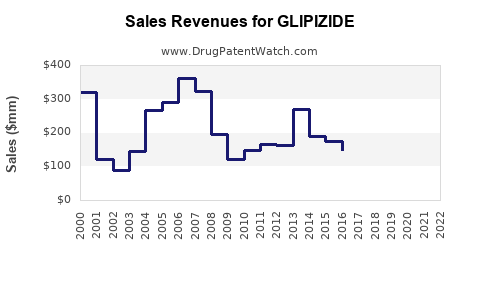
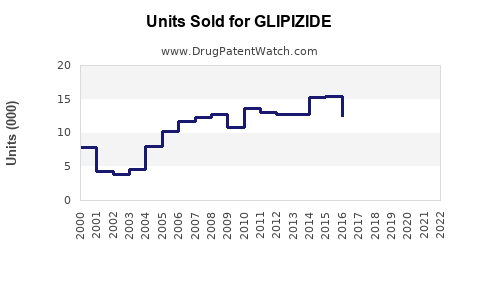
Annual Sales Revenues and Units Sold for GLIPIZIDE
| Drug Name | Revenues (USD) | Units | Year |
|---|---|---|---|
| GLIPIZIDE | ⤷ Start Trial | ⤷ Start Trial | 2022 |
| GLIPIZIDE | ⤷ Start Trial | ⤷ Start Trial | 2021 |
| GLIPIZIDE | ⤷ Start Trial | ⤷ Start Trial | 2020 |
| GLIPIZIDE | ⤷ Start Trial | ⤷ Start Trial | 2019 |
| GLIPIZIDE | ⤷ Start Trial | ⤷ Start Trial | 2018 |
| >Drug Name | >Revenues (USD) | >Units | >Year |
Glipizide Market Analysis, Sales Forecast, Patent Status, and Competitive Outlook
Glipizide is a mature, low-cost generic sulfonylurea with declining strategic importance in the U.S. diabetes market. Unit demand remains supported by affordability, broad generic availability, and use in patients who cannot access newer therapies. Revenue growth is constrained by low prices, high generic competition, limited clinical differentiation, and substitution by metformin, DPP-4 inhibitors, GLP-1 receptor agonists, and SGLT2 inhibitors.
A base-case market model projects global glipizide sales of approximately $180 million in 2025, increasing to about $190 million by 2030 at a compound annual growth rate of roughly 1%. The forecast reflects stable or modestly declining volumes offset by price increases in selected emerging markets. U.S. sales are expected to remain largely flat in value and decline gradually in prescriptions.
What is glipizide and how is it used?
Glipizide is an oral, second-generation sulfonylurea used with diet and exercise to improve glycemic control in adults with type 2 diabetes. It stimulates pancreatic beta cells to release insulin and is marketed primarily in immediate-release and extended-release tablets.
The drug is not indicated for type 1 diabetes or diabetic ketoacidosis. Its main clinical limitations are hypoglycemia and weight gain. The risk is more relevant in older adults, patients with inconsistent food intake, and patients with renal or hepatic impairment. The FDA label also identifies the possibility of secondary treatment failure as beta-cell function declines over time (U.S. Food and Drug Administration, 2023a).
Glipizide is sold under the former brand names Glucotrol and Glucotrol XL and through numerous generic products. The brand products are no longer the main commercial drivers in the U.S.
| Attribute | Glipizide |
|---|---|
| Active ingredient | Glipizide |
| Drug class | Second-generation sulfonylurea |
| Primary indication | Type 2 diabetes |
| U.S. dosage forms | Immediate-release and extended-release tablets |
| Original brand | Glucotrol |
| Extended-release brand | Glucotrol XL |
| Administration | Oral |
| Main safety concern | Hypoglycemia |
| U.S. regulatory status | Generic products approved through ANDA pathway |
| Biosimilar exposure | None |
| Current market position | Mature, low-cost generic |
How large is the glipizide market?
Glipizide is a small market relative to newer diabetes therapies. Public companies generally do not report glipizide revenue separately because the product is sold across multiple generic portfolios and represents a minor share of overall sales.
The global market is concentrated in the United States, China, India, Latin America, and selected Middle Eastern markets. U.S. revenue is limited by generic pricing, while international revenue varies according to reimbursement, local manufacturing, prescription practices, and the availability of alternative sulfonylureas.
Estimated 2025 geographic market
| Region | Estimated 2025 sales | Market characteristics |
|---|---|---|
| United States | $45 million-$65 million | High generic penetration and low prices |
| China | $40 million-$55 million | Large diabetic population and domestic manufacturing |
| India | $30 million-$45 million | Branded-generics market and high volume |
| Latin America | $20 million-$30 million | Variable reimbursement and generic use |
| Europe | $15 million-$25 million | Glipizide has limited share versus other therapies |
| Middle East and Africa | $10 million-$20 million | Price-sensitive demand and uneven access |
| Other markets | $10 million-$20 million | Fragmented distribution |
| Estimated global total | $170 million-$260 million | Low-growth mature market |
The range reflects the absence of a consolidated public revenue disclosure for all generic manufacturers. Prescription volume is more commercially meaningful than revenue because net prices are low and vary sharply across channels.
In the United States, glipizide competes in a diabetes market that includes more than 37 million people with diabetes, according to the Centers for Disease Control and Prevention (CDC, 2024). Most of the market value is concentrated in insulin, GLP-1 receptor agonists, SGLT2 inhibitors, and other branded or specialty products rather than sulfonylureas.
What are the sales projections for glipizide through 2030?
The base case assumes stable global prescription volume, modest inflationary price increases outside the United States, continued erosion in high-income markets, and sustained use in price-sensitive healthcare systems.
| Year | Base-case global sales | Low case | High case |
|---|---|---|---|
| 2024 | $175 million | $165 million | $190 million |
| 2025 | $180 million | $165 million | $200 million |
| 2026 | $182 million | $160 million | $208 million |
| 2027 | $184 million | $155 million | $215 million |
| 2028 | $186 million | $150 million | $222 million |
| 2029 | $188 million | $145 million | $230 million |
| 2030 | $190 million | $140 million | $238 million |
| 2025-2030 CAGR | 1.1% | -3.3% | 3.5% |
Base-case projection
The base case assumes:
- U.S. sales decline by approximately 1% to 3% annually in prescription-equivalent value.
- China and India provide most of the market’s volume stability.
- Emerging-market price increases partly offset volume pressure.
- No major supply disruption or regulatory withdrawal occurs.
- Generic manufacturers maintain multiple suppliers for active pharmaceutical ingredient and finished dosage forms.
Downside case
The downside case reflects faster substitution by newer therapies, declining sulfonylurea use in guideline-driven practices, tender price compression, and additional low-cost generic entrants. Under this scenario, global revenue falls to roughly $140 million by 2030.
Upside case
The upside case requires stronger demand in lower-income markets, higher diabetes prevalence, improved diagnosis, and continued use of glipizide where newer medicines remain unaffordable. It does not depend on premium pricing in the United States.
Which companies manufacture or sell glipizide?
The U.S. generic market has included manufacturers such as:
- Teva Pharmaceuticals
- Sandoz
- Lupin
- Aurobindo Pharma
- Dr. Reddy's Laboratories
- Zydus Pharmaceuticals
- Amneal Pharmaceuticals
- Rising Pharma
- AvKARE and other contract or institutional suppliers
Manufacturer participation varies by dosage strength, extended-release formulation, supply status, and national market. Generic portfolio ownership can change through product acquisitions, contract manufacturing arrangements, and distributor agreements.
Pfizer commercialized the original Glucotrol brand, but the commercial value of the originator product has been substantially displaced by generic products. Public filings from large generic companies typically aggregate glipizide within broader U.S. generics or international portfolios rather than disclose product-level revenue.
What is the FDA regulatory status of glipizide?
Glipizide is an FDA-approved small-molecule drug. Generic immediate-release and extended-release tablets are approved through abbreviated new drug applications, or ANDAs. ANDA applicants must demonstrate pharmaceutical equivalence and bioequivalence to the relevant reference product.
The FDA label covers immediate-release tablets in strengths including 5 mg and 10 mg, while extended-release products are marketed in strengths including 2.5 mg, 5 mg, and 10 mg, depending on the product and labeling version (U.S. Food and Drug Administration, 2023a; U.S. Food and Drug Administration, 2023b).
Regulatory risks are mainly operational rather than scientific. They include:
- Manufacturing inspection findings
- Product recalls
- Impurity or contamination events
- Extended-release dissolution failures
- Active pharmaceutical ingredient shortages
- Distributor or wholesaler delistings
The product has no biologic component and no biosimilar pathway exposure.
What is the Orange Book status of glipizide?
Glipizide is not protected by meaningful remaining U.S. new-drug exclusivity. The original brand exclusivity and principal composition-of-matter patent rights expired decades ago. Generic products are established in the market, and the reference-listed drug does not provide a commercially significant exclusivity barrier.
Orange Book relevance is limited to identifying reference products, dosage forms, therapeutic equivalence codes, and any product-specific patents or exclusivity entries associated with listed products. Commercial diligence should distinguish between:
- The historical Glucotrol and Glucotrol XL products.
- Current reference-listed products.
- Individual ANDA products and their manufacturing status.
- Any formulation-specific patent listing that could affect a particular generic application.
The core glipizide molecule does not have a live, commercially meaningful U.S. patent barrier.
What patents protect glipizide products?
The principal composition and original formulation patent estate has expired. Current competitive protection is more likely to arise from manufacturing know-how, supplier relationships, regulatory files, and product-specific process controls than from enforceable market-exclusivity patents.
Potential intellectual-property categories include:
| IP category | Current commercial relevance |
|---|---|
| Original composition patents | Expired |
| Original immediate-release formulation patents | Expired or commercially obsolete |
| Extended-release formulation patents | Historical protection; no broad market barrier expected |
| Manufacturing process patents | Potentially relevant to a specific process, but unlikely to block the market |
| Drug-device patents | Not material for standard tablets |
| Method-of-use patents | Limited value because type 2 diabetes use is established |
| Trade secrets | Relevant to yield, impurity control, dissolution, and scale-up |
| Regulatory exclusivity | No meaningful remaining exclusivity expected |
Because glipizide is an old generic product, patent litigation is unlikely to be a major market event. Manufacturing quality, supply continuity, and procurement economics are more important than patent enforcement.
Are there Paragraph IV challenges involving glipizide?
Paragraph IV litigation risk is low. Paragraph IV certifications are most relevant when an ANDA applicant challenges an unexpired Orange Book-listed patent. For the core glipizide market, the important patents associated with the original drug have expired, and the product is already subject to broad generic competition.
A new Paragraph IV dispute could arise only around a particular listed extended-release formulation, manufacturing method, or later-developed product. Such a dispute would normally affect a specific ANDA sponsor rather than the entire glipizide market.
The expected commercial consequence of a new Paragraph IV filing would be limited unless it involved a high-volume reference product with few approved suppliers. That is not the prevailing structure of the standard glipizide market.
What formulations are protected or commercially differentiated?
The main formulation distinction is between immediate-release and extended-release tablets.
Immediate-release glipizide
Immediate-release tablets are typically administered before meals and allow dose adjustment based on meal timing and glycemic response. They compete primarily on price, availability, and pharmacy substitution.
Extended-release glipizide
Extended-release tablets allow once-daily administration and may improve convenience. The formulation has greater technical complexity because dissolution performance must remain consistent across manufacturing lots. That complexity creates a manufacturing barrier, but not a durable market monopoly.
Formulation-level commercial opportunities include:
- Low-cost extended-release tablets
- Regional branded generics
- Contract manufacturing for public-sector tenders
- Fixed-dose combinations in countries where approved
- Packaging optimized for chronic-use adherence
- Institutional and government procurement products
The commercial ceiling remains low because therapeutic differentiation is modest and payers generally treat glipizide as a low-cost generic.
How does glipizide compare with competing diabetes drugs?
| Drug or class | Relative market position | Price level | Main advantage over glipizide | Main disadvantage |
|---|---|---|---|---|
| Metformin | First-line generic | Very low | Strong guideline position and broad experience | Gastrointestinal intolerance |
| Glimepiride | Competing sulfonylurea | Low | Once-daily dosing and broad use | Hypoglycemia and weight gain |
| Gliclazide | Important outside the U.S. | Low to moderate | Common international use and modified-release products | Limited U.S. presence |
| DPP-4 inhibitors | Established branded/generic class | Moderate | Lower hypoglycemia risk and weight neutrality | Higher cost |
| SGLT2 inhibitors | Fast-growing branded/generic class | Moderate to high | Cardiovascular and renal benefits | Cost and tolerability considerations |
| GLP-1 receptor agonists | High-value branded class | High | Weight loss and strong glucose lowering | Cost, administration, and supply constraints |
| Insulin | Essential for advanced disease | Variable | Potent glucose lowering | Hypoglycemia, administration burden |
The American Diabetes Association places greater emphasis on treatment selection based on cardiovascular, renal, weight, hypoglycemia, cost, and patient-preference factors than on sulfonylurea use alone (American Diabetes Association Professional Practice Committee, 2024). This shifts market value toward newer therapies even when glipizide remains clinically useful.
What generic entry risks exist for glipizide?
Traditional generic-entry risk is already substantially realized. The market has multiple suppliers, limited brand loyalty, and low switching costs. Future competitive risk will come from additional entrants or supplier consolidation rather than the first generic launch.
The main risks are:
- Further price erosion in institutional and retail channels
- Loss of formulary position to glimepiride or metformin
- Substitution by newer therapies as insurance coverage expands
- Reduced prescribing among older patients at high hypoglycemia risk
- Supply interruptions from a small number of active-ingredient suppliers
- Declining use in guideline-driven practices
The most defensible commercial position is a low-cost, reliable supply platform rather than a premium branded product.
What licensing deals and commercial partnerships affect glipizide?
No major recent licensing transaction appears to define the global glipizide market. Commercial arrangements are more likely to involve:
- Contract manufacturing
- Authorized generic distribution
- Regional marketing agreements
- Government and hospital procurement contracts
- API supply agreements
- Private-label pharmacy supply
The absence of a major licensing catalyst limits the prospect of a sharp revenue increase. Any transaction involving glipizide would be evaluated primarily on manufacturing cost, regulatory approvals, geographic reach, and supply reliability.
What patent litigation affects glipizide?
Glipizide does not have a material active patent-litigation profile comparable with newer diabetes products. Litigation exposure is more likely to involve:
- Product liability
- Manufacturing defects
- Labeling and failure-to-warn claims
- Contract disputes
- Antitrust or pricing allegations involving generic supply
- Regulatory enforcement related to manufacturing quality
Patent litigation is unlikely to change the overall market structure. A dispute involving one extended-release product could affect a particular supplier but would not be expected to restore originator exclusivity.
What is the commercial outlook for glipizide?
Glipizide is a defensive generic asset rather than a growth product. Its value rests on recurring demand, simple oral administration, low production cost, and continued use in price-sensitive markets.
A manufacturer can improve returns through:
- High-volume API procurement.
- Multi-market regulatory approvals.
- Reliable extended-release manufacturing.
- Government and institutional tenders.
- Portfolio bundling with metformin and other diabetes generics.
- Reduced supply interruptions.
- Regional branded-generic distribution.
Premium pricing, new-drug exclusivity, and U.S. market expansion are unlikely to drive material upside.
Key Takeaways
- Estimated global glipizide sales are approximately $180 million in 2025.
- Base-case revenue reaches about $190 million by 2030, implying roughly 1% annual growth.
- The U.S. market is mature, highly genericized, and likely to decline modestly in prescription value.
- China, India, Latin America, and other price-sensitive markets provide the strongest volume support.
- Original composition and formulation patent protection has expired.
- Paragraph IV and patent-litigation risk is low.
- No biosimilar risk exists because glipizide is a small-molecule drug.
- Extended-release manufacturing and supply reliability are the principal operational barriers.
- Metformin, glimepiride, newer oral agents, SGLT2 inhibitors, and GLP-1 receptor agonists constrain long-term demand.
- Glipizide is commercially attractive as a low-cost, high-volume generic but has limited potential for premium growth.
FAQs
Is glipizide still profitable for generic manufacturers?
Yes, but profitability depends on manufacturing scale, API cost, supply reliability, and procurement access. Margin expansion from pricing is unlikely.
Will glipizide sales increase as diabetes prevalence rises?
Higher prevalence supports unit demand, particularly in emerging markets. In high-income markets, newer therapies may capture much of the incremental spending.
Does glipizide have any remaining market exclusivity?
No meaningful broad U.S. exclusivity remains for the core immediate-release or extended-release product market.
Can a new glipizide formulation command premium pricing?
Only to a limited extent. Extended-release and adherence-oriented products may support modest differentiation, but they face generic substitution and payer price controls.
Is glipizide a target for pharmaceutical licensing or acquisition?
It may be included in a broader generic diabetes portfolio, but glipizide alone is unlikely to support a large strategic transaction. The primary value drivers are manufacturing efficiency, geographic approvals, and distribution scale.
References
-
American Diabetes Association Professional Practice Committee. (2024). 9. Pharmacologic approaches to glycemic treatment: Standards of care in diabetes-2024. Diabetes Care, 47(Supplement 1), S158-S178. https://doi.org/10.2337/dc24-S009
-
Centers for Disease Control and Prevention. (2024). National diabetes statistics report. U.S. Department of Health and Human Services. https://www.cdc.gov/diabetes/data/statistics-report/
-
U.S. Food and Drug Administration. (2023a). Glipizide extended-release tablets prescribing information. FDA.
-
U.S. Food and Drug Administration. (2023b). Glipizide tablets prescribing information. FDA.
-
U.S. Food and Drug Administration. (2024). Approved drug products with therapeutic equivalence evaluations. FDA.
More… ↓
