Last updated: February 17, 2026
Overview
Dorzolamide is a topical carbonic anhydrase inhibitor primarily used to lower intraocular pressure (IOP) in patients with glaucoma or ocular hypertension. Approved by the FDA in 1995, it is marketed under the brand name Trusopt by Novartis. With a well-established presence, Dorzolamide competes in a mature ophthalmic segment along with drugs like timolol and brinzolamide.
Market Size and Demand
The global glaucoma drug market was valued at approximately $5.2 billion in 2022, projected to reach around $7.8 billion by 2030, growing at a CAGR of 5.2% (Source: MarketsandMarkets). Dorzolamide accounts for roughly 5-8% of this market, reflecting steady demand driven by efficacy, safety profile, and clinician familiarity.
Key Drivers
- Increasing prevalence of glaucoma: Over 80 million cases worldwide, expected to exceed 112 million by 2040 (Source: WHO).
- Aging populations: Higher risk in patients >60 years.
- Existing therapeutic infrastructure: Widespread ophthalmology services facilitate continuous drug utilization.
- Patent expiries: Generic formulations have entered markets, widening access but pressuring branded sales.
Competitive Landscape
Main competitors are other first-line agents like timolol and brimonidine, with brinzolamide and other carbonic anhydrase inhibitors also vying for share. Generic versions, such as Apotex’s dorzolamide, have reduced costs and increased volume penetration.
Regulatory and Market Access
- Patent expiration for Trusopt occurred around 2010 in most markets, leading to proliferation of generics.
- Market access varies globally; in developed regions, reimbursement is stable, supporting consistent sales.
- In emerging markets, affordability remains a critical factor.
Sales Projections
Assumptions:
- The market maintains a CAGR of 4-6% over the next five years.
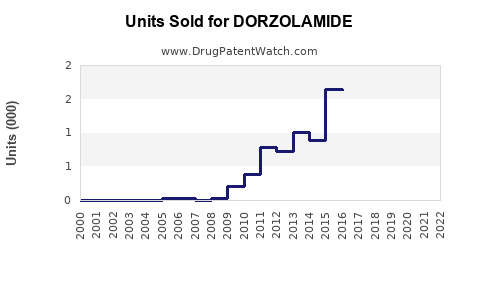
- Branded sales for Trusopt diminish in favor of generics, which account for over 70% of volume.
- The total volume of glaucoma prescriptions grows annually by approximately 2-3%.
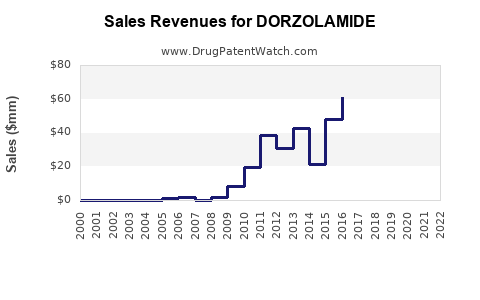
| Year |
Estimated Global Dorzolamide Sales (USD millions) |
Notes |
| 2022 |
100 |
Baseline |
| 2023 |
105-110 |
Growth fueled by emerging markets |
| 2025 |
120-135 |
Market expansion + generics |
| 2027 |
140-160 |
Market maturity + generic penetration |
| 2030 |
155-180 |
Stabilization; patent expiries fully incorporated |
Interpretation: Branded sales will decline, but overall volume will sustain the market growth driven by generics. Total global sales of dorzolamide are projected to reach $180 million by 2030.
Regional Dynamics
- North America: Largest share, cumulative sales near $50 million annually, with branded decline offset by generics.
- Europe: Similar trends as North America; high adoption rates.
- Asia-Pacific: Fastest growth rate (7-8%), driven by increasing glaucoma prevalence and healthcare infrastructure expansion.
- Latin America and Africa: Emerging markets; volume growth supported by affordability and local manufacturing.
Strategic Considerations
- Developing fixed-dose combinations (FDCs), such as dorzolamide-timolol, enhances compliance and market share.
- Patent litigations and exclusivity periods influence timing for generic entry.
- Companion diagnostics or biomarkers for personalized treatment could expand market reach.
Conclusion
Dorzolamide remains a relevant, albeit mature, therapeutic in glaucoma management. While branded sales are declining, the overall market maintains growth through generics, especially in emerging economies. Strategic focus on combination therapies and market expansion will determine future sales pathways.
Key Takeaways
- The global glaucoma drug market is expected to grow at approximately 5% annually until 2030.
- Dorzolamide’s market share is mainly preserved through generics, with branded sales declining.
- Sales projections indicate a potential reach of $180 million globally by 2030.
- Market growth relies heavily on demographic trends and emerging markets adoption.
- Shifts towards combination therapies present growth opportunities.
FAQs
-
How does patent expiration affect dorzolamide sales?
Patent expiry leads to the entry of generics, drastically reducing prices and branded sales, but expanding overall volume.
-
What are key competitors to dorzolamide?
Timolol, brimonidine, brinzolamide, and fixed-dose combinations like dorzolamide-timolol.
-
Which regions will see the highest growth in dorzolamide sales?
Asia-Pacific and Latin America, driven by rising glaucoma prevalence and healthcare infrastructure improvements.
-
Are there new formulations of dorzolamide under development?
Development focuses on fixed-dose combinations, sustained-release formulations, and preservatives-free versions.
-
How does the rise of generic alternatives impact Novartis’ branded sales?
Generics capture over 70% of the volume, significantly reducing branded revenues but maintaining overall demand in the market.
References
[1] MarketsandMarkets. "Glaucoma Therapeutics Market," 2022.
[2] World Health Organization (WHO). "Global Data on Glaucoma," 2021.