Share This Page
Drug Sales Trends for DESONIDE
✉ Email this page to a colleague
Payment Methods and Pharmacy Types for DESONIDE (2001)
Revenues by Pharmacy Type
Units Sold by Pharmacy Type
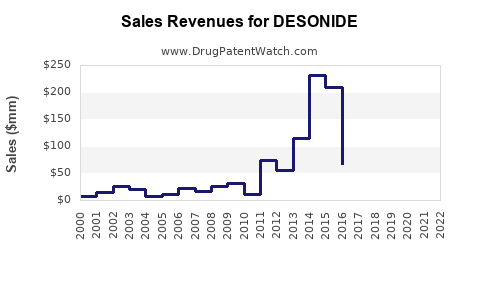
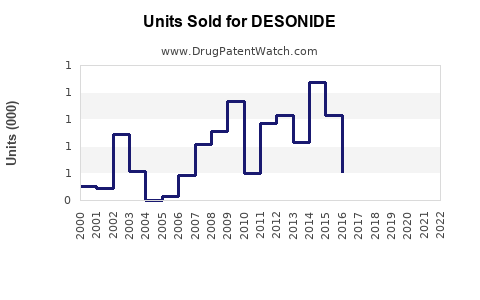
Annual Sales Revenues and Units Sold for DESONIDE
| Drug Name | Revenues (USD) | Units | Year |
|---|---|---|---|
| DESONIDE | ⤷ Start Trial | ⤷ Start Trial | 2022 |
| DESONIDE | ⤷ Start Trial | ⤷ Start Trial | 2021 |
| DESONIDE | ⤷ Start Trial | ⤷ Start Trial | 2020 |
| DESONIDE | ⤷ Start Trial | ⤷ Start Trial | 2019 |
| >Drug Name | >Revenues (USD) | >Units | >Year |
Desonide Market Analysis and Sales Projections: Generic Topical Corticosteroid Outlook
Desonide is a mature, low-potency topical corticosteroid with broad generic availability and limited commercial differentiation. Market value is concentrated in topical formulations, particularly 0.05% cream, ointment, lotion, gel and foam. The U.S. market has low patent risk, limited branded pricing power and stable demand from dermatology, primary care and pediatric prescribing.
A reasonable base-case forecast is for low-single-digit annual value growth through 2029, driven by prescription volume, inflation, formulation mix and continued demand for steroid-sparing treatment alternatives. Unit growth is likely to remain flat to modestly positive. The highest-value segment is desonide foam, while conventional cream, ointment and lotion products remain price-sensitive generic markets.
What is desonide and how is it used?
Desonide is a low-potency topical corticosteroid used to reduce inflammation and itching associated with corticosteroid-responsive dermatoses. FDA-approved topical uses include atopic dermatitis and other inflammatory or pruritic skin conditions, depending on the formulation label.
Desonide is commonly prescribed for:
- Atopic dermatitis and eczema
- Seborrheic dermatitis
- Allergic and irritant contact dermatitis
- Psoriasis in sensitive or thin-skin areas
- Pediatric inflammatory skin disease
- Facial and intertriginous dermatitis, when clinically appropriate
The product is generally positioned below medium- and high-potency corticosteroids because it has lower anti-inflammatory potency and is often selected for sensitive skin areas or younger patients.
Key desonide dosage forms
| Formulation | Typical strength | Commercial role |
|---|---|---|
| Cream | 0.05% | Largest and most commoditized segment |
| Ointment | 0.05% | Sensitive or dry skin; smaller volume |
| Lotion | 0.05% | Scalp, hairy areas and broader application |
| Gel | 0.05% | Niche formulation |
| Foam | 0.05% | Higher-value, differentiated delivery format |
The commercial market is driven more by formulation and channel than by molecular innovation. Desonide foam can command a higher price than generic cream or ointment because of convenience, cosmetic acceptability and packaging technology.
How large is the desonide market?
Public companies generally do not report desonide sales as a separate product line. Desonide is usually included within broader dermatology, topical corticosteroid or generic prescription portfolios. A precise global revenue figure therefore cannot be established from public manufacturer filings alone.
The market can be divided into four commercial segments:
- U.S. generic prescriptions for cream, ointment and lotion.
- U.S. branded or authorized-generic foam products.
- International prescription and pharmacy markets.
- Institutional, dermatology and specialty-distribution channels.
The U.S. is likely the most commercially important single market because of prescription volume, reimbursement data availability and the historical presence of branded products such as DesOwen and Verdeso. The active ingredient itself is mature and widely available outside the United States.
Estimated market structure
| Segment | Approximate share of market value | Margin profile | Competitive intensity |
|---|---|---|---|
| Generic cream and ointment | 40%-55% | Low | Very high |
| Generic lotion and gel | 10%-20% | Low to moderate | High |
| Foam products | 25%-40% | Moderate to high | Moderate |
| International and other formats | 10%-20% | Variable | High |
These ranges are analytical estimates based on dosage-form economics and generic-market structure rather than reported audited sales.
What are the desonide sales projections through 2029?
The following forecast uses a normalized 2024 market value index of 100 because public filings do not isolate global desonide revenue. The forecast reflects mature prescription demand, generic price erosion and modest formulation-mix improvement.
Base-case market forecast
| Year | Market value index | Year-over-year growth | Primary driver |
|---|---|---|---|
| 2024 | 100.0 | - | Baseline |
| 2025 | 101.5 | 1.5% | Prescription stability and price increases |
| 2026 | 103.2 | 1.7% | Foam mix and moderate volume growth |
| 2027 | 105.0 | 1.7% | Stable dermatology demand |
| 2028 | 106.8 | 1.7% | Inflation and formulation retention |
| 2029 | 108.7 | 1.8% | Incremental demand and price normalization |
Scenario analysis
| Scenario | 2024-2029 CAGR | 2029 value versus 2024 | Assumptions |
|---|---|---|---|
| Bear case | -2% to 0% | 90-100 | Accelerated generic price erosion, lower branded foam use |
| Base case | 1%-2% | 105-110 | Stable volume, modest price increases and foam resilience |
| Bull case | 3%-5% | 116-128 | Stronger foam adoption, pediatric demand and improved reimbursement |
The base case is a mature-market forecast, not a high-growth pharmaceutical opportunity. Desonide is more attractive as a dependable generic portfolio product than as a standalone growth asset.
U.S. revenue exposure
A company with a differentiated desonide foam product could generate materially higher revenue per prescription than manufacturers selling conventional generic cream. However, the commercial ceiling remains constrained by:
- Availability of multiple low-cost alternatives
- Substitution by other low-potency corticosteroids
- Payer controls
- Limited prescriber switching
- Low treatment duration for many dermatitis episodes
- Absence of meaningful exclusivity
Conventional desonide generic products should be modeled as high-volume, low-margin assets. Foam products should be modeled as lower-volume, higher-revenue assets with greater reimbursement and substitution risk.
Which companies market desonide products?
Desonide has been marketed by multiple branded and generic manufacturers over time. The relevant competitive groups include:
- Legacy branded product owners associated with DesOwen
- Manufacturers of generic desonide cream, ointment, lotion and gel
- Developers and marketers of desonide foam
- Contract manufacturers and private-label dermatology suppliers
The U.S. market has included companies such as Galderma, Perrigo, Taro Pharmaceutical Industries, Fougera, G&W Laboratories and other generic or dermatology-focused manufacturers. Product ownership and distribution arrangements can change through divestitures, licensing transactions and authorized-generic agreements.
A commercial diligence review should separate:
- Product owner
- NDA or ANDA holder
- Labeler
- Contract manufacturer
- Wholesale distributor
- Pharmacy benefit manager channel
These entities are not always the same.
What is the FDA regulatory status of desonide?
Desonide is an established FDA-approved topical corticosteroid active ingredient. Multiple dosage forms have received FDA approval through both legacy NDA pathways and generic ANDA pathways.
FDA regulatory characteristics
| Regulatory issue | Desonide status |
|---|---|
| Active ingredient | Established topical corticosteroid |
| FDA pathway | Legacy NDA and ANDA products |
| Prescription status | Primarily prescription topical products |
| Reference products | Desonide cream, ointment, lotion and foam products |
| Generic availability | Broad |
| New chemical entity exclusivity | Expired |
| Current commercial barrier | Formulation, manufacturing and distribution execution |
The main regulatory work for a new entrant involves demonstrating pharmaceutical equivalence, bioequivalence or comparative performance, product quality and manufacturing compliance. Topical products can present complex equivalence issues because approval may depend on formulation composition, rheology, particle characteristics, preservative systems, container closure and in vitro release performance.
What patents protect desonide products?
The desonide molecule is long off-patent. Core composition-of-matter protection does not create a meaningful barrier to generic entry.
Potentially relevant patent categories include:
- Foam formulation patents
- Propellant and aerosol-delivery patents
- Emulsion and vehicle patents
- Container-closure and dispensing systems
- Manufacturing-process patents
- Method-of-use patents
- Packaging and dosing systems
For conventional desonide cream, ointment and lotion, patent protection is commercially weak because the products have been marketed for decades and multiple generic versions exist.
Patent estate assessment
| Patent category | Commercial relevance |
|---|---|
| Desonide compound patent | Expired |
| Basic cream or ointment formulation | Generally expired or non-blocking |
| Foam delivery technology | Potentially relevant, but aged and formulation-specific |
| Manufacturing process | May create operational barriers without blocking all alternatives |
| Method of use | Limited value unless tied to a narrow, enforceable indication |
| Packaging and device claims | Relevant only to specific product configurations |
A current Orange Book review should be performed for the specific reference-listed product and NDA. Product-level patent listings can differ by formulation and may not apply to all desonide products.
What is the Orange Book status of desonide?
Desonide is not expected to have a meaningful active Orange Book barrier for standard generic cream, ointment, lotion or gel products. The commercial market has already experienced broad generic entry, which indicates that basic desonide products are not protected by enforceable exclusivity that prevents competition.
The principal diligence questions are product-specific:
- Whether a particular NDA has listed patents
- Whether those patents remain unexpired
- Whether the patent claims cover the proposed generic formulation
- Whether a listed patent is eligible for a Paragraph IV challenge
- Whether any regulatory exclusivity remains attached to a specific product
For a new ANDA, the relevant risk is generally formulation equivalence and approval timing rather than molecule-level patent enforcement.
When did desonide lose exclusivity?
Desonide lost meaningful molecule-level exclusivity many years ago. The active ingredient is now a generic dermatology product with multiple suppliers.
Legacy exclusivity has no material effect on current standard-formulation entry. Any remaining commercial protection would have to arise from a product-specific formulation, device, manufacturing or regulatory feature rather than from desonide itself.
Exclusivity timeline
| Exclusivity type | Current position |
|---|---|
| Compound patent | Expired |
| New chemical entity exclusivity | Expired |
| Standard formulation exclusivity | Expired |
| Generic entry | Established |
| Foam-specific protection | Requires product-level review |
| Pediatric exclusivity | No general current barrier expected |
Are there Paragraph IV challenges to desonide?
Paragraph IV risk is most relevant to a generic applicant targeting a still-listed patent associated with a branded formulation, particularly foam. Standard desonide cream and ointment products have already undergone extensive generic competition, so a new Paragraph IV event would be more likely to involve a specific formulation or delivery system than the active ingredient.
A new entrant could pursue:
- Paragraph IV certification against an unexpired listed formulation patent
- Paragraph III certification if the patent expires before approval
- Section viii statement for non-patented indications
- ANDA approval based on an established formulation with no blocking patent
The key litigation risk is claim scope. A patent covering a particular foam vehicle or aerosol system may not prevent approval of a conventional cream, lotion or ointment.
What patent litigation and settlements affect desonide?
No broad, molecule-level desonide patent litigation is a central market feature. Any relevant disputes are more likely to concern branded foam products, formulation technology, manufacturing methods or product-specific ANDA certifications.
Settlement agreements, if present, must be analyzed for:
- Generic launch date
- Authorized-generic rights
- Royalty obligations
- Supply restrictions
- Non-compete provisions
- Formulation limitations
- Patent-license scope
- Acceleration clauses tied to patent invalidity
Because the market is highly genericized, litigation risk is unlikely to support a durable monopoly for conventional desonide products.
What formulations are protected by desonide patents?
The highest-value potential protection is associated with foam and other cosmetically differentiated formulations. A formulation patent may claim:
- Specific oil and water phases
- Surfactant systems
- Alcohol content
- Propellant composition
- Foam stability
- Viscosity or spreadability
- Preservation system
- Dermal penetration characteristics
- Container and actuator configuration
A formulation patent does not automatically block all desonide products. Its commercial value depends on whether competing applicants can design around the claims while maintaining acceptable clinical performance and FDA equivalence.
Manufacturing and intellectual-property barriers
Desonide manufacturing barriers are moderate for conventional semisolid products and higher for foam products. Key technical risks include:
- Batch-to-batch consistency
- Particle-size control
- Emulsion stability
- Preservative performance
- Microbial limits
- Foam expansion and collapse behavior
- Valve and actuator reliability
- In vitro release performance
- Container compatibility
These barriers may delay entry or increase development costs but generally do not create molecule-level exclusivity.
How does desonide compare with competing topical corticosteroids?
Desonide competes in the low-potency topical corticosteroid segment, especially where clinicians want lower steroid exposure or treatment of sensitive areas.
| Drug | Relative potency | Common commercial role | Competitive position |
|---|---|---|---|
| Hydrocortisone | Low | First-line OTC and prescription therapy | Strong price competitor |
| Desonide | Low | Prescription eczema and sensitive-area therapy | Established, generic |
| Alclometasone | Low to moderate | Alternative prescription steroid | Narrower competition |
| Fluocinolone acetonide | Low to moderate | Scalp and body inflammatory disease | Formulation-dependent |
| Triamcinolone acetonide | Medium | Broad dermatology use | Major potency-based substitute |
| Tacrolimus and pimecrolimus | Nonsteroidal | Steroid-sparing therapy | Higher-cost clinical alternative |
Desonide's main competitive advantage is its established low-potency profile and availability in multiple topical vehicles. Its main weakness is limited pricing power.
What generic launch risks exist for desonide?
Generic launch risk is low for standard dosage forms and moderate for foam or technically complex delivery systems.
Standard cream, ointment and lotion
The principal risks are commercial:
- Rapid price compression
- Pharmacy substitution
- Limited formulary preference
- Low gross margin
- High number of approved suppliers
- Difficulty securing attractive distribution contracts
Foam products
Foam products have greater technical and commercial risk:
- More complex manufacturing
- Higher packaging costs
- Potential device-related failure
- Reimbursement variability
- Brand loyalty based on vehicle characteristics
- Formulation patent review
- Greater risk of product-specific litigation
An entrant with an efficient semisolid manufacturing platform and established dermatology distribution can treat desonide as a portfolio extension. A standalone launch would have weaker economics.
What licensing deals and commercial partnerships matter?
Licensing value is likely to reside in formulation technology, manufacturing capacity and channel access rather than in the desonide molecule. The most commercially relevant transaction structures include:
- In-licensing of topical foam technology
- Contract manufacturing agreements
- Authorized-generic arrangements
- Private-label supply agreements
- Regional commercialization licenses
- Dermatology portfolio acquisitions
- Co-development of semisolid or aerosol delivery systems
A licensing transaction should be valued against net sales after rebates, returns, wholesaler discounts and payer concessions. Gross list price is a poor measure of desonide economics because generic discounts can be substantial.
How strong is the desonide patent estate?
The desonide patent estate is weak for conventional products and potentially moderate for selected foam formulations.
| Asset type | Patent strength | Market implication |
|---|---|---|
| Active ingredient | Very weak | No molecule-level barrier |
| Cream and ointment | Weak | Commodity competition |
| Lotion and gel | Weak to moderate | Some formulation differentiation |
| Foam | Moderate, product-specific | Possible temporary protection |
| Manufacturing process | Moderate | May increase switching costs |
| Device and packaging | Moderate | Narrow claim scope |
Patent strength should be evaluated by claim breadth, remaining term, design-around options, formulation equivalence requirements and the number of competing approved products.
What is the commercial outlook for desonide?
Desonide is a stable but low-growth dermatology product. The strongest commercial opportunities are:
- High-quality generic supply
- Contract manufacturing
- Differentiated foam or lotion products
- Pediatric dermatology distribution
- International markets with limited generic availability
- Portfolio bundling with other topical dermatology products
The weakest opportunities are conventional cream or ointment launches without a cost advantage, supply advantage or established payer access.
Revenue should be modeled using net realized price rather than published wholesale acquisition cost. A base-case investment model should assume:
- Flat to modest prescription growth
- Continued generic price erosion
- Higher revenue contribution from foam
- Low probability of molecule-level litigation
- Moderate manufacturing complexity for foam
- Limited regulatory exclusivity
- High substitution pressure from hydrocortisone and other topical steroids
Key Takeaways
- Desonide is a mature, low-potency topical corticosteroid with broad generic availability.
- Standard cream, ointment and lotion products are low-margin commodity markets.
- Foam is the most commercially differentiated formulation and the main source of potential pricing power.
- Molecule-level patent and regulatory exclusivity have expired.
- Current patent risk is formulation-specific, particularly for foam and aerosol delivery systems.
- Base-case market value growth through 2029 is approximately 1%-2% annually.
- Unit demand should remain stable, with modest growth possible in pediatric and chronic dermatology use.
- Conventional generic entry has low legal risk but high price and distribution risk.
- Licensing value is concentrated in formulation technology, manufacturing and channel access.
- Desonide is better suited to a broader dermatology portfolio than to a standalone branded investment.
FAQs
Is desonide still profitable for generic manufacturers?
Yes, but profitability depends on manufacturing cost, supply reliability, scale and distribution access. Standard cream and ointment products generally have lower margins than foam products.
Is desonide stronger than hydrocortisone?
Desonide is generally considered a low-potency prescription corticosteroid. Its clinical potency is higher than over-the-counter hydrocortisone in many treatment contexts, but comparative activity depends on formulation, concentration, disease site and duration of use.
Can a company launch a new desonide cream without licensing a brand?
A company can generally pursue an ANDA for an approved generic reference product without licensing the legacy brand, subject to FDA requirements and any applicable product-specific patent certifications.
Does desonide have biosimilar competition?
No. Desonide is a small-molecule topical corticosteroid, not a biologic. Competition occurs through generic drug approval pathways rather than biosimilar approval.
What is the most attractive desonide product format?
Desonide foam offers the strongest potential for differentiation and higher net pricing. Cream and ointment offer larger, more established markets but face greater generic substitution and price erosion.
References
-
U.S. Food and Drug Administration. (n.d.). Drugs@FDA: FDA-approved drugs database. https://www.accessdata.fda.gov/scripts/cder/daf/
-
U.S. Food and Drug Administration. (n.d.). Approved drug products with therapeutic equivalence evaluations, Orange Book. https://www.accessdata.fda.gov/scripts/cder/ob/
-
U.S. Food and Drug Administration. (n.d.). Electronic Orange Book patent and exclusivity information. https://www.accessdata.fda.gov/scripts/cder/ob/
-
U.S. Food and Drug Administration. (n.d.). Inactive ingredient database. https://www.accessdata.fda.gov/scripts/cder/iig/
-
U.S. National Library of Medicine. (n.d.). DailyMed: Desonide product labeling. https://dailymed.nlm.nih.gov/dailymed/
-
U.S. Food and Drug Administration. (2016). ANDA submissions: Product-specific guidances for industry. https://www.fda.gov/drugs/abbreviated-new-drug-application-anda/anda-guidance-documents
-
U.S. Food and Drug Administration. (2022). Generic drug user fee amendments: Product-specific guidances. https://www.fda.gov/drugs/guidance-compliance-regulatory-information/guidances-drugs
More… ↓
