Drug Sales Trends for lidocaine
Payment Methods and Pharmacy Types for lidocaine (2000)
Revenues by Pharmacy Type
Units Sold by Pharmacy Type
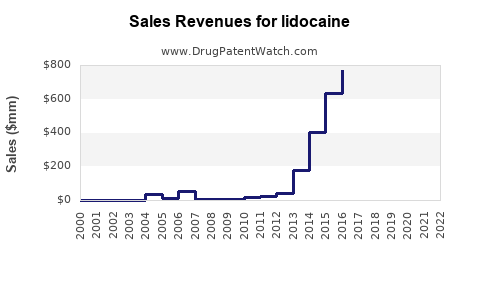
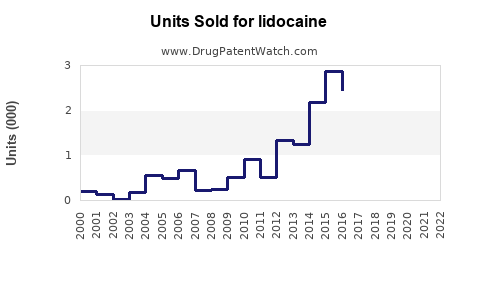
Annual Sales Revenues and Units Sold for lidocaine
| Drug Name | Revenues (USD) | Units | Year |
|---|---|---|---|
| LIDOCAINE | ⤷ Start Trial | ⤷ Start Trial | 2022 |
| LIDOCAINE | ⤷ Start Trial | ⤷ Start Trial | 2021 |
| LIDOCAINE | ⤷ Start Trial | ⤷ Start Trial | 2020 |
| LIDOCAINE | ⤷ Start Trial | ⤷ Start Trial | 2019 |
| LIDOCAINE | ⤷ Start Trial | ⤷ Start Trial | 2018 |
| >Drug Name | >Revenues (USD) | >Units | >Year |
Lidocaine Market Analysis, Sales Projections, Patent Status, and Competitive Landscape
Lidocaine is a mature, multi-indication local anesthetic with broad use in injectable, topical, dental, ophthalmic, otic, transdermal, and antiarrhythmic products. The active ingredient has no meaningful composition-of-matter exclusivity in major markets. Commercial value is distributed across many generic manufacturers, branded delivery systems, hospital suppliers, dental distributors, and over-the-counter consumer-health companies.
Global lidocaine product revenue is commonly estimated at approximately $1.3 billion to $1.7 billion in 2023-2024, depending on whether hospital-use injectable products, compounded products, consumer topical products, and combination products are included. A base-case forecast places the market near $2.0 billion to $2.4 billion by 2030, representing an estimated compound annual growth rate of roughly 5% to 7%. These figures are directional because no public company reports lidocaine revenue as a fully consolidated global category.
What is lidocaine used for and which product segments generate the most revenue?
Lidocaine is a sodium-channel blocker used to produce local or regional anesthesia and, in selected injectable formulations, to treat ventricular arrhythmias. Its commercial applications fall into five principal segments:
| Segment | Representative products | Primary customers | Commercial profile |
|---|---|---|---|
| Injectable anesthesia | Lidocaine hydrochloride injection, preservative-free and multi-dose vials | Hospitals, ambulatory surgery centers, emergency departments | High-volume, low unit price |
| Topical prescription products | Lidocaine 5% patch, creams, ointments, gels, sprays | Physicians, pharmacies, pain patients | Higher price per treatment, generic competition |
| OTC topical products | 2%, 4%, 5%, and 10% creams, sprays, gels, and patches | Consumers, retailers, e-commerce channels | Strong brand and distribution effects |
| Dental products | Injectable cartridges, gels, topical anesthetics | Dentists and dental distributors | Stable recurring demand |
| Specialty delivery systems | Metered sprays, viscous oral solutions, compounded and procedure-specific products | Hospitals, specialists, pharmacies | Product-specific differentiation |
Injectable lidocaine is generally the largest unit-volume segment. Topical and transdermal products generate greater revenue per unit because they include branded packaging, delivery systems, consumer marketing, and prescription reimbursement. Dental use is highly recurring but fragmented across manufacturers and distributors.
The FDA-approved indications include local or regional anesthesia and, for certain injectable products, ventricular arrhythmias. Product labeling differs substantially by concentration, route, preservative status, dosage form, and intended population (FDA, n.d.-a).
How large is the global lidocaine market?
Published market estimates vary because market researchers use different inclusion criteria. Some count only pharmaceutical products, while others include OTC topical products, medical devices containing lidocaine, compounded preparations, and combination products.
| Market measure | Directional estimate |
|---|---|
| Global market, 2023-2024 | $1.3 billion-$1.7 billion |
| Expected global market, 2030 | $2.0 billion-$2.4 billion |
| Implied annual growth | Approximately 5%-7% |
| North American share | Approximately 35%-45% |
| Injectable and procedural share | Approximately 40%-50% |
| Topical and transdermal share | Approximately 35%-45% |
| Dental and other uses | Approximately 10%-20% |
North America is the most commercially developed region because it combines high procedural volumes, extensive OTC distribution, and broad prescription use. Europe has a large hospital and dental market, while Asia-Pacific is the fastest-growing region due to rising healthcare access, increasing procedural activity, and expansion of consumer-health distribution.
Growth is constrained by generic pricing, low manufacturing barriers for standard formulations, hospital purchasing pressure, and substitution by other local anesthetics such as bupivacaine, ropivacaine, mepivacaine, prilocaine, and articaine.
What are the sales projections for lidocaine through 2030?
A scenario-based forecast is more useful than a single market number because lidocaine revenue depends heavily on formulation and channel mix.
| Scenario | 2024 estimated market | 2030 projected market | CAGR | Principal assumptions |
|---|---|---|---|---|
| Low | $1.3 billion | $1.7 billion | 4.5% | Strong generic erosion and limited volume expansion |
| Base | $1.5 billion | $2.1 billion | 5.8% | Stable procedures, moderate OTC growth, improved Asia-Pacific access |
| High | $1.7 billion | $2.5 billion | 6.7% | Higher procedural volumes, premium delivery systems, strong consumer demand |
The most attractive growth pools are likely to be:
- Topical products with differentiated delivery or longer wear time.
- Prescription patches and creams with improved adhesion, tolerability, or dosing convenience.
- Dental cartridges and procedure-specific formulations.
- Preservative-free injectable products for hospitals and specialty procedures.
- Combination products that pair lidocaine with antiseptics, corticosteroids, anti-inflammatory agents, or other anesthetics.
- Consumer products sold through pharmacy, mass retail, and online channels.
Standard injectable vials are likely to grow primarily through volume rather than price. Their revenue outlook is exposed to hospital tenders, shortages, manufacturing interruptions, and contract-pricing pressure.
Which companies compete in the lidocaine market?
Competition is fragmented. No single manufacturer controls the global lidocaine category across all dosage forms.
Major participants include:
- Fresenius Kabi
- Pfizer and Hospira
- Hikma Pharmaceuticals
- Sagent Pharmaceuticals
- Eugia Pharma Specialties
- Teva Pharmaceutical Industries
- Endo Pharmaceuticals
- Zydus Lifesciences
- Novartis, through selected legacy and regional products
- Viatris and legacy Mylan businesses
- Taro Pharmaceutical Industries
- Hisamitsu Pharmaceutical
- Teikoku Seiyaku
- Galderma and other consumer-health companies
- Dental suppliers such as Septodont and Dentsply Sirona
The competitive structure differs by segment. Injectable lidocaine is primarily a hospital-generic market. Dental products have stronger brand and distributor relationships. Topical OTC products compete through retail placement, advertising, packaging, claims, and product format. Prescription patches compete on reimbursement, physician familiarity, adhesive performance, and generic substitution.
What is the FDA regulatory status of lidocaine?
Lidocaine has extensive FDA regulatory precedent and is available in prescription, OTC, and abbreviated new drug application products. The regulatory pathway depends on dosage form and indication:
| Product type | Typical FDA pathway |
|---|---|
| Injectable lidocaine hydrochloride | ANDA or NDA-supported product |
| Topical cream, ointment, gel, or spray | Prescription or OTC monograph pathway, depending on strength and claims |
| Lidocaine 5% patch | ANDA or NDA-supported product |
| Dental cartridge | NDA or ANDA-supported product |
| Compounded preparation | Section 503A or 503B framework, subject to statutory conditions |
| Combination product or device-linked system | Product-specific FDA review |
The FDA’s OTC monograph framework permits certain topical anesthetic products when active ingredients, concentrations, labeling, and claims comply with applicable requirements. Prescription products outside the monograph framework require an approved application or authorized generic pathway (FDA, 2023).
Drug shortages can materially affect hospital sales. Injectable lidocaine has periodically appeared in shortage-related reporting because sterile manufacturing is vulnerable to facility disruptions, raw-material constraints, and quality-system issues. Shortages can shift purchasing toward alternative suppliers but usually do not create durable pricing power because multiple manufacturers can compete once supply normalizes.
What is the Orange Book status of lidocaine?
There is no single Orange Book status for lidocaine. The Orange Book lists approved products and, where applicable, patents and regulatory exclusivity tied to specific applications.
The active ingredient itself is long off patent. Commercial exclusivity, if present, attaches to a particular product, formulation, delivery system, or method of use rather than to lidocaine as a molecule.
Relevant Orange Book categories include:
- Injectable lidocaine products.
- Lidocaine 5% transdermal systems.
- Prescription topical formulations.
- Ophthalmic and otic products.
- Combination products.
- New delivery systems with product-specific applications.
For a specific product, Orange Book analysis should examine:
- The reference-listed drug.
- Listed patents and expiration dates.
- Pediatric exclusivity.
- 30-month stay history.
- Approved strengths and dosage forms.
- Whether a generic applicant has filed a Paragraph IV certification.
The Orange Book does not provide a complete view of all commercial barriers. Device patents, packaging patents, manufacturing patents, trademarks, state pharmacy restrictions, and non-Orange-Book formulation rights may remain relevant (FDA, n.d.-b).
When does lidocaine lose exclusivity and what generic entry risks exist?
Lidocaine’s core molecule has already lost exclusivity. Generic entry risk is therefore highest for conventional products with simple formulations and established FDA standards.
High generic-entry exposure
- Standard injectable vials.
- Basic creams, gels, ointments, and sprays.
- Conventional prescription patches after product-specific patents expire.
- Dental cartridges with established reference products.
- Products with multiple approved manufacturers.
Moderate generic-entry exposure
- Metered-dose sprays.
- Adhesive patches requiring specialized manufacturing.
- Preservative-free or single-dose presentations.
- Products with difficult container-closure or stability requirements.
Lower near-term substitution risk
- Products with complex transdermal delivery systems.
- Combination products requiring clinical or pharmacokinetic evidence.
- Device-linked products with proprietary applicators.
- Products protected by manufacturing, formulation, or trade-secret controls.
- Products with strong hospital contracts or dental-distributor relationships.
Paragraph IV litigation is product-specific. A generic applicant can challenge listed patents for a lidocaine patch or specialty formulation, but a Paragraph IV filing against one product does not affect the entire lidocaine market. Standard injectable lidocaine products generally face ANDA competition without a significant patent barrier.
What patents protect lidocaine formulations and delivery systems?
Patent protection is concentrated in product-specific technologies rather than the active ingredient. Potentially relevant patent categories include:
- Adhesive matrix composition for transdermal patches.
- Controlled-release or multilayer patch construction.
- Lidocaine particle size and solubility enhancement.
- Topical emulsions, gels, foams, and sprays.
- Metered-dose dispensing systems.
- Preservative-free packaging.
- Combination formulations.
- Manufacturing processes that improve uniformity or stability.
- Medical devices that control application or delivery.
Historical branded lidocaine products, including prescription patches, have relied on formulation and delivery-system patents rather than new-molecule patents. Patent expiration does not guarantee immediate generic substitution because FDA approval, manufacturing scale, reimbursement, and distribution also affect market entry.
A strong commercial patent estate for lidocaine requires claims that cover the product’s essential technical feature and cannot be easily designed around. Broad claims to lidocaine alone are generally unavailable because the compound is established prior art.
How strong is the lidocaine patent estate?
The overall lidocaine patent estate is weak at the molecule level and mixed at the product level.
| Estate category | Strength assessment |
|---|---|
| Active ingredient | Very weak; long-established compound |
| Standard injectable formulation | Weak |
| Basic topical cream or gel | Weak to moderate |
| Transdermal patch | Moderate, depending on adhesive and delivery claims |
| Complex combination product | Moderate to strong if clinical differentiation exists |
| Device-linked delivery system | Moderate, with potential design-around risk |
| Manufacturing process | Variable; often difficult to enforce without access to process evidence |
| Trademark and brand protection | Potentially significant in OTC markets |
The strongest defensible positions usually combine patents with regulatory approval, manufacturing know-how, distribution contracts, brand recognition, and clinical familiarity. Patent-only strategies are less durable in a market where multiple formulations can satisfy the same therapeutic need.
What patent litigation and settlement activity affects lidocaine?
Lidocaine litigation is generally concentrated around branded prescription patches, specialty formulations, and device-linked products. Standard injectable products rarely support sustained patent litigation because the products are commoditized and manufacturers can compete on price.
Typical disputes involve:
- Paragraph IV challenges to formulation or patch patents.
- Hatch-Waxman infringement actions.
- Patent-term calculations.
- Bioequivalence disputes for transdermal systems.
- Manufacturing-process allegations.
- Trade dress and trademark claims in OTC products.
- Product-liability litigation involving dosing or systemic toxicity.
Settlement agreements may include delayed generic entry, licenses, authorized-generic arrangements, or commercial supply terms. Public settlement analysis should distinguish patent settlements from ordinary commercial agreements. A settlement involving a single lidocaine patch does not establish a market-wide entry date.
Are biosimilars relevant to lidocaine?
No. Lidocaine is a small-molecule drug, not a biologic. Biosimilar pathways do not apply. Competitive entry occurs through generic-drug, OTC, 505(b)(2), or product-specific approval pathways.
This distinction reduces regulatory complexity compared with biologics but increases price competition. A manufacturer pursuing an improved lidocaine delivery system may use a 505(b)(2) application when it can rely partly on existing findings of safety and effectiveness while introducing a formulation, route, strength, or delivery change.
What licensing deals and manufacturing barriers matter?
Licensing activity is more likely at the product or technology level than at the active-ingredient level. Relevant transactions may involve:
- Regional rights to prescription patches.
- Contract manufacturing of sterile injectables.
- OTC brand licenses.
- Dental distribution agreements.
- Device and applicator technology.
- 505(b)(2) reformulations.
- Authorized-generic supply arrangements.
Manufacturing barriers are highest for sterile injectables, transdermal systems, metered sprays, and specialized dental cartridges. Critical controls include sterility assurance, particulate limits, extractables and leachables, adhesive uniformity, dose consistency, container closure, and stability.
Topical creams and gels are easier to manufacture but remain vulnerable to price competition. A company with reliable sterile capacity can capture hospital share during shortages, although that advantage may recede when competing supply returns.
How does lidocaine compare with other local anesthetics?
| Drug | Main commercial advantage | Main limitation |
|---|---|---|
| Lidocaine | Broad regulatory history, rapid onset, many dosage forms, low cost | Shorter duration than long-acting alternatives |
| Bupivacaine | Longer duration for regional anesthesia | Greater cardiotoxicity concern and slower onset |
| Ropivacaine | Long duration and regional-anesthesia use | Higher cost |
| Mepivacaine | Useful in dental and regional anesthesia | Narrower product breadth |
| Articaine | Strong dental penetration and rapid onset | Primarily dental-focused |
| Prilocaine | Common in topical combinations | Methemoglobinemia risk at higher exposure |
Lidocaine retains share because it is familiar, inexpensive, rapidly acting, and available in nearly every major administration format. It loses premium procedural share when clinicians require longer duration or specific regional-anesthesia profiles.
What is the commercial outlook for lidocaine?
The market should remain resilient but structurally commoditized. Revenue growth will come from increased procedure volume, OTC adoption, emerging-market access, specialty delivery systems, and premium combinations rather than from price increases on standard products.
The highest-value opportunities are likely to involve:
- Differentiated patches and topical delivery systems.
- Hospital supply reliability.
- Dental products with strong distributor access.
- Consumer brands with proven retail velocity.
- Specialty formulations that address adherence, dosing, or tolerability.
- Regional expansion in Asia-Pacific and Latin America.
Revenue exposure is greatest for companies concentrated in generic injectables because of tender pricing and supply volatility. Exposure is lower for companies with diversified topical, OTC, dental, and specialty-delivery portfolios.
Key Takeaways
- Lidocaine is a mature generic active ingredient with no meaningful molecule-level exclusivity.
- The global market is directionally estimated at $1.3 billion to $1.7 billion in 2023-2024.
- Base-case market revenue could reach approximately $2.1 billion by 2030.
- Injectable products lead volume; topical, transdermal, dental, and OTC products support higher value per unit.
- Orange Book and Paragraph IV analysis must be conducted product by product.
- Biosimilar risk is not relevant because lidocaine is a small molecule.
- Patent strength is weak for standard products and stronger for specialized patches, delivery systems, combinations, and manufacturing processes.
- Sterile manufacturing, distribution, brand recognition, and hospital contracts are often more important than patents.
- The best commercial opportunities are differentiated formulations, premium delivery systems, reliable injectables, dental products, and OTC brands.
FAQs About Lidocaine Market Revenue and Exclusivity
What is the largest lidocaine product segment?
Injectable lidocaine is generally the largest segment by unit volume and procedural use. Topical and transdermal products often generate greater revenue per unit.
Is lidocaine still protected by patents?
The active ingredient is not meaningfully patent-protected. Individual products may retain formulation, delivery-system, manufacturing, device, or method-of-use patents.
Can generic companies launch lidocaine products without Paragraph IV litigation?
Yes. Many conventional lidocaine products have no meaningful blocking patent barrier and can be approved through standard generic pathways. Paragraph IV risk is concentrated in specific branded products.
Does lidocaine have FDA exclusivity?
Lidocaine itself has no active ingredient exclusivity. A specific product may have limited regulatory exclusivity associated with its FDA application, pediatric studies, new formulation, or other qualifying regulatory feature.
Which lidocaine products have the strongest pricing power?
Specialized transdermal systems, branded OTC products, dental products with established distribution, preservative-free injectables, and combination products generally have greater pricing power than standard injectable vials.
References
-
U.S. Food and Drug Administration. (2023). OTC monograph M017: Topical anesthetic drug products for over-the-counter human use. https://www.accessdata.fda.gov
-
U.S. Food and Drug Administration. (n.d.-a). Lidocaine hydrochloride injection prescribing information. DailyMed. https://dailymed.nlm.nih.gov
-
U.S. Food and Drug Administration. (n.d.-b). Approved drug products with therapeutic equivalence evaluations: Orange Book. https://www.accessdata.fda.gov/scripts/cder/ob/
-
U.S. Food and Drug Administration. (n.d.-c). Drugs@FDA: FDA-approved drugs. https://www.accessdata.fda.gov/scripts/cder/daf/
-
U.S. Food and Drug Administration. (n.d.-d). Drug shortages. https://www.accessdata.fda.gov/scripts/drugshortages/
-
IQVIA. (2024). The global use of medicines 2024: Outlook to 2028. IQVIA Institute for Human Data Science.
-
U.S. Food and Drug Administration. (2024). Approved drug products and generic drug approvals. Center for Drug Evaluation and Research. https://www.fda.gov/drugs/drug-approvals-and-databases
More… ↓
