Drug Sales Trends for ZEMPLAR
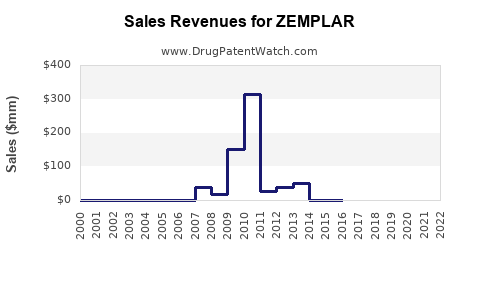
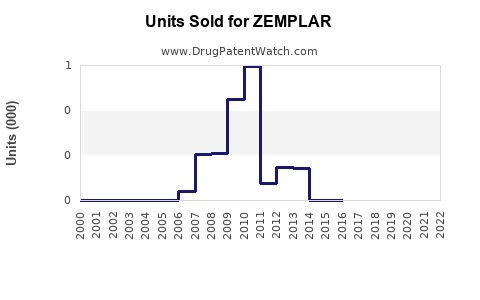
Annual Sales Revenues and Units Sold for ZEMPLAR
| Drug Name | Revenues (USD) | Units | Year |
|---|---|---|---|
| ZEMPLAR | ⤷ Start Trial | ⤷ Start Trial | 2022 |
| ZEMPLAR | ⤷ Start Trial | ⤷ Start Trial | 2021 |
| ZEMPLAR | ⤷ Start Trial | ⤷ Start Trial | 2020 |
| ZEMPLAR | ⤷ Start Trial | ⤷ Start Trial | 2019 |
| >Drug Name | >Revenues (USD) | >Units | >Year |
Zemplar Market Analysis and Sales Projections: Paricalcitol Revenue, Generic Competition, Patent Risk, and Market Outlook
Zemplar is the brand name for paricalcitol, a vitamin D analog used to prevent and treat secondary hyperparathyroidism associated with chronic kidney disease. The product has largely moved from branded growth to generic and institutional maintenance markets. Its commercial outlook is constrained by generic paricalcitol, dialysis-provider purchasing power, bundled reimbursement, and the availability of competing vitamin D therapies.
A reasonable base-case forecast places global Zemplar-branded and paricalcitol-equivalent sales in a low-growth or declining market through 2030. Branded Zemplar revenue is unlikely to regain historical levels unless AbbVie or another rights holder introduces a differentiated formulation, secures a new indication, or obtains favorable reimbursement positioning.
What is Zemplar and how does paricalcitol work?
Zemplar contains paricalcitol, a synthetic vitamin D analog. It activates the vitamin D receptor and suppresses parathyroid hormone production while generally producing less hypercalcemia and hyperphosphatemia than conventional vitamin D therapy when appropriately dosed.
The primary treatment setting is secondary hyperparathyroidism in patients with chronic kidney disease, especially patients receiving hemodialysis. The product has been marketed in several dosage forms:
| Product | Route | Principal use | Commercial relevance |
|---|---|---|---|
| Zemplar injection | Intravenous | Dialysis-center administration | Historically important institutional product |
| Zemplar capsules | Oral | Chronic outpatient treatment | Exposed to generic substitution |
| Paricalcitol injection | Intravenous | Dialysis and hospital use | Generic competition is established |
| Paricalcitol capsules | Oral | Chronic outpatient treatment | Price competition is substantial |
The FDA approved Zemplar for secondary hyperparathyroidism associated with chronic kidney disease. The product is not a biologic, so biosimilar regulation does not apply. Competition occurs through abbreviated new drug applications, generic substitution, institutional contracting, and therapeutic alternatives.[1]
How large is the Zemplar and paricalcitol market?
The addressable market is tied to the chronic kidney disease dialysis population rather than the entire vitamin D market. The United States has more than 800,000 people with end-stage kidney disease, with most receiving maintenance dialysis or living with a kidney transplant. Hemodialysis patients represent the largest direct treatment population for injectable paricalcitol.[2]
The commercial market has three layers:
- Branded Zemplar revenue. This is the smallest and most vulnerable segment.
- Generic paricalcitol revenue. Generic volume may remain stable even as total market value falls.
- Alternative therapy revenue. This includes calcitriol, doxercalciferol, etelcalcetide, cinacalcet and other treatments used to control parathyroid hormone.
Dialysis organizations negotiate heavily with manufacturers. Products used in dialysis are affected by Medicare reimbursement structures, including the End-Stage Renal Disease Prospective Payment System. The bundled payment system places pressure on providers to select lower-cost products where clinical outcomes are comparable.[3]
Market drivers
Demand for paricalcitol is supported by:
- Growth in the number of patients with advanced chronic kidney disease.
- Continued use of intravenous vitamin D analogs in dialysis centers.
- Physician familiarity with paricalcitol.
- Need to control secondary hyperparathyroidism and parathyroid hormone levels.
Market restraints
Revenue growth is limited by:
- Generic paricalcitol injection and capsules.
- Dialysis-provider consolidation.
- Medicare and commercial reimbursement pressure.
- Use of calcimimetics, including cinacalcet and etelcalcetide.
- Greater emphasis on mineral-bone disorder cost management.
- Lack of a meaningful new-patient growth strategy for the mature brand.
What are Zemplar sales and revenue trends?
AbbVie does not consistently report Zemplar as a major standalone product in its current public reporting. The product was historically included among smaller pharmaceutical products, but recent corporate disclosures do not provide a dependable standalone revenue series for Zemplar.[4]
The lack of current standalone disclosure indicates that Zemplar is no longer a material driver of AbbVie’s consolidated revenue. Commercial value now lies primarily in established demand, manufacturing capability, and residual institutional contracts rather than brand expansion.
Historical commercial profile
Zemplar’s strongest commercial period occurred before widespread generic entry and before dialysis reimbursement pressure intensified. Injectable use in dialysis centers created recurring demand, while capsule sales provided an outpatient channel.
After generic entry, the market separated into two revenue trends:
| Metric | Expected trend after generic entry |
|---|---|
| Total paricalcitol units | Flat to modestly declining |
| Branded Zemplar units | Declining |
| Average selling price | Declining |
| Generic market share | Increasing |
| Dialysis-center purchasing concentration | Increasing |
| Brand promotional spending | Declining |
The relevant investment question is no longer whether paricalcitol has clinical demand. It is whether a supplier can defend price, access, and volume against generic manufacturers and alternative therapies.
What are the Zemplar sales projections through 2030?
Because current standalone brand sales are not publicly disclosed, the most defensible approach is a scenario forecast rather than a single-point estimate. The table below models total paricalcitol market revenue, including branded and generic products, in the United States and major developed markets.
Base-case sales forecast
| Year | Global paricalcitol market estimate | Annual growth | Commercial interpretation |
|---|---|---|---|
| 2024 | $180 million-$240 million | Baseline | Mature generic market |
| 2025 | $175 million-$235 million | -2% to -3% | Continued price compression |
| 2026 | $170 million-$230 million | -2% to -3% | Stable dialysis demand |
| 2027 | $165 million-$225 million | -2% to -3% | Generic share expands |
| 2028 | $160 million-$220 million | -2% to -3% | Brand becomes niche |
| 2029 | $155 million-$215 million | -2% to -3% | Institutional pricing pressure |
| 2030 | $150 million-$210 million | -2% to -3% | Mature maintenance market |
These figures are market-model estimates, not reported company guidance. They assume stable dialysis prevalence, no major safety event, continued generic availability, and no differentiated reformulation.
Scenario analysis
| Scenario | 2030 global market | Key assumptions |
|---|---|---|
| Downside | $100 million-$140 million | Faster generic erosion, greater use of calcimimetics, lower injectable pricing |
| Base case | $150 million-$210 million | Stable treated population and gradual price decline |
| Upside | $230 million-$300 million | Higher CKD prevalence, supply disruptions, improved access in emerging markets |
Branded Zemplar revenue would likely represent only a minority of the total market in the base case. A plausible brand-specific range is $20 million to $60 million annually by 2030, with the lower end more likely if generic substitution is unrestricted and the brand lacks contracting advantages.
When does Zemplar lose exclusivity?
Zemplar’s principal commercial exclusivity has already expired in the United States. The product is now exposed to generic competition for both oral and injectable presentations.
The relevant protection categories are:
| Protection category | Current commercial status |
|---|---|
| Small-molecule active ingredient exclusivity | Expired |
| Original product patent protection | Expired or no longer sufficient to block routine generic competition |
| Pediatric exclusivity | Not a current barrier to generic entry |
| Regulatory exclusivity | Expired for the mature product |
| Formulation protection | Any surviving claims would need to be evaluated patent-by-patent |
| Method-of-use protection | Does not appear to create a broad current barrier to paricalcitol substitution |
A generic entrant does not need to reproduce every historical commercial attribute of Zemplar. It generally needs to satisfy FDA requirements for pharmaceutical equivalence and bioequivalence for the relevant dosage form.
What is the Orange Book status of Zemplar?
Zemplar is an FDA-approved small-molecule drug rather than a biologic. Its regulatory history is tracked through FDA product databases, including Drugs@FDA and the Orange Book framework for approved drug products and patent information.[1,5]
The commercial significance of the Orange Book is limited for a mature product with established generic competition. Any patent listed for a specific approved presentation would need to be assessed for:
- Patent expiration.
- Whether the patent claims the active ingredient, formulation, method of use, or manufacturing process.
- Whether the patent remains enforceable.
- Whether an approved generic product is required to certify under Paragraph IV.
- Whether the listed patent covers the generic applicant’s proposed label.
The existence of an Orange Book listing does not by itself prevent generic launch. A generic applicant can challenge a listed patent through a Paragraph IV certification or wait for the relevant patent term to expire.
Which companies are challenging Zemplar with generics?
Generic paricalcitol has been supplied by multiple manufacturers and distributors over time. The competitive field has included large generic companies, specialty manufacturers, and contract suppliers serving dialysis and hospital channels.
Potential competitive pressure comes from:
- Teva Pharmaceutical Industries.
- Dr. Reddy’s Laboratories.
- Fresenius-related pharmaceutical operations.
- Sagent Pharmaceuticals and other institutional suppliers.
- Smaller ANDA holders and authorized distributors.
The precise active supplier list changes with FDA approvals, manufacturing transfers, discontinuations, and shortage conditions. A company’s historical ANDA approval does not prove current commercial supply.
The principal competitive advantage in this market is often not brand recognition. It is manufacturing reliability, validated sterile production, regulatory compliance, wholesaler access, and pricing sufficient to win dialysis-center contracts.
What Paragraph IV challenges affect Zemplar?
Paragraph IV risk was most relevant when active Orange Book-listed patents could delay generic approval or trigger patent litigation. For a mature product with generic paricalcitol already marketed, the strategic importance of a new Paragraph IV challenge is limited.
A new entrant could still use a Paragraph IV certification if it seeks approval before the expiration of a listed patent covering a specific formulation or use. The likely outcomes are:
- No litigation if the patent holder does not sue within the statutory period.
- Patent litigation followed by settlement.
- Litigation ending in invalidity or non-infringement.
- A launch after patent expiry.
- A negotiated launch date before patent expiry.
There is no broad indication that Zemplar has a current patent dispute capable of restoring brand-level exclusivity. Patent risk should therefore be treated as presentation-specific rather than franchise-wide.
What formulations are protected by Zemplar patents?
The commercially relevant formulations are oral capsules and injectable paricalcitol. Any surviving formulation claims would likely focus on composition, dosage strength, excipients, stability, packaging, or a specific administration method.
Formulation patents can matter when:
- The generic applicant uses the same excipient system.
- The brand has a distinctive concentration or container configuration.
- Sterile manufacturing or stability requirements narrow the design-around options.
- The listed patent is tied to the approved product label.
Formulation protection is less valuable when generic manufacturers can use a different excipient system, concentration, container, or manufacturing process while preserving pharmaceutical equivalence.
Manufacturing know-how may remain commercially useful even after patent expiry. Injectable products require sterile processing, validated fill-finish operations, container-closure control, and compliance with current good manufacturing practice. These barriers can produce supply advantages but do not create statutory exclusivity.
What patent litigation and settlement agreements affect Zemplar?
Zemplar’s main commercial issue is post-exclusivity erosion rather than a current high-value patent litigation campaign. Publicly visible litigation involving mature paricalcitol products has less economic importance than litigation involving high-revenue drugs because generic entrants already operate in the category.
Potential settlement structures in this type of market include:
- Delayed generic launch.
- Authorized generic supply.
- Volume-based pricing.
- No-challenge provisions.
- License rights to specific formulations.
- Launch rights limited to a dosage form or geography.
No current settlement should be assumed to restrict all generic paricalcitol products. Settlements must be reviewed by patent, dosage form, applicant, and jurisdiction.
How does Zemplar compare with competing secondary hyperparathyroidism drugs?
| Product | Active ingredient | Main route | Competitive position |
|---|---|---|---|
| Zemplar | Paricalcitol | IV and oral | Mature vitamin D analog with generic competition |
| Hectorol | Doxercalciferol | IV and oral | Similar clinical category; also mature |
| Rocaltrol | Calcitriol | Oral and injectable | Older, inexpensive vitamin D therapy |
| Sensipar | Cinacalcet | Oral | Calcimimetic; generic competition after patent expiry |
| Parsabiv | Etelcalcetide | IV | Dialysis-center calcimimetic |
| Rayaldee | Calcifediol | Oral | More relevant to earlier-stage CKD and vitamin D deficiency |
Paricalcitol competes on physician familiarity, dosing experience, and dialysis-center workflow. Calcimimetics compete on mechanism and parathyroid hormone control. The clinical choice can depend on calcium and phosphate levels, dialysis status, tolerability, reimbursement and institutional protocols.
What is the FDA regulatory status of Zemplar?
Zemplar is an FDA-approved prescription drug. It is regulated as a conventional small-molecule pharmaceutical. Generic versions can be approved through the ANDA pathway if they meet FDA requirements for pharmaceutical equivalence, bioequivalence, manufacturing quality and labeling.
The product does not face the regulatory interchangeability framework used for biosimilars. Substitution depends on state pharmacy law, payer policy, dosage form, institutional procurement and whether the generic is therapeutically equivalent in the FDA Orange Book.
What generic launch risks exist for Zemplar?
The main generic launch risks are commercial, not regulatory.
Price erosion
Injectable paricalcitol is purchased by sophisticated institutional buyers. A new entrant may need to discount materially to displace an incumbent supplier.
Sterile manufacturing
Injectable products carry greater manufacturing and inspection risk than ordinary oral solid products. A warning letter, inspection failure, contamination event or supply interruption can change market share quickly.
Limited market size
The market is large enough to support several suppliers but may not justify aggressive investment by every generic manufacturer. Low expected revenue can reduce launch interest.
Contracting concentration
Dialysis organizations and hospital systems can consolidate demand. A supplier without a national contract may receive limited volume even after FDA approval.
Therapeutic substitution
Even successful paricalcitol suppliers face competition from calcimimetics, calcitriol and doxercalciferol. Generic entry therefore reduces price without guaranteeing unit growth.
What licensing deals could affect Zemplar?
The most commercially relevant transactions would involve:
- Rights to market paricalcitol in a specific country.
- Authorized-generic arrangements.
- Contract manufacturing for injectable paricalcitol.
- Distribution agreements with dialysis organizations.
- Acquisitions of mature sterile-injectable portfolios.
A licensing deal for Zemplar would likely be structured around geographic rights, manufacturing economics and supply obligations rather than premium royalty economics. The mature status of the product reduces the probability of a large upfront payment unless the transaction includes a broader renal portfolio.
How strong is the Zemplar patent estate?
Zemplar’s current patent estate is commercially weak as a broad exclusivity platform. The product has generic competition, no biologic exclusivity, and no apparent new molecular entity exclusivity remaining.
Patent strength can still exist in narrow areas:
| Area | Relative strength |
|---|---|
| Active ingredient | Low |
| Core indication | Low |
| Oral capsule formulation | Low to moderate, depending on surviving claims |
| Injectable formulation | Low to moderate |
| Manufacturing process | Moderate as a trade-secret and execution barrier |
| Packaging and stability | Narrow and presentation-specific |
| New indication | Potentially meaningful only with a new patentable clinical use |
The strongest remaining barrier is likely operational: sterile manufacturing, quality systems and institutional supply reliability.
What is the geographic outlook for Zemplar?
The United States remains the most commercially developed market but also has the strongest generic and reimbursement pressure. Europe is fragmented by country-level procurement, pricing and reimbursement systems. Japan and other developed Asian markets offer stable demand but may have local generic competition and pricing controls.
Emerging markets may offer volume growth as dialysis access expands, but pricing is lower and regulatory registrations vary. The global revenue opportunity is therefore divided between:
- High-price but mature markets.
- Lower-price markets with dialysis growth.
- Institutional markets where supply reliability determines purchasing.
A multinational strategy would need country-specific registrations, local distribution and manufacturing economics. A single global brand strategy is unlikely to restore historical peak revenue.
Key Takeaways
- Zemplar is a mature paricalcitol brand with established generic competition.
- The market is driven by dialysis and chronic kidney disease treatment, not broad outpatient vitamin D demand.
- Total paricalcitol market revenue is likely to decline modestly through 2030.
- A base-case global market estimate is $150 million to $210 million in 2030.
- Branded Zemplar revenue is likely to remain a minority of total paricalcitol revenue.
- Patent protection is not a broad current barrier to generic competition.
- The main barriers are sterile manufacturing, regulatory compliance, dialysis-center contracting and supply reliability.
- Calcimimetics and other vitamin D therapies limit volume growth.
- The product does not face biosimilar competition because paricalcitol is a conventional small molecule.
- Any investment case depends more on manufacturing and distribution execution than on patent exclusivity.
FAQs
Is Zemplar still sold in the United States?
Zemplar and generic paricalcitol have been marketed in the United States, although brand availability and commercial distribution can change by dosage form and supplier. Generic paricalcitol is the principal competitive reference.
Is paricalcitol a biologic or a generic drug?
Paricalcitol is a conventional small-molecule drug. Generic products are approved through the ANDA pathway rather than the biosimilar pathway.
Does Zemplar have a new chemical entity exclusivity period remaining?
No. Any original regulatory exclusivity associated with the product has expired.
Which drug competes most directly with Zemplar?
Doxercalciferol and calcitriol are the closest vitamin D analog competitors. Cinacalcet and etelcalcetide compete through a different mechanism as calcimimetics.
Is Zemplar an attractive licensing opportunity?
Only selectively. The strongest opportunity would involve low-cost sterile manufacturing, reliable dialysis-channel distribution, or rights in markets with limited generic supply. A premium brand-focused licensing thesis is weak without a new formulation, indication or reimbursement advantage.
References
-
U.S. Food and Drug Administration. (n.d.). Drugs@FDA: FDA-approved drugs. https://www.accessdata.fda.gov/scripts/cder/daf/
-
United States Renal Data System. (2023). 2023 USRDS annual data report: Epidemiology of kidney disease in the United States. National Institutes of Health, National Institute of Diabetes and Digestive and Kidney Diseases. https://usrds-adr.niddk.nih.gov/2023
-
Centers for Medicare & Medicaid Services. (2024). End-Stage Renal Disease Prospective Payment System. https://www.cms.gov/medicare/payment/prospective-payment-systems/end-stage-renal-disease-esrd
-
AbbVie Inc. (2024). Annual report pursuant to Section 13 or 15(d) of the Securities Exchange Act of 1934. https://investors.abbvie.com/financial-information/annual-reports
-
U.S. Food and Drug Administration. (n.d.). Approved drug products with therapeutic equivalence evaluations, Orange Book. https://www.fda.gov/drugs/drug-approvals-and-databases/approved-drug-products-therapeutic-equivalence-evaluations-orange-book
More… ↓
