Share This Page
Drug Sales Trends for XANAX
✉ Email this page to a colleague
Payment Methods and Pharmacy Types for XANAX (2000)
Revenues by Pharmacy Type
Units Sold by Pharmacy Type
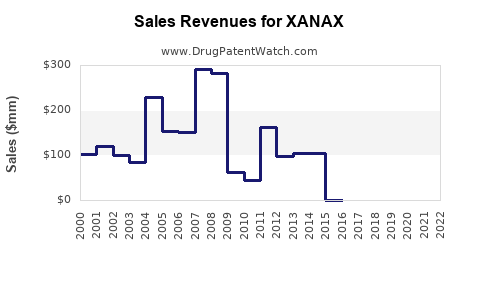
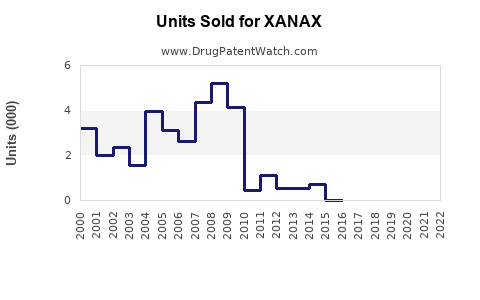
Annual Sales Revenues and Units Sold for XANAX
| Drug Name | Revenues (USD) | Units | Year |
|---|---|---|---|
| XANAX | ⤷ Start Trial | ⤷ Start Trial | 2022 |
| XANAX | ⤷ Start Trial | ⤷ Start Trial | 2021 |
| XANAX | ⤷ Start Trial | ⤷ Start Trial | 2020 |
| XANAX | ⤷ Start Trial | ⤷ Start Trial | 2019 |
| >Drug Name | >Revenues (USD) | >Units | >Year |
Xanax (Alprazolam) Market Analysis, Patent Status, and Sales Projections
Xanax, the original branded version of alprazolam, is a mature central nervous system product with no meaningful U.S. patent or regulatory exclusivity barrier. Commercial value is concentrated in the generic alprazolam market, while branded Xanax has limited revenue potential. The U.S. market is likely to contract gradually because of controlled-substance restrictions, prescribing scrutiny, substitution by SSRIs and SNRIs, and continued generic price pressure.
The base-case forecast estimates U.S. alprazolam retail-equivalent sales of approximately $520 million in 2025, declining to $455 million by 2029. Branded Xanax sales are projected at less than $35 million annually in the U.S. under the base case. These are analytical estimates rather than reported manufacturer net sales because product-level net revenue for Xanax and generic alprazolam is not publicly disclosed in a consistent format.
What is Xanax and how large is the alprazolam market?
Xanax is the original brand for alprazolam, a short-acting benzodiazepine approved by the FDA for generalized anxiety disorder and panic disorder. The product is administered orally in immediate-release tablets and extended-release tablets under the Xanax XR brand. Alprazolam is a Schedule IV controlled substance in the United States.[1,2]
The commercial market has three segments:
| Segment | Market position | Revenue outlook |
|---|---|---|
| Branded Xanax immediate-release | Originator brand with limited differentiation | Declining and low |
| Generic alprazolam immediate-release | Largest volume segment | Stable to modestly declining |
| Extended-release alprazolam | Smaller, formulation-specific segment | Vulnerable to substitution and generic competition |
Alprazolam remains widely prescribed because of rapid onset and familiarity among physicians. Its disadvantages include dependence, withdrawal risk, sedation, misuse potential and short-duration symptom control. FDA labeling warns against abuse, misuse, addiction, physical dependence and withdrawal reactions.[1]
What are Xanax sales projections for 2025 through 2029?
The following forecast uses a modeled retail-equivalent market value rather than manufacturer-recognized revenue. The model assumes continued generic substitution, low-single-digit prescription-volume erosion, annual price compression in generic products and a sharper decline in branded Xanax volume.
U.S. alprazolam market forecast
| Year | Base-case market value | Low case | High case |
|---|---|---|---|
| 2025 | $520 million | $430 million | $650 million |
| 2026 | $505 million | $405 million | $645 million |
| 2027 | $490 million | $380 million | $640 million |
| 2028 | $472 million | $355 million | $632 million |
| 2029 | $455 million | $330 million | $625 million |
| 2025-2029 CAGR | -3.3% | -6.3% | -1.0% |
The base case reflects a mature generic market, not a branded pharmaceutical growth market. The high case assumes sustained prescribing for panic disorder and limited displacement by non-benzodiazepine treatments. The low case assumes tighter prescribing controls, more payer restrictions and faster movement to SSRIs, SNRIs, buspirone and behavioral therapy.
Branded Xanax forecast
| Year | Estimated U.S. branded Xanax revenue |
|---|---|
| 2025 | $25 million-$35 million |
| 2026 | $22 million-$32 million |
| 2027 | $19 million-$29 million |
| 2028 | $17 million-$26 million |
| 2029 | $15 million-$24 million |
The brand retains some value through physician familiarity, patient recognition and prescription preference. Generic substitution limits the ability to sustain a premium price. Branded revenue could be lower if the originator reduces active promotion or if wholesalers and pharmacies favor generic inventory.
When does Xanax lose patent and market exclusivity?
Xanax lost meaningful U.S. patent protection decades ago. The original alprazolam patent, commonly identified as U.S. Patent No. 3,987,052, was issued in the 1970s and expired long before the current market period.[3]
| Protection category | Status |
|---|---|
| Original compound patent | Expired |
| FDA new-drug exclusivity | Expired |
| Immediate-release formulation exclusivity | Expired |
| Extended-release formulation exclusivity | Expired or commercially ineffective |
| Generic alprazolam availability | Established |
| Current U.S. market exclusivity | None |
The FDA approved Xanax in 1981. Generic alprazolam entered the market after expiration of the original protection, creating a long-established abbreviated new drug application pathway.[1,4]
What is the Orange Book status of Xanax?
The Orange Book identifies the approved Xanax reference product under NDA 018276. Historical patent listings associated with the product do not create a current commercial barrier to generic alprazolam entry.[4]
The relevant Orange Book conclusions are:
- No active compound patent protects alprazolam.
- No unexpired exclusivity period prevents generic approval.
- Immediate-release alprazolam is subject to established generic competition.
- Extended-release products do not have originator exclusivity capable of restoring the historical Xanax franchise.
- Any future product-specific patent would need to protect a new formulation, delivery system or method of use rather than the alprazolam molecule itself.
Orange Book status is distinct from commercial availability. A listed product may remain approved while having limited distribution or little market share.
Are there active Paragraph IV challenges to Xanax?
Paragraph IV risk is no longer the central issue for Xanax because generic alprazolam has already entered the market. Paragraph IV certifications are most relevant when a generic applicant challenges an unexpired listed patent. Xanax’s core patents and exclusivity periods expired years ago.[4,5]
The current competitive risk is therefore not a first generic launch. It is ongoing price erosion among multiple generic suppliers, contract-manufacturing changes, product discontinuations and potential competition against specific extended-release or reformulated products.
No active, commercially material Paragraph IV campaign is required to explain generic access to immediate-release alprazolam.
What formulations are protected by Xanax patents?
The original Xanax franchise includes several dosage forms:
| Formulation | Commercial status | IP assessment |
|---|---|---|
| Immediate-release tablets | Generic competition | No meaningful active originator protection |
| Orally disintegrating or alternative oral formulations | Limited market relevance | Any historical protection is expired or narrow |
| Xanax XR extended-release tablets | Generic and therapeutic substitution risk | Historical formulation protection does not block current competition |
| New abuse-deterrent or modified-release versions | Not part of the established Xanax franchise | Could require new patents and FDA approval |
Formulation patents can have greater importance than compound patents for mature drugs, but they must protect a technically distinct product with sufficient commercial demand. Alprazolam has a narrow opportunity for life-cycle management because physicians and payers generally accept low-cost immediate-release tablets.
Potential patentable areas for a new alprazolam product would include:
- Abuse-deterrent delivery systems.
- Longer-acting release profiles.
- Lower-dose precision delivery.
- Reduced peak plasma concentrations.
- Combination products.
- Alternative routes of administration.
Each approach would face clinical, regulatory and commercial barriers. A new formulation would need to show a meaningful benefit over inexpensive generic tablets.
What is the FDA regulatory status of Xanax?
Xanax is FDA-approved for anxiety associated with generalized anxiety disorder and for panic disorder, with or without agoraphobia.[1] The label includes a boxed warning relating to abuse, misuse, addiction, physical dependence and withdrawal. The FDA also warns about potentially fatal respiratory depression when benzodiazepines are combined with opioids.[1]
Regulatory factors affecting future sales include:
- Increased controlled-substance monitoring.
- State-level prescribing limits.
- Prescription drug monitoring program requirements.
- Greater scrutiny of long-term benzodiazepine use.
- Warnings relating to opioid co-prescribing.
- Clinical preference for non-benzodiazepine treatments in chronic anxiety.
These factors are more likely to reduce volume than to eliminate the market. Patients with panic disorder and acute anxiety symptoms continue to generate demand.
How strong is the Xanax patent estate?
The patent estate is weak for commercial purposes because the key protection is expired and generic substitution is established.
| Patent-estate factor | Assessment |
|---|---|
| Compound protection | None remaining |
| Active Orange Book barrier | None material |
| Formulation protection | Historical and limited |
| Method-of-use protection | No meaningful barrier to standard use |
| Manufacturing protection | Potentially relevant only to specific processes |
| Freedom-to-operate for generic tablets | Strong |
| Ability to support brand premium | Weak |
Manufacturing know-how can still affect supply reliability, quality and cost. It does not normally prevent a capable generic manufacturer from producing alprazolam under an approved FDA application. Controlled-substance quotas, API sourcing and quality-system requirements can create operational friction, but they are not substitutes for patent exclusivity.
Which companies compete with Xanax and alprazolam?
The generic market includes multiple FDA-approved manufacturers and distributors. Market share changes by strength, dosage form, wholesaler contract and pharmacy network. The most relevant competitors are generic alprazolam suppliers rather than branded benzodiazepine brands.
Therapeutic competitors include:
- Clonazepam, marketed as Klonopin and generics.
- Lorazepam, marketed as Ativan and generics.
- Diazepam, marketed as Valium and generics.
- Buspirone.
- Sertraline, escitalopram and other SSRIs.
- Venlafaxine, duloxetine and other SNRIs.
- Hydroxyzine.
- Cognitive behavioral therapy and digital behavioral-health programs.
Clonazepam competes most directly in panic disorder and chronic anxiety. SSRIs and SNRIs have a stronger long-term treatment position because they are not controlled substances and do not carry the same dependence profile.
What litigation and settlement agreements affect Xanax?
No active patent litigation is required to explain current generic access to alprazolam. The material legal exposure is product liability and controlled-substance litigation rather than an originator patent dispute.
Potential legal risks include:
- Failure-to-warn claims involving dependence and withdrawal.
- Claims involving opioid and benzodiazepine co-prescribing.
- Controlled-substance distribution investigations.
- Manufacturing or quality litigation.
- False-marking or improper patent-listing disputes involving later formulations.
No commercially material settlement agreement is necessary for the current generic market structure. Historical settlements, if any, do not restore exclusivity for the expired alprazolam compound.
How does Xanax compare with competing anxiety drugs?
| Product | Active ingredient | Controlled substance | Patent position | Market risk |
|---|---|---|---|---|
| Xanax | Alprazolam | Yes, Schedule IV | Expired | Generic erosion and regulatory scrutiny |
| Klonopin | Clonazepam | Yes, Schedule IV | Expired for core product | Competes in panic disorder |
| Ativan | Lorazepam | Yes, Schedule IV | Expired for core product | Competes in acute anxiety |
| Valium | Diazepam | Yes, Schedule IV | Expired for core product | Older, broad benzodiazepine use |
| Lexapro | Escitalopram | No | Expired | Strong chronic-treatment substitute |
| Zoloft | Sertraline | No | Expired | Strong chronic-treatment substitute |
| Buspar | Buspirone | No | Expired | Non-controlled alternative |
Xanax has a faster onset than most antidepressants but a less favorable dependence profile. That tradeoff supports continued acute-use demand while limiting long-term growth.
What generic launch scenarios exist for Xanax?
A new generic entrant would face low technical barriers but difficult economics.
Base scenario
The entrant receives FDA approval for immediate-release alprazolam and gains limited share through wholesalers and pharmacy benefit managers. Gross pricing declines as suppliers compete for contracts. The entrant’s revenue reaches a modest level but margins compress quickly.
Upside scenario
A manufacturer secures reliable API supply, wins a major pharmacy or managed-care contract and offers multiple strengths. Revenue growth comes from volume rather than price.
Downside scenario
The entrant experiences controlled-substance quota limits, supply interruptions, manufacturing observations or low reimbursement. The product becomes commercially unattractive despite FDA approval.
The most attractive opportunity is not a standard tablet. It is a differentiated formulation with an identifiable clinical benefit, but that strategy requires new clinical evidence, new regulatory review and a defensible patent position.
What is the geographic coverage and international outlook?
Alprazolam is marketed in multiple countries, but international growth is constrained by local controlled-substance rules, prescription practices and generic pricing. The United States remains commercially important because of market size and established brand recognition.
Europe generally has stronger controls on benzodiazepine duration and prescribing. Emerging markets may have greater volume growth but lower prices, weaker brand loyalty and more variable regulatory enforcement. A global forecast should therefore separate U.S. value from international unit volume.
Key Takeaways
- Xanax is a mature alprazolam brand with no meaningful U.S. patent or exclusivity protection.
- Generic alprazolam captures most market volume and economic value.
- Estimated U.S. alprazolam retail-equivalent sales are approximately $520 million in 2025 under the base case.
- The modeled market declines to approximately $455 million by 2029.
- Branded Xanax revenue is likely below $35 million annually in the United States.
- Paragraph IV litigation is not the principal current risk because generic entry is already established.
- The main commercial threats are generic price compression, controlled-substance regulation and substitution by SSRIs, SNRIs and non-drug therapy.
- A new alprazolam product would need formulation differentiation, clinical value and new patent protection to support a premium.
FAQs about Xanax market size, patents and competition
Is Xanax still profitable for its manufacturer?
Branded Xanax has limited profit potential relative to its historical peak because generic alprazolam has captured most prescriptions. Profitability depends on manufacturing cost, distribution strategy and the extent of remaining brand demand.
Does Xanax have an active patent in the United States?
The original alprazolam compound patent and related historical protections have expired. No active core patent prevents generic immediate-release alprazolam competition.
Will generic alprazolam sales continue to decline?
A gradual decline is the most likely outcome. Volume should remain substantial because alprazolam is widely recognized and prescribed, but regulatory scrutiny and non-benzodiazepine alternatives will pressure demand.
Is Xanax more commercially exposed than Klonopin?
Xanax has greater exposure to rapid-onset prescribing controls and concerns about misuse. Klonopin competes closely in panic disorder but faces the same broad generic and controlled-substance pressures.
Can a new extended-release alprazolam product obtain patent protection?
Yes, a technically distinct extended-release product could potentially receive patents if it meets novelty, non-obviousness and enablement standards. Patentability would not guarantee commercial success because generic immediate-release alprazolam is inexpensive and widely available.
References
- U.S. Food and Drug Administration. (2023). Xanax (alprazolam) prescribing information.
- U.S. Drug Enforcement Administration. (2024). Drug fact sheet: Benzodiazepines.
- U.S. Patent and Trademark Office. (1976). U.S. Patent No. 3,987,052: 1,4-Benzodiazepine derivatives.
- U.S. Food and Drug Administration. (2025). Approved drug products with therapeutic equivalence evaluations: Orange Book.
- U.S. Food and Drug Administration. (2024). Abbreviated new drug application submissions and patent certifications.
More… ↓
