Drug Sales Trends for TOBRADEX
Payment Methods and Pharmacy Types for TOBRADEX (2000)
Revenues by Pharmacy Type
Units Sold by Pharmacy Type
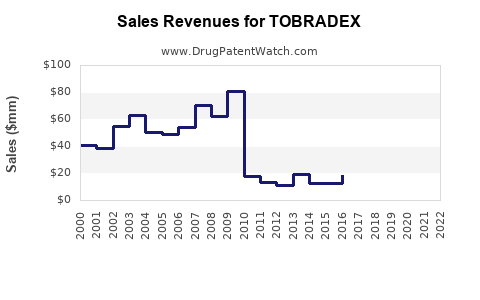
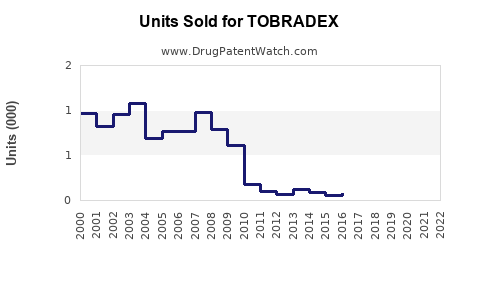
Annual Sales Revenues and Units Sold for TOBRADEX
| Drug Name | Revenues (USD) | Units | Year |
|---|---|---|---|
| TOBRADEX | ⤷ Start Trial | ⤷ Start Trial | 2022 |
| TOBRADEX | ⤷ Start Trial | ⤷ Start Trial | 2021 |
| TOBRADEX | ⤷ Start Trial | ⤷ Start Trial | 2020 |
| TOBRADEX | ⤷ Start Trial | ⤷ Start Trial | 2019 |
| TOBRADEX | ⤷ Start Trial | ⤷ Start Trial | 2018 |
| TOBRADEX | ⤷ Start Trial | ⤷ Start Trial | 2017 |
| TOBRADEX | ⤷ Start Trial | ⤷ Start Trial | 2016 |
| >Drug Name | >Revenues (USD) | >Units | >Year |
TobraDex Market Analysis and Sales Projections: Generic Pressure, Formulation Differentiation, and U.S. Outlook
TobraDex is a mature ophthalmic combination product containing tobramycin 0.3% and dexamethasone 0.1%. Its U.S. commercial outlook is driven by generic substitution, payer reimbursement, ophthalmologist prescribing, and the premium positioning of TobraDex ST rather than by regulatory exclusivity. Public sources do not disclose current TobraDex brand sales. A defensible forecast therefore requires a scenario model tied to an assumed 2024 net-sales base.
The base case projects a low-single-digit annual decline for legacy TobraDex and a flatter trajectory for TobraDex ST. The principal downside is rapid generic conversion. The principal commercial defense is formulation differentiation, particularly the ST suspension technology and physician familiarity with the Alcon brand.
What is TobraDex and which products are included in the market?
TobraDex combines an antibiotic and corticosteroid for steroid-responsive ocular inflammation where bacterial infection or a risk of bacterial infection exists. The products are used in ophthalmic conditions, including postoperative inflammation and selected external ocular infections.
| Product | Active ingredients | Dosage form | Commercial positioning |
|---|---|---|---|
| TobraDex ophthalmic suspension | Tobramycin 0.3% and dexamethasone 0.1% | Sterile ophthalmic suspension | Legacy branded product |
| TobraDex ophthalmic ointment | Tobramycin 0.3% and dexamethasone 0.1% | Ophthalmic ointment | Smaller, formulation-specific segment |
| TobraDex ST | Tobramycin 0.3% and dexamethasone 0.05% | Sterile ophthalmic suspension | Premium, reformulated product |
| Generic tobramycin/dexamethasone suspension | Tobramycin 0.3% and dexamethasone 0.1% | Ophthalmic suspension | Main price competitor |
| Generic tobramycin/dexamethasone ointment | Tobramycin 0.3% and dexamethasone 0.1% | Ophthalmic ointment | Lower-cost substitute |
| Separate tobramycin and dexamethasone products | Individual active ingredients | Drops or ointment | Alternative prescribing approach |
TobraDex and TobraDex ST are prescription products regulated by the FDA. Their labeling warns that ophthalmic corticosteroids can increase intraocular pressure, delay healing, and exacerbate or mask infection. Treatment duration and patient selection are therefore clinically important. [1, 2]
What is the FDA regulatory status of TobraDex?
TobraDex is an FDA-approved prescription ophthalmic drug. The original product is an established small-molecule combination, not a biologic. Biosimilar competition is therefore irrelevant. Competitive entry occurs through abbreviated new drug applications, branded generics, and therapeutically substitutable ophthalmic products.
TobraDex ST is a separate formulation and should not be treated as identical to the original TobraDex suspension. The products differ in formulation and dexamethasone concentration. A generic equivalent to the legacy product does not automatically reproduce the commercial or clinical attributes of TobraDex ST.
FDA market structure
The relevant regulatory pathways are:
- FDA-approved generic versions of tobramycin/dexamethasone ophthalmic suspension.
- Generic ophthalmic ointment products.
- Brand-to-generic substitution at the pharmacy level, subject to state law and payer rules.
- Separate prescribing of antibiotic and steroid products.
- Competing antibiotic/corticosteroid combinations, including products containing tobramycin with another corticosteroid.
FDA labeling and the Orange Book determine therapeutic equivalence and listed patent or exclusivity information. [1, 3]
When does TobraDex lose exclusivity?
TobraDex has no meaningful modern regulatory exclusivity profile. It is a mature product with generic competition and long-established FDA approval. Any original small-molecule composition or product patents associated with the legacy product would have expired long before the current market period.
The commercial question is not whether the original TobraDex composition remains exclusive. It is whether particular formulation, manufacturing, or product-specific claims associated with TobraDex ST remain enforceable and commercially relevant.
| Protection category | Current commercial relevance |
|---|---|
| Original TobraDex composition | Effectively expired as a market barrier |
| FDA approval exclusivity | No material current exclusivity expected for the legacy product |
| Orange Book-listed patents | Must be evaluated by NDA and product; listing status can change |
| TobraDex ST formulation protection | Potentially more relevant than legacy-product protection |
| Trademark rights | Protect the TobraDex name but do not block equivalent generics |
| Manufacturing know-how | May support quality, consistency, and supply reliability |
| Physician familiarity | Commercial advantage, but not legal exclusivity |
A patent expiration date should not be inferred from the brand name alone. TobraDex, TobraDex ointment, and TobraDex ST have separate regulatory records and may have different listed patents. The controlling source for U.S. Orange Book analysis is the FDA’s current product and patent listing data. [3]
What patents protect TobraDex and TobraDex ST?
The principal legacy product is not protected by a live composition patent that can prevent ordinary generic competition. Any remaining intellectual-property value is more likely to arise from formulation, delivery, manufacturing, or product-specific claims related to the newer suspension technology.
A patent review should distinguish between:
- Claims covering tobramycin and dexamethasone as an active combination.
- Claims covering particle size, suspension stability, viscosity, or delivery.
- Claims covering preservative systems or excipients.
- Method-of-use claims for postoperative inflammation or infection risk.
- Manufacturing claims directed to sterile ophthalmic production.
- Patents listed against a specific NDA rather than the broad brand family.
Are formulation patents more important than composition patents?
Yes. For a mature ophthalmic combination, formulation protection is generally more commercially relevant than active-ingredient protection. A formulation patent may not prevent all generic entry. It can, however, complicate an exact-equivalent launch, create litigation exposure, or force a competitor to design around specific excipient or delivery claims.
TobraDex ST’s commercial differentiation depends on the product’s formulation and dosing characteristics. Those attributes can support a premium price even when the underlying antibiotic and corticosteroid are old molecules.
Are method-of-use patents material?
Method-of-use patents can affect specific labeled or physician-directed uses, but their practical value depends on enforcement, prescribing behavior, and the ability to establish induced infringement. Generic manufacturers may seek carve-outs or rely on labeling strategies that avoid protected indications. For TobraDex, method-of-use protection is unlikely to recreate the market exclusivity associated with a new molecular entity.
How large is the TobraDex market?
The relevant market is a narrow subsegment of prescription ophthalmic anti-infective and corticosteroid combinations. It is smaller than the broad ophthalmic anti-inflammatory market and considerably smaller than major chronic eye-care categories such as glaucoma, dry eye, or retinal disease.
Market demand is influenced by:
- Cataract and other ophthalmic surgery volumes.
- Prescription rates for postoperative antibiotic/steroid therapy.
- Generic substitution rates.
- Reimbursement tier placement.
- Availability of low-cost separate-component therapy.
- Physician preference for branded formulations.
- Seasonal and geographic variation in ophthalmic infections and inflammation.
- Retail pharmacy inventory and wholesaler contracts.
TobraDex benefits from a recognized brand, longstanding physician awareness, and broad clinical familiarity. It faces structural pressure because patients and payers can often access lower-cost generic alternatives.
Who competes with TobraDex?
TobraDex competes across three layers rather than against a single product.
Direct generic competitors
The strongest competitors are generic tobramycin/dexamethasone ophthalmic suspensions and ointments. These products typically compete through lower acquisition cost, formulary preference, pharmacy substitution, and broad wholesaler availability.
Branded combination products
Competing branded products can include antibiotic/corticosteroid combinations using different active ingredients or corticosteroid components. Examples in the broader category include products based on neomycin, polymyxin, bacitracin, fluorometholone, or loteprednol, depending on the indication and prescriber preference.
Therapeutic substitutes
Separate antibiotic and corticosteroid prescriptions are a meaningful substitute. Physicians may also select a steroid with a different ocular-pressure profile or a different antibiotic based on patient history, allergy, resistance concerns, or postoperative protocol.
| Competitor type | Effect on TobraDex |
|---|---|
| Generic tobramycin/dexamethasone | Direct price and substitution pressure |
| Generic ointment | Competes in nighttime and surface-disease use |
| Separate antibiotic plus steroid | May reduce demand for fixed-dose combinations |
| Alternative branded combinations | Compete for postoperative protocols |
| Steroid-only products | Substitute when infection risk is limited |
| Antibiotic-only products | Substitute when inflammation is absent or minimal |
What are the TobraDex sales projections for 2025 through 2030?
Publicly disclosed brand-level sales for TobraDex are not available in standard FDA or company regulatory materials. The most defensible forecast is an indexed model that separates legacy TobraDex from TobraDex ST.
The table below assumes a 2024 combined TobraDex net-sales index of 100. It is not a reported revenue figure.
| Year | Bear case | Base case | Upside case |
|---|---|---|---|
| 2024 | 100 | 100 | 100 |
| 2025 | 86 | 96 | 101 |
| 2026 | 73 | 92 | 102 |
| 2027 | 62 | 88 | 103 |
| 2028 | 53 | 84 | 104 |
| 2029 | 45 | 80 | 105 |
| 2030 | 38 | 77 | 106 |
Scenario assumptions
| Scenario | Core assumptions |
|---|---|
| Bear case | Faster generic conversion, formulary exclusion, lower branded copay support, and limited premium retention for TobraDex ST |
| Base case | Continued generic erosion in legacy TobraDex, stable physician demand for TobraDex ST, and modest price pressure |
| Upside case | Stronger branded adherence, higher surgical volumes, effective promotion, and slower conversion in premium accounts |
Under the base case, every $1 million of 2024 combined net sales would translate into approximately $770,000 of 2030 net sales. Under the bear case, the same base would fall to approximately $380,000. The upside case assumes preservation of the premium segment and would produce roughly $1.06 million by 2030.
Product-level forecast
The legacy suspension and ointment should decline faster than TobraDex ST because generic equivalents directly target their active-ingredient profile and established dosage forms.
| Product | 2025-2030 expected direction | Main driver |
|---|---|---|
| TobraDex suspension | Declining | Generic substitution |
| TobraDex ointment | Declining, potentially faster | Smaller market and generic availability |
| TobraDex ST | Flat to moderately declining | Formulation differentiation and brand retention |
| Total TobraDex franchise | Declining in base case | Mature category and payer pressure |
What drives TobraDex revenue exposure?
TobraDex revenue is exposed to several commercial variables.
Generic substitution
This is the largest risk. Once pharmacies and payers treat the generic as therapeutically equivalent, the brand must justify its price through physician preference, patient support, supply reliability, or a differentiated formulation.
Payer positioning
Commercial formularies may place generic products on preferred tiers and require prior authorization for branded TobraDex. Medicare Part D and Medicaid policies can produce additional price pressure, although product-specific effects depend on plan design and state policy.
Surgical volume
Ophthalmic surgery is an important demand driver for antibiotic/corticosteroid combinations. Higher cataract procedure volumes can support prescription demand, but increased surgical volume does not guarantee higher branded sales if postoperative protocols favor generics.
Brand and formulation retention
TobraDex ST has a better defense than the original product if prescribers view its formulation as clinically or operationally preferable. That advantage is commercial rather than absolute. Payers can still encourage substitution where an equivalent or acceptable alternative is available.
Supply and manufacturing quality
Ophthalmic products require sterile manufacturing, validated filling, container-closure integrity, and tight control of suspension characteristics. Manufacturing interruptions can shift prescriptions between suppliers. Consistent supply can therefore protect share, while quality events can accelerate switching.
Which companies are challenging TobraDex?
The competitive field includes generic ophthalmic manufacturers and companies with established ophthalmology portfolios. Relevant competitors can include large generic suppliers, specialty ophthalmology companies, and contract manufacturers that supply private-label or distributor products.
The most important competitive threat is not a single named challenger. It is the aggregate effect of multiple generic suppliers offering the same active ingredients at lower prices. This fragmented competition can reduce branded negotiating power and compress pharmacy acquisition costs.
A live competitive review should examine:
- FDA-approved ANDA holders.
- Orange Book therapeutic-equivalence codes.
- Current wholesaler availability.
- National drug-code activity.
- Formulary placement.
- Product discontinuations and shortage notices.
- Litigation or paragraph IV certifications tied to any live formulation patents.
What Paragraph IV challenges and litigation affect TobraDex?
Paragraph IV litigation is most relevant to unexpired patents listed against a specific TobraDex or TobraDex ST NDA. The original TobraDex product is too mature for its basic active-ingredient combination to create a conventional new-product patent barrier.
A generic applicant may challenge a listed formulation or method patent by certifying that the patent is invalid, unenforceable, or not infringed. The patent holder can then file suit, potentially triggering a 30-month stay under the Hatch-Waxman framework, subject to statutory conditions and court rulings. [4]
No current litigation conclusion should be drawn solely from the TobraDex brand name. Litigation must be matched to the relevant NDA, patent number, ANDA applicant, filing date, and court docket. Settlement agreements, if any, would need review for entry date, authorized-generic provisions, supply arrangements, and payment terms.
What licensing deals support TobraDex sales?
TobraDex is associated with an established branded ophthalmology franchise rather than a recently licensed innovative asset. The key commercial value is in product ownership, manufacturing, distribution, and brand management.
There is no widely reported recent licensing transaction that materially changes the TobraDex market outlook. Any regional commercialization agreement would affect net sales by geography but would not eliminate generic competition in the United States.
How strong is the TobraDex patent estate?
The patent estate is weak for the legacy product and potentially stronger, but narrower, for formulation-specific protection.
| Dimension | Assessment |
|---|---|
| Active-ingredient protection | Weak or expired |
| Regulatory exclusivity | No material current barrier expected |
| Formulation protection | Potentially relevant for TobraDex ST |
| Method-of-use protection | Limited practical effect |
| Manufacturing know-how | Moderate operational value |
| Trademark and brand recognition | Moderate commercial value |
| Generic launch barrier | Low for legacy TobraDex |
The principal risk is therefore commercial erosion, not a sudden loss of patent protection. Investors should treat TobraDex as a mature branded-generic ophthalmic franchise.
What generic launch scenarios exist for TobraDex?
Three launch scenarios are commercially plausible.
Immediate substitution
A generic product receives therapeutic-equivalence status and gains rapid pharmacy substitution. The brand retains only prescriptions written specifically for TobraDex or accounts with restrictive substitution policies.
Gradual conversion
Prescribers continue using TobraDex for selected patients, while payers and pharmacies convert routine prescriptions. This produces a slower revenue decline and gives TobraDex ST more time to retain premium share.
Formulation-led defense
TobraDex ST maintains a differentiated position because prescribers prefer its suspension characteristics, dosing profile, or postoperative performance. The original TobraDex products still decline, but the franchise remains supported by the newer formulation.
What geographic markets matter most?
The United States is likely to remain the most commercially important market because of its branded prescription economics, Orange Book substitution framework, and concentration of ophthalmic surgery. International markets differ materially in reimbursement, patent enforcement, tender purchasing, and generic substitution rules.
| Region | Commercial outlook |
|---|---|
| United States | Mature brand with substantial generic pressure |
| Europe | Greater country-level reimbursement and tender variation |
| Canada | Smaller market with strong generic substitution |
| Japan | Local regulatory and reimbursement dynamics |
| Emerging markets | Higher volume potential but lower pricing and weaker brand premium |
A global forecast should not apply U.S. pricing or substitution assumptions to international sales.
Key Takeaways
- TobraDex is a mature tobramycin/dexamethasone ophthalmic franchise with limited remaining exclusivity value in the legacy product.
- Generic competition is the main threat to revenue, not biosimilars or a new molecular competitor.
- TobraDex ST has greater commercial defensibility because its value depends partly on formulation differentiation.
- Public sources do not provide current brand-level TobraDex sales, so projections should be modeled from an assumed net-sales base.
- The base-case indexed forecast declines from 100 in 2024 to 77 in 2030.
- Generic substitution, formulary placement, ophthalmic surgery volumes, and supply reliability are the main revenue drivers.
- Any patent or Paragraph IV conclusion must be tied to the specific NDA, Orange Book listing, patent number, and ANDA applicant.
- The legacy TobraDex product has a low generic launch barrier; TobraDex ST may have a narrower formulation-based defense.
FAQs
Is TobraDex still under patent protection?
The legacy TobraDex active-ingredient combination is a mature product and does not have meaningful composition-based exclusivity. Any relevant protection would more likely relate to a specific formulation, manufacturing process, or TobraDex ST product claim.
Does TobraDex ST have generic competition?
Generic competition to the underlying tobramycin/dexamethasone category exists. Whether a specific product is therapeutically equivalent to TobraDex ST depends on its FDA approval, formulation, and Orange Book status.
Is TobraDex a high-growth pharmaceutical product?
No. TobraDex is a mature ophthalmic product. Its commercial outlook is generally flat to declining, with TobraDex ST offering the strongest opportunity to preserve branded revenue.
What is the largest risk to TobraDex sales?
The largest risk is payer- and pharmacy-driven substitution to lower-cost generic tobramycin/dexamethasone products.
Can TobraDex revenue grow despite generic competition?
Yes, but growth would require favorable surgical-volume trends, retention of branded prescribing, stronger performance of TobraDex ST, or expansion in markets where generic substitution remains limited.
References
-
U.S. Food and Drug Administration. (n.d.). TobraDex ophthalmic suspension and ointment prescribing information. FDA/DailyMed. https://dailymed.nlm.nih.gov/
-
U.S. Food and Drug Administration. (n.d.). TobraDex ST prescribing information. FDA/DailyMed. https://dailymed.nlm.nih.gov/
-
U.S. Food and Drug Administration. (n.d.). Approved drug products with therapeutic equivalence evaluations: Orange Book. https://www.accessdata.fda.gov/scripts/cder/ob/
-
U.S. Food and Drug Administration. (n.d.). Abbreviated new drug application approvals and patent certifications. FDA. https://www.fda.gov/drugs/abbreviated-new-drug-application-anda/generic-drug-patent-certifications-paragraph-i-paragraph-ii-paragraph-iii-and-paragraph-iv-labeling
More… ↓
