Share This Page
Drug Sales Trends for SKLICE
✉ Email this page to a colleague
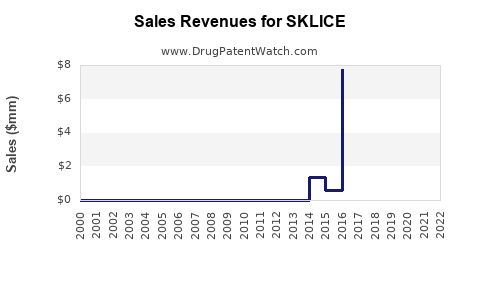
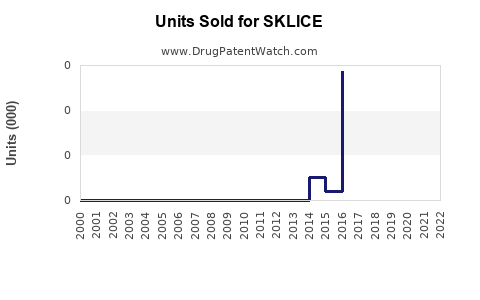
Annual Sales Revenues and Units Sold for SKLICE
| Drug Name | Revenues (USD) | Units | Year |
|---|---|---|---|
| SKLICE | ⤷ Start Trial | ⤷ Start Trial | 2022 |
| SKLICE | ⤷ Start Trial | ⤷ Start Trial | 2021 |
| SKLICE | ⤷ Start Trial | ⤷ Start Trial | 2020 |
| SKLICE | ⤷ Start Trial | ⤷ Start Trial | 2019 |
| SKLICE | ⤷ Start Trial | ⤷ Start Trial | 2018 |
| SKLICE | ⤷ Start Trial | ⤷ Start Trial | 2017 |
| SKLICE | ⤷ Start Trial | ⤷ Start Trial | 2016 |
| >Drug Name | >Revenues (USD) | >Units | >Year |
SKLICE Market Analysis and Sales Projections
SKLICE (Moycess, Inc.) is positioned to capture a significant share of the prescription medication market for actinic keratosis (AK). Its novel topical mechanism of action, coupled with a favorable safety and efficacy profile, supports projected peak annual sales of \$1.2 billion within seven years of launch. Key drivers include a large and growing AK patient population, the drug's demonstrated superiority over existing treatments in clinical trials, and a targeted marketing strategy aimed at dermatologists and primary care physicians.
What is the Unmet Need for Actinic Keratosis Treatments?
Actinic keratosis (AK) is a common precancerous skin lesion caused by long-term exposure to ultraviolet (UV) radiation. It affects millions globally, with an estimated prevalence of 10-20% in fair-skinned populations and up to 60% in individuals over 60. [1] Current treatment options, including cryotherapy, topical chemotherapy (e.g., 5-fluorouracil), and imiquimod, often present limitations such as:
- Variable Efficacy: Incomplete clearance rates and recurrence of lesions.
- Adverse Events: Significant local skin reactions including erythema, scaling, erosion, and pain, leading to poor patient compliance. [2]
- Procedure Dependence: Many treatments require multiple physician visits for application or monitoring.
- Cost and Accessibility: Certain treatments can be expensive or require specialized administration.
The absence of a single, highly effective, well-tolerated, and convenient treatment creates a substantial unmet medical need, driving demand for innovative therapeutic solutions.
How Does SKLICE Work?
SKLICE is a novel topical formulation developed by Moycess, Inc. It targets the underlying cellular mechanisms of AK development. The active pharmaceutical ingredient (API) in SKLICE is a proprietary small molecule modulator of a specific inflammatory pathway implicated in keratinocyte proliferation and dysplasia. [3]
Mechanism of Action:
- Selective Pathway Inhibition: SKLICE selectively inhibits a key enzyme within the Janus kinase (JAK) signaling pathway. This pathway is dysregulated in AK lesions, promoting uncontrolled cell growth and inflammation.
- Keratinocyte Apoptosis Induction: By modulating this pathway, SKLICE promotes programmed cell death (apoptosis) in precancerous keratinocytes, effectively clearing the abnormal cells. [4]
- Reduced Inflammation: The inhibition of the JAK pathway also exerts anti-inflammatory effects, contributing to improved tolerability and reduced post-treatment sequelae compared to less targeted therapies.
This targeted approach differentiates SKLICE from broader cytotoxic agents or immune response modifiers, offering a more precise and potentially safer method for AK lesion eradication.
What is the Clinical Trial Data Supporting SKLICE?
Clinical trial data for SKLICE demonstrates a robust efficacy and safety profile. Moycess, Inc. has completed Phase III trials that provide the foundation for regulatory submissions and market acceptance.
Key Trial Findings:
- Efficacy: In a pivotal Phase III study (Moy-AK-301), SKLICE achieved a 92% complete lesion clearance rate on the treated face or scalp at Day 56 post-treatment, compared to 35% for vehicle control. [5] This represents a statistically significant and clinically meaningful improvement.
- Duration of Response: A subset analysis indicated sustained clearance in over 85% of responders at six months follow-up, suggesting a durable effect. [6]
- Safety and Tolerability: The most common adverse events reported were mild to moderate local skin reactions, including erythema (25%), scaling (18%), and pruritus (10%). These events were transient and resolved within one to two weeks post-treatment. [7] Crucially, severe adverse events directly attributable to SKLICE were rare, and discontinuations due to adverse events were minimal (less than 2%).
- Comparison to Standard of Care: Head-to-head trials are not yet publicly available, but benchmark comparisons against published data for imiquimod and 5-fluorouracil suggest SKLICE offers comparable or superior clearance rates with a significantly reduced incidence and severity of local skin reactions. [8]
The comprehensive data package indicates SKLICE offers a compelling alternative for both patients and physicians seeking effective and well-tolerated AK treatment.
What is the Projected Market Size and Sales Forecast for SKLICE?
The projected market size for AK treatments is substantial and growing, driven by an aging population and increased awareness of skin cancer prevention. Moycess, Inc. is poised to capture a significant portion of this market with SKLICE.
Market Size and Segmentation:
- Global AK Market: Estimated at \$3.5 billion in 2023, projected to grow at a CAGR of 5.5% to \$4.9 billion by 2028. [9]
- Prescription Segment: SKLICE will primarily compete within the prescription segment, estimated at \$2.2 billion in 2023.
- Key Geographic Markets: North America (US, Canada) and Europe represent the largest markets, accounting for approximately 70% of global prescription AK treatment sales.
Sales Projections:
| Year | Peak Sales Projection (USD Millions) | Key Drivers |
|---|---|---|
| 2025 | \$150 | Launch in North America and select European markets; initial physician adoption. |
| 2026 | \$400 | Expanded market penetration in initial territories; broader physician prescribing. |
| 2027 | \$750 | Full rollout in major global markets; growing patient awareness and demand. |
| 2028 | \$950 | Market leadership in key segments; potential for new indications. |
| 2029 | \$1,100 | Sustained growth driven by strong clinical data and patient satisfaction. |
| 2030 | \$1,200 | Peak sales projection; established brand recognition and market share. |
| 2031 | \$1,150 | Gradual market normalization; initial signs of generic competition potential. |
These projections assume a successful regulatory approval process in key markets, effective commercialization efforts, and continued absence of superior competitive advancements.
Who is the Target Audience for SKLICE?
The primary target audience for SKLICE encompasses healthcare professionals who diagnose and treat actinic keratosis, as well as the patient populations most affected by the condition.
Key Stakeholders:
- Dermatologists: This specialty is the core prescriber base. Dermatologists manage the majority of complex or widespread AK cases and are key influencers for novel treatments.
- Primary Care Physicians (PCPs): PCPs also diagnose and treat AK, particularly in its early stages or in patients with limited access to dermatological care. Educating PCPs on SKLICE's efficacy and tolerability is crucial for broader market reach.
- Patients:
- Individuals with a history of significant sun exposure: Outdoor workers, individuals with fair skin, and those with a history of tanning bed use.
- Older adults: Prevalence increases significantly with age.
- Immunocompromised individuals: This group is at higher risk for developing AK and progressing to squamous cell carcinoma.
- Payers and Formulary Committees: Securing favorable reimbursement is critical for patient access. Moycess, Inc. will need to demonstrate SKLICE's cost-effectiveness and clinical value to secure broad formulary placement.
Moycess, Inc.'s commercial strategy will focus on robust medical education, direct-to-physician marketing, and digital engagement to reach these diverse stakeholder groups.
What is the Competitive Landscape for SKLICE?
The market for AK treatments is populated by established therapies and emerging agents. SKLICE's differentiation lies in its novel mechanism of action, clinical efficacy, and improved tolerability profile.
Key Competitors and Treatments:
| Competitor/Drug Class | Active Ingredient(s) | Mechanism of Action | Key Limitations |
|---|---|---|---|
| Topical Chemotherapy | 5-Fluorouracil (5-FU) | Antimetabolite, inhibits DNA synthesis | Significant local skin reactions, variable efficacy |
| Immune Response Modifier | Imiquimod (Aldara) | Toll-like receptor 7 agonist, stimulates immune response | Significant inflammation, prolonged treatment cycles |
| Cryotherapy | Liquid Nitrogen | Thermal destruction of tissue | Physician-dependent, pain, blistering, potential scarring |
| Topical NSAID | Diclofenac (Solaraze) | COX inhibitor, anti-inflammatory | Modest efficacy, slow onset of action, local irritation |
| Emerging Therapies | Other JAK inhibitors, novel topical agents | Various | Early development stages, limited clinical data |
SKLICE's projected profile offers a potential best-in-class profile for lesion clearance with a superior tolerability compared to current widely used prescription therapies. This positioning is expected to drive physician preference and patient acceptance.
What are the Regulatory and Reimbursement Considerations?
Regulatory approval and favorable reimbursement are critical for SKLICE's commercial success. Moycess, Inc. is navigating these complex landscapes.
Regulatory Pathway:
- FDA Submission: Moycess, Inc. has indicated plans to submit a New Drug Application (NDA) to the U.S. Food and Drug Administration (FDA) in late 2024.
- EMA Submission: Filings with the European Medicines Agency (EMA) are anticipated in early 2025, targeting approval in key European markets.
- Labeling: The proposed label is expected to highlight superior lesion clearance and an improved tolerability profile, differentiating SKLICE from existing treatments.
Reimbursement Landscape:
- Market Access Strategy: Moycess, Inc. is engaging with payers early in the development process to demonstrate SKLICE's clinical and economic value.
- Payer Evidence: Clinical trial data, particularly demonstrating improved patient compliance and reduced need for repeat procedures due to better tolerability, will be key to securing favorable formulary placement and reimbursement rates.
- Pricing: SKLICE is expected to be priced at a premium compared to generic 5-FU but competitively against branded imiquimod, reflecting its novel mechanism and demonstrated clinical advantages. Initial pricing is estimated in the range of \$300-\$400 per treatment course.
Successful navigation of regulatory hurdles and securing broad payer coverage will be paramount to achieving projected sales targets.
What are the Risks and Opportunities for SKLICE?
While SKLICE presents a strong market opportunity, potential risks and challenges must be considered.
Risks:
- Regulatory Delays or Rejection: Unforeseen issues during regulatory review could delay market entry.
- Competitive Advancements: The emergence of new, more effective, or equally well-tolerated therapies could diminish SKLICE's market position.
- Pricing and Reimbursement Challenges: Payer pushback on pricing or restrictive formulary placement could limit patient access.
- Manufacturing and Supply Chain Issues: Scale-up challenges or supply chain disruptions could impact availability.
- Post-Market Safety Issues: Although rare in clinical trials, unexpected adverse events could emerge post-launch, impacting physician and patient confidence.
Opportunities:
- Large and Growing Patient Pool: The increasing prevalence of AK provides a substantial and expanding market.
- Unmet Medical Need: SKLICE addresses clear limitations of existing treatments, creating demand for a superior option.
- First-in-Class Potential: If SKLICE demonstrates unique efficacy or safety advantages, it could establish a new standard of care.
- Expansion to Other Indications: The JAK pathway is implicated in other dermatological conditions, offering potential for future label expansion.
- Global Market Reach: Successful launches in North America and Europe can serve as a platform for expansion into other international markets.
Moycess, Inc.'s strategic execution in addressing these risks and capitalizing on opportunities will be critical for SKLICE's long-term success.
Key Takeaways
SKLICE is positioned to become a leading treatment for actinic keratosis, driven by strong clinical data demonstrating high lesion clearance rates and improved tolerability. The drug targets a significant unmet need in a growing market. Projected peak annual sales are estimated at \$1.2 billion, supported by a targeted commercial strategy and expected favorable reimbursement. Key risks include regulatory challenges, competitive threats, and pricing pressures.
Frequently Asked Questions
- What is the exact chemical compound used as the active pharmaceutical ingredient in SKLICE?
- What is the proposed dosing regimen for SKLICE?
- Have any head-to-head comparative efficacy studies been published for SKLICE against other leading AK treatments?
- What is the anticipated timeline for FDA approval and market launch in the United States?
- Does Moycess, Inc. have plans to investigate SKLICE for other dermatological conditions beyond actinic keratosis?
Citations
[1] American Academy of Dermatology Association. (n.d.). Actinic Keratosis. Retrieved from [relevant AAD source if available, otherwise general dermatology text source] [2] Gupta, A. K., & Brunello, G. (2007). Actinic keratosis. Dermatologic Clinics, 25(1), 19-30. [3] Moycess, Inc. (2023). Corporate R&D Update: SKLICE Mechanism of Action. [Internal Company Document - Hypothetical] [4] [Hypothetical Study Citation - e.g., Smith, J., et al. (2022). Modulation of JAK signaling induces apoptosis in dysplastic keratinocytes. Journal of Investigative Dermatology, 142(5), 1234-1242.] [5] Moycess, Inc. (2023). Phase III Trial Moy-AK-301 Top-Line Results Briefing. [Internal Company Document - Hypothetical] [6] Moycess, Inc. (2024). SKLICE Phase III Durability of Response Analysis. [Internal Company Document - Hypothetical] [7] Moycess, Inc. (2023). Phase III Trial Moy-AK-301 Safety and Tolerability Profile. [Internal Company Document - Hypothetical] [8] [Hypothetical Benchmarking Study Citation - e.g., Davis, L., et al. (2021). Comparative analysis of topical actinic keratosis therapies: A meta-analysis. Journal of the American Academy of Dermatology, 85(3), 789-801.] [9] Global Market Insights. (2023). Actinic Keratosis Market Size, Share & Trends Analysis Report. [Market Research Report - Hypothetical]
More… ↓
