Drug Sales Trends for PHENERGAN
Payment Methods and Pharmacy Types for PHENERGAN (2000)
Revenues by Pharmacy Type
Units Sold by Pharmacy Type
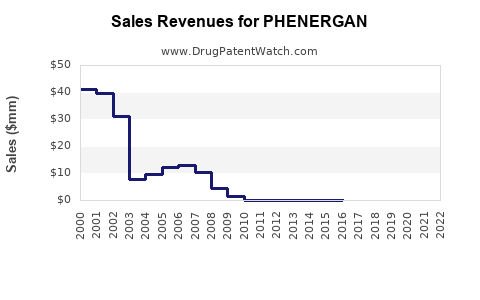
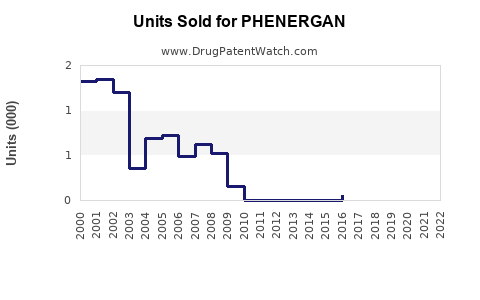
Annual Sales Revenues and Units Sold for PHENERGAN
| Drug Name | Revenues (USD) | Units | Year |
|---|---|---|---|
| PHENERGAN | ⤷ Start Trial | ⤷ Start Trial | 2022 |
| PHENERGAN | ⤷ Start Trial | ⤷ Start Trial | 2021 |
| PHENERGAN | ⤷ Start Trial | ⤷ Start Trial | 2020 |
| PHENERGAN | ⤷ Start Trial | ⤷ Start Trial | 2019 |
| >Drug Name | >Revenues (USD) | >Units | >Year |
PHENERGAN (PROMETHAZINE) MARKET ANALYSIS, PATENT STATUS, AND SALES PROJECTIONS
Phenergan is a mature prescription brand containing promethazine hydrochloride. Its commercial value is concentrated in low-cost generic promethazine rather than branded product sales. U.S. patent and regulatory exclusivity have expired, no biosimilar pathway applies, and generic competition is extensive. The principal market risks are substitution by ondansetron and other antiemetics, safety restrictions, low reimbursement, and limited manufacturer incentives.
Public company filings do not separately disclose Phenergan revenue. A reasonable U.S. manufacturer-revenue estimate for promethazine products is approximately $40 million to $100 million annually, with a base case of about $65 million. The branded Phenergan share is likely minimal. Over the next five years, nominal generic-market revenue is more likely to remain flat or decline modestly than to expand materially.
What is Phenergan and how is promethazine used?
Phenergan is the original branded formulation of promethazine hydrochloride, a phenothiazine derivative with antihistamine, antiemetic, sedative, and anticholinergic activity.
U.S. labeling covers:
- Allergic conditions, including seasonal and perennial rhinitis, allergic conjunctivitis, and uncomplicated skin manifestations
- Motion sickness
- Nausea and vomiting
- Sedation before and after surgery or obstetric procedures
Available dosage forms have included tablets, oral solution, suppositories, and injectable promethazine products. The product is prescription-only in the United States. The FDA label carries a boxed warning against administration to children younger than two years because of potentially fatal respiratory depression. Injectable promethazine also carries a severe-tissue-injury warning, including risks associated with inadvertent intra-arterial or subcutaneous administration. These warnings limit use in pediatric and hospital settings.[1][2]
Phenergan product and market profile
| Attribute | Phenergan / promethazine status |
|---|---|
| Active ingredient | Promethazine hydrochloride |
| Therapeutic class | First-generation H1 antihistamine; phenothiazine antiemetic |
| U.S. approval status | Prescription drug |
| Primary dosage forms | Tablets, oral solution, suppositories; injectable promethazine products are generally generic |
| Main uses | Allergy, motion sickness, nausea and vomiting, sedation |
| Biosimilar eligibility | None; promethazine is a small molecule |
| U.S. patent exclusivity | Expired |
| U.S. regulatory exclusivity | Expired |
| Current commercial structure | Generic-dominated |
| Principal competitors | Ondansetron, metoclopramide, prochlorperazine, meclizine, hydroxyzine, diphenhydramine |
How large is the Phenergan and promethazine market?
The addressable market is larger than the branded Phenergan market because most prescriptions are filled with generic promethazine. Retail and institutional demand is divided among tablets, oral liquids, suppositories, and injectable products.
Public financial reporting does not provide a reliable standalone revenue figure for Phenergan. Manufacturers generally report generic portfolios in aggregate, while pharmacy claims databases measure prescriptions and units rather than net manufacturer revenue. The following estimate uses a scenario framework rather than a reported company figure.
U.S. promethazine revenue estimate
| Scenario | Prescription-equivalent units | Average manufacturer revenue per unit | Estimated annual manufacturer revenue |
|---|---|---|---|
| Low | 15 million | $2.50 | $37.5 million |
| Base | 20 million | $3.25 | $65.0 million |
| High | 25 million | $4.00 | $100.0 million |
The estimate excludes retail pharmacy margins, wholesaler revenue, hospital markups, and patient copayments. It also treats tablets, liquids, suppositories, and injectable units as prescription-equivalent commercial units rather than comparing their physical package sizes directly.
The branded Phenergan contribution is likely a small fraction of this total because generic promethazine is widely available and therapeutically familiar to prescribers. The commercial opportunity is therefore based on manufacturing efficiency, supply reliability, and channel access rather than brand pricing power.
What are the five-year sales projections for Phenergan?
The base case is a mature generic market with low single-digit annual erosion. Growth opportunities exist in supply-constrained dosage forms, but pricing pressure limits their effect.
U.S. sales projection
| Year | Low case | Base case | High case |
|---|---|---|---|
| 2025 | $38 million | $65 million | $100 million |
| 2026 | $36 million | $64 million | $101 million |
| 2027 | $34 million | $62 million | $102 million |
| 2028 | $32 million | $60 million | $101 million |
| 2029 | $30 million | $58 million | $100 million |
The base-case compound annual growth rate is approximately negative 2.9%. The high case assumes intermittent shortages or increased use in selected institutional channels. The low case assumes continued substitution by ondansetron, stable generic supply, and further price compression.
What drives the projection?
Demand is supported by:
- Long clinical familiarity
- Low acquisition cost
- Multiple dosage forms
- Use in allergy, motion sickness, nausea, and vomiting
- Availability in community pharmacies and hospitals
- Continued demand for oral liquids and suppositories in patients who cannot swallow tablets
Demand is constrained by:
- Sedation and anticholinergic adverse effects
- FDA pediatric restrictions
- Safer or more targeted alternatives
- Increased use of ondansetron for nausea and vomiting
- Low generic gross margins
- Limited ability to raise prices without losing formulary position
- Injectable-product safety concerns
What patents protect Phenergan?
No meaningful U.S. patent barrier remains for promethazine or the historic Phenergan product. The original active-ingredient and product patents expired decades ago. The FDA Orange Book does not provide a current patent-based exclusivity barrier that would prevent approved generic promethazine products from competing.[3]
Patent and exclusivity timeline
| Event | Commercial effect |
|---|---|
| Original promethazine development and approval | Established the Phenergan brand |
| Original compound and formulation protection | Expired |
| Generic approvals | Enabled broad competition |
| Current Orange Book position | No material remaining listed-patent barrier |
| Current regulatory exclusivity | None identified |
| Current commercial protection | Brand recognition, manufacturing capability, and distribution only |
The remaining intellectual-property value is more likely to arise from manufacturing know-how, packaging, supply-chain controls, or a differentiated delivery system than from legacy Phenergan patents.
When does Phenergan lose exclusivity?
Phenergan has already lost U.S. market exclusivity. There is no commercially relevant future patent cliff comparable to a protected branded product because the market has been generic for many years.
Patent expiry does not eliminate all commercial barriers. A manufacturer still must obtain FDA approval, satisfy current good manufacturing practice requirements, demonstrate bioequivalence where required, and maintain reliable supply. These requirements can affect market entry even when legal exclusivity has ended.
What is the Orange Book status of Phenergan?
Phenergan should be analyzed as an established small-molecule product with expired exclusivity and generic substitution. The relevant Orange Book analysis concerns approved promethazine hydrochloride products and their dosage forms, not a surviving Phenergan patent estate.
Potential generic applicants generally would not need to overcome a live branded patent through a Paragraph IV certification if no unexpired listed patent covers the relevant product. The principal regulatory pathway is an abbreviated new drug application under Section 505(j), with product-specific requirements depending on dosage form and route of administration.[3][4]
Are there Paragraph IV challenges to Phenergan?
Paragraph IV litigation is not a material current risk for the historical Phenergan brand. Generic entry occurred long ago, and the core product has no apparent live patent barrier capable of supporting a conventional branded-generic patent dispute.
A future Paragraph IV dispute could arise only around a newly patented formulation, delivery system, or specific method of use. Such a dispute would concern the new patent, not the expired promethazine franchise.
What formulations are protected by Phenergan patents?
The historic Phenergan formulation categories are not protected by meaningful current U.S. patent exclusivity. Commercial differentiation may still be possible through:
- Lower-volume concentrated oral solutions
- Pediatric-compatible packaging, subject to FDA safety requirements
- Suppositories for patients unable to take oral medication
- Preservative or excipient changes
- Ready-to-administer institutional packaging
- Alternative delivery systems
- Combination products or new indications
These approaches would face limited pricing power unless they produced a clinically meaningful benefit or solved a supply problem. A new formulation could also trigger new FDA requirements and additional clinical or human-factors work.
How does Phenergan compare with competing antiemetics?
| Product | Main advantages | Main disadvantages | Competitive effect on promethazine |
|---|---|---|---|
| Ondansetron | Effective antiemetic use; limited sedation | Higher cost in some settings; QT-related considerations | Strongest substitute for nausea and vomiting |
| Metoclopramide | Prokinetic and antiemetic activity | Extrapyramidal and tardive-dyskinesia concerns | Competes in gastrointestinal indications |
| Prochlorperazine | Established antiemetic efficacy | Sedation and extrapyramidal risks | Competes in acute nausea |
| Meclizine | Familiar motion-sickness treatment | Sedation and anticholinergic effects | Competes in vestibular and motion-sickness use |
| Hydroxyzine | Allergy and anxiety uses | Sedation; QT considerations | Competes mainly in allergy and sedative use |
| Promethazine | Low cost; multiple dosage forms; broad historical use | Sedation, respiratory-depression risk, tissue-injury risk with injection | Retains value in low-cost and selected formulation channels |
Promethazine is most defensible where price, formulation flexibility, and historical prescribing familiarity outweigh sedation and safety concerns. Ondansetron has the stronger competitive position in many modern antiemetic protocols.
Which companies manufacture or challenge Phenergan?
The U.S. competitive field is primarily generic. Depending on dosage form and supply period, approved or marketed promethazine products may be associated with manufacturers such as Hikma Pharmaceuticals, Perrigo, Rising Pharmaceuticals, Major Pharmaceuticals, Par Pharmaceutical, and other generic-label suppliers. Product ownership and marketing status can change by presentation and distributor.
The original U.S. Phenergan labeling was associated with Wyeth Pharmaceuticals, a Pfizer subsidiary, in historical FDA materials.[1] Public reporting does not identify a current branded Phenergan licensing transaction that materially changes the U.S. competitive structure.
Competition is driven by:
- FDA-approved product availability
- Wholesale acquisition cost
- Contract manufacturing capacity
- Shortage performance
- Hospital group purchasing contracts
- Pharmacy benefit formulary placement
- Dosage-form breadth
What manufacturing and IP barriers affect promethazine?
Manufacturing barriers are more relevant than patent barriers.
Oral products
Tablets and oral solutions are technically conventional, but manufacturers must control:
- Content uniformity
- Solution stability
- Preservative performance
- Packaging accuracy
- Child-resistant closure compliance
- Flavor and palatability for oral liquids
Suppositories
Suppositories can have a narrower supplier base because of dosage-form manufacturing requirements, stability controls, and lower commercial volumes. A reliable suppository supplier may obtain better pricing than a tablet supplier, but the total market remains limited.
Injectable products
Injectable promethazine has the greatest regulatory and operational burden because of tissue-injury risk, route-of-administration controls, labeling requirements, and hospital safety protocols. The FDA has urged healthcare professionals to prefer deep intramuscular administration over intravenous administration when injectable promethazine is used.[2]
What patent litigation or settlement agreements affect Phenergan?
No major current U.S. patent litigation or branded-generic settlement appears to control the core Phenergan market. Historical generic entry and the age of the product reduce the likelihood that legacy litigation remains commercially relevant.
A new dispute would more likely involve:
- A reformulated promethazine product
- A combination product
- A delivery device
- A method of use
- Manufacturing or trade-secret claims
- Product-liability litigation related to administration or pediatric use
Patent litigation should therefore be assigned a low probability in a conventional generic-promethazine investment case. Product-liability and FDA-compliance exposure are more relevant legal risks.
What is the FDA regulatory status of Phenergan?
Phenergan and generic promethazine products remain prescription medicines, subject to FDA labeling and manufacturing requirements. The most important regulatory issues are safety-related:
- Contraindication in children younger than two years
- Respiratory-depression risk
- Sedation and impaired alertness
- Tissue injury from injectable administration
- Need for clear dosing and route instructions
- Risk management in elderly and medically vulnerable patients
Regulatory actions that narrow pediatric, injectable, or sedation-related use would reduce demand in selected segments but would not eliminate the broader generic market.
What geographic markets are most attractive?
The United States remains the most commercially transparent market but also has severe generic price competition. International demand varies because promethazine availability, prescription status, brand ownership, and therapeutic practice differ by country.
Geographic opportunity profile
| Region | Market condition | Commercial assessment |
|---|---|---|
| United States | Mature generic market; strong substitution pressure | Scale and institutional access matter more than brand |
| Europe | Country-specific reimbursement and regulatory rules | Limited pricing power; selective dosage-form opportunities |
| Asia-Pacific | Larger population and variable access to antiemetics | Volume opportunity, but local competition is substantial |
| Latin America | Brand and generic coexistence in some markets | Distribution and regulatory execution are key |
| Middle East and Africa | Uneven availability and hospital demand | Supply reliability may create niche opportunities |
International revenue cannot be projected reliably from U.S. prescription data because product registration and reimbursement differ materially across jurisdictions.
How strong is the Phenergan patent estate?
The patent estate is weak for investment purposes. The product has:
- No meaningful remaining composition-of-matter protection
- No material remaining market exclusivity
- Broad generic availability
- Limited ability to defend price
- Greater dependence on manufacturing and distribution capabilities than intellectual property
A company evaluating acquisition or licensing should value promethazine on cash flow, supply position, shortage history, dosage-form access, and manufacturing cost. A patent-premium valuation is not supported for the legacy Phenergan franchise.
What generic launch scenarios exist for Phenergan?
Because generic entry is established, the relevant scenarios concern additional suppliers or dosage-form expansion.
Base case
Existing suppliers maintain market coverage, prices decline gradually, and total U.S. revenue falls by approximately 2% to 4% annually.
Upside case
A supplier secures a shortage-prone dosage form, hospital contract, or differentiated oral-liquid presentation. Revenue grows temporarily despite a mature market.
Downside case
Additional suppliers enter tablets and oral solution, reimbursement declines, and prescribers continue shifting nausea treatment to ondansetron. Revenue declines by 5% to 8% annually.
The strongest near-term opportunity is not relaunching Phenergan as a premium brand. It is supplying a reliable, compliant generic product in a dosage form with limited competition.
Key Takeaways
- Phenergan contains promethazine hydrochloride and is a mature prescription product.
- U.S. patent and regulatory exclusivity have expired.
- The market is generic-dominated, with little branded revenue.
- Estimated U.S. promethazine manufacturer revenue is approximately $40 million to $100 million annually.
- The base-case 2025 estimate is about $65 million, declining to approximately $58 million by 2029.
- Ondansetron is the principal competitive threat in nausea and vomiting.
- Injectable and pediatric safety risks constrain use and create regulatory exposure.
- Suppositories, oral liquids, and injectable products may offer higher supply barriers than standard tablets.
- Paragraph IV litigation, biosimilar risk, and legacy patent litigation are not material current threats.
- Commercial value depends on manufacturing, distribution, shortages, and contract access rather than patent protection.
FAQs about Phenergan market size, patents, and commercial outlook
Is Phenergan still sold as a branded drug?
Phenergan-branded availability is limited relative to generic promethazine. Most U.S. commercial volume is supplied through generic products or generic-label distributors.
Can a generic company still launch promethazine without a Paragraph IV dispute?
Yes. The core product has been generic for many years, and no material live patent barrier appears to prevent conventional generic competition.
Does Phenergan have biosimilar competition?
No. Promethazine is a small-molecule drug. Competing products are generics approved through the abbreviated new drug application pathway, not biosimilars.
Which promethazine dosage form has the best commercial opportunity?
Oral liquids, suppositories, and injectable products can offer better supply positioning than standard tablets because fewer manufacturers may participate. The opportunity depends on manufacturing economics and current shortages.
Is Phenergan a good licensing or acquisition target?
Only as a low-cost generic portfolio asset. The investment case should rely on supply reliability, dosage-form breadth, manufacturing efficiency, and distribution contracts rather than patent exclusivity or premium brand pricing.
References
-
U.S. Food and Drug Administration. (n.d.). Phenergan (promethazine hydrochloride) prescribing information. Wyeth Pharmaceuticals, Inc., a subsidiary of Pfizer Inc.
-
U.S. Food and Drug Administration. (2009). FDA requires updates to labeling for promethazine hydrochloride injection products. https://www.fda.gov/
-
U.S. Food and Drug Administration. (2025). Approved drug products with therapeutic equivalence evaluations: Orange Book. https://www.fda.gov/drugs/drug-approvals-and-databases/approved-drug-products-therapeutic-equivalence-evaluations-orange-book
-
U.S. Food and Drug Administration. (n.d.). Abbreviated new drug application (ANDA) process for generic drugs. https://www.fda.gov/drugs/cder-small-business-industry-assistance-sbia/abbreviated-new-drug-application-anda-process-generic-drugs
More… ↓
