Drug Sales Trends for NAPRELAN
Payment Methods and Pharmacy Types for NAPRELAN (2000)
Revenues by Pharmacy Type
Units Sold by Pharmacy Type
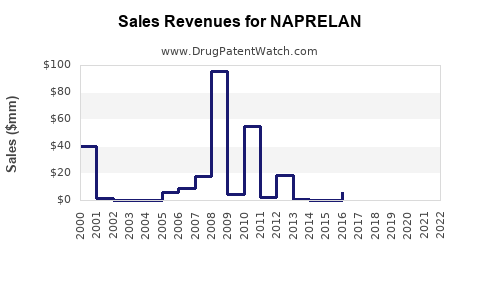
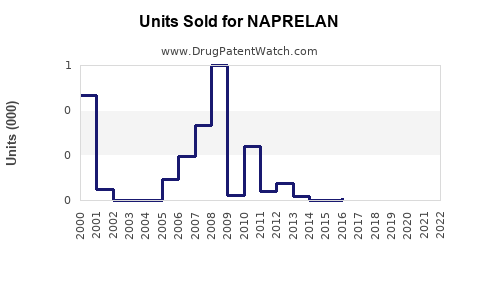
Annual Sales Revenues and Units Sold for NAPRELAN
| Drug Name | Revenues (USD) | Units | Year |
|---|---|---|---|
| NAPRELAN | ⤷ Start Trial | ⤷ Start Trial | 2022 |
| NAPRELAN | ⤷ Start Trial | ⤷ Start Trial | 2021 |
| NAPRELAN | ⤷ Start Trial | ⤷ Start Trial | 2020 |
| NAPRELAN | ⤷ Start Trial | ⤷ Start Trial | 2019 |
| NAPRELAN | ⤷ Start Trial | ⤷ Start Trial | 2018 |
| NAPRELAN | ⤷ Start Trial | ⤷ Start Trial | 2017 |
| NAPRELAN | ⤷ Start Trial | ⤷ Start Trial | 2016 |
| >Drug Name | >Revenues (USD) | >Units | >Year |
NAPRELAN Market Analysis and Sales Projections: Controlled-Release Naproxen Sodium
Naprelan is a prescription controlled-release formulation of naproxen sodium used for osteoarthritis, rheumatoid arthritis and ankylosing spondylitis. Its commercial value is limited by generic naproxen competition, extensive NSAID substitution and the apparent absence of a currently active branded sales platform. Public sources do not disclose standalone Naprelan revenue. The relevant commercial opportunity is therefore a controlled-release naproxen product, not a conventional branded-drug launch.
Under a U.S.-focused scenario, annual manufacturer net sales for a relaunch or authorized-generic strategy could reach approximately $2 million to $8 million by 2029. A branded relaunch without meaningful differentiation would likely remain below $2 million annually. A broader generic portfolio with hospital, long-term-care and specialty-pharmacy contracts could reach $10 million to $20 million, but that outcome would require substantial formulary access and reliable supply.
What is Naprelan and how does the drug work?
Naprelan is an extended-release tablet containing naproxen sodium, a nonsteroidal anti-inflammatory drug. The controlled-release dosage form is designed to provide prolonged naproxen exposure from once-daily administration.
The product has been associated with three strengths:
| Product | Strength | Dosage form | Primary commercial role |
|---|---|---|---|
| Naprelan | 375 mg | Controlled-release tablet | Lower-dose chronic therapy |
| Naprelan | 500 mg | Controlled-release tablet | Standard chronic therapy |
| Naprelan | 750 mg | Controlled-release tablet | Higher-dose chronic therapy |
The FDA labeling identifies Naprelan for relief of signs and symptoms associated with osteoarthritis, rheumatoid arthritis and ankylosing spondylitis. The labeling also carries class warnings for gastrointestinal bleeding, cardiovascular thrombotic events, hypertension, renal toxicity and serious skin reactions.[1]
Naproxen sodium is the salt form of naproxen. Its principal differentiation from immediate-release naproxen is dosage-form performance rather than a new active ingredient. That distinction reduces pricing power because prescribers can generally substitute immediate-release or generic extended-release naproxen products.
What is the FDA regulatory status of Naprelan?
Naprelan was approved through a U.S. New Drug Application for controlled-release naproxen sodium tablets. The product is not a biologic and does not create biosimilar exposure. Competition occurs through generic drug approval under abbreviated new drug applications.
The principal regulatory issues are:
- Demonstration of pharmaceutical equivalence.
- Bioequivalence to the applicable reference product.
- Manufacturing consistency for the extended-release matrix.
- Stability and dissolution performance.
- Compliance with NSAID labeling and post-market safety requirements.
The FDA may approve generic controlled-release products if they meet applicable equivalence standards. A generic competitor does not need to reproduce the brand’s commercial positioning, physician promotion or packaging. That creates a low barrier to price competition once regulatory and manufacturing requirements are met.
What is the Orange Book status of Naprelan?
The FDA Orange Book is the primary source for current U.S. reference-listed-drug and patent-listing information. Naprelan’s commercial relevance is constrained if the brand is listed as discontinued or has no active, enforceable patent protection blocking generic approval.
A discontinued brand can remain relevant as an FDA reference product depending on its regulatory listing and availability of an approved reference standard. Its commercial presence, however, is separate from its regulatory status.
| Orange Book issue | Commercial impact |
|---|---|
| Active reference-listed-drug status | Supports generic approval referencing the product |
| Discontinued brand status | Reduces physician and pharmacy pull-through |
| No active listed patents | Removes a principal barrier to ANDA approval |
| Listed method-of-use patents | May permit carve-outs, but usually does not protect the core product |
| No exclusivity remaining | Allows immediate generic competition upon approval |
Publicly available information does not support a current branded Naprelan exclusivity period or an active exclusivity-based barrier to generic competition. The applicable Orange Book entry should be checked against the FDA’s current edition before any transaction, launch or litigation decision.[2]
When does Naprelan lose exclusivity?
Naprelan’s practical market exclusivity has already expired. The original approval dates to the 1990s, and any ordinary five-year new-chemical-entity exclusivity would have ended long ago. Any historical patent protection for the controlled-release formulation would also have reached its ordinary expiration period before the current market.
The commercial question is therefore not when Naprelan will lose exclusivity. It is whether a manufacturer can create a profitable controlled-release naproxen product after exclusivity.
Relevant exclusivity categories are:
| Exclusivity category | Naprelan outlook |
|---|---|
| New chemical entity exclusivity | Expired |
| Three-year clinical-investigation exclusivity | No current protection identified |
| Pediatric exclusivity | No current protection identified |
| Orphan-drug exclusivity | Not applicable |
| Patent-term extension | No current commercial barrier identified |
| Data exclusivity for a biologic | Not applicable |
How large is the naproxen and NSAID market?
Naproxen competes in a mature, high-volume analgesic and anti-inflammatory market. The market includes:
- Prescription naproxen.
- Prescription naproxen sodium.
- Over-the-counter naproxen sodium.
- Ibuprofen and other NSAIDs.
- Acetaminophen for non-NSAID pain treatment.
- Topical NSAIDs.
- Selective COX-2 inhibitors.
- Intra-articular and biologic treatments for inflammatory arthritis.
The largest demand pools are osteoarthritis, rheumatoid arthritis, musculoskeletal pain and chronic back pain. Naproxen is clinically established, inexpensive and familiar to prescribers. Those factors support unit demand but suppress revenue per prescription.
Naprelan has a narrower addressable market than total naproxen because controlled-release tablets are most relevant to patients requiring sustained chronic therapy and those who value once-daily dosing. The product is not positioned to capture the full over-the-counter naproxen market.
How does Naprelan compare with competing drugs?
| Product or category | Key advantage | Key limitation versus Naprelan |
|---|---|---|
| Immediate-release naproxen | Low price and broad availability | More frequent dosing |
| Generic naproxen sodium | Pharmacy access and low acquisition cost | Limited differentiation |
| OTC Aleve | Strong consumer recognition | Lower physician control and self-medication risks |
| Ibuprofen | Extensive consumer and generic availability | Often requires more frequent dosing |
| Celecoxib | Prescription COX-2 positioning | Higher price and cardiovascular-risk considerations |
| Meloxicam | Once-daily prescription dosing | Different pharmacokinetic and clinical profile |
| Diclofenac | Strong anti-inflammatory use | More prominent cardiovascular and hepatic concerns |
| Topical diclofenac | Lower systemic exposure | Limited utility for widespread or deep-joint pain |
Naprelan’s strongest product attribute is once-daily controlled release. Its main weakness is that generic immediate-release naproxen, generic extended-release products and other once-daily NSAIDs can address the same prescribing need at lower cost.
What are the projected Naprelan sales through 2029?
Because public financial filings do not separately report Naprelan revenue, the following forecast is a scenario model for U.S. manufacturer net sales. It is not a reported historical-sales series.
Base-case forecast
Assumptions include a low-price prescription product, no meaningful patent barrier, limited physician promotion, generic competition and distribution through retail and mail-order channels.
| Year | Estimated prescriptions | Estimated net sales |
|---|---|---|
| 2025 | 90,000 | $1.2 million |
| 2026 | 120,000 | $1.7 million |
| 2027 | 165,000 | $2.4 million |
| 2028 | 215,000 | $3.2 million |
| 2029 | 270,000 | $4.1 million |
The base case assumes a net revenue of approximately $14 to $16 per prescription. That range reflects heavy generic pricing pressure and limited brand reimbursement.
Scenario analysis
| Scenario | 2029 prescriptions | 2029 net sales | Conditions |
|---|---|---|---|
| Downside | 75,000 | $0.9 million | No strong payer access; fragmented supply |
| Base case | 270,000 | $4.1 million | Stable generic distribution and modest chronic-use uptake |
| Upside | 650,000 | $10.4 million | National contracts, dependable supply and once-daily positioning |
| Strategic portfolio case | 1.0 million | $15 million-$20 million | Multiple strengths, institutional contracts and broad generic distribution |
The upside case requires more than brand awareness. It depends on pharmacy stocking, formulary placement, competitive acquisition cost and an adequate supply chain. A branded relaunch is unlikely to justify high promotional spending because expected price elasticity is substantial.
What drives Naprelan revenue growth?
The principal revenue drivers are:
Once-daily dosing
Once-daily administration can support adherence in chronic arthritis treatment. The benefit is commercially useful only if payers accept a premium over immediate-release naproxen or other generic once-daily NSAIDs.
Institutional and long-term-care contracts
Hospitals, rehabilitation facilities and long-term-care operators may value predictable dosing and simplified medication administration. Contract volume can improve manufacturing utilization, but institutional prices are often lower than retail prices.
Generic availability
A manufacturer with multiple strengths and dependable fill rates can gain share when competitors experience shortages. The opportunity is operational rather than patent-driven.
Pharmacy benefit coverage
Preferred formulary placement can increase prescription volume. Nonpreferred status or prior authorization would materially reduce adoption because low-cost alternatives are widely available.
Patient switching
Patients already using naproxen may be switched to a controlled-release product when dosing frequency, adherence or gastrointestinal tolerability is a concern. Switching is limited by the absence of a clear clinical advantage over other once-daily NSAIDs.
What generic launch risks exist for Naprelan?
The main generic launch risks are commercial, regulatory and manufacturing-related.
| Risk | Likely effect |
|---|---|
| Low reimbursement | Limits net price and gross margin |
| Immediate-release substitution | Reduces controlled-release volume |
| Multiple ANDA competitors | Accelerates price erosion |
| Dissolution variability | Raises regulatory and batch-release risk |
| Active pharmaceutical ingredient shortages | Interrupts supply and loses pharmacy placement |
| Low prescriber awareness | Increases dependence on payer and distributor channels |
| NSAID safety concerns | Restricts chronic-use promotion |
| Reference-product uncertainty | Complicates ANDA strategy if the brand is discontinued |
Controlled-release tablets require more complex formulation control than conventional immediate-release naproxen. Manufacturing barriers are therefore higher than for standard naproxen tablets, but they are not generally high enough to support durable monopoly pricing.
What patents protect Naprelan?
The original commercial value of Naprelan was based on controlled-release formulation technology and related regulatory rights rather than a new active molecule. Any historical formulation patents would have covered features such as release characteristics, tablet composition or administration methods.
No current patent position is identified here as creating a practical U.S. barrier to generic controlled-release naproxen sodium. The relevant diligence points are:
- Historical U.S. patents assigned to the original product developer.
- Orange Book patent listings associated with the reference product.
- Patent expiration and terminal-disclaimer data.
- Paragraph IV certifications filed against listed patents.
- Any patent litigation involving generic applicants.
- Manufacturing patents covering matrix composition or release-control technology.
A Paragraph IV challenge is commercially relevant only if an unexpired Orange Book-listed patent remains enforceable. For an established 1990s product, that condition is unlikely to support a current market-exclusion strategy.
Which companies are challenging Naprelan?
Naprelan does not have the type of high-profile Paragraph IV litigation profile associated with recent specialty drugs or biologics. Generic naproxen and naproxen sodium products are marketed by multiple manufacturers, but the public record does not establish a current, material litigation campaign centered on Naprelan.
Potential competitors include manufacturers of:
- Generic naproxen sodium immediate-release tablets.
- Generic naproxen extended-release tablets.
- Authorized generic products.
- Competing once-daily NSAIDs.
- OTC naproxen sodium.
A current competitive review should distinguish between products referencing Naprelan specifically and products competing for the same prescription demand without relying on the Naprelan formulation.
What licensing deals affect Naprelan?
No major current licensing transaction is identified as a material driver of Naprelan sales. Historical ownership and commercialization arrangements may have changed as pharmaceutical assets moved among specialty and generic companies, but the product’s current economics are more likely determined by manufacturing rights, supply agreements and distribution contracts than by royalty-bearing innovation licenses.
A buyer evaluating the asset should focus on:
- NDA ownership and transfer history.
- Manufacturing-site approvals.
- Contract manufacturing terms.
- Rights to the Naprelan trademark.
- Distribution agreements.
- Product-liability allocation.
- Inventory and supply obligations.
- Rights to any formulation know-how.
How strong is the Naprelan patent estate?
The patent estate is commercially weak by branded-pharmaceutical standards. The active ingredient is old, the original approval is more than two decades old, and generic alternatives are available. Any remaining value would likely be concentrated in formulation know-how, manufacturing reliability, regulatory files and commercial relationships.
| Patent-estate factor | Assessment |
|---|---|
| Active ingredient protection | None of practical value |
| Core product exclusivity | Expired |
| Formulation protection | Historical; current blocking value appears limited |
| Method-of-use protection | Limited commercial relevance |
| Manufacturing know-how | Potentially useful but difficult to value publicly |
| Geographic protection | Mainly U.S. regulatory and trademark rights |
| Litigation leverage | Low absent an unexpired listed patent |
What is the likely generic launch scenario?
The most likely scenario is continued substitution toward low-cost naproxen products, with controlled-release volume remaining a niche segment. If a manufacturer relaunches Naprelan, the successful model would be a low-cost, multi-strength generic or authorized-generic strategy rather than a premium branded campaign.
A realistic launch plan would prioritize:
- FDA-compliant supply in all three strengths.
- Wholesale and group-purchasing contracts.
- Pharmacy benefit manager access.
- Long-term-care and institutional channels.
- Manufacturing redundancy.
- A net-price structure below branded once-daily NSAID competitors.
- Limited, evidence-based adherence messaging.
Key Takeaways
- Naprelan is an extended-release naproxen sodium prescription product.
- Its original market exclusivity has expired.
- Public sources do not provide standalone current Naprelan revenue.
- The commercial opportunity is a controlled-release naproxen product, not a protected branded franchise.
- Base-case U.S. sales could reach about $4 million by 2029 after a relaunch, assuming modest distribution and generic pricing.
- An upside case of $10 million or more requires national contracts, reliable supply and payer access.
- The principal barriers are reimbursement, substitution and manufacturing economics rather than patents.
- Biosimilar risk is not applicable because Naprelan is a small-molecule drug.
- No current Paragraph IV litigation or licensing transaction is identified as a material market driver.
FAQs
Is Naprelan still available in the United States?
Naprelan’s current branded availability appears limited. Controlled-release naproxen products and generic alternatives may be available depending on manufacturer, wholesaler inventory and pharmacy sourcing.
Is Naprelan stronger than regular naproxen?
Naprelan is not inherently a stronger active ingredient. Its controlled-release formulation is designed to extend drug release and support less frequent dosing.
Can a generic company launch Naprelan without a patent license?
A generic company generally does not need a patent license if no enforceable patent blocks approval and launch. It must still satisfy FDA requirements for the applicable abbreviated application.
Does Naprelan have biosimilar competition?
No. Naprelan contains the small-molecule drug naproxen sodium. Competition is through generic-drug pathways, not biosimilar approval.
Would a Naprelan relaunch support premium pricing?
A premium price would be difficult to sustain. The product would need superior payer access, dependable supply, a recognized adherence benefit or a differentiated formulation to support pricing above generic naproxen alternatives.
References
- U.S. Food and Drug Administration. (n.d.). Naprelan: Naproxen sodium controlled-release tablets prescribing information. FDA/DailyMed.
- U.S. Food and Drug Administration. (2025). Approved drug products with therapeutic equivalence evaluations: Orange Book. FDA.
- U.S. Food and Drug Administration. (n.d.). Abbreviated new drug application process for generic drugs. FDA.
- U.S. Food and Drug Administration. (n.d.). Drug safety communication: FDA strengthens warning that non-aspirin nonsteroidal anti-inflammatory drugs increase chance of heart attack or stroke. FDA.
- DailyMed. (n.d.). Naproxen sodium extended-release tablets. National Library of Medicine.
More… ↓
