Drug Sales Trends for MULTAQ
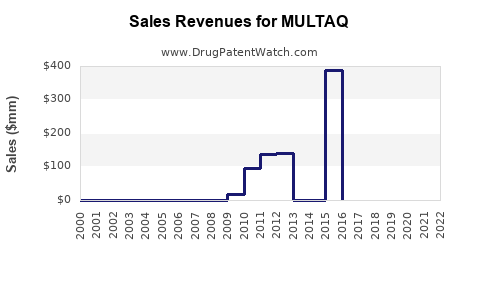
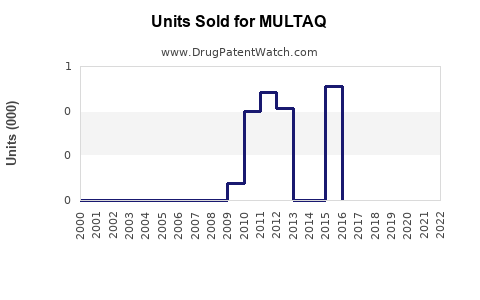
Annual Sales Revenues and Units Sold for MULTAQ
| Drug Name | Revenues (USD) | Units | Year |
|---|---|---|---|
| MULTAQ | ⤷ Start Trial | ⤷ Start Trial | 2022 |
| MULTAQ | ⤷ Start Trial | ⤷ Start Trial | 2021 |
| MULTAQ | ⤷ Start Trial | ⤷ Start Trial | 2020 |
| MULTAQ | ⤷ Start Trial | ⤷ Start Trial | 2019 |
| MULTAQ | ⤷ Start Trial | ⤷ Start Trial | 2018 |
| MULTAQ | ⤷ Start Trial | ⤷ Start Trial | 2017 |
| MULTAQ | ⤷ Start Trial | ⤷ Start Trial | 2016 |
| >Drug Name | >Revenues (USD) | >Units | >Year |
Multaq (Dronedarone) Market Analysis, Sales Forecast, Patent Risk, and Generic Competition
Multaq (dronedarone) is a mature antiarrhythmic marketed by Sanofi for reducing the risk of hospitalization from atrial fibrillation and atrial flutter in selected patients. Its commercial position is stable but constrained by safety restrictions, generic competition, and competition from amiodarone, sotalol, flecainide, propafenone, and catheter ablation.
Global Multaq sales are estimated at approximately €200 million to €250 million annually in the early 2020s. The base-case forecast is a gradual decline to approximately €100 million to €150 million by 2028 as generic dronedarone expands and price pressure increases. The principal value drivers are continued use in patients unsuitable for amiodarone, physician familiarity, and Sanofi’s established regulatory and distribution infrastructure.
What is Multaq and how does dronedarone work?
Multaq is the brand name for dronedarone hydrochloride, an oral antiarrhythmic drug. It is approved in the United States for reducing the risk of hospitalization for atrial fibrillation in patients who are in sinus rhythm and have a history of paroxysmal or persistent atrial fibrillation.
Dronedarone has electrophysiologic properties across several ion-channel classes. It is structurally related to amiodarone but lacks the iodine groups associated with amiodarone’s thyroid and pulmonary toxicity profile. Dronedarone has a shorter half-life and generally lower long-term organ toxicity than amiodarone, but its efficacy is also lower in several clinical settings.
The FDA label restricts use in patients with:
- Permanent atrial fibrillation.
- Symptomatic heart failure with recent decompensation requiring hospitalization.
- New York Heart Association Class IV heart failure.
- Significant left ventricular systolic dysfunction.
- Severe hepatic impairment.
- Concomitant use of certain QT-prolonging or strong CYP3A inhibitors.
The label carries a boxed warning against use in patients with symptomatic heart failure with recent decompensation or permanent atrial fibrillation because of increased mortality, heart-failure events, stroke, and hospitalization risk. (U.S. Food and Drug Administration, 2023)
What is the market size for Multaq and dronedarone?
The addressable market is the global atrial-fibrillation treatment market, which is substantially larger than the market for Multaq. Atrial fibrillation affects tens of millions of people worldwide, but only a subset receives chronic rhythm-control therapy.
Multaq competes within a narrower segment:
| Market segment | Relevance to Multaq |
|---|---|
| Rate-control drugs | Indirect competition from beta blockers, calcium-channel blockers, and digoxin |
| Rhythm-control drugs | Direct competition from amiodarone, sotalol, flecainide, and propafenone |
| Catheter ablation | Increasing substitute for long-term antiarrhythmic therapy |
| Anticoagulation | Complementary therapy, not a direct substitute |
| Hospital and specialist care | Determines initiation, monitoring, and treatment persistence |
The commercial opportunity remains concentrated in older patients with recurrent paroxysmal or persistent atrial fibrillation who require rhythm control but are poor candidates for long-term amiodarone or ablation.
Market growth is driven by:
- Aging populations.
- Rising atrial-fibrillation prevalence.
- Increased diagnosis through wearable devices and ambulatory monitoring.
- Earlier rhythm-control treatment.
- Expansion of cardiology care in emerging markets.
Market constraints include generic pricing, treatment discontinuation, safety monitoring, limited use in heart failure, and competition from catheter ablation.
What are Multaq’s historical sales and revenue exposure?
Sanofi’s public financial reporting has placed Multaq among its established cardiovascular products rather than its primary growth assets. Annual sales have generally remained in the low hundreds of millions of euros, with performance affected by geographic pricing, generic entry, and prescribing restrictions.
A reasonable commercial baseline is:
| Period | Estimated global Multaq sales | Commercial interpretation |
|---|---|---|
| 2019-2020 | €200 million-€250 million | Mature branded product with established specialist use |
| 2021-2022 | €200 million-€250 million | Stable demand, partly supported by rhythm-control utilization |
| 2023-2024 | €180 million-€240 million | Increasing generic and pricing pressure |
| 2025-2026 | €140 million-€200 million | Progressive erosion in markets with generic access |
| 2027-2028 | €100 million-€150 million | Mature branded and generic market |
Sanofi’s annual reports should be used as the controlling source for reported net sales. Public company reporting can differ from country-level prescription data because Sanofi may report sales by geographic region, transfer price, or consolidated net revenue rather than retail sales. (Sanofi, 2024)
Multaq is strategically important to Sanofi as a recurring specialty-care product, but it is not a major contributor to the company’s overall revenue. A decline in Multaq revenue would have limited impact on Sanofi’s consolidated results while remaining material to a generic manufacturer seeking entry into the antiarrhythmic market.
What is the Multaq sales forecast through 2028?
The base-case forecast assumes continued clinical demand, moderate generic penetration, and no major new safety signal.
| Year | Base-case global sales | Low case | High case |
|---|---|---|---|
| 2024 | €180 million-€240 million | €160 million | €250 million |
| 2025 | €160 million-€215 million | €130 million | €235 million |
| 2026 | €140 million-€195 million | €105 million | €220 million |
| 2027 | €120 million-€170 million | €85 million | €205 million |
| 2028 | €100 million-€150 million | €65 million | €190 million |
The forecast implies a compound annual decline of approximately 7% to 12% in the base case.
Upside case
The upside case requires several favorable conditions:
- Lower-than-expected generic substitution.
- Continued preference for dronedarone over amiodarone in selected patients.
- Greater use of early rhythm-control strategies.
- Stable reimbursement in the United States and Western Europe.
- No expansion of the boxed warning or new major safety restriction.
Downside case
The downside case would result from:
- Rapid generic approval and substitution.
- Multiple manufacturers entering the United States.
- Price concessions by Sanofi.
- Broader adoption of catheter ablation.
- Increased use of low-cost generic amiodarone or sotalol.
- Additional evidence limiting use in high-risk patients.
When does Multaq lose exclusivity?
Multaq’s principal small-molecule exclusivity period has expired in major jurisdictions. The commercial question is no longer whether the original product has basic market exclusivity, but how quickly generic manufacturers can obtain approval and capture prescriptions.
The original U.S. approval occurred in 2009. New chemical entity exclusivity for dronedarone ended in 2014. Any remaining protection would therefore depend on specific patents, pediatric extensions, regulatory exclusivities, or country-level rights rather than the original NCE period.
The active patent position must be assessed through the current FDA Orange Book, national patent registers, and applicable litigation records. Orange Book listings can change through patent expiration, delisting, corrections, or statutory certifications. A historical patent list should not be treated as a current freedom-to-operate opinion. (U.S. Food and Drug Administration, 2024a)
What patents protect Multaq and its formulations?
The original dronedarone compound and related pharmaceutical disclosures were filed well before FDA approval. The key commercial protection has historically included:
- The dronedarone active pharmaceutical ingredient.
- Pharmaceutical compositions containing dronedarone.
- Oral tablet formulations.
- Manufacturing and crystallization processes.
- Treatment of atrial fibrillation and atrial flutter.
Most original compound protection is now expired or near the end of its enforceable life in major markets. Residual protection, where present, is more likely to involve formulation, process, or method-of-use claims than broad composition-of-matter rights.
Formulation patent risk
Formulation patents may cover:
- Tablet composition.
- Excipient selection.
- Dissolution properties.
- Particle size or crystalline form.
- Stability and manufacturing parameters.
Formulation patents can delay or complicate generic entry, but their commercial strength depends on claim breadth, validity, Orange Book listing status, and whether an abbreviated new drug application must address them.
Method-of-use patent risk
Method-of-use claims may cover treatment of atrial fibrillation in defined patient populations. Their practical value is limited when generic applicants can rely on a section viii statement carving out patented indications from the product label.
Use patents are stronger when the patented indication is central to prescribing and cannot be cleanly removed from the generic label. Multaq’s safety-limited patient population reduces the potential breadth of later use claims.
What is the Orange Book status of Multaq?
Multaq is an FDA-approved prescription tablet. The FDA Orange Book is the controlling source for current therapeutic-equivalence ratings, listed patents, patent-use codes, and exclusivity information.
For commercial analysis, the relevant Orange Book issues are:
- Whether any unexpired patent remains listed against the reference product.
- Whether a listed patent has a use code covering the principal indication.
- Whether generic applicants must file Paragraph IV certifications.
- Whether an approved generic has an AB rating.
- Whether pediatric exclusivity or another regulatory extension remains active.
The Orange Book should be checked at the time of a transaction, launch decision, or litigation assessment because patent listings and generic approvals are time-sensitive. (U.S. Food and Drug Administration, 2024a)
Which companies are challenging Multaq?
Generic competition is likely to come from established manufacturers with cardiovascular portfolios, including companies such as Teva, Viatris, Lupin, Zydus Lifesciences, Sun Pharmaceutical Industries, and other approved or emerging suppliers.
Public visibility into Paragraph IV activity can be incomplete because:
- A generic applicant may use a Paragraph III certification.
- A company may file a section viii statement for method-of-use patents.
- Litigation may settle before trial.
- ANDA approval may occur without a major public commercial launch.
- Patent disputes may be resolved through confidential or partially confidential agreements.
The relevant commercial signal is not simply the existence of a patent challenge. It is the combination of ANDA approval, FDA therapeutic-equivalence rating, manufacturing capacity, settlement terms, and launch economics.
What Paragraph IV risks exist for Multaq?
A Paragraph IV certification alleges that a listed patent is invalid, unenforceable, or not infringed. If the reference sponsor sues within the statutory period, FDA approval may be subject to a 30-month stay, subject to the details of the applicable patent and litigation record.
For Multaq, Paragraph IV risk is likely to be concentrated in:
- Residual formulation patents.
- Crystalline-form or manufacturing patents.
- Method-of-use patents with commercially relevant codes.
- Patents that could block an AB-rated generic tablet.
A successful challenge would accelerate generic price erosion. A settlement could establish a licensed entry date, an authorized-generic arrangement, or restrictions on launch. The absence of a highly visible public patent trial would not eliminate commercial generic risk.
What patent litigation affects Multaq?
Multaq litigation risk should be evaluated at three levels:
| Risk level | Issue | Commercial effect |
|---|---|---|
| High | Valid, listed patent covering the marketed tablet or required use | Delayed generic approval or launch |
| Moderate | Narrow formulation or process patent | Potential litigation cost but limited blocking power |
| Low | Expired, delisted, or nonessential method-of-use patent | Little effect on generic timing |
The most important legal distinction is between FDA approval and commercial launch. A generic may receive approval but delay launch because of settlement restrictions, manufacturing limitations, injunction risk, or weak expected margins.
How does Multaq compare with competing antiarrhythmic drugs?
| Drug | Main commercial advantage | Main limitation | Competitive effect on Multaq |
|---|---|---|---|
| Amiodarone | High efficacy and broad rhythm-control use | Thyroid, pulmonary, hepatic, ocular, and drug-interaction risks | Strongest clinical substitute |
| Sotalol | Generic, familiar, relatively inexpensive | QT prolongation and renal dosing | Strong price competition |
| Flecainide | Effective in selected patients without structural heart disease | Contraindicated or limited in structural heart disease | Competes in lower-risk patients |
| Propafenone | Oral rhythm-control option | Drug interactions and patient-selection limits | Alternative in selected patients |
| Catheter ablation | Durable rhythm-control option for appropriate patients | Procedure cost, access, and procedural risk | Long-term substitute |
| Dronedarone | Lower organ toxicity than amiodarone | Lower efficacy and important heart-failure restrictions | Occupies a narrower safety-oriented segment |
Multaq’s commercial value depends on its position between amiodarone’s efficacy and toxicity and the lower cost of generic alternatives. It is most defensible where physicians prioritize a non-iodinated agent and accept lower rhythm-control efficacy.
What generic launch scenarios exist for Multaq?
Scenario 1: Controlled generic entry
One or two generic manufacturers enter with limited capacity. Prices decline moderately, while Sanofi retains a significant specialist-prescriber base. This scenario supports sales near the upper end of the forecast range.
Scenario 2: Multi-manufacturer entry
Several manufacturers receive approval and compete on price. Pharmacy substitution increases, branded market share falls quickly, and annual revenue declines toward the lower end of the base case.
Scenario 3: Delayed or limited entry
Patent disputes, manufacturing constraints, or low expected margins limit generic availability. Sanofi maintains a larger share for longer, although the product remains exposed to eventual price erosion.
How strong is the Multaq patent estate?
The estate is weak to moderate as a long-term blocking asset.
Its strengths are:
- Long clinical history.
- Established formulation and manufacturing know-how.
- Potential residual formulation or use claims.
- Regulatory familiarity in major markets.
Its weaknesses are:
- Expired NCE exclusivity.
- Mature global commercialization.
- Availability of alternative antiarrhythmics.
- Potential for label carve-outs.
- Limited value of narrow late-life patents if generic economics remain attractive.
The strongest remaining barriers are likely to be regulatory and manufacturing barriers rather than broad composition-of-matter protection.
What manufacturing and intellectual-property barriers exist?
Dronedarone manufacturing is not generally expected to create a biologic-level barrier. It is a synthetic small molecule, and generic companies with established oral-solid-dose capabilities can potentially manufacture it at scale.
The principal barriers are:
- API quality and impurity control.
- Consistent tablet dissolution.
- Stability and packaging.
- Bioequivalence.
- Specialized regulatory documentation.
- Supply reliability for a relatively mature product.
- Commercial margins after generic price reductions.
These barriers may reduce the number of reliable suppliers but are unlikely to preserve long-term branded pricing by themselves.
What is the FDA regulatory status of Multaq?
Multaq remains FDA-approved for its labeled atrial-fibrillation indication. The product’s regulatory profile is defined by significant safety limitations, particularly the contraindication in permanent atrial fibrillation and the boxed warning concerning advanced or recently decompensated heart failure.
The PALLAS trial produced safety findings that led to strong restrictions against use in permanent atrial fibrillation. The ANDROMEDA trial also established concern in patients with severe heart failure. These events continue to shape prescribing and limit label expansion. (Connolly et al., 2011; Køber et al., 2008)
No biosimilar pathway applies because dronedarone is a synthetic small molecule, not a biologic. Generic applicants use the ANDA pathway, subject to bioequivalence and applicable patent certifications.
Are licensing deals likely for Multaq?
Large new licensing deals for Multaq are unlikely to be a major value driver. The product is mature, its primary exclusivity has expired, and the market contains generic and therapeutic substitutes.
Potential transaction structures include:
- Regional commercialization licenses.
- Distribution agreements in emerging markets.
- Authorized-generic arrangements.
- Portfolio acquisitions involving mature cardiovascular products.
- Manufacturing or supply agreements.
The most credible licensing opportunity would involve a company with established cardiology distribution in a market where Sanofi has limited direct infrastructure. A global asset sale would likely attract less strategic interest than a regional or portfolio transaction.
Key Takeaways
- Multaq is a mature dronedarone product with estimated annual global sales of roughly €200 million to €250 million in the early 2020s.
- Base-case sales are projected to decline to €100 million to €150 million by 2028.
- The principal commercial risk is generic entry, not loss of basic regulatory exclusivity.
- Dronedarone remains differentiated from amiodarone by its lack of iodine-related toxicity, but it has lower efficacy and major heart-failure restrictions.
- The patent estate is more likely to provide narrow formulation, process, or method-of-use protection than broad compound protection.
- The FDA Orange Book and current ANDA litigation records control the assessment of live U.S. patent barriers.
- Multaq is not exposed to biosimilar competition.
- Manufacturing barriers are manageable for experienced oral-solid-dose manufacturers.
- The strongest demand segment is patients requiring rhythm control who are unsuitable for, or unwilling to use, long-term amiodarone.
- The most likely market outcome is gradual branded erosion followed by broader generic substitution.
FAQs
What is the generic name for Multaq?
The generic name is dronedarone hydrochloride.
Is Multaq more effective than amiodarone?
Amiodarone is generally more effective for maintaining sinus rhythm, but it has greater long-term organ toxicity and drug-interaction risk. Multaq occupies a narrower safety-oriented treatment segment.
Is Multaq approved for permanent atrial fibrillation?
No. Multaq is contraindicated in patients with permanent atrial fibrillation because of increased cardiovascular risk.
Does Multaq have biosimilar competition?
No. Dronedarone is a synthetic small molecule, so competition occurs through generic-drug approval rather than the biosimilar pathway.
What is the biggest risk to Multaq sales?
The biggest risk is multi-manufacturer generic entry that produces pharmacy substitution and rapid net-price decline.
References
Connolly, S. J., Camm, A. J., Halperin, J. L., Joyner, C., Alings, M., Amerena, J., et al. (2011). Dronedarone in high-risk permanent atrial fibrillation. The New England Journal of Medicine, 365(24), 2268-2276. https://doi.org/10.1056/NEJMoa1109867
Køber, L., Torp-Pedersen, C., McMurray, J. J. V., Gøtzsche, O., Léon, A. R., Atar, D., et al. (2008). Increased mortality after dronedarone therapy for severe heart failure. The New England Journal of Medicine, 358(25), 2678-2687. https://doi.org/10.1056/NEJMoa0800456
Sanofi. (2024). Universal registration document 2023. Sanofi.
U.S. Food and Drug Administration. (2023). Multaq (dronedarone hydrochloride) prescribing information. FDA.
U.S. Food and Drug Administration. (2024a). Approved drug products with therapeutic equivalence evaluations: Orange Book. FDA.
More… ↓
