You're using a free limited version of DrugPatentWatch: Upgrade for Complete Access

Last Updated: January 1, 2026

Drug Sales Trends for FUROSEMIDE


✉ Email this page to a colleague

« Back to Dashboard


Payment Methods and Pharmacy Types for FUROSEMIDE (2000)

Revenues by Pharmacy Type

Pharmacy Type Revenues
MAIL-ORDER $15,573,929
INSIDE ANOTHER STORE $70,539,141
[disabled in preview] $170,645,926
This preview shows a limited data set
Subscribe for full access, or try a Trial

Units Sold by Pharmacy Type

Pharmacy Type Units
MAIL-ORDER 1,103,615
INSIDE ANOTHER STORE 7,212,812
[disabled in preview] 15,964,337
This preview shows a limited data set
Subscribe for full access, or try a Trial

Revenues by Payment Method

Payment Method Revenues
MEDICAID $22,177,887
MEDICARE $18,434,456
[disabled in preview] $209,580,395
This preview shows a limited data set
Subscribe for full access, or try a Trial
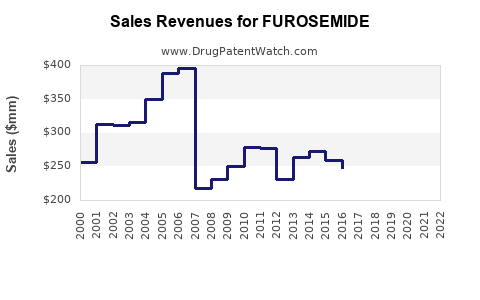
Drug Sales Revenue Trends for FUROSEMIDE
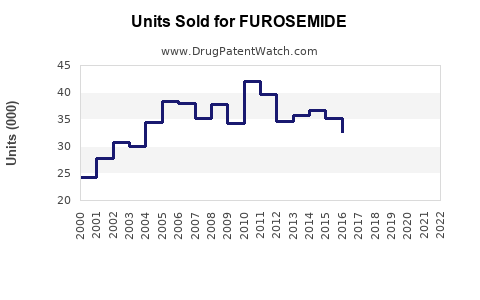
Drug Units Sold Trends for FUROSEMIDE

Annual Sales Revenues and Units Sold for FUROSEMIDE

These sales figures are drawn from a US national survey of drug expenditures

Market Analysis and Sales Projections for FUROSEMIDE

Last updated: July 29, 2025

Introduction

Furosemide, a potent loop diuretic, is widely prescribed for fluid retention and hypertension management. Its global market landscape is shaped by the prevalence of cardiovascular diseases, regulatory environments, manufacturing dynamics, and emerging therapeutic applications. This report provides an in-depth market analysis and sales forecast for Furosemide through 2030, catering to pharmaceutical companies, investors, and healthcare strategists seeking data-driven insights.

Market Overview

Therapeutic Indications and Usage

Furosemide primarily treats edema associated with congestive heart failure, liver cirrhosis, and renal disease. Its efficacy in reducing pulmonary congestion makes it a frontline diuretic in cardiology. Additionally, off-label uses include hypertensive crises and certain nephrotic syndromes, although these constitute a smaller market segment.

Regulatory Status

Furosemide is off-patent globally, classified as a generic medication. This status fosters widespread availability but constrains profitability growth for branded formulations. Regulatory agencies such as the FDA (U.S.) and EMA (Europe) facilitate market entry but impose quality standards critical for manufacturing and distribution.

Manufacturing & Supply Chain Dynamics

The global production landscape is competitive, with key players including Novartis, Teva Pharmaceuticals, Sandoz, and local generics manufacturers. Supply chain resilience impacts availability, especially amid global disruptions like the COVID-19 pandemic, influencing market stability.

Market Drivers

  • Rising prevalence of hypertension and heart failure.
  • Growing aging populations globally.
  • Increased healthcare expenditurenacted on cardiovascular diseases.
  • Adoption of Furosemide in hospital and outpatient settings.

Market Restraints

  • Availability of alternative diuretics with favorable safety profiles.
  • Limited patent protection curbing innovation-driven growth.
  • Concerns over side effects like electrolyte imbalance, limiting off-label uses.

Global Market Analysis

Regional Market Dynamics

North America

Dominates due to high cardiovascular disease burdens and extensive healthcare infrastructure. The U.S. accounts for roughly 40% of the global market, driven by aging demographics and large-volume prescribing.

Europe

Displays mature but steady growth, with robust healthcare systems and stringent regulatory environments. Generics comprise a significant portion of sales.

Asia-Pacific

Emerging as a high-growth region owing to rapid urbanization, increasing cardiovascular disease incidence, and expanding healthcare access. Countries like China and India are witnessing substantial production and consumption increases.

Latin America & Middle East

Moderate markets with distinctive growth opportunities stemming from improving healthcare systems and increasing disease prevalence.

Market Size and Trends

The global Furosemide market was valued at approximately USD 1.7 billion in 2022. It is projected to grow at a compound annual growth rate (CAGR) of approximately 3.5% from 2023 to 2030, reaching USD 2.2 billion by 2030. Factors influencing this growth include the aging demographic, rising chronic disease rates, and expanding outpatient prescription trends.

Competitive Landscape

Major players focus on manufacturing capacity optimization, quality assurance, and cost leadership. Price competition is intense due to the generic nature. Strategic alliances and regional manufacturing expansions are common to penetrate emerging markets.

Sales Projections (2023–2030)

Year Estimated Global Sales (USD Billion) Growth Rate (%) Key Influencing Factors
2023 1.75 Post-pandemic stabilization, steady prescription rates
2024 1.81 3.4 Increased cardiovascular disease burden
2025 1.89 4.4 Aging population accelerates demand
2026 1.97 4.2 Expanded use in hospital and outpatient settings
2027 2.05 4.0 Growing markets in Asia-Pacific
2028 2.12 3.4 Intensified marketing and manufacturing capacity in emerging markets
2029 2.16 2.0 Market saturation in developed regions
2030 2.20 1.9 Stabilization and potential off-label use expansion

Assumptions: The projection assumes consistent healthcare infrastructure development, ongoing demand for diuretics, and monotonic pressure on generic pricing.

Market Challenges and Opportunities

Challenges

  • Pricing pressures due to drug commoditization.
  • Regulatory hurdles impacting manufacturing standards.
  • Patient safety concerns leading to prescription restrictions.

Opportunities

  • Development of combination therapies incorporating Furosemide.
  • Formulation innovations, including sustained-release tablets.
  • Entry into emerging markets with tailored pricing and distribution strategies.
  • Leveraging digital health tools for optimal prescribing practices.

Conclusions

The Furosemide market remains a stable, mature segment driven by broad clinical utility and an aging global populace. While patent expirations limit innovation, strategic focus on manufacturing efficiency, regional expansion, and formulation improvements can sustain growth. Continuous monitoring of regulatory shifts and emerging therapeutic alternatives is crucial for stakeholders aiming to optimize market positioning.

Key Takeaways

  • The global Furosemide market is projected to reach USD 2.2 billion by 2030, growing at a CAGR of roughly 3.5%.
  • North America leads the market, but Asia-Pacific offers high-growth opportunities.
  • The market’s maturity limits aggressive revenue expansion; innovation focuses on formulations and combination therapies.
  • Competitive dynamics favor cost-efficient manufacturing, with local generic producers increasing market share.
  • Regulatory frameworks and safety concerns necessitate vigilant compliance and pharmacovigilance.

FAQs

1. How does the patent landscape affect Furosemide market sales?
Since Furosemide is off-patent globally, the market predominantly comprises generic formulations, resulting in price competition but limiting growth driven by new branded products.

2. What are the key factors influencing regional sales differences?
Prevalence of cardiovascular diseases, healthcare infrastructure, regulation stringency, and regional manufacturing capabilities shape regional sales. North America and Europe dominate due to higher ADMs, while Asia-Pacific offers growth prospects owing to increasing disease burden and expanding healthcare access.

3. How might emerging diabetes and hypertension management therapies impact Furosemide demand?
The advent of novel antihypertensives and diuretics with improved safety profiles may shift prescribing patterns, potentially reducing dependence on traditional Furosemide, particularly if newer options demonstrate better tolerability.

4. What is the expected impact of formulation innovations on future sales?
Innovations such as sustained-release formulations and combination pills could enhance patient compliance, expand off-label uses, and open new market segments, positively influencing sales.

5. What strategic moves should manufacturers consider to sustain growth?
Manufacturers should focus on expanding in emerging markets, optimizing supply chains, investing in formulation R&D, and establishing strategic alliances to capitalize on regional needs and healthcare trends.


Sources

  1. MarketWatch, "Global Furosemide Market Size, Status and Forecast 2022-2030."
  2. WHO Global Health Statistics, 2022.
  3. IQVIA Reports, "Cardiovascular Pharmaceutical Market Dynamics," 2022.
  4. European Medicines Agency (EMA).
  5. US FDA Approved Drugs Database, 2023.

More… ↓

⤷  Get Started Free

Make Better Decisions: Try a trial or see plans & pricing

Drugs may be covered by multiple patents or regulatory protections. All trademarks and applicant names are the property of their respective owners or licensors. Although great care is taken in the proper and correct provision of this service, thinkBiotech LLC does not accept any responsibility for possible consequences of errors or omissions in the provided data. The data presented herein is for information purposes only. There is no warranty that the data contained herein is error free. We do not provide individual investment advice. This service is not registered with any financial regulatory agency. The information we publish is educational only and based on our opinions plus our models. By using DrugPatentWatch you acknowledge that we do not provide personalized recommendations or advice. thinkBiotech performs no independent verification of facts as provided by public sources nor are attempts made to provide legal or investing advice. Any reliance on data provided herein is done solely at the discretion of the user. Users of this service are advised to seek professional advice and independent confirmation before considering acting on any of the provided information. thinkBiotech LLC reserves the right to amend, extend or withdraw any part or all of the offered service without notice.