Share This Page
Drug Sales Trends for DESLORATADINE
✉ Email this page to a colleague
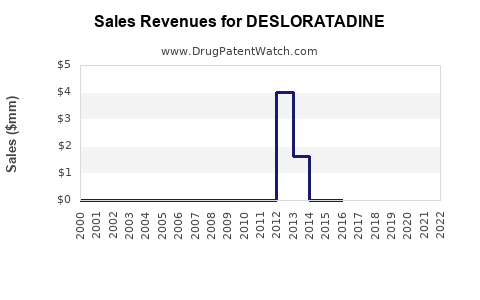
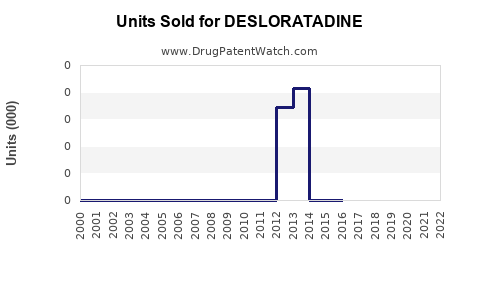
Annual Sales Revenues and Units Sold for DESLORATADINE
| Drug Name | Revenues (USD) | Units | Year |
|---|---|---|---|
| DESLORATADINE | ⤷ Start Trial | ⤷ Start Trial | 2022 |
| DESLORATADINE | ⤷ Start Trial | ⤷ Start Trial | 2021 |
| DESLORATADINE | ⤷ Start Trial | ⤷ Start Trial | 2020 |
| >Drug Name | >Revenues (USD) | >Units | >Year |
Desloratadine Market Analysis, Sales Forecast, Patent Expiry and Competitive Outlook
Desloratadine is a mature, genericized second-generation antihistamine with limited branded pricing power and low patent risk. The commercial market is driven by generic prescriptions, over-the-counter availability in several countries, seasonal allergic rhinitis demand, and competition from loratadine, cetirizine, levocetirizine, fexofenadine and newer combination products. Global desloratadine sales are likely to remain stable in nominal terms through 2030, while unit demand grows modestly and average selling prices decline.
The base-case analyst model estimates global desloratadine sales of approximately $550 million in 2025, rising to $600 million by 2030. The forecast includes prescription, pharmacy and selected over-the-counter channels. It excludes combination products in which desloratadine is not the primary value driver.
What is the current desloratadine market size?
Public company filings do not separately report global desloratadine sales. The originator product, Clarinex, has been genericized for more than a decade, and sales are now fragmented among generic manufacturers, local brands and nonprescription distributors.
The market is concentrated in five product categories:
- Desloratadine 5 mg tablets
- Desloratadine orally disintegrating tablets
- Desloratadine oral solution or syrup
- Pediatric liquid formulations
- Desloratadine combinations, including products paired with pseudoephedrine
A reasonable 2025 market estimate is:
| Market segment | Estimated 2025 sales | Share of total |
|---|---|---|
| Generic oral tablets | $300 million | 55% |
| Generic liquid and pediatric products | $95 million | 17% |
| Branded prescription products | $45 million | 8% |
| Over-the-counter products | $80 million | 15% |
| Combination products | $30 million | 5% |
| Total modeled market | $550 million | 100% |
The estimate reflects a mature market with low unit-price inflation, continued generic substitution and relatively stable allergy prevalence. The estimate is a market model rather than a reported figure from a single company or syndicated database.
How are desloratadine sales expected to change through 2030?
The base case assumes unit growth of 2% to 3% annually, offset by price erosion of approximately 1% to 2% annually in developed markets. Emerging markets contribute most of the unit growth because of expanding pharmacy access and increased diagnosis of allergic rhinitis.
Desloratadine global sales projection
| Year | Bear case | Base case | Bull case |
|---|---|---|---|
| 2024 | $520 million | $530 million | $545 million |
| 2025 | $515 million | $550 million | $575 million |
| 2026 | $510 million | $558 million | $600 million |
| 2027 | $505 million | $567 million | $625 million |
| 2028 | $500 million | $577 million | $650 million |
| 2029 | $495 million | $588 million | $675 million |
| 2030 | $490 million | $600 million | $700 million |
| 2025-2030 CAGR | -1.0% | 1.8% | 4.0% |
The base case depends on continued demand in Latin America, Eastern Europe, the Middle East and Asia-Pacific. The bear case reflects faster switching to cetirizine, levocetirizine and fexofenadine, plus deeper generic price discounting. The bull case assumes stronger over-the-counter expansion and sustained use of pediatric liquid products.
In nominal terms, the market is likely to be broadly flat to moderately positive. In volume terms, growth should be higher because falling prices reduce revenue per treatment course.
Which companies sell desloratadine?
The commercial field includes the former originator, multinational generic manufacturers and regional pharmaceutical companies.
Originator and major generic participants
| Company | Commercial role |
|---|---|
| Merck & Co. | Former owner and marketer of Clarinex in the United States |
| Schering-Plough | Original developer and commercializer before its acquisition by Merck |
| Teva Pharmaceutical Industries | Generic desloratadine supplier in several regulated markets |
| Sandoz | Generic and regional branded supplier |
| Viatris | Generic portfolio participant in selected markets |
| Cipla | Regional supplier, particularly in emerging markets |
| Dr. Reddy's Laboratories | Generic and branded-generic supplier |
| Sun Pharmaceutical Industries | Regional branded-generic supplier |
| Torrent Pharmaceuticals | Branded-generic supplier in selected countries |
| Local manufacturers | Important in Latin America, Asia, the Middle East and Eastern Europe |
The exact supplier list differs by country because desloratadine is sold through local registrations, licensing arrangements and private-label distribution. Many manufacturers compete without significant global brand recognition.
How does desloratadine compare with competing antihistamines?
Desloratadine competes primarily on tolerability, once-daily dosing and low sedation relative to first-generation antihistamines. Its clinical differentiation is limited because the same attributes are available from several generic alternatives.
| Product | Active ingredient | Main commercial advantage | Competitive weakness |
|---|---|---|---|
| Clarinex and generics | Desloratadine | Once-daily dosing; low sedation | Mature generic competition |
| Claritin and generics | Loratadine | Broad consumer recognition; OTC distribution | Similar efficacy and heavy price competition |
| Zyrtec and generics | Cetirizine | Strong consumer awareness and perceived efficacy | More reports of drowsiness in some users |
| Xyzal and generics | Levocetirizine | Prescription and OTC positioning; efficacy perception | Higher price than basic generics in some markets |
| Allegra and generics | Fexofenadine | Low-sedation positioning | Price and availability vary by country |
| First-generation antihistamines | Diphenhydramine and others | Low acquisition cost; broad availability | Sedation and anticholinergic effects |
Desloratadine has a stronger position where prescribers prefer a non-sedating antihistamine and where local formularies reimburse the product. It has a weaker position in markets where loratadine or cetirizine is available over the counter at a lower price.
What is the FDA regulatory status of desloratadine?
The FDA approved Clarinex tablets under NDA 21-165 in 2001 for allergic rhinitis and chronic idiopathic urticaria. Subsequent presentations included orally disintegrating tablets and oral solution. The active ingredient is desloratadine, the major active metabolite of loratadine. The approved adult tablet strength is generally 5 mg once daily, with lower pediatric doses delivered through liquid or orally disintegrating formulations.
The FDA has approved abbreviated new drug applications for generic desloratadine tablets and other dosage forms. Generic applicants demonstrate bioequivalence rather than repeating the originator's full clinical development program. FDA labeling and product information identify desloratadine as a second-generation H1 antihistamine.[1]
Desloratadine is not a biologic. Biosimilar competition is therefore not relevant. The relevant competitive pathway is the ANDA route for small-molecule generics.
What is the Orange Book status of desloratadine?
The original Clarinex patents have expired, and desloratadine is no longer protected by a commercially meaningful U.S. compound patent estate.
The principal historical U.S. patent associated with desloratadine was U.S. Patent No. 5,607,965. Its protection was based on the active compound and related pharmaceutical claims. The patent term ended in the mid-2010s after accounting for the statutory term and any applicable pediatric extension.[2]
Patent and exclusivity timeline
| Event | Approximate date | Commercial effect |
|---|---|---|
| U.S. compound patent granted | 1997 | Originator protection |
| Clarinex U.S. approval | 2001 | Launch of branded prescription product |
| Pediatric and formulation expansion | Early to mid-2000s | Broader product coverage |
| Core patent expiry | 2014 | Generic entry risk becomes material |
| Pediatric-related extension period | Approximately 2015 | Final limited extension |
| Generic approvals | Early 2010s onward | Rapid price and share erosion |
| Current position | 2025 | No meaningful U.S. exclusivity barrier |
The current Orange Book question is primarily historical. Any remaining listings would need to be evaluated product by product, but no active composition-of-matter protection should prevent generic desloratadine entry in the United States. Formulation or method-of-use claims, where present in individual jurisdictions, do not restore broad market exclusivity for the molecule.
What formulations are protected by desloratadine patents?
Desloratadine development included tablets, orally disintegrating tablets and oral solutions. The commercial value of these formulations is now limited because generic manufacturers can offer equivalent dosage forms and because formulation patents have either expired or provide narrow protection.
The most defensible remaining product differentiation is operational rather than legal:
- Pediatric liquids with improved taste and dosing devices
- Orally disintegrating tablets for patients with swallowing difficulty
- Unit-dose packaging
- Combination products containing pseudoephedrine
- Private-label OTC packaging
- Formulations designed for specific national regulatory requirements
Formulation development can support a new registration or a modest price premium, but it is unlikely to create a durable global moat. A formulation patent would need strong claims, a commercially important dosage form and effective enforcement in a high-value market to change that conclusion.
When did desloratadine lose exclusivity?
Desloratadine lost meaningful U.S. market exclusivity during the early to mid-2010s. The core patent had expired by approximately 2014, and any pediatric extension did not materially delay generic competition beyond approximately 2015.
The practical exclusivity timeline was shorter than the formal patent timeline because generic applicants could prepare ANDAs before patent expiry and challenge listed patents under Paragraph IV procedures. Once generic products entered, Clarinex lost share rapidly because antihistamines are therapeutically substitutable and payers have strong incentives to prefer low-cost products.
Which companies challenged desloratadine patents under Paragraph IV?
Generic applicants typically use Paragraph IV certifications when they assert that listed patents are invalid, unenforceable or not infringed. Public FDA and court records indicate that generic desloratadine development occurred through multiple ANDA applicants during the period when Clarinex patents were still relevant.
The commercial impact of those challenges was greater than the litigation value of the product. Desloratadine had a large potential generic pool, low manufacturing complexity and no complex-device barrier. Once the core patent protections expired, multiple suppliers could enter, which reduced the likelihood that any individual challenger would preserve a long period of market exclusivity.
There is no current Paragraph IV risk that materially changes the U.S. desloratadine market outlook. The principal risk is generic price competition, not patent litigation.
What patent litigation and settlement agreements affect desloratadine?
No active U.S. litigation is expected to constrain broad desloratadine access in 2025. Historical disputes would have centered on:
- Compound patent validity
- Paragraph IV certification
- Formulation claims
- Pediatric dosage forms
- Launch timing
- Authorized-generic arrangements
Any historical settlement would need to be assessed against the specific ANDA, patent number and jurisdiction. Settlements involving expired patents do not create present-day commercial barriers. The market has moved from litigation-driven exclusivity to procurement-driven competition.
How strong is the desloratadine patent estate?
The current patent estate is weak from an originator perspective and adequate from a generic-manufacturer perspective.
| Patent estate factor | Assessment |
|---|---|
| Composition-of-matter protection | Expired |
| U.S. regulatory exclusivity | Expired |
| Formulation protection | Expired or narrow |
| Method-of-use protection | Limited commercial relevance |
| Manufacturing complexity | Low to moderate |
| ANDA substitution risk | High |
| Biosimilar risk | Not applicable |
| OTC brand protection | Dependent on trademarks and distribution |
| Global enforcement value | Low for the base molecule |
Manufacturing is not a major barrier. Desloratadine is a small molecule with established synthetic routes and broad active pharmaceutical ingredient availability. The main barriers are regulatory registration, quality control, local pharmacopoeial compliance and distribution access.
What geographic markets offer the strongest growth?
The United States is a mature, highly competitive market. Revenue growth will depend on OTC positioning, retail distribution and supplier consolidation rather than higher prices.
Europe has substantial generic penetration and national reimbursement controls. Sales are stable, but margins are constrained. Country-level opportunities depend on tender access and pharmacy substitution rules.
Emerging markets provide the clearest unit-growth opportunity:
- Latin America: strong branded-generic presence and seasonal allergy demand
- India: broad physician and pharmacy distribution, with intense price competition
- Middle East: demand for branded generics and pediatric formulations
- Southeast Asia: rising access to non-sedating antihistamines
- Eastern Europe: generic substitution and pharmacy-led purchasing
Companies with local registrations, reliable API supply and low-cost packaging have an advantage over originator-style commercial models.
What revenue exposure does desloratadine create for manufacturers?
Desloratadine is unlikely to be a material growth driver for large multinational pharmaceutical companies. It can be commercially useful for generic manufacturers because it offers:
- Established clinical demand
- Low development risk
- Multiple dosage forms
- Seasonal volume increases
- Cross-selling with respiratory and allergy products
- Opportunities for private-label and regional brands
The principal financial risk is margin compression. A manufacturer dependent on a single tablet presentation may face rapid price erosion. A broader portfolio covering liquids, orally disintegrating tablets, combinations and adjacent antihistamines can improve account retention, but it also increases competition within the same therapeutic category.
What generic launch scenarios exist for desloratadine?
Base case
Generic suppliers maintain broad availability, with annual price erosion of 1% to 2%. Volume grows in emerging markets, while the U.S. and Western Europe remain flat. The global market reaches approximately $600 million by 2030.
Bear case
Cetirizine, levocetirizine and fexofenadine capture additional share. Retailers increase private-label substitution, and suppliers compete through tenders. Global revenue falls to approximately $490 million by 2030.
Bull case
OTC adoption expands, pediatric liquids gain share and allergy diagnosis increases in emerging markets. Global revenue reaches approximately $700 million by 2030, although gross margins remain below branded-drug levels.
How do licensing deals affect desloratadine sales?
Licensing is more relevant to regional distribution than to molecule-level innovation. Potential arrangements include:
- Local marketing rights for branded generics
- Contract manufacturing and private-label supply
- API supply agreements
- OTC commercialization partnerships
- Combination-product distribution rights
Large upfront licensing payments are unlikely because the active ingredient has no remaining broad patent exclusivity. Deal value is more likely to depend on registration ownership, distribution reach, manufacturing cost and tender access.
Key Takeaways
- Desloratadine is a mature, genericized antihistamine with no meaningful U.S. composition-of-matter exclusivity.
- The estimated global market is approximately $550 million in 2025.
- Base-case sales reach about $600 million by 2030, representing roughly 1.8% annual growth.
- Unit demand should grow modestly, but generic price erosion will limit revenue expansion.
- Generic tablets remain the largest segment, while pediatric liquids and OTC products offer the clearest commercial opportunities.
- The main competitors are loratadine, cetirizine, levocetirizine and fexofenadine.
- Patent litigation and Paragraph IV activity no longer present a major barrier to U.S. entry.
- Biosimilar risk does not apply because desloratadine is a small molecule.
- Manufacturing barriers are low; regulatory registration, local distribution and price control are more important.
- The strongest opportunities are in emerging markets and differentiated dosage forms, not in premium branded tablets.
FAQs
Is desloratadine still a profitable drug?
It can be profitable for efficient generic manufacturers with low production costs, reliable API sourcing and broad distribution. It is unlikely to support premium pricing or large originator-level margins.
Is Clarinex still commercially important?
Clarinex has limited commercial importance compared with its pre-generic period. Generic desloratadine, local brands and OTC products now account for most market activity.
Can a company obtain new patents on desloratadine?
A company may patent a genuinely novel formulation, delivery system or manufacturing process, but a new patent would not restore broad protection for the known desloratadine molecule.
Will desloratadine sales increase if allergy prevalence rises?
Higher allergy prevalence can increase unit demand, but revenue gains may be limited because generic prices continue to decline and patients can switch to competing antihistamines.
Is desloratadine suitable for an OTC portfolio acquisition?
It can fit an OTC portfolio when the buyer has pharmacy access, private-label capabilities or an established allergy franchise. The product is less attractive as a stand-alone acquisition because patent protection has expired and competition is intense.
References
-
U.S. Food and Drug Administration. (2024). Drugs@FDA: Clarinex and desloratadine products. https://www.accessdata.fda.gov/scripts/cder/daf/
-
U.S. Patent and Trademark Office. (1997). U.S. Patent No. 5,607,965: Desloratadine and pharmaceutical compositions. https://patents.google.com/patent/US5607965
-
U.S. Food and Drug Administration. (2024). Approved drug products with therapeutic equivalence evaluations: Orange Book. https://www.fda.gov/drugs/drug-approvals-and-databases/approved-drug-products-therapeutic-equivalence-evaluations-orange-book
-
Merck & Co., Inc. (2007). Annual report pursuant to Section 13 or 15(d) of the Securities Exchange Act of 1934. https://www.merck.com/investor-relations/annual-reports/
-
World Health Organization Collaborating Centre for Drug Statistics Methodology. (2024). ATC/DDD index: Desloratadine. https://atcddd.fhi.no/atc_ddd_index/
More… ↓
