Share This Page
Drug Sales Trends for CYCLOBENZAPRINE
✉ Email this page to a colleague
Payment Methods and Pharmacy Types for CYCLOBENZAPRINE (2000)
Revenues by Pharmacy Type
Units Sold by Pharmacy Type
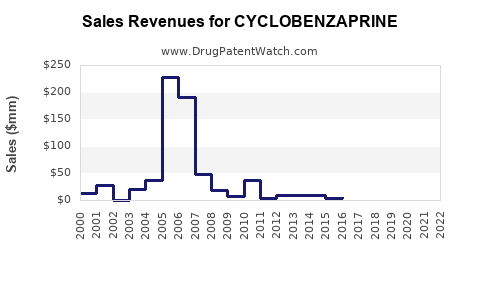

Annual Sales Revenues and Units Sold for CYCLOBENZAPRINE
| Drug Name | Revenues (USD) | Units | Year |
|---|---|---|---|
| CYCLOBENZAPRINE | ⤷ Start Trial | ⤷ Start Trial | 2022 |
| CYCLOBENZAPRINE | ⤷ Start Trial | ⤷ Start Trial | 2021 |
| CYCLOBENZAPRINE | ⤷ Start Trial | ⤷ Start Trial | 2020 |
| CYCLOBENZAPRINE | ⤷ Start Trial | ⤷ Start Trial | 2019 |
| CYCLOBENZAPRINE | ⤷ Start Trial | ⤷ Start Trial | 2018 |
| CYCLOBENZAPRINE | ⤷ Start Trial | ⤷ Start Trial | 2017 |
| >Drug Name | >Revenues (USD) | >Units | >Year |
# Cyclobenzaprine Market Analysis, Patent Status, Competitive Landscape, and Sales Projections
Cyclobenzaprine is a mature, low-cost generic skeletal-muscle relaxant with substantial prescription volume but limited pricing power. The U.S. market is dominated by immediate-release 5 mg and 10 mg tablets. Extended-release capsules, previously marketed as Amrix, have a smaller commercial role and face generic substitution.
The base-case U.S. manufacturer market is estimated at approximately $120 million to $150 million in 2025 net sales, with annual growth of 1% to 3% through 2029. Prescription volume should remain broadly stable, while revenue growth depends on product mix, wholesaler pricing, Medicaid and Medicare reimbursement, and continued demand for low-cost treatment of acute musculoskeletal pain.
What is the current FDA regulatory status of cyclobenzaprine?
Cyclobenzaprine hydrochloride is FDA-approved for short-term treatment of muscle spasm associated with acute, painful musculoskeletal conditions. The FDA labeling limits use to two or three weeks because evidence supporting longer-term treatment is limited.[1]
The principal U.S. dosage forms are:
| Dosage form | Common strengths | Commercial status | Market position |
|---|---|---|---|
| Immediate-release tablet | 5 mg, 7.5 mg, 10 mg | Widely available as generic | Core market |
| Extended-release capsule | 15 mg, 30 mg | Generic versions available; Amrix brand no longer a major commercial product | Smaller niche |
| Oral solution or compounded liquid | Varies | Limited availability | Institutional and specialty use |
Cyclobenzaprine is not an opioid, benzodiazepine, biologic, or controlled substance under the federal Controlled Substances Act. Its principal competitive disadvantages are sedation, anticholinergic effects, limited recommended duration, and the availability of other low-cost muscle relaxants.
FDA labeling warns about drowsiness, dry mouth, dizziness, and interactions with monoamine oxidase inhibitors and serotonergic medicines.[1] Older adults are a commercially important but clinically constrained population because cyclobenzaprine is listed in the American Geriatrics Society Beers Criteria as a potentially inappropriate medication.[2]
How large is the cyclobenzaprine market?
Cyclobenzaprine remains one of the most frequently prescribed skeletal-muscle relaxants in the United States. Its main demand drivers are acute low-back pain, neck pain, muscle spasm, emergency-department prescribing, primary-care prescribing, and short-term treatment after musculoskeletal injury.
Public sources do not provide a single audited figure for total cyclobenzaprine sales across all pharmacies and manufacturers. A practical market model based on prescription volume, generic reimbursement, and product mix produces the following range:
| Metric | 2025 estimated range | 2029 base-case estimate |
|---|---|---|
| U.S. prescriptions | 45 million to 60 million | 47 million to 63 million |
| Manufacturer net sales | $105 million to $175 million | $110 million to $185 million |
| Pharmacy retail value | $250 million to $450 million | $260 million to $470 million |
| Average manufacturer net revenue per prescription | $2.25 to $3.00 | $2.30 to $2.95 |
| Average retail value per prescription | $5.50 to $8.00 | $5.50 to $7.50 |
The range reflects the difference between manufacturer net sales and pharmacy-level revenue. Generic manufacturers sell to wholesalers and pharmacies at prices that are materially below retail cash prices.
Prescription volume is likely to be more durable than revenue. Generic competition prevents manufacturers from capturing most of the value created by high utilization. Retail prices can increase when shortages occur, but the effect is usually temporary because multiple approved suppliers can reenter the market.
What are the cyclobenzaprine sales projections through 2029?
The following base case assumes stable prescription demand, modest growth in U.S. utilization, continued generic competition, and no major supply disruption.
| Year | Estimated prescriptions | Manufacturer net sales | Retail pharmacy value |
|---|---|---|---|
| 2025 | 52 million | $135 million | $350 million |
| 2026 | 52.5 million | $137 million | $355 million |
| 2027 | 53 million | $140 million | $360 million |
| 2028 | 53.5 million | $143 million | $366 million |
| 2029 | 54 million | $146 million | $372 million |
The base-case manufacturer compound annual growth rate is approximately 2%. The market is more likely to produce stable cash flow than high growth.
Upside and downside scenarios
| Scenario | 2029 prescriptions | 2029 manufacturer sales | Main assumptions |
|---|---|---|---|
| Downside | 45 million | $100 million | Continued substitution with tizanidine and methocarbamol, lower reimbursement, fewer acute prescriptions |
| Base case | 54 million | $146 million | Stable use, modest population growth, flat-to-positive generic pricing |
| Upside | 64 million | $205 million | Supply shortages among competitors, higher prescription volume, greater share for higher-margin extended-release products |
The upside case is more likely to arise from competitor supply disruption than from durable pricing power. Cyclobenzaprine has no meaningful exclusivity mechanism that would support sustained premium pricing.
Which companies manufacture and sell cyclobenzaprine?
The U.S. immediate-release market is supplied by multiple generic manufacturers and contract manufacturers. Supplier participation can change by dosage strength, National Drug Code, wholesaler arrangement, and product availability.
Relevant companies and historical or current commercial participants include:
- Amneal Pharmaceuticals
- Camber Pharmaceuticals
- Dr. Reddy's Laboratories
- Lannett Company
- Major Pharmaceuticals and other private-label distributors
- Par Pharmaceutical, now associated with Endo's generic business
- Solco Healthcare
- Teva Pharmaceuticals
- Trigen Laboratories
- Watson Laboratories, now associated with Actavis and Teva operations
The competitive structure is fragmented. Manufacturers generally compete on supply reliability, wholesaler contracts, formulary access, manufacturing cost, and ability to maintain FDA-compliant production rather than on clinical differentiation.
Brand Flexeril is no longer the primary commercial product. Amrix, an extended-release cyclobenzaprine capsule developed by Cephalon, also has limited commercial importance after loss of exclusivity and generic entry.
What patents protect cyclobenzaprine products?
The original cyclobenzaprine compound is long off patent. Current commercial protection is not based on composition-of-matter exclusivity.
The relevant historical intellectual-property categories were:
| Protection category | Historical relevance | Current commercial effect |
|---|---|---|
| Original cyclobenzaprine compound | Covered the early branded product | Expired |
| Immediate-release tablets | Primarily protected through regulatory approval and manufacturing know-how | No meaningful blocking patent estate |
| Extended-release capsules | Covered by formulation and controlled-release patent claims | Historical protection has expired or ceased to block generic entry |
| Method-of-use claims | Addressed treatment of muscle spasm and related conditions | Limited enforceability and no practical market exclusivity |
| Manufacturing processes | May protect specific granulation, coating, or release-control methods | Can create process barriers but does not block standard generic tablets |
The FDA Orange Book is the operative source for listed patents and exclusivity associated with approved drug products.[3] Cyclobenzaprine immediate-release tablets do not have a commercially significant active patent estate that prevents generic competition. Extended-release products also do not have an active brand-level barrier comparable to a protected new chemical entity.
When did cyclobenzaprine lose exclusivity?
Immediate-release cyclobenzaprine lost meaningful market exclusivity decades ago. Generic tablets have been available for many years, and the market has reached a mature multisupplier phase.
Extended-release Amrix had a later commercial lifecycle because the dosage form required controlled-release formulation technology and separate regulatory approval. Its historical formulation protection delayed broad generic competition, but the product no longer has a defensible branded position in the U.S. market.
The commercial timeline is:
| Period | Event |
|---|---|
| 1970s | Flexeril introduced in the United States |
| 1980s-1990s | Generic immediate-release cyclobenzaprine becomes established |
| 2000s | Extended-release Amrix introduced |
| 2010s | Generic competition expands across immediate-release and extended-release products |
| 2020s | Market operates primarily as a low-cost generic market |
Are there Paragraph IV challenges for cyclobenzaprine?
Paragraph IV litigation was most relevant to the launch of generic extended-release cyclobenzaprine products. Generic applicants could challenge listed patents by asserting that patents were invalid, unenforceable, or not infringed under the Hatch-Waxman framework.
For immediate-release cyclobenzaprine, Paragraph IV activity is no longer a major commercial issue because the product is already widely genericized. For extended-release capsules, historical Paragraph IV filings and related litigation affected the timing of generic entry, but they do not create current branded market protection.
A current investment thesis should therefore focus on:
- FDA approval status of the specific generic product.
- Active Orange Book listings for the referenced brand or NDA.
- Manufacturing capacity and product availability.
- State substitution and payer contracting.
- Any current FDA warning letter, import alert, or manufacturing restriction.
What formulations are protected by cyclobenzaprine patents?
The principal formulation distinction is between immediate-release tablets and extended-release capsules.
Immediate-release tablets are technically simple and have limited differentiation. Competitive advantages can come from tablet size, scoring, packaging, stability, and low-cost production, but these characteristics generally do not support premium pricing.
Extended-release capsules require controlled drug release over a longer dosing interval. The commercial rationale is reduced dosing frequency and potentially better adherence. The formulation may use coated particles, matrix technology, or multiparticulate delivery. These products have higher development and manufacturing complexity than standard tablets, but generic approval removes most of the pricing advantage.
The extended-release opportunity is limited by:
- Smaller prescribing volume than immediate-release tablets.
- Higher formulation-development costs.
- Greater bioequivalence requirements.
- Substitution pressure from inexpensive immediate-release tablets.
- Limited willingness among payers to reimburse a premium for convenience.
How does cyclobenzaprine compare with competing muscle relaxants?
Cyclobenzaprine competes primarily with tizanidine, methocarbamol, baclofen, and carisoprodol. The products differ in indication, adverse-effect profile, abuse liability, and prescribing setting.
| Drug | Main commercial strength | Main disadvantage |
|---|---|---|
| Cyclobenzaprine | High prescriber familiarity and low generic cost | Sedation, anticholinergic effects, short-term labeling |
| Methocarbamol | Broad generic availability and perceived tolerability | Sedation and variable clinical preference |
| Tizanidine | Useful when spasticity and muscle tone reduction are priorities | Hypotension, sedation, drug interactions |
| Baclofen | Established role in spasticity | Less suited to routine acute musculoskeletal pain |
| Carisoprodol | Rapid symptomatic effect in some settings | Abuse and dependence concerns; controlled substance |
Cyclobenzaprine retains an advantage in routine acute musculoskeletal prescribing because of physician familiarity, broad availability, and low cost. Tizanidine and methocarbamol are the most credible volume competitors in the acute pain segment.
What generic entry risks affect cyclobenzaprine sales?
Generic-entry risk is already substantially realized. The remaining risk is not a sudden first generic launch but continued price erosion, supplier consolidation, and payer-driven substitution.
The principal risks are:
- Additional ANDA approvals increasing the number of suppliers.
- Wholesaler and pharmacy purchasing consolidation.
- Loss of higher-margin extended-release prescriptions.
- Clinical movement away from skeletal-muscle relaxants in older adults.
- Increased use of nonpharmacologic treatment for acute low-back pain.
- Safety concerns related to sedation and falls.
- State and payer restrictions on prolonged therapy.
- Manufacturing interruptions at major generic plants.
Supply disruption can temporarily increase prices, but a durable revenue increase would require a sustained reduction in the number of qualified suppliers.
What is the patent strength of the cyclobenzaprine estate?
The estate is weak for immediate-release products and commercially limited for extended-release products.
| Patent factor | Assessment |
|---|---|
| Composition-of-matter protection | Expired |
| Active Orange Book blocking patents | No material barrier for immediate-release tablets |
| Formulation protection | Historical importance for extended-release capsules |
| Method-of-use protection | Weak commercial value |
| Manufacturing know-how | Moderate operational value, limited legal exclusivity |
| Freedom-to-operate for standard tablets | Generally favorable for approved generic manufacturers |
The strongest practical barrier is regulatory and operational, not patent-based. A manufacturer with an approved ANDA, reliable API supply, and compliant manufacturing can compete effectively.
What is the FDA and Orange Book outlook for cyclobenzaprine?
The FDA regulatory outlook is stable. Cyclobenzaprine is an established generic medicine with no expected new-drug exclusivity event. The Orange Book remains relevant for product-specific patent listings, but it is unlikely to produce a near-term change in the overall competitive structure.
The commercial focus should be on approved suppliers, current product shortages, FDA inspection history, and reimbursement rather than on patent expiry dates.
What licensing deals affect cyclobenzaprine?
No major current licensing transaction is central to the U.S. cyclobenzaprine market. Historical commercialization involved branded-product development and licensing arrangements associated with Flexeril and Amrix, but those arrangements do not materially affect current generic sales economics.
Current value is captured through generic manufacturing, private-label distribution, contract supply, and wholesaler agreements. Licensing is more relevant to market-entry strategy in countries where a local partner is required for registration or distribution.
What is the geographic coverage of cyclobenzaprine sales?
The United States is the most commercially visible market because of its extensive generic prescribing and public FDA data. Cyclobenzaprine is also sold internationally, but product names, approved indications, formulations, and reimbursement differ by country.
Key geographic considerations include:
- U.S.: Mature generic market with high prescription volume.
- Canada: Generic availability with provincial reimbursement controls.
- Latin America: Variable registration and branded-generic competition.
- Europe: Less uniform commercial positioning and different treatment practices.
- Asia-Pacific: Opportunity depends on local registration, manufacturing, and distribution partnerships.
Global revenue is difficult to aggregate because manufacturers often report cyclobenzaprine within broader generic portfolios rather than as a separate product.
Key Takeaways
- Cyclobenzaprine is a mature generic muscle relaxant with stable demand and limited pricing power.
- Estimated 2025 U.S. manufacturer net sales are approximately $120 million to $150 million.
- Base-case 2029 manufacturer sales are approximately $146 million, assuming modest prescription growth.
- Immediate-release tablets account for most market volume.
- Extended-release capsules provide a smaller, technically more complex niche.
- Composition-of-matter and meaningful branded exclusivity have expired.
- Current commercial barriers are manufacturing, FDA compliance, supply reliability, and payer access.
- The main competitors are methocarbamol, tizanidine, baclofen, and carisoprodol.
- Biosimilar risk does not apply because cyclobenzaprine is a small-molecule drug.
- The highest-probability commercial outcome is stable volume with low single-digit revenue growth.
FAQs About Cyclobenzaprine Market Opportunities
Can a new manufacturer still enter the cyclobenzaprine market?
Yes. Entry is generally based on ANDA approval, bioequivalence, compliant manufacturing, API sourcing, and distribution access. Patent barriers are not the principal obstacle.
Is extended-release cyclobenzaprine commercially attractive?
It can provide higher revenue per prescription than immediate-release tablets, but its total market is smaller and development requirements are more demanding. The opportunity is best suited to manufacturers with existing modified-release capabilities.
Does cyclobenzaprine have biosimilar competition?
No. Cyclobenzaprine is a chemically synthesized small-molecule drug. Competition occurs through generic versions approved under the ANDA pathway, not through biosimilar applications.
Could cyclobenzaprine sales decline despite stable prescription volume?
Yes. Revenue can fall if payers increase generic reimbursement pressure, manufacturers compete more aggressively, or prescriptions shift from higher-value extended-release products to low-cost immediate-release tablets.
What is the most important due-diligence issue for a cyclobenzaprine acquisition?
The most important issue is the target product's supply and reimbursement position. Analysts should evaluate ANDA status, manufacturing inspection history, API security, wholesaler concentration, product-level gross-to-net deductions, and current prescription share.
References
- U.S. Food and Drug Administration. (2023). Cyclobenzaprine hydrochloride tablets prescribing information. FDA.
- American Geriatrics Society Beers Criteria Update Expert Panel. (2023). American Geriatrics Society 2023 updated AGS Beers Criteria for potentially inappropriate medication use in older adults. Journal of the American Geriatrics Society, 71(7), 2052-2081.
- U.S. Food and Drug Administration. (2024). Approved drug products with therapeutic equivalence evaluations: The Orange Book. FDA.
- U.S. Food and Drug Administration. (2024). Drugs@FDA: FDA-approved drugs database. FDA.
- American Hospital Formulary Service. (2024). Cyclobenzaprine hydrochloride drug monograph. AHFS Drug Information.
More… ↓
