Drug Sales Trends for COZAAR
Payment Methods and Pharmacy Types for COZAAR (2000)
Revenues by Pharmacy Type
Units Sold by Pharmacy Type
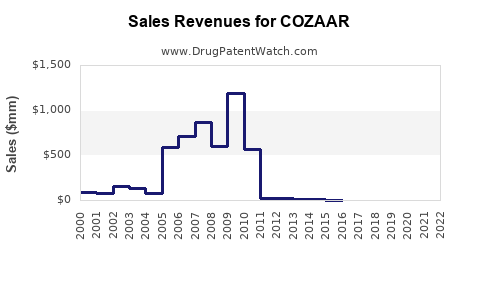
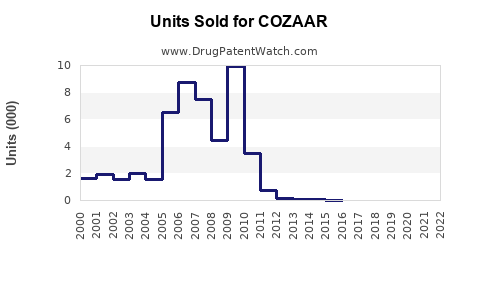
Annual Sales Revenues and Units Sold for COZAAR
| Drug Name | Revenues (USD) | Units | Year |
|---|---|---|---|
| COZAAR | ⤷ Start Trial | ⤷ Start Trial | 2022 |
| COZAAR | ⤷ Start Trial | ⤷ Start Trial | 2021 |
| COZAAR | ⤷ Start Trial | ⤷ Start Trial | 2020 |
| COZAAR | ⤷ Start Trial | ⤷ Start Trial | 2019 |
| >Drug Name | >Revenues (USD) | >Units | >Year |
Cozaar Market Analysis and Sales Projections: Losartan Patent, Generic Competition, and Commercial Outlook
Cozaar is the branded form of losartan potassium, an angiotensin II receptor blocker marketed primarily for hypertension, diabetic nephropathy, and reduction of stroke risk in selected hypertensive patients. Its U.S. composition-of-matter patent expired in 2010, and generic losartan now controls the market. The brand has limited commercial relevance in the United States, while losartan remains a high-volume, low-price antihypertensive globally.
The commercial outlook is stable unit demand, continued price erosion, and limited growth in branded revenue. Global sales of losartan products should remain supported by hypertension prevalence and broad generic access, but the molecule is unlikely to regain premium pricing.
What is Cozaar and how is losartan used?
Cozaar contains losartan potassium, an oral angiotensin II receptor blocker. Merck developed and originally commercialized Cozaar. The FDA approved Cozaar in April 1995 for hypertension. The label later expanded to include diabetic nephropathy in patients with Type 2 diabetes and hypertension, and stroke-risk reduction in selected patients with hypertension and left ventricular hypertrophy. [1]
Losartan is sold in several principal forms:
| Product | Active ingredient | Typical use | Commercial status |
|---|---|---|---|
| Cozaar | Losartan potassium | Hypertension and related cardiovascular indications | Mature brand |
| Generic losartan | Losartan potassium | Hypertension, diabetic nephropathy, stroke-risk reduction | Dominant U.S. form |
| Hyzaar | Losartan potassium and hydrochlorothiazide | Hypertension | Generic and branded combinations |
| Generic losartan/HCTZ | Losartan potassium and hydrochlorothiazide | Hypertension | Highly competitive |
| Pediatric losartan products | Losartan potassium | Hypertension in selected pediatric patients | Limited volume |
Losartan is generally prescribed once daily, with common tablet strengths of 25 mg, 50 mg, and 100 mg. The combination product is commonly available in 50/12.5 mg and 100/12.5 mg or 100/25 mg strengths.
How large is the Cozaar and losartan market?
The economically relevant market is generic losartan, not branded Cozaar. Public company filings no longer provide a reliable standalone global sales figure for Cozaar because Merck ceased treating the product as a major growth brand after generic entry. Current revenue is distributed among generic manufacturers, local distributors, and country-specific brand owners.
Market structure
The losartan market has four commercial characteristics:
- High prescription volume.
- Low average selling prices.
- Numerous suppliers.
- Limited differentiation between manufacturers.
The U.S. market is almost entirely generic. Brand Cozaar has little practical share because losartan is available through multiple FDA-approved abbreviated new drug applications at substantially lower prices. Outside the United States, branded losartan may retain share in markets where physician prescribing, reimbursement, or pharmacy substitution is less aggressive.
Losartan competes within the ARB class against:
- Valsartan
- Irbesartan
- Candesartan
- Telmisartan
- Olmesartan
- Eprosartan in selected markets
It also competes with ACE inhibitors, calcium-channel blockers, thiazide diuretics, beta blockers, and fixed-dose antihypertensive combinations.
What were Cozaar’s historical sales before generic entry?
Cozaar and Hyzaar were major Merck products before patent expiry. Merck reported the two products together in its annual filings, making exact standalone Cozaar sales difficult to isolate. The combined franchise generated multibillion-dollar annual revenue before generic competition materially reduced sales. [2]
The principal commercial decline occurred after the U.S. patent and regulatory exclusivity period ended. Generic losartan entered the U.S. market in 2010, causing rapid erosion in both price and branded volume. The same pattern occurred in other countries as local patent rights expired.
| Period | Commercial position |
|---|---|
| 1995-2005 | Growth and expansion of the ARB franchise |
| 2006-2009 | Mature branded product with substantial global sales |
| 2010 | U.S. generic entry and sharp price pressure |
| 2011-2015 | Broad international generic erosion |
| 2016-present | High-volume generic molecule with limited branded value |
Cozaar's historical revenue should not be used as a proxy for current sales potential. The patent-protected product and today's generic market have materially different pricing and competitive structures.
When did Cozaar lose patent exclusivity?
The core U.S. losartan patent was U.S. Patent No. 5,138,069, assigned to E.I. du Pont de Nemours and Company and associated with losartan compounds and their pharmaceutical use. The patent expired in 2010 after patent-term adjustments and applicable exclusivity periods. The FDA Orange Book identifies patent and exclusivity information for approved drug products and provides the principal public reference for U.S. listed patents. [3]
Cozaar exclusivity timeline
| Event | Date or period |
|---|---|
| FDA approval of Cozaar | April 14, 1995 |
| Core losartan patent | U.S. Patent No. 5,138,069 |
| U.S. generic entry | 2010 |
| Current U.S. status | Generic-dominated |
| Current brand protection | No economically meaningful U.S. blocking patent estate |
The exact launch timing of individual generic manufacturers varied by ANDA approval, litigation outcome, settlement terms, and market launch decisions. Generic entry did not eliminate all product-level patents immediately in every jurisdiction, but it removed the principal U.S. exclusivity barrier.
What patents protect Cozaar today?
Cozaar does not have a commercially significant active U.S. patent position protecting the basic losartan molecule. The principal patent estate expired before the current market period.
Potentially relevant rights may still exist in certain jurisdictions for:
- Specific formulations
- Manufacturing processes
- Combination products
- Pediatric or dosing methods
- Device or packaging configurations
- Country-specific secondary patents
Those rights generally do not recreate the original Cozaar franchise. Generic losartan products use established manufacturing routes and conventional oral solid dosage forms. Any remaining secondary patent must be evaluated country by country and claim by claim.
Formulation and method-of-use protection
The main commercial products are immediate-release tablets. These products have limited formulation differentiation. A formulation patent could be relevant if it covered a specific excipient system, dissolution profile, stability method, or modified-release platform. Standard immediate-release losartan tablets, however, are exposed to broad generic competition.
Method-of-use patents are also unlikely to create substantial U.S. revenue protection because the principal labeled indications have been public for decades. Generic applicants can use regulatory pathways that exclude patented indications in appropriate circumstances, while physicians may prescribe generic losartan for multiple lawful uses.
What is the FDA and Orange Book status of Cozaar?
Cozaar remains an FDA-approved product, but its commercial position is mature. The FDA-approved reference product is listed under the losartan potassium active ingredient. Generic manufacturers have received ANDA approvals for losartan tablets and losartan/hydrochlorothiazide tablets. [3]
The regulatory position has four implications:
- Cozaar is not a new drug with remaining market exclusivity.
- Generic losartan can rely on the reference product's established safety and efficacy record.
- Abbreviated approval lowers development cost and regulatory risk.
- Brand substitution and formulary controls favor generic manufacturers.
The 2018-2019 losartan recalls involving certain lots from selected manufacturers related to nitrosamine contamination concerns. The FDA investigated and issued recalls affecting specific products and lots, not the entire losartan molecule or every manufacturer. [4] The episode created temporary supply reallocations but did not restore branded pricing power.
Which companies compete in the losartan market?
The competitive landscape includes large generic manufacturers, regional suppliers, and contract manufacturers. Suppliers with historical or continuing participation in U.S. losartan markets have included:
- Teva Pharmaceutical Industries
- Sandoz and Novartis-related generic operations
- Mylan, now part of Viatris
- Lupin
- Torrent Pharmaceuticals
- Zydus Pharmaceuticals
- Dr. Reddy's Laboratories
- Camber Pharmaceuticals
- Solco Healthcare
- Major regional manufacturers outside the United States
The active ingredient is widely available from Asian and other international API producers. Manufacturing scale, regulatory compliance, supply reliability, and procurement contracts are more important than clinical differentiation.
How strong is the patent estate for Cozaar?
The patent estate is weak for current commercial purposes.
| Patent factor | Assessment |
|---|---|
| Core composition patent | Expired |
| U.S. basic product exclusivity | Expired |
| Broad method-of-use protection | Limited commercial effect |
| Immediate-release tablet protection | Weak |
| API manufacturing barriers | Moderate operational barrier, not a durable monopoly |
| Biosimilar exposure | Not applicable |
| Generic substitution risk | Very high |
Losartan is a small-molecule drug, so biosimilar law does not apply. The relevant competitive threat is generic substitution through the ANDA pathway, not biosimilar approval under the Public Health Service Act.
Are there Paragraph IV challenges to Cozaar?
Paragraph IV challenges were relevant before and around generic entry. Under the Hatch-Waxman Act, an ANDA applicant may certify that a listed patent is invalid, unenforceable, or will not be infringed. Such a certification can trigger patent litigation and a potential 30-month stay of FDA approval. [5]
For Cozaar, the Paragraph IV risk period is historical rather than a current market barrier. The core patent has expired, and new entrants generally face no comparable blocking patent dispute over the basic losartan molecule. Litigation risk can still arise from manufacturing patents, formulation patents, product labeling, or commercial contracts, but those issues are narrower.
What generic entry risks exist for Cozaar?
Generic entry risk is effectively realized rather than prospective. The principal risks are now:
- Continued price deflation
- Additional supplier entry
- Pharmacy and payer substitution
- Contract loss to lower-cost manufacturers
- API supply interruptions
- Regulatory action involving manufacturing quality
- Recalls or import restrictions
- Declining branded prescriptions
For generic manufacturers, the risk is not loss of exclusivity but loss of volume or margin. Losartan is a scale product. Manufacturers with low costs and reliable supply can remain competitive, while smaller suppliers may exit when prices fall below sustainable levels.
What are the sales projections for Cozaar and losartan?
Branded Cozaar projection
Branded Cozaar sales should remain immaterial in the United States. A reasonable commercial projection is:
| Scenario | 2025-2026 U.S. brand outlook | 2030 U.S. brand outlook |
|---|---|---|
| Base case | Minimal residual sales | Near-zero to immaterial |
| Downside | Brand withdrawal or further substitution | No meaningful sales |
| Upside | Limited institutional or physician loyalty | Still immaterial |
International brand sales may persist in markets with weaker generic substitution. They are unlikely to reproduce historical Merck revenue because generic losartan is available across most major markets.
Generic losartan projection
The molecule should maintain broad demand through 2030. A volume-based projection is more appropriate than a brand-style growth forecast.
| Market driver | 2025-2030 direction |
|---|---|
| Hypertension prevalence | Positive |
| Aging population | Positive |
| Generic substitution | Positive for volume, negative for price |
| Average selling price | Flat to declining |
| Total prescription units | Low single-digit growth in many markets |
| Manufacturer revenue | Flat to modest decline |
| Branded revenue | Continued decline |
Under a base case, global losartan unit demand could grow at approximately 1% to 3% annually through 2030, while manufacturer revenue remains flat or declines because price erosion offsets volume growth. Emerging markets are likely to contribute most of the unit expansion. Developed markets will remain mature and price-sensitive.
A reasonable commercial range for the molecule is therefore:
- Brand Cozaar: declining or immaterial revenue in the United States.
- Generic losartan: durable, high-volume revenue with low margins.
- Losartan/HCTZ: stable demand but stronger competition from other fixed-dose combinations.
- Global franchise: mature market with limited innovation-driven growth.
How does Cozaar compare with competing ARBs?
| Drug | Generic status | Key commercial characteristic |
|---|---|---|
| Losartan | Generic | Long-established, low cost, broad use |
| Valsartan | Generic | Large global volume and extensive combination use |
| Irbesartan | Generic | Strong diabetes and renal-use positioning |
| Candesartan | Generic | Clinical use in hypertension and heart failure |
| Telmisartan | Generic | Long half-life and broad combination portfolio |
| Olmesartan | Generic | Mature product with ongoing safety and labeling considerations |
Losartan's advantages are low cost, extensive clinical familiarity, and broad availability. Its disadvantages include intense generic competition and limited pricing power. Telmisartan and valsartan may have stronger commercial positions in selected combination markets, while irbesartan remains competitive in renal and diabetes-related prescribing.
What licensing deals affect Cozaar?
The original Cozaar franchise was based on discovery, development, and commercialization rights associated with losartan and related ARB technology. Current licensing economics are limited because the principal product patents have expired. Any present licensing value is more likely to relate to:
- Regional commercialization rights
- Manufacturing supply agreements
- Distribution arrangements
- Combination-product portfolios
- Regulatory registrations
- Local trademarks
A new license for basic losartan would have limited strategic value unless it included geographic access, reliable supply, or a differentiated combination product.
What is the generic launch outlook?
A new generic launch would face low technical risk but high commercial competition. The likely launch model is:
- FDA or other regulator approval.
- Initial wholesaler and pharmacy contracts.
- Low launch pricing.
- Rapid substitution into payer formularies.
- Margin compression as additional suppliers enter.
- Volume retention based on supply reliability and cost.
Manufacturing barriers remain relevant. Losartan API production requires validated synthesis, impurity control, analytical testing, and regulatory compliance. Nitrosamine controls and supply-chain oversight have increased quality requirements. These factors create operational barriers but do not provide durable patent protection.
Key Takeaways
- Cozaar is the branded form of losartan potassium.
- The core U.S. patent estate expired in 2010.
- Generic losartan dominates the U.S. market.
- Branded Cozaar has little remaining U.S. revenue potential.
- Losartan demand should remain stable through 2030 because of hypertension prevalence and generic affordability.
- Unit growth is likely to be modest, while price and margin pressure continue.
- Losartan is exposed to generic competition, not biosimilar competition.
- Remaining patent opportunities are narrow and may involve formulations, combinations, methods, or regional rights.
- The strongest commercial assets are manufacturing scale, regulatory compliance, supply reliability, and distribution access.
- Cozaar's historical multibillion-dollar franchise is not a suitable forecast baseline for current revenue.
Frequently Asked Questions
Is Cozaar still sold in the United States?
Yes. Cozaar remains an FDA-approved product, but generic losartan is the principal U.S. commercial form and is generally favored by payers and pharmacies.
Is losartan a biologic or a small-molecule drug?
Losartan is a small-molecule drug. Generic losartan is approved through the ANDA pathway, and biosimilar rules do not apply.
Can a company obtain a new patent on losartan?
A company may seek patents on a genuinely novel formulation, manufacturing process, combination, or delivery system. It cannot restore the expired composition patent through routine patent filing.
Does Cozaar have pediatric exclusivity today?
No current pediatric exclusivity period creates a meaningful market barrier for standard losartan products. Any historical pediatric protection does not restore the expired core exclusivity position.
What is the main investment thesis for losartan?
Losartan is a defensive generic-volume product rather than a growth asset. Its investment value depends on manufacturing cost, supply reliability, market access, and portfolio synergies, not branded pricing power.
References
- U.S. Food and Drug Administration. (2023). Cozaar (losartan potassium) prescribing information.
- Merck & Co., Inc. (2010). 2010 annual report.
- U.S. Food and Drug Administration. (2024). Approved drug products with therapeutic equivalence evaluations, Orange Book.
- U.S. Food and Drug Administration. (2019). FDA updates and press announcements on ARB recalls and nitrosamine impurities.
- U.S. Congress. (1984). Drug Price Competition and Patent Term Restoration Act of 1984, 21 U.S.C. § 355.
More… ↓
