Share This Page
Drug Sales Trends for CLARITIN
✉ Email this page to a colleague
Payment Methods and Pharmacy Types for CLARITIN (2000)
Revenues by Pharmacy Type
Units Sold by Pharmacy Type
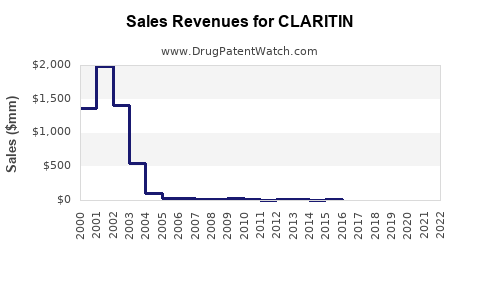
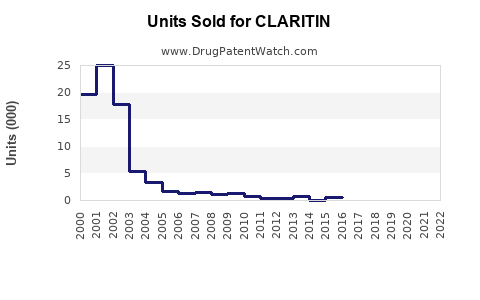
Annual Sales Revenues and Units Sold for CLARITIN
| Drug Name | Revenues (USD) | Units | Year |
|---|---|---|---|
| CLARITIN | ⤷ Start Trial | ⤷ Start Trial | 2022 |
| CLARITIN | ⤷ Start Trial | ⤷ Start Trial | 2021 |
| CLARITIN | ⤷ Start Trial | ⤷ Start Trial | 2020 |
| CLARITIN | ⤷ Start Trial | ⤷ Start Trial | 2019 |
| CLARITIN | ⤷ Start Trial | ⤷ Start Trial | 2018 |
| CLARITIN | ⤷ Start Trial | ⤷ Start Trial | 2017 |
| >Drug Name | >Revenues (USD) | >Units | >Year |
Claritin Market Analysis, Sales Projections, Patent Status, and Generic Competition
Claritin, the loratadine-based allergy brand owned by Bayer, is a mature over-the-counter antihistamine with broad retail distribution and limited remaining intellectual-property protection. Its commercial value rests on brand recognition, retailer placement, product extensions, and seasonal allergy demand rather than exclusivity.
Standalone Claritin revenue is not publicly disclosed by Bayer. The following projection uses an analyst model based on mature-brand erosion, category growth, seasonal demand, and continued competition from store-brand loratadine. The base case estimates low-single-digit annual revenue decline for branded Claritin through 2029, with stronger performance in selected international markets and weaker performance in U.S. tablets.
What is Claritin and how does it compete in the allergy market?
Claritin is a nonprescription antihistamine containing loratadine. It is marketed primarily for temporary relief of allergy symptoms, including sneezing, runny nose, itchy or watery eyes, and nasal or throat irritation. The product is generally positioned as a once-daily, non-drowsy alternative to older antihistamines.
Bayer acquired the Claritin brand through its 2014 acquisition of Merck’s consumer-care business. The brand is part of Bayer’s Consumer Health portfolio, which also includes products such as Allegra, Aleve, Aspirin, Bepanthen, and One A Day in various markets.[1]
The U.S. allergy-treatment market includes:
- Loratadine products, led by Claritin and store brands
- Cetirizine products, including Zyrtec and private-label equivalents
- Fexofenadine products, including Allegra and private-label equivalents
- Intranasal corticosteroids, including Flonase
- Combination products for allergy and congestion
- Prescription and over-the-counter immunotherapy products
Claritin’s main commercial advantage is brand familiarity. Its main weakness is ingredient commoditization. Loratadine is widely available as a low-priced generic and private-label product.
How large is the Claritin market?
Bayer does not report Claritin as a separately disclosed revenue line. Public financial reporting aggregates consumer-health products by operating segment or category rather than identifying sales for individual brands.[1]
A practical market framework is:
| Market segment | Claritin position | Commercial condition |
|---|---|---|
| U.S. loratadine tablets | Strong brand, mature | High generic substitution |
| U.S. liquid and chewable products | Moderate | Important for children and family use |
| U.S. combination products | Selective | Competes with congestion brands |
| Canada and Europe | Established | Market share varies by country |
| Latin America and Asia-Pacific | Variable | Distribution and local brands affect growth |
| Online retail | Growing channel | Price transparency pressures margins |
| Mass retail and pharmacy | Core channel | Seasonal promotions remain important |
Claritin demand is highly seasonal. Sales typically rise before and during peak pollen periods, with weather patterns, pollen counts, respiratory illness, and promotional activity affecting quarterly results.
The brand also has an important household-replenishment component. Consumers may buy allergy products annually, but generic substitution is common once the active ingredient is known.
What are the current Claritin sales projections?
Because Bayer does not disclose standalone Claritin sales, the projection below is an indexed model. The 2024 estimated Claritin retail-equivalent revenue base is set at 100. The model measures expected brand revenue rather than total loratadine-category sales.
| Year | Bear case index | Base case index | Bull case index | Base-case annual change |
|---|---|---|---|---|
| 2024 | 100 | 100 | 100 | Base year |
| 2025 | 96 | 98 | 101 | -2.0% |
| 2026 | 92 | 96 | 102 | -2.0% |
| 2027 | 88 | 94 | 103 | -2.1% |
| 2028 | 84 | 92 | 104 | -2.1% |
| 2029 | 80 | 90 | 105 | -2.2% |
The base case assumes:
- Continued volume growth in the overall allergy category
- A gradual shift from branded Claritin to low-priced loratadine
- Stable or slightly higher average prices for branded products
- No major product recall or distribution disruption
- Continued availability of tablets, liqui-gels, chewables, children’s products, and combination products
- Limited benefit from new intellectual property
The bull case assumes stronger online conversion, effective product reformulation, favorable allergy seasons, and successful premium pricing. The bear case assumes accelerated private-label substitution, retailer de-emphasis, lower promotional support, and loss of shelf space to cetirizine or fexofenadine brands.
If 2024 Claritin revenue were represented by a hypothetical $1 billion baseline, the base case would imply approximately $900 million in 2029. The figure is an analytical conversion of the index and is not a reported Bayer sales figure.
When did Claritin lose exclusivity?
Claritin’s U.S. prescription exclusivity ended in the early 2000s. Loratadine was originally developed by Schering-Plough and received U.S. approval as a prescription product in 1993. The product later switched to over-the-counter status in 2002.[2]
The principal U.S. composition-of-matter patent associated with loratadine was U.S. Patent No. 4,282,233. Its effective term ended before or around the time generic and OTC competition expanded, depending on applicable patent-term calculations and regulatory extensions. The core active-ingredient protection no longer limits market entry.
Key exclusivity timeline
| Event | Approximate date | Commercial impact |
|---|---|---|
| Loratadine patent filing | 1980 | Originator patent estate established |
| U.S. patent issued | 1981 | Core compound protection granted |
| Prescription approval | 1993 | Claritin launched as a prescription medicine |
| FDA OTC switch | 2002 | Direct consumer and mass-retail access expanded |
| Generic loratadine entry | Early 2000s | Core price protection ended |
| Current market | 2024-2025 | Brand competition is commercial, not patent-driven |
The OTC switch increased consumer access but also exposed Claritin to direct store-brand competition. Once loratadine became available without a prescription, retailers gained a strong incentive to sell lower-priced equivalents.
What patents protect Claritin today?
The core loratadine compound is no longer protected by an enforceable U.S. patent monopoly. Current patent value, where present, is more likely to concern specific formulations, delivery systems, combinations, packaging, or manufacturing processes.
Potentially relevant patent categories include:
| Patent category | Current strategic value |
|---|---|
| Loratadine composition of matter | Expired or commercially exhausted |
| Immediate-release tablets | Low, because generic products are established |
| Liquids and chewables | Limited, unless a genuinely differentiated formulation exists |
| Combination products | Product-specific and potentially narrower |
| Packaging and trademarks | Commercial protection, not drug exclusivity |
| Manufacturing processes | Relevant only if technically difficult or cost-saving |
| New delivery systems | Possible value if supported by regulatory and consumer differentiation |
Claritin’s strongest remaining protection is trademark and brand equity. Trademark protection prevents confusingly similar branding but does not prevent competitors from selling loratadine under their own names.
What is the Orange Book status of Claritin?
The FDA Orange Book primarily identifies approved prescription drug products and related patent and exclusivity information. A standard OTC Claritin product is not protected today by an active Orange Book patent listing that blocks generic loratadine competition.
Historical prescription NDAs and patent information may remain relevant to the product’s development history, but they do not create current market exclusivity for ordinary OTC loratadine tablets.
The practical regulatory position is:
- Claritin is primarily an OTC product.
- Generic loratadine products are widely marketed.
- No current Paragraph IV strategy is required to challenge the basic Claritin product.
- OTC monograph and general OTC compliance pathways are more relevant than an active prescription patent estate for standard loratadine products.[3]
Which companies are challenging Claritin?
Claritin faces competition from both branded antihistamines and private-label manufacturers. The principal competitive groups include:
| Competitor | Active ingredient or category | Competitive effect |
|---|---|---|
| Zyrtec | Cetirizine | Strong once-daily allergy competitor |
| Allegra | Fexofenadine | Competes on non-drowsiness and efficacy positioning |
| Flonase | Fluticasone propionate | Competes in nasal-allergy treatment |
| Store-brand loratadine | Loratadine | Direct price substitution |
| Store-brand cetirizine | Cetirizine | Retailer-controlled alternative |
| Store-brand fexofenadine | Fexofenadine | Expands low-cost substitution |
| Combination allergy products | Multiple ingredients | Captures consumers with congestion symptoms |
The most important challengers are not individual generic companies. They are major retailers that control shelf placement, search ranking, private-label pricing, and promotional visibility.
Retailers such as CVS, Walgreens, Walmart, Target, Costco, Amazon, and grocery chains can redirect demand toward their own loratadine products. This weakens Claritin’s negotiating position even when the brand retains high consumer awareness.
Are there Paragraph IV challenges to Claritin?
Paragraph IV litigation is not a material current risk to ordinary OTC Claritin because the core product has already faced generic entry and no longer depends on an active patent barrier.
Historically, generic applicants could challenge patents associated with the prescription version of loratadine through abbreviated new drug application procedures. Those disputes are commercially resolved because loratadine generics are already established in the U.S. market.
A future Paragraph IV risk would arise only if Bayer introduced a new prescription-strength, reformulated, or technologically differentiated loratadine product with listed patents. That scenario does not affect standard OTC Claritin tablets.
What formulation patents protect Claritin products?
Formulation patents have limited economic value for the legacy Claritin portfolio unless they create a meaningful consumer benefit. Potentially differentiating formats include:
- Rapid-dissolve tablets
- Chewable tablets
- Grape or fruit-flavored liquids
- Liqui-gels
- Pediatric dosing formats
- Combination products
- Extended-release or controlled-release products
These formats can support price segmentation, but they are usually vulnerable to design-around strategies. A competitor may use a different excipient system, capsule shell, flavor, tablet geometry, or packaging design while delivering the same active ingredient.
For Claritin, formulation innovation is more likely to support marketing and category management than long-duration exclusivity.
What is the FDA regulatory status of Claritin?
Claritin is an FDA-authorized OTC allergy medicine. The original prescription approval was followed by an OTC switch, allowing consumers to purchase the product without a prescription.
The FDA’s OTC framework governs labeling, active ingredients, dosage forms, warnings, and consumer-use instructions. Loratadine products must comply with applicable FDA requirements for antihistamine labeling and manufacturing.[3]
Regulatory risks are relatively low for standard products. The principal risks are:
- Labeling violations
- Manufacturing deviations
- Product-quality complaints
- Supply interruptions
- Incorrect pediatric dosing information
- Claims that exceed permitted OTC labeling
Regulatory status does not provide Claritin with meaningful exclusivity. It provides market authorization and compliance requirements.
How strong is the Claritin patent estate?
Claritin has a weak current patent estate but a strong commercial trademark position.
| Asset | Current strength | Reason |
|---|---|---|
| Loratadine compound patent | Low | Core protection expired |
| Standard tablet protection | Low | Generic and private-label products established |
| Pediatric and chewable formats | Low to moderate | Differentiation is possible but narrow |
| Combination products | Moderate in specific products | Depends on formulation and claims |
| Manufacturing patents | Variable | May create cost advantages but limited blocking power |
| Claritin trademark | Strong | Consumer recognition and brand continuity |
| Retail distribution | Moderate | Broad access supports conversion and repeat purchase |
Patent strength should not be confused with brand strength. Claritin can remain commercially valuable after patent expiry because consumers recognize the name and retailers use branded products to segment prices.
What licensing deals affect Claritin?
The most significant transaction affecting Claritin ownership was Bayer’s acquisition of Merck’s consumer-care business in 2014. The transaction transferred Bayer control of the Claritin brand in the relevant consumer-health portfolio.[4]
No current licensing arrangement is publicly identified as a major independent driver of Claritin’s U.S. revenue. Local distribution, manufacturing, and commercialization arrangements may differ by country, but these do not create a new global patent position.
The commercial question is therefore portfolio management rather than license economics. Bayer can extend the brand through new formats, regional distribution, co-marketing, and retail partnerships, but the core loratadine product remains open to competition.
What generic launch risks exist for Claritin?
Generic launch risk is already realized rather than pending. The key issue is continued share transfer from Claritin to lower-priced products.
The main downside drivers are:
- Private-label price discounts.
- Retailer substitution at the point of purchase.
- E-commerce search ranking based on price.
- Consumer acceptance of equivalent loratadine products.
- Limited clinical differentiation among once-daily antihistamines.
- Promotional fatigue for mature allergy brands.
Claritin can defend revenue through brand trust, packaging, consumer advertising, product variety, and availability. Those defenses support a slower decline, but they do not restore prescription-era exclusivity.
How does Claritin compare with Zyrtec and Allegra?
| Factor | Claritin | Zyrtec | Allegra |
|---|---|---|---|
| Active ingredient | Loratadine | Cetirizine | Fexofenadine |
| Core positioning | Non-drowsy, once daily | Strong allergy relief, once daily | Non-drowsy, once daily |
| Patent position | Mature and expired | Mature and expired | Mature and expired |
| Generic pressure | High | High | High |
| Main commercial asset | Brand recognition | Strong symptom-relief reputation | Non-drowsiness positioning |
| Retail exposure | Broad | Broad | Broad |
| Growth profile | Mature to declining | Mature, competitive | Mature, competitive |
The three brands compete in a largely interchangeable category. Consumer preference, perceived efficacy, sedation concerns, price, and retailer placement are more important than patent protection.
What litigation affects Claritin?
Current commercial litigation risk is more likely to involve product liability, advertising, labeling, trademark, or supply matters than patent litigation over loratadine itself.
Potential litigation areas include:
- False or unsupported comparative advertising
- Trademark infringement
- Packaging similarity
- Product contamination or manufacturing defects
- Consumer claims involving side effects
- Retail distribution agreements
- Patent disputes involving a new formulation or combination product
No active core-patent dispute is required for generic companies to sell ordinary loratadine products. The absence of a live blocking patent reduces litigation risk for generic entry but increases price pressure on the brand.
What is the geographic outlook for Claritin?
Claritin’s geographic performance will vary according to OTC regulation, allergy prevalence, retail concentration, generic penetration, and Bayer’s local distribution.
The strongest revenue-defense opportunities are likely to come from:
- Markets where the Claritin trademark has high recognition
- Countries with strong pharmacy and supermarket distribution
- Regions with growing OTC self-care spending
- Markets where private-label penetration remains moderate
- Pediatric and liquid-product segments
The highest erosion risk exists in mature markets with transparent online pricing and established generic loratadine supply.
Key Takeaways
- Claritin is a mature OTC loratadine brand owned by Bayer.
- Its core U.S. compound and product exclusivity have ended.
- The brand has no meaningful current patent barrier protecting standard loratadine tablets.
- Bayer does not separately disclose Claritin revenue.
- The base-case model projects indexed brand revenue declining from 100 in 2024 to 90 in 2029.
- Generic and private-label products represent the principal competitive threat.
- Brand recognition, retail placement, product extensions, and seasonal demand remain the main commercial supports.
- Paragraph IV litigation is not a material current risk for ordinary OTC Claritin.
- Formulation and combination products may offer limited differentiation but are unlikely to recreate compound-level exclusivity.
- Claritin remains commercially relevant, but its value is driven by brand economics rather than patent economics.
FAQs About Claritin Sales, Patents, and Market Competition
Does Bayer disclose annual Claritin sales?
No. Bayer reports consumer-health performance at broader portfolio or segment levels and does not identify standalone Claritin revenue in its principal public financial disclosures.[1]
Is Claritin still protected by a patent?
The original loratadine compound protection is no longer a practical market barrier. Standard Claritin products compete directly with generic and private-label loratadine.
Can consumers buy generic Claritin?
Yes. Generic loratadine is widely sold in tablets, liquids, chewables, and other OTC formats. Retailers often sell loratadine under store brands at materially lower prices.
Will Claritin lose all market share after patent expiry?
No. Mature consumer brands can retain share through recognition, advertising, distribution, packaging, and perceived quality. The expected effect is gradual revenue erosion rather than immediate disappearance.
Is Claritin a biosimilar or biologic product?
No. Claritin contains loratadine, a chemically synthesized small-molecule drug. Biosimilar regulation does not apply.
References
- Bayer AG. (2024). Annual report 2023. Bayer AG.
- U.S. Food and Drug Administration. (2002). FDA approves over-the-counter Claritin. U.S. Department of Health and Human Services.
- U.S. Food and Drug Administration. (2024). Over-the-counter drug monograph system and antihistamine products. U.S. Department of Health and Human Services.
- Bayer AG. (2014). Bayer to acquire Merck’s consumer care business. Bayer AG.
More… ↓
