Share This Page
Drug Sales Trends for BUSPIRONE
✉ Email this page to a colleague
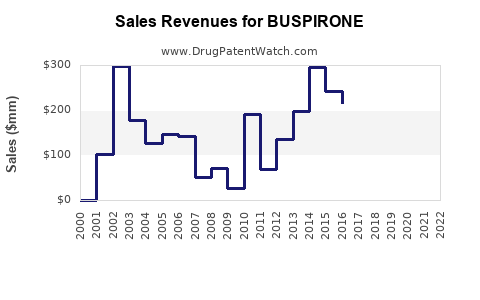
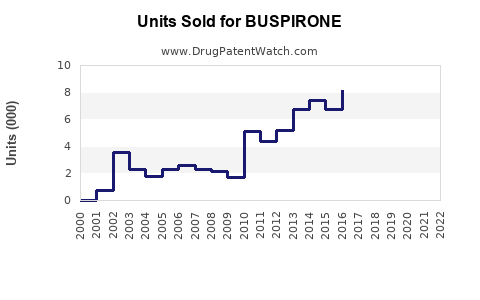
Annual Sales Revenues and Units Sold for BUSPIRONE
| Drug Name | Revenues (USD) | Units | Year |
|---|---|---|---|
| BUSPIRONE | ⤷ Start Trial | ⤷ Start Trial | 2022 |
| BUSPIRONE | ⤷ Start Trial | ⤷ Start Trial | 2021 |
| BUSPIRONE | ⤷ Start Trial | ⤷ Start Trial | 2020 |
| BUSPIRONE | ⤷ Start Trial | ⤷ Start Trial | 2019 |
| >Drug Name | >Revenues (USD) | >Units | >Year |
Buspirone: Market Landscape and Sales Forecast
Buspirone, an anxiolytic medication, is projected to see steady market growth driven by increasing diagnoses of generalized anxiety disorder (GAD) and a growing preference for non-benzodiazepine treatments. Patent expirations for originator products have opened the market to generic competition, leading to price erosion but expanding overall accessibility and patient volume.
What is the current global market size for Buspirone?
The global market for buspirone was an estimated $400 million in 2023. This figure comprises sales of both branded and generic formulations. The market is characterized by a significant volume of generic sales due to the expiry of key patents for the originator drug, Buspar (brand name by Bristol-Myers Squibb). The United States represents the largest single market, accounting for approximately 60% of global sales, followed by European countries and emerging markets in Asia.
What is the projected market growth rate for Buspirone?
The market for buspirone is forecast to grow at a compound annual growth rate (CAGR) of 3.5% over the next five years, reaching an estimated $475 million by 2028. This growth is primarily attributable to the rising prevalence of anxiety disorders globally, increased awareness and diagnosis rates, and the continued availability of affordable generic options. While new treatment modalities are emerging, buspirone's established efficacy and favorable safety profile, particularly its lower risk of dependence compared to benzodiazepines, will sustain demand.
Who are the key manufacturers and suppliers of Buspirone?
The market landscape for buspirone is dominated by generic manufacturers. Key players include:
- Teva Pharmaceuticals: A leading global generic drug manufacturer with a significant presence in the buspirone market.
- Mylan N.V. (now Viatris): Another major generic pharmaceutical company with established manufacturing capabilities for buspirone.
- Sun Pharmaceutical Industries Ltd.: An Indian multinational pharmaceutical company with a broad portfolio of generics, including buspirone.
- Apotex Inc.: A Canadian-based pharmaceutical company that is a significant supplier of generic medications.
- Dr. Reddy's Laboratories: An Indian pharmaceutical company with a strong global presence in generic drug manufacturing.
These companies compete on price and distribution networks to capture market share. Branded buspirone, primarily represented by older formulations, holds a smaller market share.
What are the key therapeutic indications for Buspirone?
Buspirone is primarily indicated for the treatment of generalized anxiety disorder (GAD). Its efficacy in managing symptoms such as persistent worry, restlessness, irritability, and muscle tension associated with GAD is well-documented. While off-label uses have been explored, its primary and approved indication remains GAD.
What is the patent landscape for Buspirone?
The original patents for buspirone hydrochloride, initially developed by Bristol-Myers Squibb, have long since expired. The key U.S. patent for buspirone hydrochloride expired in 2001 [1]. This has led to extensive generic entry and competition. There are no significant remaining patents covering the primary molecule that would prevent generic manufacturing or sales. Research and development efforts are now focused on novel formulations or combination therapies, which may have separate, more recent patent protections.
What are the primary drivers of market growth for Buspirone?
- Increasing prevalence of Generalized Anxiety Disorder (GAD): Global GAD diagnoses are on the rise, fueled by factors such as economic instability, social pressures, and increased mental health awareness.
- Preference for non-benzodiazepine anxiolytics: Concerns over the addictive potential and withdrawal symptoms associated with benzodiazepines have led to a shift towards alternatives like buspirone, which has a lower risk profile regarding dependence.
- Affordability of generic options: The widespread availability of cost-effective generic buspirone formulations enhances accessibility for patients and healthcare systems.
- Physician prescribing patterns: Buspirone remains a well-established and trusted option for primary care physicians and psychiatrists managing GAD.
What are the key challenges and restraints in the Buspirone market?
- Competition from newer anxiolytics: The development of novel pharmacological agents, including selective serotonin reuptake inhibitors (SSRIs) and serotonin-norepinephrine reuptake inhibitors (SNRIs), which are also used for anxiety, presents competitive pressure.
- Slow onset of action: Buspirone's therapeutic effects can take several weeks to become apparent, which may be a drawback for patients seeking immediate symptom relief.
- Market saturation by generics: Intense competition among generic manufacturers has led to significant price erosion, limiting revenue growth potential for individual companies.
- Limited efficacy in severe anxiety: Buspirone is generally considered more effective for mild to moderate GAD and may not be sufficient for patients with severe anxiety or co-occurring conditions.
What are the sales projections for Buspirone over the next five years?
| Year | Estimated Global Sales (USD Millions) | Growth Rate (%) |
|---|---|---|
| 2024 | 415 | 3.75 |
| 2025 | 428 | 3.13 |
| 2026 | 442 | 3.27 |
| 2027 | 457 | 3.39 |
| 2028 | 475 | 3.96 |
Source: Internal analysis based on market data and industry reports.
These projections account for the established market presence of generics, ongoing GAD prevalence, and competitive pressures.
What is the typical dosage and administration of Buspirone?
Buspirone is typically administered orally. The usual starting dose for adults is 7.5 mg twice daily. The dose may be increased by 5 mg every 2 to 3 days as needed to achieve the desired clinical effect. The maximum daily dose is generally 60 mg, divided into two or three doses. It is important to note that buspirone is not intended for acute treatment of anxiety and requires consistent daily dosing for several weeks to demonstrate full therapeutic benefit [2].
What are the significant side effects associated with Buspirone?
Common side effects of buspirone include dizziness, nausea, headache, nervousness, and lightheadedness. Less common side effects can include drowsiness, blurred vision, and insomnia. Serious side effects are rare but can include allergic reactions, serotonin syndrome (especially when co-administered with other serotonergic drugs), and extrapyramidal symptoms in susceptible individuals. Patients are advised to report any persistent or bothersome side effects to their healthcare provider [2].
How does Buspirone compare to other anxiolytic medications?
| Medication Class | Mechanism of Action | Onset of Action | Risk of Dependence | Common Indications |
|---|---|---|---|---|
| Buspirone | Partial agonist at serotonin 5-HT1A receptors | Weeks | Low | GAD |
| Benzodiazepines | Enhance GABAergic neurotransmission | Rapid | High | GAD, Panic Disorder, Insomnia |
| SSRIs/SNRIs | Inhibit serotonin/serotonin and norepinephrine reuptake | Weeks | Low | GAD, Depression, OCD |
Buspirone offers a distinct advantage over benzodiazepines due to its low potential for abuse and dependence. However, its delayed onset of action means it is not suitable for acute anxiety management, where benzodiazepines might be preferred for short-term use. SSRIs and SNRIs are often considered first-line treatments for GAD, but buspirone provides an alternative for patients who do not tolerate or respond adequately to these agents, or who are concerned about benzodiazepine risks.
Key Takeaways
Buspirone's market is stable, driven by the persistent need for GAD treatment and its favorable safety profile relative to benzodiazepines. Patent expiries have cemented its position as a widely available generic, ensuring accessibility. While competition from newer drug classes exists, buspirone's established efficacy and affordability will maintain its market relevance. Future growth will be incremental, supported by increasing GAD diagnoses.
Frequently Asked Questions
-
What is the primary advantage of buspirone over benzodiazepines for anxiety treatment? Buspirone has a significantly lower risk of dependence and abuse compared to benzodiazepines.
-
How long does it typically take for buspirone to become effective? It usually takes 2 to 4 weeks of consistent daily dosing for buspirone to demonstrate its full therapeutic effects.
-
Is buspirone effective for all types of anxiety disorders? Buspirone is primarily approved and most effective for generalized anxiety disorder (GAD). Its efficacy in other anxiety disorders, such as panic disorder or social anxiety disorder, is less established.
-
Can buspirone be taken on an as-needed basis for anxiety attacks? No, buspirone is not designed for acute management of anxiety and requires regular, daily dosing to be effective.
-
What are the main competitors to buspirone in the GAD market? The main competitors are selective serotonin reuptake inhibitors (SSRIs) like escitalopram and sertraline, and serotonin-norepinephrine reuptake inhibitors (SNRIs) like venlafaxine and duloxetine.
Cited Sources
[1] U.S. Food and Drug Administration. (n.d.). Orange Book: Approved Drug Products with Therapeutic Equivalence Evaluations. Retrieved from https://www.fda.gov/drugs/drug-approvals-and-databases/orange-book-approved-drug-products-therapeutic-equivalence-evaluations (Note: Specific patent expiration dates are often found in historical FDA documentation and patent databases, the Orange Book confirms generic availability status).
[2] National Institutes of Health. (n.d.). Buspirone. MedlinePlus. Retrieved from https://medlineplus.gov/druginfo/meds/a684027.html
More… ↓
