Drug Sales Trends for AVODART
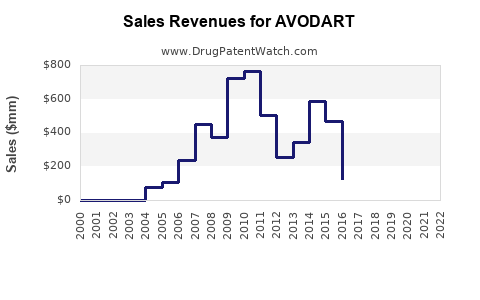
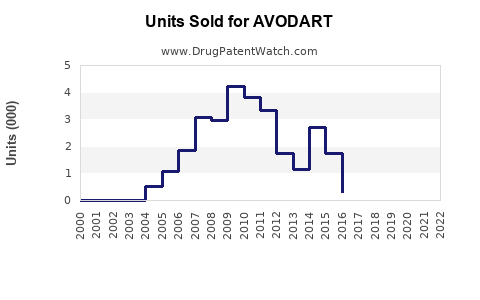
Annual Sales Revenues and Units Sold for AVODART
| Drug Name | Revenues (USD) | Units | Year |
|---|---|---|---|
| AVODART | ⤷ Start Trial | ⤷ Start Trial | 2022 |
| AVODART | ⤷ Start Trial | ⤷ Start Trial | 2021 |
| AVODART | ⤷ Start Trial | ⤷ Start Trial | 2020 |
| AVODART | ⤷ Start Trial | ⤷ Start Trial | 2019 |
| AVODART | ⤷ Start Trial | ⤷ Start Trial | 2018 |
| AVODART | ⤷ Start Trial | ⤷ Start Trial | 2017 |
| >Drug Name | >Revenues (USD) | >Units | >Year |
AVODART Market Analysis and Sales Projections Through 2030
Avodart, GSK's brand of dutasteride 0.5 mg, is a mature benign prostatic hyperplasia treatment with limited branded revenue potential and a larger generic-molecule opportunity. U.S. composition-patent protection has ended, generic dutasteride is widely available, and GSK does not report Avodart as a standalone product in current financial disclosures. Future sales will depend on generic prescription volume, combination therapy adoption, market access, and use in selected prostate-cancer and hair-loss markets.
The commercial outlook is weak for the Avodart brand but stable for dutasteride as an active pharmaceutical ingredient. A base-case model places global dutasteride-related pharmaceutical sales at approximately $350 million to $500 million in 2025, with low-single-digit annual growth through 2030. Branded Avodart sales are likely to decline or remain below $50 million globally unless GSK expands commercialization in markets with limited generic substitution.
What is Avodart and how is it used?
Avodart contains dutasteride, a dual 5-alpha reductase inhibitor that suppresses conversion of testosterone to dihydrotestosterone. The FDA-approved indication is the treatment of symptomatic benign prostatic hyperplasia in men with an enlarged prostate. The recommended dose is 0.5 mg orally once daily. Dutasteride is also marketed with tamsulosin as Jalyn in the United States. [1]
Dutasteride inhibits both type 1 and type 2 5-alpha reductase enzymes. Finasteride, its principal pharmacologic competitor, primarily inhibits type 2. Dutasteride therefore produces more extensive dihydrotestosterone suppression, but both products compete in the same long-term BPH treatment segment.
| Product | Active ingredient | Primary indication | Dose | Commercial status |
|---|---|---|---|---|
| Avodart | Dutasteride | Benign prostatic hyperplasia | 0.5 mg daily | Mature branded product |
| Generic dutasteride | Dutasteride | Benign prostatic hyperplasia | 0.5 mg daily | Widely available |
| Jalyn | Dutasteride/tamsulosin | BPH | 0.5 mg/0.4 mg daily | Branded combination |
| Proscar and generic finasteride | Finasteride | BPH | 5 mg daily | Major substitute |
| Propecia and generic finasteride | Finasteride | Male-pattern hair loss | 1 mg daily | Competes in off-label markets |
How large is the Avodart and dutasteride market?
The market must be separated into two categories:
- Avodart branded sales.
- Total dutasteride sales across branded and generic products.
GSK does not provide a current standalone Avodart revenue line in its annual reporting. The product is grouped within broader pharmaceutical categories or omitted from material-product disclosures because sales are no longer financially significant to the company. [2]
Public market databases also differ in whether they count hospital, retail, branded, generic, combination-product, and international sales. A single reported market figure can therefore overstate or understate the economic value of the Avodart franchise.
Estimated 2025 market structure
The following estimates are scenario-based and represent the economic market for dutasteride-containing products rather than audited company revenue.
| Segment | Estimated 2025 sales | Estimated share |
|---|---|---|
| U.S. generic dutasteride | $80 million-$130 million | 20%-30% |
| European generic and branded dutasteride | $70 million-$120 million | 15%-25% |
| Japan and other developed markets | $50 million-$90 million | 10%-20% |
| Emerging markets | $130 million-$200 million | 30%-45% |
| Avodart brand and licensed branded products | Less than $50 million | Less than 10% |
| Total dutasteride-related market | $350 million-$500 million | 100% |
These ranges are analytical estimates, not reported GSK sales. The broad range reflects generic price dispersion, country-level reimbursement, unreported private-market sales, and the absence of a consolidated public dataset for all dutasteride products.
What are the main market-growth drivers for Avodart?
The strongest demand driver is the aging male population. BPH prevalence increases with age, and the number of men requiring chronic lower-urinary-tract-symptom treatment continues to rise in North America, Europe, and Asia.
Dutasteride also benefits from several treatment characteristics:
- It reduces prostate volume over time.
- It lowers the risk of acute urinary retention and BPH-related surgery.
- It is used in men with larger prostate volumes, where 5-alpha reductase inhibitors are more clinically relevant.
- It can be used with an alpha blocker when rapid symptom control is needed.
- It has established physician familiarity and long-term safety data.
Guidelines generally position 5-alpha reductase inhibitors for men with demonstrable prostate enlargement, elevated prostate-specific antigen, or increased risk of progression. Alpha blockers remain important competitors because they provide faster symptom relief. [3]
The market does not have the same growth profile as newer branded urology therapies. Dutasteride is inexpensive, orally administered, and supported by generic competition. Volume growth therefore produces limited revenue growth.
What factors are reducing Avodart sales?
Generic substitution is the principal commercial risk. In the United States and other developed markets, pharmacy benefit managers and public payers generally prefer generic dutasteride over Avodart. The price difference limits GSK's ability to maintain a branded premium.
Other constraints include:
Slow treatment switching
Patients who achieve stable symptom control often remain on their existing therapy. This reduces the rate at which physicians switch from finasteride or generic dutasteride to branded Avodart.
Competition from finasteride
Finasteride is available in multiple generic forms and has a lower cost base. Physicians may use it before dutasteride, particularly in patients with less severe prostate enlargement or lower progression risk.
Combination-therapy substitution
Jalyn competes with separate prescriptions for generic dutasteride and generic tamsulosin. The availability of both components as low-cost generics limits the pricing power of the fixed-dose combination.
Limited regulatory differentiation
Avodart does not have a recent regulatory innovation that would justify a significant premium. Its commercial position is based on the dutasteride molecule, not on a differentiated delivery system, formulation, or dosing technology.
When did Avodart lose market exclusivity?
Avodart's U.S. market exclusivity ended after the expiration and settlement of its core intellectual-property protection. FDA records now list multiple approved generic dutasteride products, confirming that the product no longer has meaningful U.S. single-source protection. [4]
The relevant commercial timeline is:
| Period | Event | Commercial impact |
|---|---|---|
| 2001 | FDA approval of Avodart in the United States | GSK establishes the BPH brand |
| 2000s | Expansion of international approvals | Global commercial penetration |
| 2010s | Abbreviated New Drug Applications and patent challenges | Generic-entry preparation |
| Mid-2010s | Generic dutasteride becomes available in the United States | Rapid pressure on brand pricing |
| 2020s | Broad generic availability | Avodart becomes a low-value residual brand |
The existence of generic entry means that a Paragraph IV challenge is no longer the primary commercial issue. Any future patent dispute would be more likely to involve a specific formulation, combination, manufacturing process, or market-specific use rather than the basic Avodart capsule.
What patents protect Avodart today?
The core dutasteride composition and product patents no longer provide meaningful blocking protection in the United States. Current commercial barriers are primarily regulatory, manufacturing, distribution, and physician-prescribing barriers.
Potential residual intellectual-property categories include:
- Country-specific process patents.
- Combination-product patents covering dutasteride and tamsulosin.
- Formulation or release-profile patents.
- Method-of-use patents for defined patient populations.
- Patent rights in markets where generic approvals or enforcement timelines differ.
- Trade secrets covering manufacturing processes and analytical controls.
These rights have limited value unless they prevent a commercially substitutable product from reaching a major market. A patent covering a narrow method of use generally has lower practical value when physicians can prescribe generic dutasteride under the approved BPH indication.
What is the FDA and Orange Book status of Avodart?
Avodart is an FDA-approved prescription drug for BPH. Its U.S. dosage form is a 0.5 mg soft gelatin capsule. Generic dutasteride products have been approved through the ANDA pathway, allowing applicants to rely on the reference product's safety and efficacy findings while demonstrating pharmaceutical equivalence and bioequivalence. [1, 4]
The Orange Book remains relevant for:
- Identifying the reference listed drug.
- Reviewing patents and regulatory exclusivity.
- Tracking generic approvals.
- Assessing whether any listed patent could delay approval.
- Reviewing approved dosage forms and product sponsors.
The current regulatory profile is that of a mature reference product with multiple generic competitors. It does not have biologic exclusivity or biosimilar exposure because dutasteride is a small-molecule drug. The principal substitution risk is generic, not biosimilar.
Which companies compete with Avodart?
Competition is fragmented across products and treatment approaches.
| Competitor | Company type | Main competitive advantage |
|---|---|---|
| Generic dutasteride | Multiple manufacturers | Lowest price and broad payer coverage |
| Generic finasteride | Multiple manufacturers | Lower cost and long prescribing history |
| Proscar | Legacy branded product | Physician familiarity |
| Jalyn | GSK or authorized commercial partners | Fixed-dose dutasteride/tamsulosin convenience |
| Generic dutasteride/tamsulosin | Multiple manufacturers in selected markets | Combination convenience at lower cost |
| Tamsulosin and other alpha blockers | Multiple manufacturers | Faster symptom improvement |
| Tadalafil | Eli Lilly and generics | BPH and erectile-dysfunction overlap |
| Procedural therapies | Urology providers and device companies | Alternative to chronic medication |
The most direct competitor is generic dutasteride, followed by generic finasteride. Tamsulosin is a treatment competitor rather than a direct molecular substitute because it addresses symptoms through a different mechanism.
What are Avodart sales projections through 2030?
The projection below separates the total dutasteride market from the Avodart brand. It assumes continued generic substitution, stable BPH prevalence, modest growth in emerging markets, and no material new indication.
| Year | Global dutasteride market, base case | Avodart brand sales, base case | Primary assumption |
|---|---|---|---|
| 2025 | $350 million-$500 million | $20 million-$45 million | Mature generic market |
| 2026 | $360 million-$515 million | $18 million-$42 million | Continued price erosion |
| 2027 | $370 million-$530 million | $17 million-$40 million | Volume offsets lower prices |
| 2028 | $380 million-$545 million | $16 million-$38 million | Emerging-market growth |
| 2029 | $390 million-$560 million | $15 million-$36 million | Stable developed-market demand |
| 2030 | $400 million-$575 million | $14 million-$35 million | Low-single-digit market growth |
Scenario analysis
| Scenario | 2030 total dutasteride market | 2030 Avodart brand sales | Conditions |
|---|---|---|---|
| Downside | $300 million-$400 million | Less than $15 million | Faster generic substitution and price compression |
| Base case | $400 million-$575 million | $14 million-$35 million | Stable volume and modest emerging-market growth |
| Upside | $600 million-$800 million | $35 million-$75 million | Stronger combination use, expanded emerging-market access, or new commercial positioning |
The upside case does not assume material U.S. branded growth. It depends mainly on international pricing, combination products, or a new approved indication. A significant Avodart revenue recovery would require clinical differentiation or a commercial agreement that creates a protected channel.
How strong is the Avodart patent estate?
The patent estate is weak as a basis for future branded growth in the United States. The product has lost the central attributes of a high-value pharmaceutical franchise:
- No meaningful U.S. composition-patent barrier.
- Multiple generic competitors.
- No biologic exclusivity.
- No current evidence of a broad, enforceable formulation moat.
- Limited ability to prevent substitution under standard BPH prescribing.
- No publicly reported late-stage lifecycle program tied to Avodart.
The remaining value is commercial rather than exclusionary. GSK may retain manufacturing know-how, trademarks, regulatory files, supply relationships, and market-specific rights. Those assets can support residual sales but are unlikely to support premium pricing.
What generic-launch risks exist for Avodart?
Generic risk is already realized rather than prospective. Future erosion will occur through additional entrants, lower tender prices, and substitution of generic dutasteride/tamsulosin for branded combination therapy.
The principal generic-launch effects are:
- Lower average selling prices.
- Reduced pharmacy stocking of Avodart.
- Greater payer restrictions on brand reimbursement.
- Lower physician incentive to prescribe the brand.
- Expanded use of parallel trade in Europe.
- Greater vulnerability in government tenders across emerging markets.
The remaining brand sales are most exposed in markets with automatic substitution, centralized procurement, or high generic penetration. Avodart may retain limited demand where physician preference, brand recognition, or supply reliability supports continued use.
What is the commercial outlook for GSK?
Avodart is unlikely to influence GSK's valuation or overall revenue trajectory. The product is immaterial compared with GSK's vaccines, respiratory medicines, HIV portfolio, and newer specialty products. GSK's financial disclosures do not identify Avodart as a material growth driver. [2]
For licensing or acquisition analysis, Avodart is more relevant as part of a broader mature-products portfolio than as a standalone asset. A transaction would need to capture several markets or combine Avodart with generic manufacturing capacity to achieve meaningful scale.
The most defensible investment view is:
- Avodart brand: declining, low-value residual revenue.
- Dutasteride molecule: durable volume with low pricing power.
- Generic manufacturer: potentially attractive only with efficient production and broad geographic coverage.
- New formulation developer: limited value unless the product receives regulatory differentiation.
- Combination-product owner: moderate opportunity where adherence or convenience supports premium reimbursement.
Key Takeaways
- Avodart is GSK's branded dutasteride product for benign prostatic hyperplasia.
- U.S. core exclusivity has ended, and generic dutasteride is widely available.
- GSK does not publicly report a current standalone Avodart revenue figure.
- Estimated global dutasteride-related sales are approximately $350 million-$500 million in 2025.
- Base-case total-market sales reach approximately $400 million-$575 million by 2030.
- Avodart brand sales are estimated at $20 million-$45 million in 2025 and $14 million-$35 million by 2030.
- Generic substitution, finasteride, alpha blockers, and fixed-dose combination products are the main competitive pressures.
- Dutasteride has no biosimilar risk because it is a small-molecule drug.
- The patent estate offers limited protection for future U.S. branded growth.
- The principal commercial opportunity is in generic manufacturing, emerging markets, and combination products rather than the Avodart brand.
FAQs About Avodart Market Sales and Exclusivity
Is Avodart still sold in the United States?
Yes. Avodart remains an FDA-approved reference product, but generic dutasteride is widely available and generally receives payer and pharmacy preference.
Does GSK still disclose Avodart revenue?
GSK does not provide a current standalone Avodart revenue line in its principal public financial disclosures. The product is no longer treated as a material companywide revenue driver.
Is dutasteride more commercially valuable than finasteride?
Dutasteride can command greater clinical interest in men with larger prostates because it inhibits both type 1 and type 2 5-alpha reductase. Finasteride has broader generic availability, lower cost, and longer market familiarity. Commercial value depends on volume and price, not pharmacologic potency alone.
Can a new formulation of dutasteride obtain market exclusivity?
A new formulation could receive patent protection or regulatory exclusivity if it demonstrates a distinct, patentable product or delivery system and meets FDA approval requirements. That protection would not automatically restore exclusivity for conventional Avodart capsules.
Is Jalyn exposed to the same generic risks as Avodart?
Yes. Jalyn faces substitution from separate generic dutasteride and tamsulosin prescriptions, as well as generic fixed-dose combinations where approved. Its commercial advantage is convenience rather than a durable patent barrier.
References
-
U.S. Food and Drug Administration. (2024). Avodart (dutasteride) prescribing information. FDA.
-
GSK plc. (2024). Annual report 2023. GSK.
-
American Urological Association. (2023). Management of lower urinary tract symptoms attributed to benign prostatic hyperplasia: AUA guideline. American Urological Association.
-
U.S. Food and Drug Administration. (2024). Approved drug products with therapeutic equivalence evaluations: Orange Book. FDA.
More… ↓
