Share This Page
Drug Sales Trends for fosinopril sodium
✉ Email this page to a colleague
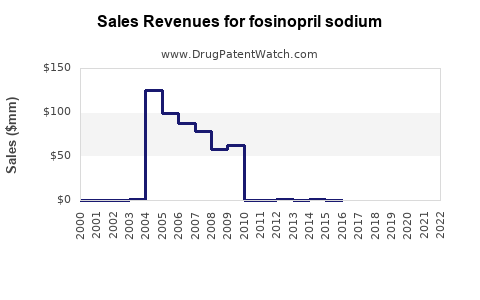
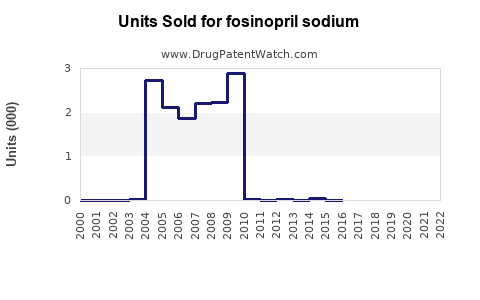
Annual Sales Revenues and Units Sold for fosinopril sodium
| Drug Name | Revenues (USD) | Units | Year |
|---|---|---|---|
| FOSINOPRIL SODIUM | ⤷ Start Trial | ⤷ Start Trial | 2022 |
| FOSINOPRIL SODIUM | ⤷ Start Trial | ⤷ Start Trial | 2021 |
| FOSINOPRIL SODIUM | ⤷ Start Trial | ⤷ Start Trial | 2020 |
| FOSINOPRIL SODIUM | ⤷ Start Trial | ⤷ Start Trial | 2019 |
| FOSINOPRIL SODIUM | ⤷ Start Trial | ⤷ Start Trial | 2018 |
| FOSINOPRIL SODIUM | ⤷ Start Trial | ⤷ Start Trial | 2017 |
| >Drug Name | >Revenues (USD) | >Units | >Year |
Fosinopril Sodium Market Analysis and Sales Projections, 2025-2030
Fosinopril sodium is a mature, genericized angiotensin-converting enzyme inhibitor used primarily for hypertension and heart failure. The market has low regulatory and patent barriers, intense generic competition, limited pricing power, and declining clinical relevance relative to newer antihypertensive combinations. Global annual sales of fosinopril sodium finished products are estimated at approximately $35 million to $75 million in 2025, with a base-case decline to $25 million to $50 million by 2030. The estimate excludes hospital tenders with unavailable public pricing and direct sales of active pharmaceutical ingredient.
What is the current market status of fosinopril sodium?
Fosinopril sodium is the prodrug salt of fosinopril. It is converted in vivo to fosinoprilat, an ACE inhibitor that reduces angiotensin II formation and aldosterone secretion. The product is available mainly as immediate-release tablets in 10 mg, 20 mg, and 40 mg strengths.
The reference product, Monopril, was developed and commercialized by Bristol-Myers Squibb. Fosinopril received U.S. Food and Drug Administration approval in 1991. Its principal commercial indications are:
- Hypertension
- Treatment of heart failure as an adjunct to other therapies
Fosinopril has several pharmacokinetic characteristics that distinguish it from some older ACE inhibitors. It is a prodrug, has both renal and hepatic elimination pathways, and is less dependent on renal clearance than some competing agents. Those characteristics support use in selected patients but have not prevented the product from losing share to lisinopril, enalapril, ramipril, losartan, and fixed-dose combinations.
Fosinopril sodium product profile
| Attribute | Description |
|---|---|
| Active ingredient | Fosinopril sodium |
| Drug class | ACE inhibitor |
| Original brand | Monopril |
| Original sponsor | Bristol-Myers Squibb |
| Initial U.S. approval | 1991 |
| Common strengths | 10 mg, 20 mg, 40 mg |
| Primary dosage form | Immediate-release tablet |
| Main indications | Hypertension and heart failure |
| Prescription status | Prescription medicine |
| U.S. patent position | Core exclusivity expired |
| Current market structure | Multi-source generic |
| Biosimilar exposure | None; small-molecule drug |
How large is the fosinopril sodium market?
Public sources do not provide a single audited global market total for fosinopril sodium. The product is sold through numerous generic manufacturers, country-specific distributors, hospital tenders, and retail pharmacies. Many sales are reported at portfolio level rather than by molecule.
A bottom-up market model produces the following 2025 estimate:
| Region | Estimated 2025 sales | Market characteristics |
|---|---|---|
| United States | $8 million-$18 million | Generic retail and Medicaid, low unit prices |
| Western Europe | $10 million-$20 million | Mature generic markets, reference pricing |
| Central and Eastern Europe | $4 million-$9 million | Tender-driven and price-sensitive |
| China | $5 million-$12 million | Local generic supply and hospital procurement |
| Latin America | $3 million-$8 million | Mixed branded-generic and generic channels |
| Middle East and Africa | $2 million-$6 million | Public procurement and distributor sales |
| Other markets | $3 million-$7 million | Fragmented national markets |
| Total estimated market | $35 million-$75 million | Finished-product sales |
The central estimate is approximately $52 million in 2025. This estimate reflects generic net sales rather than retail list prices.
Fosinopril is a small market within the broader ACE inhibitor segment. Lisinopril and enalapril generally have much larger prescription bases because of earlier generic penetration, broader formulary adoption, lower prices, and stronger physician familiarity. Ramipril retains meaningful share in cardiovascular prevention markets, while perindopril has greater presence in several European markets.
What are the sales projections for fosinopril sodium through 2030?
The base case assumes a 4% to 7% annual decline in global sales. Decline is driven by generic price compression, lower prescribing frequency, therapeutic substitution, and the continued use of newer fixed-dose combinations.
| Year | Low case | Base case | High case |
|---|---|---|---|
| 2025 | $35 million | $52 million | $75 million |
| 2026 | $33 million | $49 million | $73 million |
| 2027 | $31 million | $46 million | $71 million |
| 2028 | $29 million | $43 million | $69 million |
| 2029 | $27 million | $41 million | $67 million |
| 2030 | $25 million | $38 million | $65 million |
| 2025-2030 CAGR | -6.5% | -5.4% | -2.8% |
The base-case forecast implies approximately $228 million in cumulative global sales during 2025-2030. These values represent market-level finished-product revenue, not the revenue of any individual manufacturer.
Projection assumptions
The forecast uses four main assumptions:
- The number of treated hypertension patients continues to rise globally, but fosinopril captures little of that growth.
- Generic unit prices decline by approximately 3% to 6% annually in competitive markets.
- Fosinopril remains available in major markets but experiences gradual formulary and physician substitution.
- No major new indication, combination product, or regulatory event materially changes demand.
A stronger outcome would require supply disruption affecting competing ACE inhibitors, successful positioning in patients with specific renal or tolerability considerations, or expansion in markets where generic fosinopril has limited current penetration.
Which companies manufacture or sell fosinopril sodium?
Fosinopril sodium is supplied by a fragmented group of generic pharmaceutical companies. Manufacturer participation differs by country and can change after product discontinuations, acquisitions, or tender awards.
Known or historically reported suppliers have included:
- Teva Pharmaceuticals
- Mylan, now part of Viatris
- Sandoz
- Apotex
- Lupin
- Cipla
- Zydus Lifesciences
- Torrent Pharmaceuticals
- Aurobindo Pharma
- Sun Pharmaceutical Industries
- Various regional manufacturers and contract suppliers
The United States market has historically included generic fosinopril sodium tablets from multiple abbreviated new drug application holders. The FDA’s Orange Book identifies approved products and therapeutic-equivalence information, but active commercial availability must be confirmed through current manufacturer and wholesaler data rather than assumed from an approval listing.[1]
What is the FDA regulatory status of fosinopril sodium?
Fosinopril sodium is an FDA-approved small-molecule prescription drug. Generic products are approved through the abbreviated new drug application pathway under section 505(j) of the Federal Food, Drug, and Cosmetic Act.
The regulatory profile is mature:
| Regulatory issue | Status |
|---|---|
| Reference product | Monopril |
| Approval pathway for generics | ANDA |
| Bioequivalence requirement | Yes |
| Biosimilar pathway | Not applicable |
| New chemical entity exclusivity | Expired |
| Core patent exclusivity | Expired |
| Pediatric exclusivity | Expired or no longer commercially relevant |
| Regulatory barrier | Low to moderate |
| Current commercial barrier | Price, supply reliability, and distribution |
Fosinopril sodium is not a biologic and therefore has no biosimilar pathway. Competitive entry depends on pharmaceutical equivalence, bioequivalence, manufacturing compliance, and commercial economics.
What patents protect fosinopril sodium?
The original composition-of-matter and product-related patent estate for fosinopril has expired. Current commercial value does not depend on a live core patent covering the active ingredient.
Potentially relevant intellectual-property categories include:
- Expired composition-of-matter patents
- Expired salt or prodrug patents
- Manufacturing-process patents
- Formulation patents
- Packaging and stability claims
- Country-specific patents for later-developed combinations
These categories have limited ability to block ordinary generic fosinopril sodium tablets. Process patents can affect a particular manufacturing route, but they generally do not restore product-level exclusivity if alternative non-infringing processes are available.
Orange Book status
Fosinopril sodium’s core commercial status is that of an off-patent, multisource product. Any remaining Orange Book-listed patents, if present for a specific reference or combination product, should be reviewed by product and strength. The existence of an Orange Book listing does not establish that all generic products face a launch prohibition.
For investment and licensing analysis, the relevant conclusion is that a standard fosinopril sodium tablet does not have a credible long-term patent moat. The principal barriers are operational rather than legal.
Are there Paragraph IV challenges to fosinopril sodium?
Paragraph IV litigation risk is low because the foundational patents expired years ago and the product is already genericized. A current applicant would normally face little commercial value in challenging an active core patent because the principal market has already moved to multisource competition.
Any Paragraph IV activity would most likely relate to:
- A later-developed formulation
- A combination product
- A specific manufacturing process
- A newly listed patent associated with a reformulated product
The expected commercial benefit of a first Paragraph IV launch is limited. Fosinopril sodium has no meaningful 180-day exclusivity opportunity comparable to a high-value branded product because the molecule has been off patent for decades.
What formulations are protected by fosinopril sodium patents?
The commercially important dosage form is the immediate-release tablet. No current formulation category appears capable of supporting substantial exclusivity for the ordinary product.
Potential formulation opportunities include:
| Formulation concept | Commercial assessment |
|---|---|
| Immediate-release tablet | Mature generic market; weak differentiation |
| Higher-dose tablet | Limited value because 40 mg is already established |
| Oral solution | Potential niche for swallowing difficulty, but small market |
| Fixed-dose combination | Possible differentiation, but competing ACE inhibitor combinations dominate |
| Modified-release formulation | Technical opportunity, but limited clinical and reimbursement support |
| Pediatric formulation | Niche market with uncertain commercial return |
| Abuse-deterrent or specialty formulation | Not commercially relevant for this molecule |
A reformulated product would need a clear clinical or adherence advantage. Price-based competition alone is unlikely to justify development costs.
How does fosinopril compare with competing ACE inhibitors?
| Drug | Commercial position | Main advantage over fosinopril | Main limitation |
|---|---|---|---|
| Lisinopril | Leading generic ACE inhibitor | Low cost, simple dosing, extensive familiarity | Renal elimination and cough risk |
| Enalapril | Large generic market | Long clinical history and broad availability | Generic price pressure |
| Ramipril | Strong cardiovascular positioning | Evidence base in high-risk patients | More expensive in some markets |
| Perindopril | Important in parts of Europe | Combination and cardiovascular use | Geographic concentration |
| Captopril | Older low-cost option | Short-acting flexibility | Frequent dosing |
| Fosinopril | Niche generic | Dual renal and hepatic elimination | Smaller prescriber base |
Fosinopril’s most credible commercial position is as a low-cost alternative where clinicians value its pharmacokinetic profile or where local formularies include it. It is unlikely to regain broad class share without a new clinical proposition.
What are the main market drivers and risks?
Growth drivers
Global hypertension prevalence supports baseline demand for antihypertensive therapy. The World Health Organization estimates that approximately 1.28 billion adults aged 30 to 79 years have hypertension, although treatment growth does not translate directly into fosinopril growth.[2]
Other potential drivers include:
- Continued access to low-cost cardiovascular medicines
- Expansion of generic procurement in emerging markets
- Use in patients requiring an ACE inhibitor with nonrenal elimination
- Periodic shortages of larger ACE inhibitor products
- Regional preference for branded generics
Market risks
The principal risks are:
- Continued migration to lisinopril, ramipril, ARBs, and combination products
- Annual price erosion in tender and retail markets
- Manufacturer discontinuations caused by low margins
- Limited promotional support
- Reduced use of ACE inhibitors where ARBs are preferred because of cough or tolerability
- Lack of new clinical data supporting differentiation
- Small addressable market for specialty reformulations
Supply concentration can create short-term price increases, but such events are unlikely to produce durable market expansion.
What generic launch scenarios exist for fosinopril sodium?
A new generic entrant would face three commercial scenarios.
| Scenario | Expected outcome |
|---|---|
| Lowest-cost commodity supplier | Rapid volume access but weak margins and high tender pressure |
| Reliable multi-country supplier | Better customer retention and moderate share potential |
| Differentiated formulation or combination | Higher development risk and limited evidence of market size |
A conventional tablet entrant would likely need one or more of the following:
- Approved supply in multiple strengths
- Demonstrated manufacturing reliability
- Competitive acquisition cost
- Established wholesaler or tender access
- Low-cost API sourcing
- Registration in several national markets
A realistic objective for a new manufacturer would be share capture from supply-constrained competitors rather than expansion of the overall fosinopril market.
What is the revenue exposure for manufacturers?
Revenue exposure is generally modest on a portfolio basis because fosinopril is one product among many generic cardiovascular medicines. The largest risks occur for manufacturers with:
- High dependence on a small number of low-margin products
- Single-site production
- Concentrated government-tender exposure
- Uncompetitive API costs
- Weak distribution outside one national market
At the molecule level, a manufacturer with 5% of a $52 million global market would generate approximately $2.6 million in annual finished-product sales before country-specific deductions. A 10% share would represent approximately $5.2 million. These figures show why fosinopril is more suitable as a portfolio filler than as a standalone strategic growth asset.
How strong is the fosinopril sodium patent estate?
The patent estate is weak for ordinary tablets. Core patents are expired, regulatory exclusivity is no longer relevant, and generic substitution is established. Process patents may protect individual manufacturing routes but do not create broad market exclusivity.
| Estate component | Strength |
|---|---|
| Composition of matter | None for current commercial protection |
| Standard tablet formulation | Weak |
| Method of use | Weak for established indications |
| Manufacturing process | Potentially relevant to individual suppliers |
| Combination products | Product-specific and potentially stronger |
| Geographic coverage | Uneven, dependent on local registrations |
| Litigation leverage | Low |
Key Takeaways
- Fosinopril sodium is a mature, off-patent ACE inhibitor with a fragmented generic market.
- Estimated global finished-product sales are $35 million to $75 million in 2025, with a base case of approximately $52 million.
- Base-case sales decline to approximately $38 million by 2030.
- The market has low patent risk and low Paragraph IV value.
- Standard immediate-release tablets have limited differentiation and weak pricing power.
- The United States, Western Europe, China, and selected emerging markets account for most commercial opportunity.
- Manufacturing reliability, API cost, tender access, and distribution are more important than intellectual-property protection.
- A new entrant is more likely to capture existing volume than expand total fosinopril demand.
- Fosinopril is better suited to a broad generic cardiovascular portfolio than to a standalone investment thesis.
FAQs
Is fosinopril sodium still commercially available?
Yes. Fosinopril sodium remains available as a generic prescription tablet in multiple markets, although product availability varies by country, manufacturer, and wholesaler.
Does fosinopril sodium have patent protection in the United States?
The foundational patent protection has expired. Any remaining patent issue would be product-specific, such as a later formulation, combination product, or manufacturing process.
Is fosinopril sodium a good generic development opportunity?
It is a low-risk regulatory opportunity but a weak standalone commercial opportunity. Development is most attractive for manufacturers with existing cardiovascular distribution, low production costs, or access to public tenders.
What is the expected U.S. market size for fosinopril sodium?
The U.S. finished-product market is estimated at approximately $8 million to $18 million in 2025. The range reflects uncertainty in prescription volume, manufacturer participation, and net pricing.
Can fosinopril sodium sales increase after 2030?
A sustained increase is unlikely without a new combination product, a supply disruption affecting competing therapies, or a clinically differentiated formulation. The base case is continued low-single-digit annual decline.
References
-
U.S. Food and Drug Administration. (2024). Approved drug products with therapeutic equivalence evaluations: Orange Book. https://www.fda.gov/drugs/drug-approvals-and-databases/approved-drug-products-therapeutic-equivalence-evaluations-orange-book
-
World Health Organization. (2023). Global report on hypertension: The race against a silent killer. https://www.who.int/publications/i/item/9789240081062
-
U.S. Food and Drug Administration. (1991). Monopril prescribing information. FDA Drugs@FDA database. https://www.accessdata.fda.gov/scripts/cder/daf/
-
National Library of Medicine. (2024). Fosinopril sodium tablet: DailyMed labeling. https://dailymed.nlm.nih.gov/dailymed/
-
U.S. Food and Drug Administration. (2024). Generic drug facts. https://www.fda.gov/drugs/generic-drugs/generic-drug-facts
More… ↓
