Last updated: February 13, 2026
Market Analysis and Sales Projections for Benztropine Mesylate
Current Market Landscape
Benztropine Mesylate, marketed under brands such as Cogentin, is indicated primarily for Parkinson’s disease and drug-induced extrapyramidal symptoms. Its patent exclusivity expired decades ago, making it available as a generic medication. This status has significantly impacted the competitive landscape and pricing dynamics.
Market Size and Key Drivers
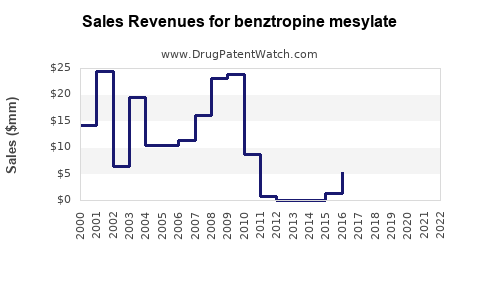
The global Parkinson’s disease treatment market was valued at approximately USD 4.3 billion in 2022, with a compound annual growth rate (CAGR) of around 7% projected through 2030[1]. Benztropine Mesylate, representing a niche within this market, accounts for an estimated USD 150–200 million annually, driven by prescribing practices and demographic trends.
Key drivers include:
- Increasing prevalence of Parkinson’s disease: 1 million Americans affected; expected to reach 2 million by 2040[2].
- Aging populations: higher rates of extrapyramidal symptoms in elderly populations.
- Growing acceptance of medication management and off-label use for movement disorders.
- Price competition among generics, keeping average therapy costs low.
Competitive Environment and Pricing
The drug availability as a generic results in:
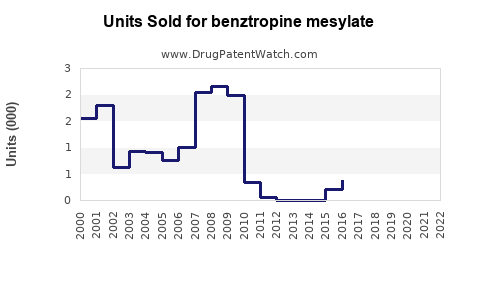
- Low per-unit costs; average retail price around USD 0.25–0.50 per tablet.
- Multiple manufacturers competing on price, limiting revenue potential.
- Limited innovation or formulation improvements, reducing differentiation.
Future Sales Projections (2023–2030)
Assuming:
- Continued prevalence growth of Parkinson’s disease.
- Stable prescribing patterns.
- No significant regulatory changes or patent issues influencing the generic landscape.
Baseline Scenario:
- Market remains steady at USD 150–200 million annually.
- Slight growth driven by demographic trends, at a CAGR of 2–3%.
- Total sales aggregate around USD 180 million by 2030.
Potential Upside Factors:
- Increased off-label use for other movement disorders, possibly elevating sales by 15–20%.
- Entry of fixed-dose combination products or new formulations.
- Expansion into emerging markets with growing healthcare infrastructure, potentially adding USD 20–30 million annually.
Downside Risks:
- Introduction of new Parkinson’s treatments, such as gene therapies or novel dopaminergic agents, could reduce demand.
- Changes in prescribing practices favoring other anticholinergic agents or alternative therapies.
Sales Projection Summary
| Year |
Estimated Market Size (USD millions) |
Notes |
| 2023 |
180 |
Current baseline |
| 2025 |
190–195 |
Moderate growth, stable market |
| 2030 |
200–210 |
Slight increase, demographic-driven |
Strategic Implications
- The low-cost, mature status of Benztropine Mesylate constrains high-margin growth.
- Focus on optimizing supply chain and cost efficiency can maximize margins.
- Markets in regions with less regulatory competition may present growth opportunities, especially through partnerships or local manufacturing.
Key Takeaways
- The market for Benztropine Mesylate is stable with modest growth prospects.
- It is primarily driven by an aging population with Parkinson’s disease, maintaining steady demand.
- The generic status implies limited pricing power, but opportunities exist in emerging markets.
- Future sales are likely to remain within the USD 180–220 million range annually through 2030.
- Competition from newer therapies may eventually erode market share, but current impact remains limited.
FAQs
1. What factors influence the demand for Benztropine Mesylate?
Demand hinges on Parkinson’s disease prevalence, off-label uses, and prescribing habits. Demographic trends and healthcare access also play roles.
2. How does the patent status of Benztropine Mesylate affect its market?
Patent expiry leads to multiple generic manufacturers, resulting in competitive pricing and limited revenue growth potential for individual producers.
3. Are there significant new formulations or delivery methods planned?
No widely announced new formulations; the drug remains a simple oral tablet with limited innovation due to its mature market status.
4. What is the outlook for entering emerging markets?
Emerging markets with expanding healthcare infrastructure and demographic shifts could add USD 20–30 million annually to global sales, contingent on regulatory approval and market access.
5. How might future innovations impact the market for Benztropine Mesylate?
Innovations such as gene therapies, deep brain stimulation, or new pharmacological agents could reduce its prominence over time, especially if cost-effective and efficacious alternatives become available.
References
[1] MarketsandMarkets, 2022. Parkinson’s Disease Drugs Market Forecast.
[2] Parkinson’s Foundation, 2021. Parkinson’s Disease Facts & Figures.