Last Updated: May 10, 2026

Drug Sales Trends for WELLBUTRIN


✉ Email this page to a colleague

« Back to Dashboard


Payment Methods and Pharmacy Types for WELLBUTRIN (2022)

Revenues by Pharmacy Type

Pharmacy Type Revenues
INSIDE ANOTHER STORE $162,237,203
INSIDE HMO/CLINIC/HOSPITAL $213,800,542
[disabled in preview] $2,302,962,671
This preview shows a limited data set
Subscribe for full access, or try a Trial

Units Sold by Pharmacy Type

Pharmacy Type Units
INSIDE ANOTHER STORE 36,437
INSIDE HMO/CLINIC/HOSPITAL 80,442
[disabled in preview] 623,301
This preview shows a limited data set
Subscribe for full access, or try a Trial

Revenues by Payment Method

Payment Method Revenues
MEDICAID $1,955,812,311
MEDICARE $76,600,044
[disabled in preview] $646,588,061
This preview shows a limited data set
Subscribe for full access, or try a Trial
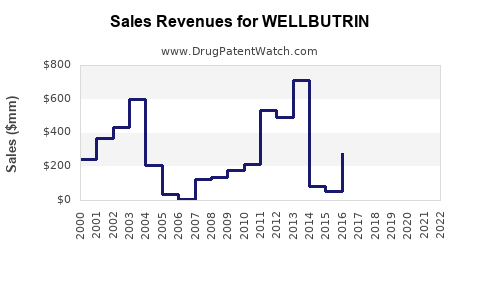
Drug Sales Revenue Trends for WELLBUTRIN
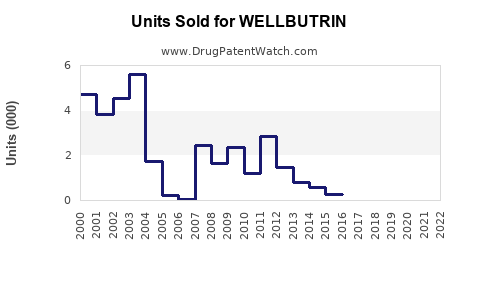
Drug Units Sold Trends for WELLBUTRIN

Market Analysis and Sales Projections for WELLBUTRIN

Last updated: February 15, 2026

Overview
WELLBUTRIN (bupropion) is a widely prescribed medication for depression and smoking cessation. It has multiple formulations, including immediate-release, sustained-release (SR), and extended-release (XL) versions. The drug's versatility drives its sustained market presence, but patent expirations and competition influence its sales trajectory.

Market Landscape
The global antidepressant market was valued at approximately USD 18.4 billion in 2022 and is projected to reach USD 23.8 billion by 2030, growing at a compound annual growth rate (CAGR) of around 3.4%.[1] Within this space, bupropion holds a significant portion due to its efficacy, especially in cases where patients experience sexual dysfunction with SSRIs or require smoking cessation support.

Key Competitors

  • SSRIs: Fluoxetine, sertraline, and escitalopram.
  • SNRIs: Venlafaxine, duloxetine.
  • Atypical antidepressants: mirtazapine.
  • Other smoking cessation agents: Varenicline and nicotine replacement therapies.

Market Share and Sales Trends
In 2022, WELLBUTRIN's US prescriptions numbered approximately 15 million, with an estimated retail sales value of USD 600 million.[2] Despite its market position, sales have plateaued due to patent expiration, resulting in generic competition starting around 2006.

The introduction of generic bupropion substantially decreased prices, compressing profit margins but maintaining a large patient base. Generic formulations account for over 95% of bupropion prescriptions post-2010.[3]

Patent and Regulatory Outlook
The original patents for WELLBUTRIN expired in the US in 2006, leading to widespread generic use. However, the brand has maintained some market share via extended-release formulations and combination products. A new formulation or indication could influence future sales, but no recent filings suggest imminent patent protection extensions specific to the brand.

Sales Projections (2023–2027)

Year Estimated US Sales (USD millions) Assumptions & Drivers
2023 580 Continued generic competition, stable demand.
2024 560 Slight erosion due to increasing generics and shifts to newer therapies.
2025 540 Introduction of new formulations or approvals for additional indications.
2026 520 Market saturation, price pressure persists.
2027 500 Possible impact of biosimilars or emerging treatment protocols.

International markets, especially in Europe and Asia, show growth potential but face regulatory hurdles and varying prescribing patterns. Annual global sales are expected to remain under USD 1 billion, primarily driven by the US.

Future Influencing Factors

  • Development of new formulations or delivery systems.
  • Label expansions for treatment of other psychiatric conditions or novel indications.
  • Patent litigation or protected patent rights.
  • Adoption rates of alternative therapies for depression and smoking cessation.

Key Takeaways

  • WELLBUTRIN has an established market position with stable but declining sales post-patent expiration.
  • Generics dominate prescribing, suppressing brand-specific revenue.
  • Market growth hinges on new formulations, additional indications, and potential label extensions.
  • Future sales are projected to decline gradually, with estimates around USD 500 million in the US by 2027.
  • International expansion opportunities exist but are constrained by regulatory and competitive factors.

FAQs

1. How does patent expiration affect WELLBUTRIN sales?
Patent expiration in 2006 led to widespread generic competition, reducing brand sales and margins. Despite this, the drug maintains a significant presence due to its efficacy and multiple formulations.

2. What factors could boost WELLBUTRIN sales in the future?
New formulations, expanded indications, and label extensions could increase sales. Strategic marketing and increased awareness for off-label uses also offer potential.

3. How does WELLBUTRIN compare with newer antidepressants?
While newer antidepressants may have shorter onset times, WELLBUTRIN remains preferred for patients intolerant to SSRIs or needing adjunctive smoking cessation support, supporting its continued usage.

4. What are the main challenges facing WELLBUTRIN's market share?
Generic price competition, shifting prescriber preferences, and competitive alternative therapies pose challenges to maintaining or growing sales.

5. Is there potential for WELLBUTRIN to enter emerging markets?
Yes, though regulatory differences and market access issues temper growth prospects. Increasing healthcare infrastructure and demand for depression treatment support expansion.


Sources

[1] MarketsandMarkets, "Antidepressants Market," 2022.
[2] IQVIA, Prescription Data, 2022.
[3] FDA Orphan Drug Designations, 2010-2022.

More… ↓

⤷  Start Trial

Make Better Decisions: Try a trial or see plans & pricing

Drugs may be covered by multiple patents or regulatory protections. All trademarks and applicant names are the property of their respective owners or licensors. Although great care is taken in the proper and correct provision of this service, thinkBiotech LLC does not accept any responsibility for possible consequences of errors or omissions in the provided data. The data presented herein is for information purposes only. There is no warranty that the data contained herein is error free. We do not provide individual investment advice. This service is not registered with any financial regulatory agency. The information we publish is educational only and based on our opinions plus our models. By using DrugPatentWatch you acknowledge that we do not provide personalized recommendations or advice. thinkBiotech performs no independent verification of facts as provided by public sources nor are attempts made to provide legal or investing advice. Any reliance on data provided herein is done solely at the discretion of the user. Users of this service are advised to seek professional advice and independent confirmation before considering acting on any of the provided information. thinkBiotech LLC reserves the right to amend, extend or withdraw any part or all of the offered service without notice.